PWDAD to celebrate 30 years 1994-2024
PWDAD to feature Navilens signage for first time
 |
|
Peoples with Disabilities Awareness Day 2024 on March 5 will feature Navilens signage for the first time.
The signage allows visually impaired attendees to use their cell phone to scan codes, giving them enhanced information about the event, vendors and scheduled events. The codes are also easier to scan than traditional QR codes.
|
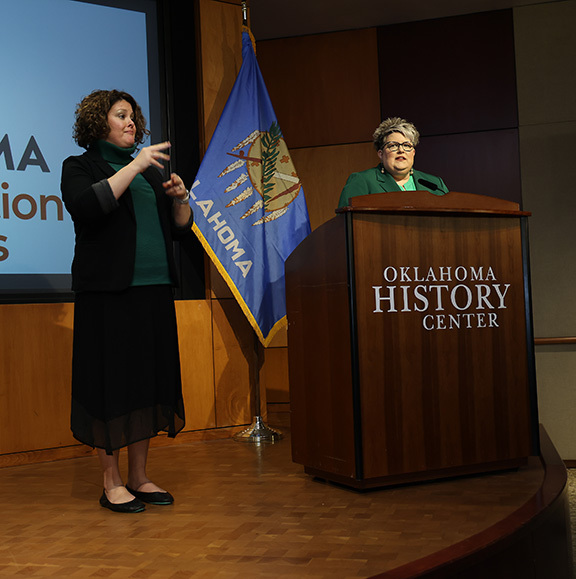 PWDAD turning into hot ticket for vendors, attendees
More than 550 Oklahomans have so far signed up to attend the 2024 People with Disabilities Awareness Day on March 5. The vendor tables are filled, and there are even 20 additional groups wanting a spot at the event.
This year’s PWDAD, which is hosted by DRS, is marking its 30th year.
PWDAD will be held from noon to 4:30 p.m. at the Oklahoma History Center, 800 Nazih Zuhdi Drive, Oklahoma City. The event is open to the public, and people are encouraged to wear green to show support. People should eat before attending PWDAD.
People with Disabilities Awareness Day is an opportunity for Oklahomans with disabilities to engage lawmakers and share their personal stories about what services are helping them live independent lives and pursue careers. This year, participants are encouraged to visit the event website at www.okdrs.gov/pwdad/registration, and register for the event. Facebook users can stay up to date on the event by visiting the Oklahoma Department of Rehabilitation Services Facebook page. When posting on social media, participants are asked to use #PWDAD2024 in their posts.
This year’s event will feature Navilens signage for the first time. The signage allows attendees who are visually impaired to use their cell phone to scan codes, giving them enhanced information about the event, vendors and scheduled events. The codes are also easier to scan than traditional QR codes.
The 2024 event will include the honoring of 11 individuals. Some have received services from DRS and have excelled at pursuing goals such as education, training, independent living and obtaining employment. Others have worked to assist Oklahomans with disabilities or demonstrated excellence in reporting on the journeys of Oklahomans with disabilities.
Award winners include:
- Vocational Rehabilitation Client of the Year – Ethan Smith
- Services for the Blind and Visually Impaired Client of the Year – Elmer Norton
- Oklahoma School for the Blind Student of the Year – Emileigh Jackson
- Oklahoma School for the Deaf Student of the Year – Riley Newell
- Business of the Year – CVS
- State Agency Partner of the Year – Department of Human Services, Development Disability Services
- Workforce Partner of the Year – Central Oklahoma Workforce Innovation Board
- Communications Award – KOCO News 5 Morning Show
- Senator of the Year – Senator Julia Kirt, D-Oklahoma City
- Representative of the Year – State Representative Mark Lawson, R-Sapulpa
- Lifetime Achievement Award - Lynn Cragg, Oklahoma School for the Blind.

Have you been a PWDAD Legislative Leader before? Would you be willing to show others that it’s not scary or hard? We still need three mentors to help create new DRS advocates.
Do you want to share the good news about DRS? Are you a little nervous approaching the lawmakers or their staff? We make it easy. Join us and we will guide you through the process in a team setting.
Sign up today by emailing Dana Tallon at dtallon@okdrs.gov.

Oklahoma’s People with Disabilities Awareness Day 2024 is less than a month away, and T-shirts are available to buy to wear at the event.
Three different T-shirt designs are available in the store. Two designs celebrate PWDAD, and one commemorates DRS’ 30th anniversary as an independent agency.
Remember to register for this year’s event that will bring hundreds of people with disabilities, their families and supporters together. The event will be held on March 5.
To make sure you receive your shirts before the event, the owner of the company producing the shirts recommends customers order before Feb. 20 if receiving by mail. Those picking the shirts up at the store can order as late as March 4.
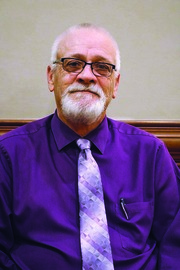
Charles Watt, DRS administrative programs officer, was named president of the Accessibility Professionals Association during the group’s annual conference on Jan. 25 in Austin.
Watt, who has worked for DRS for 27 years, kicked off his tenure by delivering the closing remarks at the conference on Jan. 26. During 2023, Watt served as president-elect of the group’s board of directors. He is the first non-Texan to serve as president of the APA.
“It looks very possible we will have a productive year in 2024 as the APA continues to pursue taking on more of a national presence and expanding beyond its origin as a Texas-centric organization,” he said. “We currently have 284 members with more and more new members coming from outside Texas.”
The APA’s conference had 180 attendees, and more than half were from states other than Texas.
Watt said a key challenge for the APA is finding a new executive director or management firm to replace a 15-year veteran who announced her intention to retire.
The push to grow the APA beyond Texas is something Watt is excited to tackle.
“We are also continuing to seek to add new chapters for the organization,” he said. “We currently have two, the Rocky Mountain Chapter and a newly created Texas chapter. The creation of the Texas chapter signals a firm commitment to transform an overwhelmingly Texas-based organization into one with aspirations of having a national focus.”
The APA is seeking to add chapters in Florida and California.
“I’m looking forward to the coming year and the challenges and rewards of being so intimately involved with an organization I care deeply about as it continues to grow and transform,” he said.
|

A couple of weeks ago, I traveled to Austin to attend the annual conference of the Accessibility Professionals Association. It’s an organization in which I have been a proud member since 2017.
The focus of the APA is on accessibility in the built environment, and we bring in some of the most respected speakers and presenters to share their expertise on architectural accessibility in every type of facility imaginable. Although we focus on the standards found in the U.S., the keynote speaker this year was a wheelchair user from Canada, Julie Sawchuk. She has a very visible presence on LinkedIn, and I highly recommend following her there.
It was very interesting to see and hear how Canada’s accessibility standards differ from those we have here. Each province in Canada, there are 10, have their own standards. There is no overarching national standard. One thing which is mandated in Ontario, the province where Sawchuk lives and works, is to have emergency call buttons in their toilet rooms. This is something which, in my opinion, should be considered in the United States.
However, more than the novelty of seeing and hearing how another country attempts to provide accessibility for people with disabilities, it is always educational to hear a person’s individual story and how their limitations impact their needs for accessibility.
I have a statement I put into the cover letter of every accessibility evaluation I do: “The ADA Standards for Accessible Design are based on anthropometric studies and the methodologies whereby individuals with disabilities utilize various required elements. These are the factors which determine standards on sizes, heights, placement, and other characteristics of the elements. The standards attempt to provide the greatest accessibility for the greatest number of people. Instances of non-compliance will inevitably create barriers for some individuals; the only question is, ‘How many?’”
The statement is intended to make people aware of how the technical standards required by the ADA provide only minimum accessibility. There will always be those whose specific limitations will not be completely provided for in the mandated placement of grab bars, lavatories, water closets, etc.
Listening to Sawchuk describe what she needs and looks for in an accessible toilet room only reinforced my commitment to make my evaluation reports start with the enforceable requirements but to also explain how to go beyond the minimal requirements to incorporate functional considerations, which might not be in the requirements themselves. We really need to understand the individual needs of the people we serve.
This is where we need to be heading if we truly want to make the built environment more welcoming and usable by more people. But unfortunately, in Oklahoma, we first need to focus on getting the minimum requirements consistently right.
|