 Assistive technology opening doors for athletes
As we start the New Year, it’s best to focus on the things that are most important. For many at this time of year, it’s football. Although the core of the game is the same, it has certainly undergone many changes over the years since I first started watching in the Vince Lombardi era.
Medical information has led to rule changes designed to improve player safety and the player’s equipment has also changed for the same reason. Other changes were also instituted to provide better communication between coaches in the sky boxes, watching the “big picture” of the game and their counterparts on the sidelines. Equipment changes were also made to improve communication between the players on the field and the coaches on the sidelines.
Current NFL rules allow only one player on the field per team to have speakers in their helmets, so coaches can talk to them. Usually, it’s the quarterbacks and middle linebackers since they’re the ones who call the plays and get their teammates in the right positions. It only allows one-way communication between coach and player.
The NCAA has generally been slow to adopt technological advancements but the “sign-stealing” controversy which occurred this past year led them to allow speakers in helmets and tablet technology on the sidelines in the bowl games. It’s possible this new rule will be adopted for future seasons so the sight of the big, colorful signs with confusing pictures of random things we’ve seen being used to convey the play calls may become a thing of the past.
Now, Gallaudet University has taken helmet technology to a whole new level. Gallaudet is, of course, the preeminent Deaf University in the country. Their football team plays in Division III of the NCAA. There have been some deaf football players in the NFL. Five to be exact. The Oklahoma School for the Deaf, in Sulphur, has a successful football program, winning their conference championship six times since 2012, including the last two years running.
Having audio communication devices in football helmets doesn’t do anything for deaf football players, so the coaches and players at Gallaudet joined forces with AT&T to develop an AR, or augmented reality, system to incorporate into the helmets. This system, which has been in development for two years, allows coaches to select a play on a connected tablet and a diagram of the play is displayed on the visor of the football helmet. It’s somewhat similar, but simpler, than the “head-up” displays used by modern military pilots, which are slowly making their way into commercial products. This new system won Invention of the Year at the 2023 Technicl.ly Awards.
Is it possible, given this new technology, that we might see a deaf football player request it as a reasonable accommodation in the NCAA or NFL? One of the landmark ADA cases was PGA Tour, Inc. v Martin, where Casey Martin, a professional golfer asked to be permitted to use a golf cart during tournaments. Casey Martin had a circulatory condition which made it difficult for him to walk all 18 holes every day during the tournaments.
The case made it to the Supreme Court where the PGA Tour not only made an assertion it would be a “fundamental alteration” to the conditions of a tournament for Martin to be able to ride in a golf cart, but also the PGA Tour was, essentially, a private club exempt from the provisions of the ADA.
The Supreme Court, in a 7-2 decision decided in favor of Martin. They not only focused on elements of competitive fairness in the tournaments, but ruled, the tour was a public accommodation, a commercial enterprise engaged in a money-making endeavor. The players were “employees” and entitled to reasonable accommodations as are any other employees of public accommodations. So, yeah, it’s possible we could see a deaf college or professional athlete ask for this helmet as an accommodation sometime in the future.
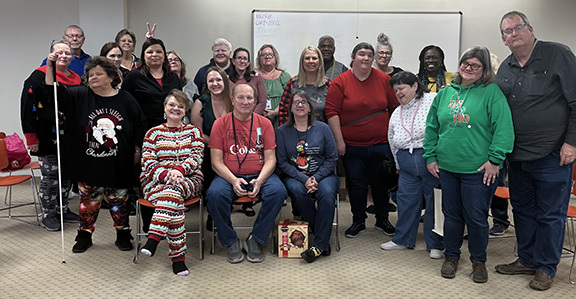
Staff from DRS’ Unit 63 and Unit 61 met on Dec. 13 for a brief morning meeting and later had a holiday celebration.
Unit staff were joined by staff drivers, and they had a potluck lunch where they recognized the drivers and showed their appreciation to the drivers for dedication to DRS’ visually impaired and blind staff as well as to the agency’s clients.
After the were all stuffed with goodies, they played a Christmas present “Hot Potato” game and a Dirty Santa gift exchange game.

Students with disabilities who are taking part in Project Search with the Moore Public Schools just wrapped up their first rotation inside Norman Regional Hospital HealthPlex. They are now into their second rotation through departments.
Project SEARCH was developed at Cincinnati Children’s Hospital Medical Center when Erin Riehle, who was Director of Cincinnati Children’s Emergency Department, said she felt because the hospital served individuals with developmental disabilities, it made sense that they should commit to hiring people in this group. Work began to develop a program to train people with developmental disabilities to fill some of the high- turnover, entry-level positions in her department, including complex and systematic tasks such as stocking supply cabinets.
Today, students with disabilities between the ages of 18 to 24 can earn medical workplace work experience through programs across the country including the Oklahoma City metro area.
The students earn real-world job experiences over the course of nine months through nonpaid internships. They are exposed to various job skills and positions over three 10-week rotations. Students receive on-the-job coaching and worksite accommodations.
Those taking part in the second rotation and the departments they are working in include:
- Gustavo Caceres - Ortho Spine
- Jonah Carrethers - Post Cardiac Care Unit
- Kadin Gauden - Emergency and Outpatient Lab
- Robert Holley - kitchen
- Nick Lockhart - mail and floor tech
- Ryan Manelski - linens
- Natalie Nesbitt- medical surgical observation
- Alex Stephens- cafeteria.
Taken from submitted DRS Client Success story
Ada’s Christian Maloy has psychosocial disabilities and turned to DRS for services to build an independent future.
Services Maloy received included training, job readiness training, counseling, job placement, and informational and referral. Vocational Rehabilitation Specialist McKenzie Ramer assisted Maloy with building a path toward an independent future.
“DRS in Ada has helped me in many ways to get my college degree and then getting a good job,” Maloy said. “My parents are both in education and have always instilled in me that education is important. DRS helped me pay for college, so I am able to graduate without any student loans.”
Maloy wrote a thank you note to Ramer after receiving services.
“Dear McKenzie, Thank you so much for all that you and the people at DRS did for me to help me graduate from UCO (University of Central Oklahoma). I appreciate you texting me and reminding me of certain deadlines. You are very good at your job. Thanks again,” Maloy wrote.
Do you want to learn how to make an unformatted Word document accessible to people with disabilities?
Able Tech has an online course to teach you how.
Internet access is available either at the tip of a finger or a trip to the library. More people are using the world wide web to shop, do research and communicate via social media or Zoom.
The Oklahoma Department of support Rehabilitation Services’ Disability Resource Guide makes it easy for users to find more than 2,500 government agencies, community organizations and groups for Oklahomans with and without disabilities. It is free and available at https://www.okdrs.gov/guide/home.
“The resource guide is helpful for Oklahomans who are looking for disability and non-disability related content,” DRS Executive Director Melinda Fruendt said. “It is useful to our staff and the general public because of the information gathered all in one place.”
The guide originated on paper more than 20 years ago and now exists online.
At the start of the pandemic, the resource guide’s importance grew because of its online availability, and it’s a helpful tool for people to find medical and mental health clinics, and additional resources important to the disability community. It has hospital offices listed from across the state, hotlines and toll-free numbers.
Telecommuting was a requirement for most office jobs during the lockdown. Now, the option to work from home has become more popular, especially in the disability community because it takes away several barriers.
Some home offices that were rarely used before, now require modification. The guide has a chapter titled “Assistive Technology” to help people find what they need to do their jobs efficiently and make their houses more accessible.
While working from home is not for everyone, some have decided to go back to the office. For those who cannot drive, and they need to call a company to get a lift. Others might require an accessible car that someone else drives. The guide has a chapter titled “Transportation,” to help Oklahomans find a ride or modified vehicle so they can reach their destination.
The guide includes DRS services, such as the DRS Transition Program, Services for the Blind and Visually Impaired and Vocational Rehabilitation. Other state agencies listed are Oklahoma Department of Human Services, Oklahoma Department of Transportation and more. It also features information for veterans, drug and alcohol rehab centers and disability related legal resources. It is continuously being revised and adding new sources.
There are some advantages to be a state employee. Most notably, it can translate into some discount when shopping or seeking services.
Click here to learn more about available discounts.
From DRS News Archives
Courtesy of Valiant Leader
Date: Jan. 6, 2016
MUSKOGEE – Jonathon Phelps, a 10th grade student and native of Valiant won the Gold Medal in the Trailblazer category at this year’s Oklahoma School for the Blind’s third Oklahoma Regional Cane Quest on Dec. 10.
The unique Cane Quest competition gives students who are blind or visually impaired
impaired an opportunity to test their white canes, usually used to help them travel efficiently as a tool to earn points and win prizes.
Younger students demonstrated skills by completing a variety of tasks on the OSB campus. Older students navigate a route in downtown Muskogee.

This edition's question:
I can be cracked, made, told and played. What am I?
Answer:
???
Last edition's question:
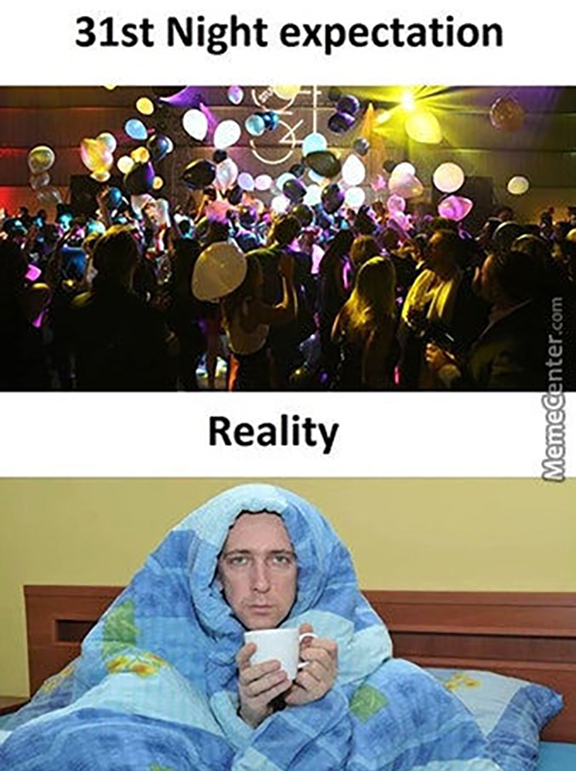
It was New Year’s Eve. Why did the girl sprinkle sugar on her pillow?
Answer:
She wanted sweet dreams.
Those getting right included:
1. Rowena Alford
|