|
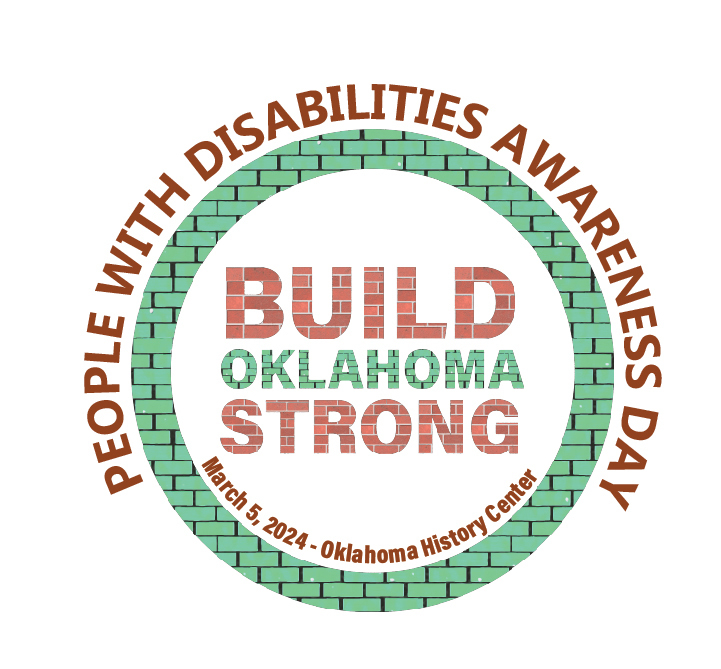
Oklahoma’s People with Disabilities Awareness Day, which brings hundreds of people with disabilities, their families and their supporters together, will be held on March 5.
PWDAD celebrates the commitment and hard work of Oklahomans with disabilities to lead independent lives and pursue work. Also, it connects vendors who can provide critical services to Oklahomans.
The 2024 event will be held from noon to 4 p.m. at the Oklahoma History Center, 800 Nazih Zuhdi Drive, Oklahoma City. PWDAD is open to the public, and people are encouraged to wear green to show support.
Volunteers are critical to the success of PWDAD, and if you are willing to help, please go ahead and register for the event.
To register to attend or volunteer at PWDAD, go here.
If you mention the event on social media before or on the day of the event, use the hashtag #PWDAD2024 so we can build a community around this event.
If you have any questions or need help registering, please call us at (405) 951-3478 or email, cmartin@okdrs.gov.
|
|
Mayor's committee honors two DRS employees
Two DRS employees were honored by the Oklahoma City Mayor’s Committee on Disability Concerns during the City Council meeting on Oct. 24.
The employees honored included:
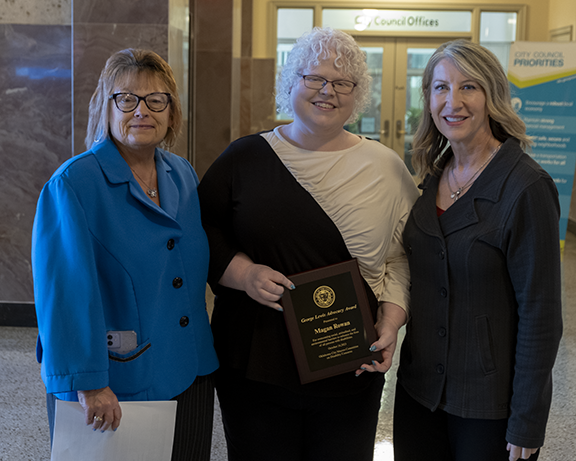 From left, Teresa McDermott, SBVI field service coordinator, Magan Rowan and SBVI Administrator Tracy Brigham.
Magan Rowan
Rowan was recognized with the George Lewis Advocacy Award: This award recognizes an Oklahoma City area resident with a disability who has performed outstanding and notable feats to enhance the empowerment and/or employment of individuals with disabilities by rising above his or her own disability and encouraging others with disabilities to do the same. This individual displays these principles through community involvement and in his or her area of employment. This individual has also promoted overcoming social, attitudinal, and environmental barriers to enhance the lives of all persons with disabilities and shown good citizenship in his or her everyday activities.
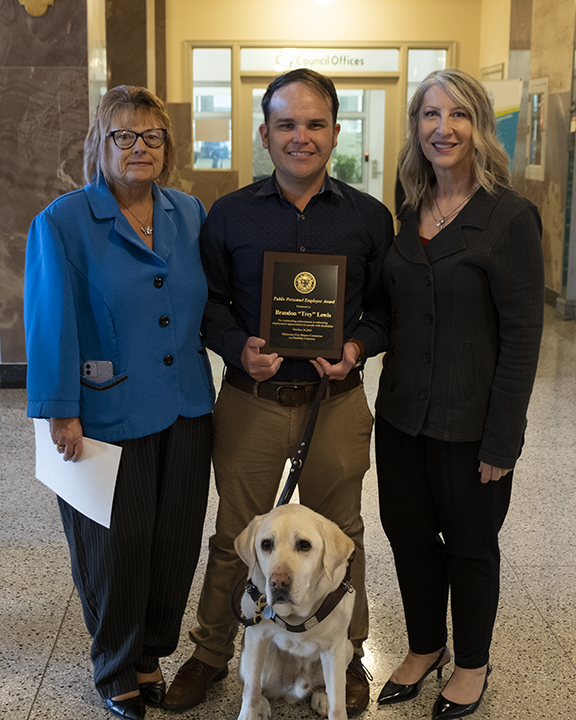 From left, McDermott, Trey Lewis and Brigham.
Trey Lewis
Lewis was recognized with the Public Personnel Employee Award: This award honors an outstanding public agency employee for contributing to the removal of social, attitudinal, and environmental barriers for individuals with disabilities in the agency in which he or she is employed. Any individual in a local, state, or federal agency (including a public college or school) is eligible.

Recently, I was somewhat embarrassed, when a friend of mine, a deaf attorney from Atlanta who specializes in all things ADA-related, sent me a news story he found that highlighted the Department of Justice’s determination that the inaccessibility of Oklahoma’s mobile ID app violated the ADA. He wasn’t trying to rub my nose in it, he just wanted to make sure I had also seen the story.
Sheepishly, I replied I was aware of the DOJ’s press release and admitted my home state had plenty of work to do to even get to a place where ADA compliance was included in the planning stages of new projects. I relayed my general experience, over the past few years, in finding a woeful lack of consideration of the accessible design standards of the ADA in the construction of new buildings and renovation of older ones.
Last month, this point was made even more stark when I was asked to do an evaluation of an office location in a building that was constructed in 2019. All the elements were there, accessible parking spaces, a curb ramp, grab bars in the restrooms, etc. However, they were all done incorrectly. The parking spaces weren’t level or properly sized, the ramp was too steep, and the grab bars, toilets, and sinks were not correctly positioned. The ADA design standards have been around since 1992 and the most updated version was introduced in 2010, but they didn’t bother to consult the technical details for accessibility that can be found in them.
Then earlier this week, I received communication from one of the Workforce Board Directors about a response from an evaluation I did of a recently remodeled restroom being utilized at one of the American Job centers. The board director had relayed the two, very minor, changes which needed to be made to bring the restroom completely in compliance with the ADA standards to the manager of the building.
The manager seemed to be wholly unconcerned about improving accessibility. Instead, the focus was on needing “to know exactly who is in our building and their purpose,” referring to the AJC having me, a certified expert on accessibility in the built environment, examining whether federal requirements were being met. The manager categorically refused to make the minor corrections suggested. Being more focused about territorial concerns than in improving accessibility for a segment of the population they exist to serve shows how, for some people, concern for individuals with disabilities is not a high priority.
Ultimately, the closing statement in my response to my friend in Atlanta holds true. In Oklahoma, we seriously need to get our act together. And we who serve the disability community, need to constantly advocate for it.
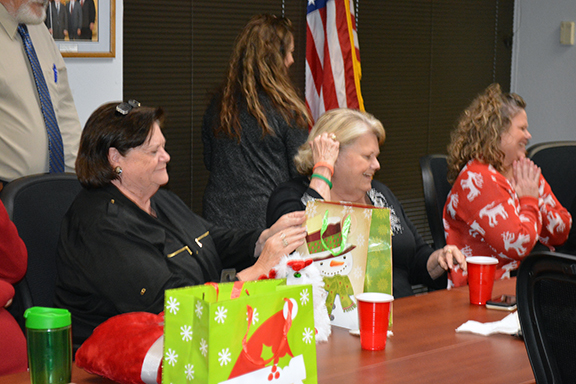
Did your DRS office celebrate the holidays with a party?
Share your photos from the celebration with us, and we will share them in the next edition of Breakling Barriers.
 From the DRS Communications staff
Idabel’s William David White received services from DRS that helped stay employed.
White, who has a hearing disability, received services including counseling and guidance, physical restoration and information and referral.
“DRS helped me stay at my job longer and be more productive,” he said.
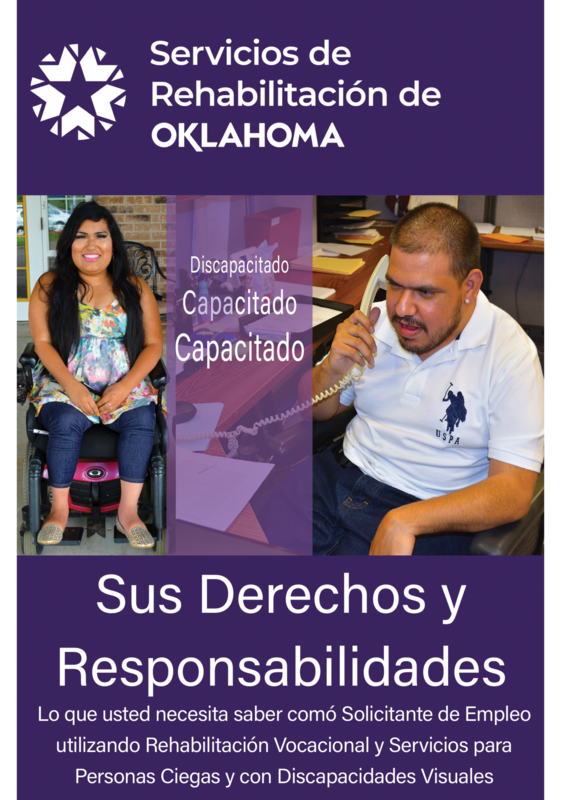
The Spanish version of Rights and Responsibilities is back in stock.
Order the brochure for your office from the DRS publication page.

Do you want to learn how to make an unformatted Word document accessible to people with disabilities?
Able Tech has an online course to teach you how.

Here are some of the new people you may meet soon at an upcoming event. Take some time to welcome the following to their new positions and see who's retired.
New hires or new jobs:
OSD – Direct Care Specialist, Katherine Mosshart, began the new job on Nov. 1.
VR – Rehabilitation Technician, Graceson LaFever, began the new job on Nov. 1.
VR – Rehabilitation Technician, Janisa Kelley, began the new job on Nov. 1.
VR – Vocational Rehabilitation Specialist, Christopher Mitchell, began the new job on Nov. 6.
SBVI – Rehabilitation Technician, Jayce Camp, began the new job on Nov. 6.
SBVI – Administrative Assistant, Sarah Knight, began the new job on Nov. 1.
SBVI – Rehabilitation Technician, Courtney Black, began the new job on Nov. 1.
SBVI – Vending Machine Technician, Corbin Burnham, began the new job on Nov. 1.
Branding for any business or agency requires consistency.
One area where that consistency is needed is in our email signatures.
If you are new to DRS or want to make sure your email signature is in compliance, go to our handy email signature tips guide.

Courtesy Oklahoma Department of Health
OKLAHOMA CITY – Every year, approximately one in six Americans become ill with a foodborne illness, according to the Centers for Disease Control and Prevention.
The symptoms usually include nausea, vomiting and/or diarrhea, all of which are unwelcome at the holidays. To prevent illness, the Oklahoma State Department of Health reminds everyone to practice food safety when preparing meals for the upcoming holidays.
Follow these food safety tips to prepare meals and keep gatherings free of foodborne illness:
-
Clean: Wash hands with soap and warm water for 20 seconds before, during and after handling food. Wash cutting boards, dishes, utensils and counter tops with hot soapy water after preparing each food item and before you go on to the next food.
-
Separate: Germs that cause illness can spread from raw food to other foods. Use separate cutting boards and keep raw meats and their juices away from fruits and vegetables.
-
Cook: Always check the internal temperature of cooked meat, poultry and egg dishes with a food thermometer to ensure the food is cooked to a safe temperature. For more information, please visit the Safe Minimum Cooking Chart.
-
Chill: Be safe with leftovers. Refrigerate leftover foods promptly. When foods are left out unrefrigerated, harmful germs multiply quickly. Discard any food left out more than two hours.
-
Illness: Anyone who has been sick with diarrhea or vomiting should not prepare food for at least 24 hours after symptoms have stopped.
Tips for Preparing and Reheating Turkey:
-
Thaw: Allow enough time for a frozen turkey to defrost. Turkey, thawed incorrectly, may look safe to eat but will be undercooked, allowing illness-causing germs to survive inside. For more information about how to properly thaw a turkey based on weight and time in the refrigerator, in cold water, or using the microwave, please visit Safe Holiday Cooking.
-
Cook: Use a meat thermometer to ensure the internal temperature of the turkey is at least 165 degrees Fahrenheit. For stuffed turkeys, the internal temperature of the stuffing must reach 165 degrees before it is safe to eat; however, the safest way to cook stuffing is to cook in a separate casserole dish.
-
Store: After preparing the meal, refrigerate remaining foods and leftover turkey within two hours. Eat leftover turkey, stuffing and gravy within three to four days. Reheat leftover gravy to a rolling boil, and thoroughly reheat other leftovers to 165 degrees.
For more safe holiday food preparation details, click here.
The Oklahoma State Department of Health (OSDH) protects and improves public health through its system of local health services and strategies focused on preventing disease. OSDH provides technical support and guidance to 68 county health departments in Oklahoma, as well as guidance and consultation to the two independent city-county health departments in Oklahoma City and Tulsa. Learn more at Oklahoma.gov/health.

From the DRS News Archives
Courtesy of The Elk City Daily News
Dated: Jan. 8, 2012
Oklahoma City - For people who love to read, a disability that blocks access to books is a life-changing event - and not in a good way.
"Reading for myself was the thing I missed the most after I lost my vision," Benny Meier said.
Always an avid reader, Meier now gets audio versions of his books and magazines free of
charge from the Oklahoma Library for the Blind and Physically Handicapped (OLBPH) in Oklahoma City.
"The library for me has been a godsend - a tremendous blessing to a person who is blind or visually impaired," Meier said. "We can keep up with what's going on in the world through books and magazines just like people who can see them."
OLBPH circulates reading materials, along with special playback equipment, to more than 4,000 Oklahomans who have difficulty using standard print due to blindness, visual impairments, reading disabilities or physical limitations.
The materials are delivered at no charge by postage-free mail.
Library programs in Oklahoma are administered by Visual Services, a division of the Oklahoma Department of Rehabilitation Services (DRS). The special library services are affiliated with the National Library Service for the Blind and Physically Handicapped, which is part of the Library of Congress.
"We have 60,000 book titles, roughly equivalent to a medium-sized public library," Library for the Blind Director Paul Adams said. "Our audio books are prepared in a special format that can't be played on standard players, so that only those unable to use standard print get free audio books.
OLBPH's local recording studio produces audio books and local magazines by Oklahoma authors and those with an Oklahoma connection and a free Internet radio service called Oklahoma Talking Information Service (OTIS) with access to programming 24 hours per day.
More About Benny Meier - Originally from Shattuck, Meier wanted to be a big league baseball player like his childhood idol, Mickey Mantle. The eye disease retinitis pigmentosa damaged Meier's retina causing gradual vision loss that led him to DRS' Visual Services employment program.
Meier's first Visual Services counselor Jerry Dunlap, later the first DRS state agency director, got him set up with the Library for the Blind in 1966. At that time, Meier endured cracks and pops on phonograph records and later listened to as many as 10 cassettes for each book.
Benny and his wife Angela, a visitor to the United States from Mexico, married in 1968 and supported their family with increasing responsibilities at several jobs. He retired from the Veterans Administration Medical Center in Oklahoma City in 1997 after a 31-year career as an x-ray film processor.
Meier's wife Angela retired the year before after 25 years as a library technician for the Library for the Blind. She often brought home books by Meier's favorite authors, including Louis Lamour, Tom Clancy, Iris Johansen, David Valduchi and John Sanford.
How Library Services Work - Every other month, the National Library Services sends patrons a recorded list of book titles in 60 categories. Meier gives his list to Angela, who completes and forwards the order to a librarian assigned to assist each patron.
Meier, who follows sports news - especially baseball -- in five or six newspapers each day, phones in toll free to the National Federation of
the Blind Newsline, a free, national newspaper reading service hosted by OLBPH in Oklahoma.
Patrons may also search, request and reserve reading materials online or download thousands of titles from the Braille and Audio Reading Download (BARD) on the OLBPH website at http://www.library.state.ok.us
The national Library of Congress is transitioning their National Library Service for Blind and Physically Handicapped program from audio cassette to a new digital audio format capable of greatly improved audio quality and storage capacity.
The audio cartridges are portable memory storage devices designed to resemble cassettes. That shape is familiar to most patrons and easy to handle. One unique feature is a hole in the center big enough for a finger to conveniently dip in to remove cartridges from the players.
Most Oklahoma patrons still have both the cassette and digital audio players, ensuring that they have access to books prepared in both formats.
"One digital cartridge can hold dozens of hours of reading material where you would need multiple cassettes to get that same information," Meier said, "The digital format is just more convenient, easier to handle and the audio quality is very good - no static, no popping, no distortion. It's very clear."
The Library of Congress expects to have all book titles translated to digital formats so that cassettes can be phased out completely by 2015.
"I encourage people to try the library's program and see if you like it," Meier said, " You don't have to stay seated. You can take your player with you wherever you go."
To get more information or to apply for services, contact the Oklahoma Library for the Blind and Physically Handicapped toll free at 800-523-0288. Those who have hearing disabilities may call on the TTY/TDD line at 405-521-4672. Application forms are available on the Library's website at http://www.library.state.ok.us or email may be sent to Library@drs.state.ok.us.


This edition's question:
What kind of pictures do elves take?
Answer:
???
Last edition's question:
Who says “Oh, oh, oh”?
Answer:
Santa walking backward
Those getting it right included:
- Renee Skocdopole
- Kristyl ONeal-Helms
- Rowena Alford
|