|
YOUTH, PARENTS, TEACHERS, AND COUNSELORS |
|
School Work Study is Happening Across Oklahoma
School Work Study (SWS) is a paid work training program that provides an opportunity for youth to learn universal skills that every employer looks for when hiring employees. Soft skills include reliability, teamwork, problem-solving, customer service and effective communication.
This opportunity can provide youth with career goals, advanced employment opportunities, self-advocacy, mentorship, and accountability. SWS programs provide familiarity with employing institutions, the development of social networks, and the learning of appropriate worker roles that may help young adults with disabilities overcome certain obstacles.
SWS training sites vary based on where you live, whether or not your school has a contract with DRS, your availability and interests, but students will typically work 15 hours per week during the school year and possibly 20 hours a week during the summer months. This is a paid work experience opportunity paid for by the Oklahoma Department of Rehabilitation Services (DRS) for individuals enrolled in the program.
SWS is designed to increase employment skills, overcome vocational barriers in a work setting, and provide paid work experiences within the school system and a community integrated setting. SWS provides amazing opportunities for youth with disabilities. These opportunities include:
- Learning about work tolerance and stamina.
- Building a recent, positive work record.
- Identifying the need for further training and support to achieve and maintain competitive employment.
- Gaining self-confidence.
- Exploring different career opportunities.
Our goal for SWS is to provide students with the skills and training needed for a successful career and valuable work experiences. Contact us today to discuss details and get started!
Renee Sansom Briscoe, 405-212-7789 or rsansom@okdrs.gov, Stacey Dutton, 405-255-5105 or sdutton@okdrs.gov and/or Chris Compton, 405-605-9651 or ccompton@okdrs.gov.
|
|
Fall 2022 - Winter 2023: Family and Community Trainings

- Planning for Waiver Services: November. 9, 2022 at 12:00p.m.
Please join the Center for Learning and Leadership/University Center for Excellence in Developmental Disabilities (UCEDD) and the Oklahoma Disability Law Center in this family training. We will be going over DDS waiver services options for people with intellectual disabilities and how their family can help prepare them to be part of the Individual Plan and Person Center Planning process.
Link to Register:
https://zoom.us/meeting/register/tJAoce2hrjspGNHvabIoDRXAraoLkt3tbWFm
- Using Life Course to plan for Long-term Supports: December 7, 2022 at 12:00p.m.
Please join the Center for Learning and Leadership /UCEDD, Oklahoma Family Network and the Oklahoma Disability Law Center training on Using Life Course to help prepare for waiver services. You will learn about Charting the Life Course tools and how they can help you prepare for long-term supports.
Link to Register:
https://zoom.us/meeting/register/tJAkduGuqzstGdU3QlNqWHrRshZavTqgaj3A
-
Basics of Self-Directed Services: December 14, 2022 at 12p.m.
Please join the Center for Learning and Leadership/UCEDD and the Oklahoma Disability Law Center as we share what we know about Self-Directed Services. Learn how other families have used SDS for long-term supports. This training will help you be prepared to determine if you want to choose SDS when the opportunity arises.
Link to Register:
https://zoom.us/meeting/register/tJEvcuqhqj8uHdxim_drqHDMpcZlwhAi4TM6
- Long-term Planning – Financial and Employment Options: January 18, 2023 at 12:00p.m.
The Center for Learning and Leadership/UCEDD and the Oklahoma Disability Law Center invite you to the family training on Long-term Planning - Financial and Employment Options. This training is designed to help plan for the future by sharing options to insure the protection of long-term supports and benefits, including waiver supports and methods for saving money beyond the typical Medicaid asset limits. Learn about options for community integrated employment such as Ticket to Work and options to help secure funds for future needs such as OK STABLE accounts. Come learn about what could be available to you or the person care for.
Link to Register:
https://zoom.us/meeting/register/tJAvf-uvqjIvG9T-FjEFHj3Dd7nVeg49xl6R
|
November 2022: Down Syndrome Association of Central Oklahoma New Parent Breakfast
Down Syndrome Association of Central Oklahoma (DSACO) is inviting families to join them for the New Parent Breakfast at 9:30a.m. on Saturday, November 6th at the DSACO office. This is open to all our families, especially those who have a prenatal diagnosis or are new to the DSACO family!
The breakfast offers our new parents the opportunity to visit with experienced parents of children with Down syndrome and begin building new friendships with new parents and their children who will be experiencing the journey for the first time. There is not cost for registration.
|
|
|
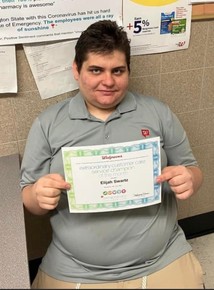
Meet Elijah from Collinsville
We recently met with Elijah from Collinsville. Elijah recently graduated from Collinsville High School. In our conversation, he shared experiences and even gave some advice on how to succeed. Here are some questions and responses from our talk.
What are your hobbies? My hobbies are watching tv and playing video games.
What is your favorite tv show? My favorite show is The Price is Right.
What is your favorite Thanksgiving Day food? Pumpkin Pie
Where do you work? Walgreens
What do you do there? I get stuff off of the truck on truck days.
How did you get that job? Gabby, my job coach from Job Connection.
Are you saving your money? No, I’m not saving money.
What have you been spending money on? I spend money on games and eating out. I also have to buy my own clothes.
Where did you work at STEP (Summer Transition Employment Program)? Walgreens
Where did you work while in school (School Work Study)? Cafeteria
What have you learned from working at school and STEP that helped you? I learned how to work with other people.
You have earned April Employee of the Month at Walgreens and the 2022 Governor’s Disability Employment Award of Excellence. Congratulations! What does it feel like to know people are observing your hard work to win those awards? I feel good about getting the award, but I feel nervous about meeting (Governor) Kevin Stitt.
Do you have any advice for other students with disabilities? I would give them an “air five” and tell them “good job” and “keep working hard”.
What do you want the world to know about you? I’m funny.
Who would like to give a shoutout to? Mrs. Dutton, Coach Davis, and Mrs. Cook.
|
 |
|
Nominate Someone Today
If you know a current or former student who has participated in Transition events with DRS or who has found success through DRS Transition services, please let us know by submitting this nomination form.
|
|
|
Wichita and Affilliated Tribes Vocational Rehabilitation
-
The Wichita and Affiliated Tribes Vocational Rehabilitation Program (WATVR) Transition Services help Native American high school junior and seniors with physical, mental and cognitive disabilities continue their education, train for a job and find a job after completing their education.
Service Area
WATVR covers the following counties:
Blaine, Caddo, Canadian, Grady, Kiowa, Washita
Services
WATVR can:
- Attend and advocate for native students (16 or older) on an IEP or 504 meeting.
- Develop work opportunities for student participants with disabilities.
- Disseminate strategies and information to improve the transition to postsecondary activities for student participants.
- Explore interests and capabilities of student participants (16 and older).
- Provide vocational counseling and guidance.
- Help with assistive devices not covered by school to assist overcome barriers to employment.
- Help with tuition assistance.
- Provide testing fees (ACT/SAT)
- Work clothing for new jobs
- Physical or mental evaluations
- Resume building, Interview Etiquette, etc.
Questions about WATVR can be directed to Adrian Smith at:
adrian.smith@wichitatribe.com
|
Blessings To Share Foundation C.A.R.E.S. Club
Blessings to Share Foundation, located at the Asbury Development Center in Tulsa, serves the greater Tulsa Metro Area and provides highly replicable, community-based, and professionally developed programs that empower neurodiverse, transition-age adults with Intellectual and Developmental Disabilities ("I/DD"), including autism spectrum disorder (ASD). Their C.A.R.E.S. programs were created to Care, Advocate, Resource, Empower, and Support the individuals and families they serve.
As of September, they officially launched their newest program, C.A.R.E.S. Club.
- C.A.R.E.S. Club offers classes and seminars developed by college professors at Missouri State University and Oral Roberts University that cover topics in professional and personal development, fitness and nutrition, relationship building, and mental wellness, as well as art, music, and faith/meditation.
- Members are each paired with qualified C.A.R.E.S. coaches to help guide and keep them accountable for achieving their goals, which they personally define with their coach through an Individual Life Plan. They hire coaches part-time who have a big heart and significant training in the field, such as Special Education teachers, Occupational Therapy Master’s students, or Social Workers.
- They also never forget to have FUN! Relationship building is one of their primary focuses at C.A.R.E.S. Club. Members regularly gather just to hang out, play games, talk about life, and take part in social activities both at the Club and throughout the community. Through building relationships, they are empowering their members to combat the isolation that is so often experienced leaving high school.
If you would like more information about membership levels and events that they are hosting coming up, please contact their organization at contact@btsfoundation.org or 918-921-9199. They can’t wait to meet you!
|
|
 Oklahoma Works
 helps connect individuals with education and employment opportunities. This could be a very helpful resource for young people with disabilities. The best way to engage with their services is to contact the local Workforce Development Board.
|
 Birthright Living Legacy
Located in Tulsa, Birthright Living Legacy provides various workshops, education and other programs that help fathers interested in taking a more active role within their family unit. Through these programs and participation options, fathers will have the opportunity to have positive interactions with other fathers while nurturing their relationships with their children. This is all made possible by participating in activities that they both enjoy.
Birthright Living Legacy is also providing a podcast where they talk about various topics and stories of fathers who are living legacies. The link below opens the website for this amazing new podcast. They are helping strengthen Oklahoma families in some important ways. We hope readers will check out what they're doing.
|
|
Fun Facts about Thanksgiving

For your reading pleasure, here are some fun facts about Thanksgiving to share around the dinner table:
The first Thanksgiving was celebrated in 1621 over a three day harvest festival. It included 50 Pilgrims, 90 Wampanoag Indians. It is believed by historians that only five women were present.
Turkey wasn’t on the menu at the first Thanksgiving. Venison, duck, goose, oysters, lobster, eel, and fish were likely served, alongside pumpkins and cranberries (but not pumpkin pie or cranberry sauce!).
Abraham Lincoln proclaimed Thanksgiving a national holiday on October 3, 1863. Sarah Josepha Hale, the woman who wrote “Mary Had A Little Lamb,” convinced Lincoln to make Thanksgiving a national holiday after writing letters for 17 years.
The history of U.S. presidents pardoning turkeys is patchy. Harry Truman is often credited with being the first president to pardon a turkey, but that’s not quite true. He was the first to receive a ceremonial turkey from the National Turkey Federation – and he had it for dinner. John F. Kennedy was the first to let a Thanksgiving turkey go, followed by Richard Nixon who sent his turkey to a petting zoo. George H.W. Bush is the president who formalized the turkey pardoning tradition in 1989.
There are four towns in the United States named “Turkey.” They can be found in Arizona, Texas, Louisiana, and North Carolina.
The average number of calories consumed on Thanksgiving is 4,500.
Butterball answers more than 100,000 turkey-cooking questions via their Butterball Turkey Hotline each November and December.
The tradition of football on Thanksgiving began in 1876 with a game between Yale and Princeton. The first NFL games were played on Thanksgiving in 1920.
|
Opportunity for Second-Year College Students: Future Leaders in Public Service Internship Program

Managed by the Partnership for Public Service, the Future Leaders in Public Service (FLIPS) Internship Program is actively recruiting its summer 2023 cohort and seeking young talent—undergraduate, graduate and professional students from across disciplines—to join the federal workforce as paid interns.
This is a great opportunity for young people of all abilities who are interested in pursuing a career in public service. For more information, check out the one-pager!
|
|
|
|
Born and raised in California, Porsheana originally moved to Oklahoma to pursue a college degree. Inspired by her grandmother to always treat people how she wants to be treated and doing what’s right. Porsheana has always been a humanitarian at heart taking an interest in helping others and pursuing careers that followed. Over the past 12 years Porsheana has worked with children/adolescents with autism, mothers battling addiction, children in Child Protective Services (CPS), wellness coaching, beauty and now Vocational Rehabilitation services. She graduated from Langston University with a Bachelors in Child Development and then continued on to receive her Master’s Degree in Family and Child Studies from the University of Central Oklahoma. Porsheana has been a Vocational Rehabilitation Counselor for DRS the past two years and currently pursuing her Certified Rehabilitation Counselor (CRC) certification. She has chosen to continue her education to ensure she gains all the knowledge and skills to help each family she encounters. In her short time at DRS, she has had the opportunity to help many families and also build some great connections in the community. Porsheana truly enjoys helping others. She has said that because her background is so diverse, it makes her feel more confident and relatable. She wants to be able to leave an impression on people she encounters. We are lucky to have Porsheana on our team!
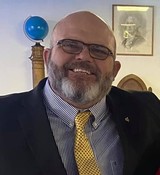
Brian has been with DRS in the Services for the Blind and Visually Impaired (SBVI) department since January of this year. He is assigned to Unit #60, located in the Lawton office. He currently has a bachelor’s degree from Cameron University in Organizational Leadership and is pursuing his master’s degree to become a Licensed Professional Counselor (LPC).
Brian is originally from Southern Ohio, but retired from the U. S. Army in 2017 and decided to stay in Cache. He decided that it was time to help others in more than just volunteering in the community. The opportunity to do that came by a phone call about the position opening with DRS. The inspiration and drive to take this position was to lend a helping hand to those who needed more than a little assistance while realizing their goals and dreams.
Interesting fact, Brian is a Mason and Shriner in Oklahoma and is great with fundraising. He is always willing to share his knowledge with others when help is needed. We are very lucky to have Brian on our team!
|
 Porsheana Brown
Vocational Rehabilitation Specialist
Vocational Rehabilitation
o. 405-743-6902
f. 405-743-6924
pbrown2@okdrs.gov
 Brian Montgomery
Vocational Rehabilitation Specialist
Vocational Rehabilitation
o. 580-585-4217
f. 555-585-4232
bmontgomery@okdrs.gov
|
|
What is Transition?
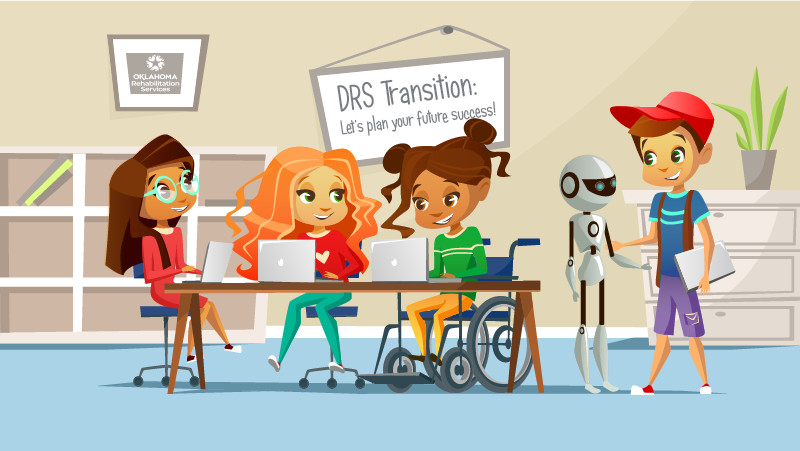
The Transition Program provides services to prepare students with disabilities for employment and life after high school. Services may include career counseling, vocational evaluation, work adjustment training, on-the-job training, work-study, and job development and placement. The Vocational Rehabilitation and Services for the Blind and Visually Impaired divisions jointly run the Transition program so the youth can easily move into adult services when it is time.
|
|
We can help create the blueprint for your youth’s success |
|
|
|
|