|
- Quarterly Report Reminders
- How to Write a Strong Quarterly Report Narrative
- Oklahoma Association of County Clerks Conference
- Priority Funding Strategy Highlight – Medications for Opioid Use Disorder
- Upcoming Events
|
|
 |
|
Quarterly Report Reminders |

Quarterly Report Due - July 31, 2026
- The next quarterly report is due July 31, 2026 for activities and expenses that occurred between April 01 and June 30, 2026.
- Office hours will be hosted throughout the month of July for grantees to ask questions about the upcoming quarterly report submission. An email from our office will be sent with the dates, times and meeting links.
- Reports are required for all quarters, even with $0 expenditures.
|
 |
|
How to Write a Strong Quarterly Report Narrative |

Step 1: Review your implementation Plan
Your implementation plan is found in the Objectives, Activities, and Proposed Measures section of OGX. This serves as your guide for narrative reporting.
Step 2: Report Progress by Objective and Activity
- Organize your narrative by Objective and Activity
- Describe progress on each Proposed Measure for each activity
- Report quantitative results (e.g., number of trainings delivered, number of people served)
- Compare progress to goals:
- Your target
- Progress this quarter
- Total progress to date
Step 3: Report Challenges or Delays
If progress was limited:
- Explain what caused the challenge or delay
- Describe steps you are taking next
Step 4: Double-Check Your Report
Return to the implementation plan and ensure:
- All aspects of the plan are addressed
- No unrelated activities are included
These steps are also located in the Oklahoma Opioid Abatement Grant Compliance Guide along with an example report.
|
|
|
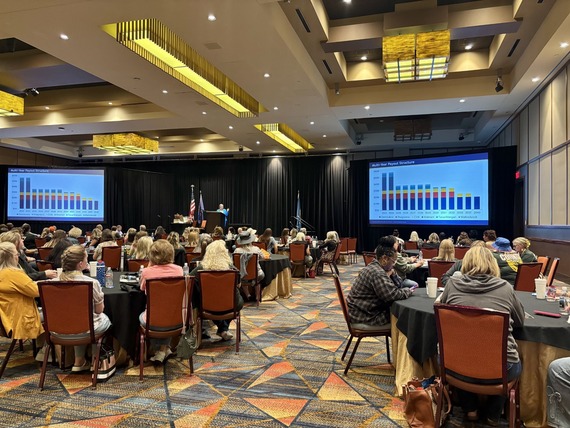
Jill Nichols, Opioid Response and Grants Coordinator, spoke at the County Clerks and Deputies' Association of Oklahoma's annual conference on June 4th at the Choctaw Casino in Durant. She shared on the history of the opioid settlements in Oklahoma, an overview of funding and appropriations, and the requirements for eligible political subdivisions who wish to apply for funding. |
|

Medications for opioid use disorder (MOUD) is another priority funding strategies adopted by the Opioid Abatement Board. MOUD is the front-line approach for treatment of people with opioid use disorder. This evidence-based approach uses FDA-approved medications in combination with comprehensive support services like medical care, mental health treatment, addiction counseling, and recovery support. This briefing document includes an overview of MOUD, who is the target population, and what to consider if you are interested in MOUD as an opioid abatement strategy.
|
To read more about this strategy and if it is a good fit for your community,
click the button below.
|
|
 |
|
July Opioid Abatement Board Meeting |
Monday, July 27 at 2:30 PM
Office of Oklahoma Attorney General
313 NE 21st Street, Oklahoma City, OK 73105
 |
|
Office Closed - Fourth of July |
The Office of the Attorney General will be closed on Friday, July 3rd in observance of the Fourth of July.
|
|
Members
|
Appointing Authority
|
|
Attorney General Gentner Drummond
|
Statute
|
|
Josh Cantwell
|
Governor
|
|
LeRoy Young, D.O.
|
State Auditor and Inspector
|
|
Scott Martin
|
State Treasurer
|
|
Brad DeLozier
|
State Superintendent of Public Instruction
|
|
Carol Bush
|
Speaker of the House
|
|
Dr. Kelly Dunn
|
Speaker of the House
|
|
Lori Parish
|
Senate President Pro Tempore
|
|
Dr. Atul Walia
|
Senate President Pro Tempore
|
|
|
 Jill Nichols
Opioid Response & Grants Coordinator
Jill.Nichols@oag.ok.gov
Khylee Rankin, LCSW
Assistant Opioid Response & Grant Coordinator
Khylee.Rankin@oag.ok.gov
Isela Perez
Opioid Response Statewide Projects Specialist
Isela.Perez@oag.ok.gov
Traci Ballard
Deputy General Counsel
Traci.Ballard@oag.ok.gov
Regional Field Representatives
Bonnie Johnson - Southwest
Opioid Abatement Grant Field Representative - Southwest
Bonnie.Johnson@oag.ok.gov
The individual listed as the primary contact for the university, county, school district, or municipality will automatically receive this email. If other individuals from your institution need to receive it, please send their name and email address to Khylee Rankin, Khylee.Rankin@oag.ok.gov, and she will add them to the list. |
|
 |
|
|
|
Title 74, sections 30.3 through 30.8 create the Political Subdivisions Opioid Abatement Grants Act. The Act’s purpose is to promote and protect the health of Oklahomans by using monetary grants to abate the opioid crisis in a comprehensive manner that includes cooperation and collaboration with political subdivisions.
Grants will fund treatment and recovery programs, assistance with co-occurring disorders and mental health issues, opioid abuse education and prevention, proper prescription efforts, and strategies to decrease the supply of narcotics across the state. Grants are rigorously reviewed and approved by the Oklahoma Opioid Abatement Board comprising of the Attorney General and appointees of the Governor, Speaker of the House, Senate President Pro Tempore, State Treasurer, State Superintendent for Public Instruction, and State Auditor and Inspector.
|
|
|
|