|
|
What’s Inside this month’s email?
- Deadline Approaching for 2026 Government & Joint Applications
- Program Announcements & Reminders
- Change in Grant Project Personnel? Now what?
- Upcoming Peer Exchange Opportunity
- Priority Strategy Highlight - Contingency Management
- Opioid Abatement Staff Spotlight
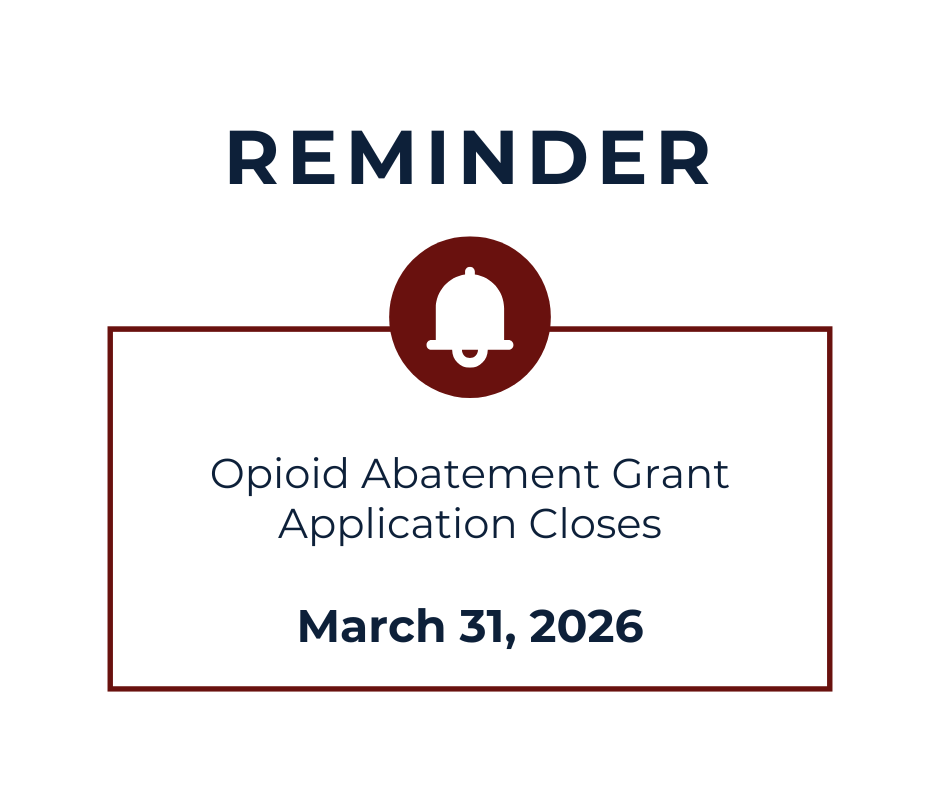 The 2026 Opioid Abatement Grant application for government political subdivisions (county, municipality, and public trusts) and collaborative/joint applicants closes on March 31, 2026. Check out February’s newsletter for tips on registering, applying, and submitting a grant application!
Click the button below for more information on the opioid abatement grant, the application process, and to access the application.
|
|
 |
|
Quarterly reports for quarter 1
(January 01 – March 31, 2026) are due April 30, 2026.
|
 |
|
2024 Grant Award Recipients |
Continue to submit the quarterly report and supporting documentation via email to OAG Staff Jill Nichols or Khylee Rankin.
 |
|
2025 Grant Award Recipients |
Watch for an email from our office with a Quarterly Report Tutorial document for the quarterly report in the OGX platform. The tutorial will walk you through how to access, complete, and submit the report through the OGX portal. The first report for the grant will be due on April 30, 2026.
|
|
Compliance & Evaluation Reminder
 |
|
As a reminder, the Steadman Group & NiVAC assist the Attorney General’s Office in monitoring and ensuring grant compliance for your opioid abatement grant award. Please respond in a timely manner to any financial and programmatic emails related to your award sent from Charles Gunn, Mathew Kyker, Olivia Golan or Vanessa Mallory.
|
|
|

When there is a change in key grant project personnel at your organization, you are required to notify our office. Key personnel include the Authorized Official, Project Director, Main Point of Contact or Fiscal Contact named on the original grant application.
Submit the change request via a note in OGX. Include in the note the following information:
- Short description for the change
- Name of the new individual
- Key grant project personnel role (Authorized Official, Project Director, etc.)
- Contact information for new individual (work phone, email, etc.)
Our office will review the request and notify the grantee of approval through OGX.
|

The Institute for Intergovernmental Research (IIR), on behalf of the State Justice Institute, is hosting a Peer Exchange in Adams County, Ohio on May 5-6, 2026.
Up to five communities will be selected to receive travel scholarships, allowing each selected site to send a team of 3-4 practitioners to participate in this structured two-day peer exchange at no cost.
According to their announcement, "Observe, first-hand, the many successful aspects of Adams County’s innovative programming that force-multiply into a comprehensive, collaborative rural response to behavioral health and substance use."
Click here to learn more about this interactive learning experience and apply for a scholarship to attend.
|
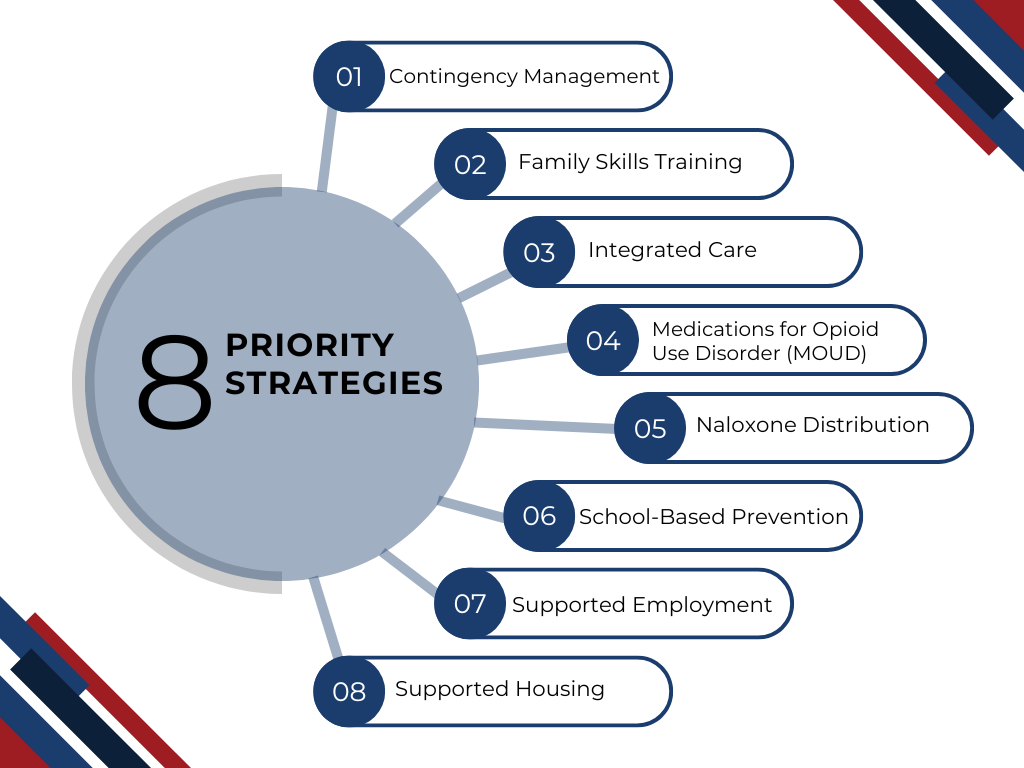 The Opioid Abatement Board identified 8 priority funding strategies in 2025. They are: 1. Contigency Management 2. Family Skills Training 3. Integrated Care 4. Medications for Opioid Use Disorder 5. Nalxone Distribution 6. School-Based Prevention 7. Supported Employment 8. Supported Housing
Contingency Management is one of the evidence-based treatments adopted by the Opioid Abatement Board as a priority strategy for funding. Contingency management is a substance use disorder treatment approach that rewards clients for treatment and recovery-oriented behaviors. This strategy is successful for people involved in the criminal legal system or patients already receiving medications for opioid use disorder (MOUD).
Click here to read more about this strategy and if it is a good fit for your community!

Jill Nichols is the Opioid Response and Grants Coordinator for the Oklahoma Office of the Attorney General. Since joining the AG’s office in early 2024, she has worked with the Oklahoma Opioid Abatement Board and the office’s General Counsel unit to develop the opioid abatement program from its inception as a piece of legislation to opening the first application to a fully evolved functioning grant distribution and management operation.
Under her leadership, Oklahoma has distributed tens of millions of dollars in opioid settlement fund grants to political subdivisions across the state and initiated broad-scale projects designed to provide maximum impact and resources on a state-wide level.
As one of the countless Oklahomans who have lost a parent to the impacts of opioid and alcohol abuse, Jill’s dedication to the mission of her office is deeply personal.
|
|
|
Members
|
Appointing Authority
|
|
Attorney General Gentner Drummond
|
Statute
|
|
Josh Cantwell
|
Governor
|
|
LeRoy Young, D.O.
|
State Auditor and Inspector
|
|
Scott Martin
|
State Treasurer
|
|
Brad DeLozier
|
State Superintendent of Public Instruction
|
|
Carol Bush
|
Speaker of the House
|
|
Dr. Kelly Dunn
|
Speaker of the House
|
|
Lori Parish
|
Senate President Pro Tempore
|
|
Dr. Atul Walia
|
Senate President Pro Tempore
|
|
|
Jill Nichols
Opioid Response & Grants Coordinator
Jill.Nichols@oag.ok.gov
Khylee Rankin, LCSW
Assistant Opioid Response & Grant Coordinator
Khylee.Rankin@oag.ok.gov
Traci Ballard
Deputy General Counsel
Traci.Ballard@oag.ok.gov
The individual listed as the primary contact for the university, county, school district, or municipality will automatically receive this email. If other individuals from your institution need to receive it, please send their name and email address to Khylee Rankin, Khylee.Rankin@oag.ok.gov, and she will add them to the list. |
|
 |
|
|
|
Title 74, sections 30.3 through 30.8 create the Political Subdivisions Opioid Abatement Grants Act. The Act’s purpose is to promote and protect the health of Oklahomans by using monetary grants to abate the opioid crisis in a comprehensive manner that includes cooperation and collaboration with political subdivisions.
Grants will fund treatment and recovery programs, assistance with co-occurring disorders and mental health issues, opioid abuse education and prevention, proper prescription efforts, and strategies to decrease the supply of narcotics across the state. Grants are rigorously reviewed and approved by the Oklahoma Opioid Abatement Board comprising of the Attorney General and appointees of the Governor, Speaker of the House, Senate President Pro Tempore, State Treasurer, State Superintendent for Public Instruction, and State Auditor and Inspector.
|
|
|
|
|