|
|
What's inside this month's email?
- January Opioid Planning Conferences & Registration
- Opioid Abatement Priority Strategies Q&A
- Free Expert Grant Consultation & Grant Writing Services
- Upcoming Event Information
- Important Links and Staff Contact Information
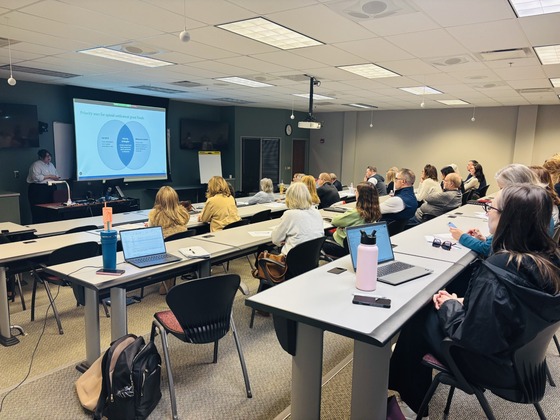 The Opioid Abatement Planning Conferences hosted by Healthy Minds Policy Initiative kicked off the first week of January in Broken Arrow, OK. Around 25 individuals interested in applying for the Opioid Abatement grant attended to learn about grant eligibility, currently funded projects, and resources and support for submitting a successful application.
If you are interested in applying for a grant, check out the information in the Announcements section below for the final event scheduled for this month!
|
|
 |
|
Final Opioid Abatement Planning Conference - Ardmore |
Interested in applying for an opioid abatement grant? Join the Oklahoma Office of the Attorney General and Healthy Minds Policy Initiative at a learning session for eligible and prospective applicants for Oklahoma’s opioid abatement grants.
Ardmore | January 22, 11 a.m. to noon
Who are these events for? Representatives of cities, counties, school districts or other eligible political subdivisions that have either 1) never applied for an opioid abatement grant from the Oklahoma Attorney General's Office before, or 2) plan to revise and resubmit a previous application
On the agenda:
- An overview of grant eligibility
- Information about Oklahoma’s opioid abatement funding cycle
- Oklahoma’s priority strategies for opioid abatement
- Examples of currently funded grant projects
- Grant writing support: how to access help
This event is free to attend, but registration is required. Please RSVP for the final Opioid Planning Conference below.
|
|
 |
|
What are the priority strategies?
They are the prioritized practices selected by the Opioid Abatement Board to maximize the impact of opioid abatement dollars in Oklahoma cities, counties, and school districts. The eight strategies are:
- Contingency Management
- Family Skills Training
- Integrated Care
- Medications for Opioid Use Disorder (MOUD)
- Naloxone Distribution
- School-based Prevention
- Supported Employment
- Supported Housing
|
How were the priority strategies identified?
They were identified through a review of best practices for opioid abatement informed by the National Association of Counties (NACo), Substance Abuse and Mental Health Services Administration’s Evidence-Based Practices Resource Center, and other registries of evidence-based practices and research-based opioid abatement guidance.
Why are they important?
Communities are strongly encouraged to use these strategies when planning and applying for the opioid abatement grant. The eight identified priority strategies focus on:
- Observed need of adoption in Oklahoma
- Able to be effectively implemented and produce outcomes in the 3-year grant period
- Represent both preventative and treatment options
Stay tuned: In next month's newsletter we will dive deeper
into one of the Priority Strategies!
|
|
Interested in applying for an opioid abatement grant? Healthy Minds’ Policy Initiative provides free, one-on-one support to potential applicants. Technical assistance can help you develop your project idea, understand grant requirements, or support application planning and review. Contact Jessica Hawkins, Director of Community Initiatives, at jhawkins@healthymindspolicy.org to set up a time to discuss how their services can best assist you.
|
 |
|
Do you have an opioid abatement project in mind for your community, but need help with writing the grant application? Contact either Jill Nichols or Khylee Rankin for information on no-cost grant writing services. |
|
|
Members
|
Appointing Authority
|
|
Attorney General Gentner Drummond
|
Statute
|
|
Josh Cantwell
|
Governor
|
|
LeRoy Young, D.O.
|
State Auditor and Inspector General
|
|
Scott Martin
|
State Treasurer
|
|
Brad DeLozier
|
State Superintendent of Public Instruction
|
|
Carol Bush
|
Speaker of the House
|
|
Dr. Kelly Dunn
|
Speaker of the House
|
|
Lori Parish
|
Senate President Pro Tempore
|
|
Dr. Atul Walia
|
Senate President Pro Tempore
|
|
|
Jill Nichols
Opioid Response & Grants Coordinator
Jill.Nichols@oag.ok.gov
Khylee Rankin, LCSW
Assistant Opioid Response & Grants Coordinator
Khylee.Rankin@oag.ok.gov
Traci Ballard
Deputy General Counsel
Traci.Ballard@oag.ok.gov
The individual listed as the primary contact for the university, county, school district, or municipality will automatically receive this email. If other individuals from your institution need to receive it, please send their name and email address to Khylee Rankin, Khylee.Rankin@oag.ok.gov, and she will add them to the list. |
|
 |
|
|
|
Title 74, sections 30.3 through 30.8 create the Political Subdivisions Opioid Abatement Grants Act. The Act’s purpose is to promote and protect the health of Oklahomans by using monetary grants to abate the opioid crisis in a comprehensive manner that includes cooperation and collaboration with political subdivisions.
Grants will fund treatment and recovery programs, assistance with co-occurring disorders and mental health issues, opioid abuse education and prevention, proper prescription efforts, and strategies to decrease the supply of narcotics across the state. Grants are rigorously reviewed and approved by the Oklahoma Opioid Abatement Board comprising of the Attorney General and appointees of the Governor, Speaker of the House, Senate President Pro Tempore, State Treasurer, State Superintendent for Public Instruction, and State Auditor and Inspector.
|
|
|
|