 Josh Klug began working for Burlington Stores in Cincinnati in December 2020 as a Loss Prevention and Recovery Specialist. In this position, Josh redirects shoppers when exit alarms are triggered. He also returns merchandise to where it belongs.
Mark Leugers, Employment Specialist and Job Developer with the Ohio Valley Goodwill, explained the strides Josh has made. “Josh was initially very shy and had difficulty talking with store customers and others. He has certainly made a lot of progress since he has been at Burlington and is a valued employee.”
During a time of high staff turnover, Josh has been a reliable and consistent employee at the store. His supervisors report that he is always on time, comes ready to work, and is a team player.
Josh likes to spend time with his wife and watch movies with church members when he's not working. Josh appreciates his family, who has supported him along the way.
According to Carol Prince, Josh’s Vocational Rehabilitation Coordinator with the Hamilton County Mental Health and Recovery Services Board, a team effort has supported Josh’s success. “He had the unending faith of his parents. He was determined to work in the community, found the right position and a supportive employer, and benefitted from job development and coaching,” Carol shared. “I am so proud of Josh.”
When asked how he feels about his job, Josh said, “It’s totally awesome!”
To hear more about Josh’s story, watch a video from Ohio Valley Goodwill Industries.
If you or somebody you know has a disability and would like to work, visit OODWorks.com or call 800-282-4536.
 Designated by the Ohio General Assembly beginning in 2016, Ohio Service Dog Awareness Week, the last week of July, recognizes service dogs that have assisted Ohio citizens with disabilities, including adults, children, and veterans.
Service dogs are trained to help people with disabilities, such as those who are blind or have low vision; those who are deaf or hard of hearing; and those with mental health disabilities, physical disabilities, seizure disorders, or diabetes.
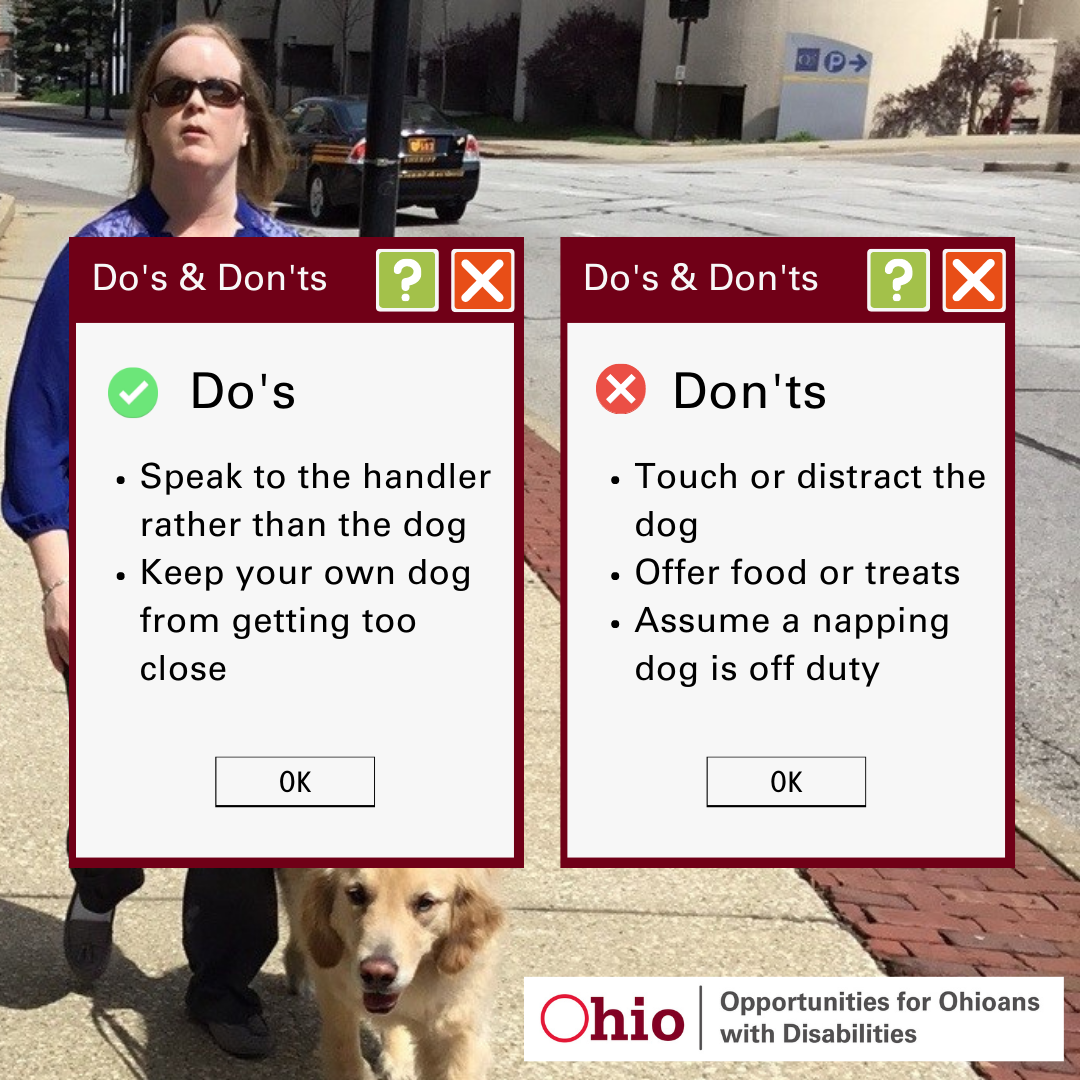
Here are some helpful do’s and don’ts for when you see a service dog:
Do
- Speak to the handler rather than the dog
- Keep your own dog from getting too close
Don’t
- Touch or distract the dog
- Offer food or treats
- Assume a napping dog is off duty
OOD’s Service Animals in the Workplace Guide offers more helpful tips, etiquette, reasonable accommodation considerations, and addresses what to do if other employees have allergies.
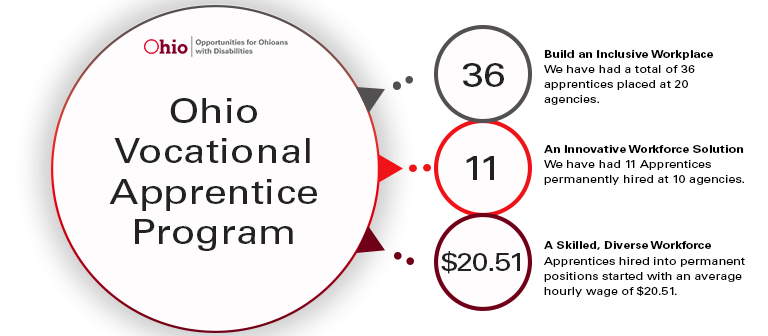 National Intern Day is July 28, 2022, an occasion to recognize and celebrate future leaders in the workplace. Here in Ohio, the Vocational Apprentice Program supports Ohio Governor Mike DeWine’s Executive Order 2019-03D, which established Ohio as a Disability Inclusion State and a Model Employer of Individuals with Disabilities. Through this program, students and adults with disabilities who are eligible for OOD services gain valuable work experience, exposure, and access to state government employment through paid apprenticeships with state agencies. The goal of this program is for apprentices to secure permanent employment in state government upon completion of the apprenticeship.
OOD partners with State of Ohio agencies to identify their workforce needs and develops apprenticeship opportunities that align with the job and educational goals of OOD-eligible participants. OOD assists participants to apply and interview for the apprenticeship and complete the onboarding process. OOD will also provide any needed on-the-job supports and can be a resource for worksite accessibility consultations and reasonable accommodations.
OOD funds all wages for the apprenticeship, up to $15 per hour, 25 hours per week for a maximum of 1,000 hours.
For more information, contact OOD Business Relations Manager Jon Hackathorn at jon.hackathorn@ood.ohio.gov or 614-306-1744.
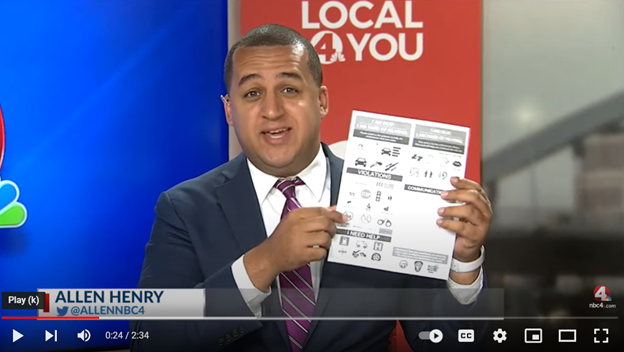 WCMH Channel 4 Columbus recently featured a story on a new communication card to help individuals who are deaf or hard of hearing exchange information with law enforcement. Learn more about the communication card and download or print it from OOD’s website.
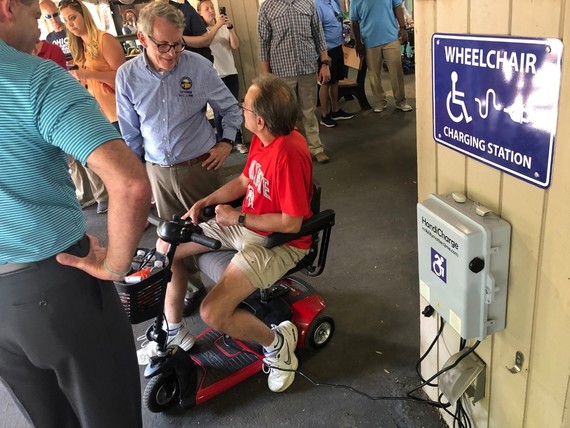 Governor DeWine talks to a gentleman charging his wheelchair during the 2019 Ohio State Fair.
The return of this year’s Ohio State Fair, which takes place from July 27 to August 7, 2022, will be more accessible and inclusive for everyone!
Fairgoers will enjoy continued accessibility enhancements: wheelchair/mobility device charging stations, technology to connect people who are blind or have low vision to an agent who can help with navigation, accessible picnic tables, service animal relief areas, and a dedicated sensory-friendly morning.
“I am pleased that the Ohio State Fair is committed to inclusion and accessibility,” said Governor DeWine. “This year’s enhancements will help even more people celebrate Ohio’s products, businesses, people, and history. Whatever you are looking for, you can Find It Here at the Ohio State Fair!”
OOD teamed up with the State Fair to make complimentary wheelchair/mobility device charging stations available. The stations are in marked areas in the Bricker MarketPlace Building, Kasich Hall, Lausche Youth Center, Natural Resources Park Pavilion, Taste of Ohio Café, and WCOL Celeste Center.
“The Ohio State Fair is a great way to recharge from work and enjoy the summer,” said OOD Director Kevin Miller. “Since visitors usually spend the entire day at the Fair, it’s important that charging stations are available to keep wheelchairs, scooters, and other mobility devices going strong.”
Also made available with support from OOD and the National Federation of the Blind of Ohio, fairgoers who are blind or have low vision can use Aira – which stands for Artificial Intelligence Remote Assistance – to connect, for free, to a remote agent via a cell phone or through specially-fashioned glasses. Both the application and the glasses allow the agent to access visual information, which is especially helpful for navigating a large, unfamiliar area. The agent is also able to locate users through GPS and direct them to places of interest.
"The Ohio State Fair is one of the best in the country and the most accessible it’s ever been,” said Lt. Governor Jon Husted. “These new enhancements, especially the technology-driven Aira, which will assist fairgoers who are blind or have low vision navigate the grounds, will help make sure everyone has a great experience.”
The addition of six accessible picnic tables throughout the Fairgrounds will encourage visitors to relax and enjoy their favorite foods. Ohio Penal Industries, a division of the Ohio Department of Rehabilitation and Correction, made the units, providing fairgoers opportunities for socializing with friends and making people feel more included.
With service animals permitted at the Fair, another great addition this year are service animal relief areas with pick-up bags and waste receptacles. Service animals are those that have been individually trained to do work or perform tasks for a person with a disability. Service animal relief areas with waste receptacles will be available on the Rhodes Center Lawn, Central Park, and Natural Resources Park.
In collaboration with the Ohio Center for Autism and Low Incidence (OCALI), the Ohio State Fair is turning down the lights and volume in an effort to host a sensory-friendly morning event on August 3 from 10 a.m. to 1 p.m. Fairgoers will have an opportunity to ride the rides with no flashing lights or music, visit the Fair’s educational activities, take a break in the air-conditioned Quiet Room (located in the Taste of Ohio Café), and explore many activities in the shade of the Natural Resources Park. Find a parking permit for the event and more information at OCALI’s website.
“We know the Fair can be a bit overwhelming for some people,” said Ohio State Fair General Manager Virgil Strickler. “By offering the sensory-friendly morning, as well as calming, natural spaces, we’re supporting an enjoyable experience for all families.”
These additions build on efforts the Ohio State Fair has already had in place:
- Buildings and most restrooms are accessible
- Motorized and non-motorized wheelchair rentals
- Sign language interpretation (by advance request)
- Free assistive listening devices for use at the WCOL Celeste Center, Main Street Stage, and Gazebo Stage
- Accessible seats for concerts in the WCOL Celeste Center can be purchased at the same cost directly from Ticketmaster (to view accessible seats, click the “filters” button, then toggle on the “accessibility” button to see)
“We’re thankful for partnerships with Opportunities for Ohioans with Disabilities and OCALI to make the Fair an inclusive and welcoming space,” explained Strickler.
Learn more at the Ohio State Fair’s accessibility webpage. During the Fair, conveniently-located guest information services booths offer daily schedules, maps, and directions. For additional information, contact ohioexpocenter@expo.ohio.gov or call 614-644-3247.
 On July 26, 2022, the Americans with Disabilities Act (ADA) turns 31 and is marked by ADA Awareness Day.
The Employers' ADA Handbook is a five-part webinar series from OOD to help employers navigate Title I of the Americans with Disabilities Act (ADA). All sessions in this series are archived and include an accompanying learner’s guide. Topics include Title I Overview, Reasonable Accommodations and Undue Hardship, Performance, Conduct and Safety, Resources and Funding, and concludes with an Accessibility Hour to answer frequently asked questions.
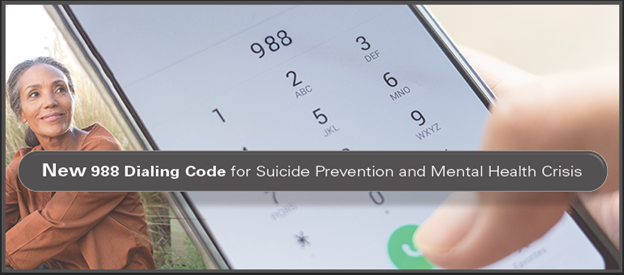 988—the new universal three-digit dialing code for suicide prevention and mental health crisis—went into effect nationwide on Saturday, July 16, 2022. SAMHSA (the Substance Abuse and Mental Health Services Administration of the U.S. Department of Health and Human Services) administers the new “988 Suicide and Crisis Lifeline,” which replaces the toll-free National Suicide Prevention Lifeline 1-800-273-TALK (1-800-273-8255). Importantly, the pre-existing 10-digit number will remain active and will connect callers to the new 988 Lifeline.
The 988 Lifeline is designed to become a simple alternative to both 911 and the existing 1-800 number. One of the goals of the new number is to reduce the use of 911 for suicide and mental health crises, because calling 911 in such situations too often results in inadequate or inappropriate intervention by the police, or unnecessary hospitalization or incarceration. Calling 988 instead will direct the caller to representatives specifically trained in the management of suicide risk and other mental health crises.
This new, simplified tool is critical for older adults and those living with a disability because such individuals are at greater risk for mental health crisis and suicide. As SAMHSA pointed out in its Appropriations Report for 988, suicide rates are higher among older adults. Among men, the suicide rate is highest for adults aged 75 and older, while among women, the suicide rate is highest among those aged 45 to 64.
Likewise, a recent study found that people with disabilities were significantly more likely than those without disabilities to report suicidal ideation, planning, or attempt. The 988 Suicide and Crisis Lifeline offers a simpler and more effective way for older adults and those living with disabilities to access help in the event of a mental health crisis.
Some helpful tips about using Lifeline:
- After dialing 988, a caller in need of the Veterans Crisis Line can then press “1” to be routed to that resource, while a caller in need of assistance in Spanish can press “2.” Interpretation through Language Line Solutions is also available in more than 250 other languages.
- People who are deaf or hard of hearing can access TTY by dialing 711 then 1-800-273-8255 or using their preferred relay service. Lifeline is in the process of expanding to video phone service.
- Lifeline also offers services through chat and text (in English only).
For more information, please see the following resources:
This Year the Ohio State Fair will be More Accessible Than Ever Before
abc 6, 7-20-22
Summer Crisis Program Helps Seneca County Residents
Review Times, 7-20-22
Cadence Coffee and Creperie Sets Vulnerable Youth Up for Success
The Business Journal, 7-20-22
ASL Interpreter who Gained Fame During COVID Briefings Raising Profile of Deaf Community
abc 6, 7-20-22
Path to Healing: Loveland Farm Offering Cooking Class for People of All Abilities
Local 12, 7-19-22
Cerebral Palsy Vigilante Inspires, Motivates Others Through Marathon Running
Spectrum News 1, 7-19-22
Silence Brought Me a Community and an Escape
The New York Times Magazine, 7-19-22
This Ohio City Just Launched an Accessibility Guide for Visitors with Disabilities
Travel and Leisure, 7-18-22
ODOT Launches New Mobility Hub in Four-County Area
Coshocton Tribune, 7-18-22
Card Released to Help Hearing Impaired During Ohio Traffic Stops
WOWK TV, 7-15-22
Local Advocate Brings Visibility to Ohio Service Dog Awareness Week
Yahoo! News, 7-14-22
Diagnosed with Autism at 30, Former NFL Star Finally Finds Answers
NBC Today, 7-14-22
|