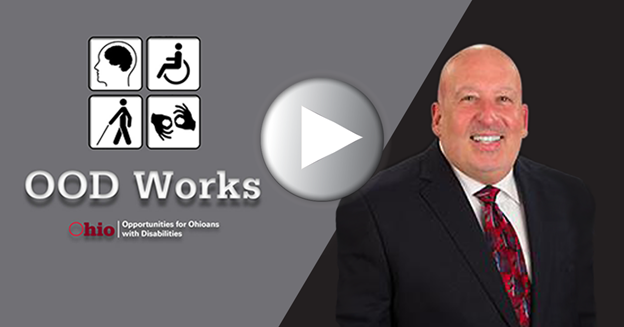
Michael Schor is the Associate Professor of Instruction at Ohio University (OU) where he teaches finance courses and is the president of the OU Chapter of the American Association of University Professors. He was a participant with Opportunities for Ohioans with Disabilities (OOD) about fifteen years ago. Recently, Michael reached out to his former OOD Vocational Rehabilitation Counselor, Melinda Wingard, to share how he is doing.
“I think people all have special parts of their past and things in which they’re interested in that could be aborted or blocked by a disability or change in circumstances,” Michael reflected. “Whatever kinds of things people are going through, it’s important not to lose valuable parts of themselves and to have that full richness in life by removing barriers.”
Tune in to episode 31 wherever you listen to podcasts by searching "OOD Works." Transcripts and MP3 files are available at ood.ohio.gov/podcast.
By Ohio Treasurer Robert Sprague
August is ABLE to Save Month, and I can think of no better time to raise awareness about the life-changing impact ABLE accounts are making nationwide.
It goes without saying, people living with disabilities often face many barriers when it comes to employment, and disability-related expenses can pose a real financial strain on individuals and their families. However, we have a powerful tool to break down those barriers, unlock each person’s potential, and make our communities and economy stronger.
Through STABLE Account – Ohio's ABLE program – the Treasurer’s office plays a key role in the effort to enhance financial independence for people living with disabilities.
Before STABLE accounts, people living with disabilities could only save $2,000 before losing means-tested benefits such as Medicaid or Supplemental Security Income (SSI). These old rules discouraged saving and investing, and asset limits made it very difficult for an individual to join the workforce.
STABLE accounts help remove those barriers to saving and employment, empowering people to have more control over their finances, and allowing accountholders to more fully participate in their communities and the labor force.
People are living more independently - buying cars, paying rent, and even putting down payments on their first homes. This financial stability is powerful and gives individuals and their families the peace of mind that comes with a plan for the future. Impactful stories like these are why we're reaching out to more Ohioans to get them enrolled.
Since taking office in January 2019, we have more than doubled STABLE Account enrollment. Today, there are more than 24,000 active accounts, and $250 million in account contributions have been made. Partnerships with the State of Ohio, as well as several local governments and private employers, now allow qualifying employees to make recurring direct deposits into STABLE accounts.
Accountholders can save up to $15,000 each year without jeopardizing federal assistance programs. If the accountholder is employed, they can save an additional $12,760 each year. Earnings on STABLE accounts grow tax-free, as long as funds are spent on qualified expenses, such as housing, transportation, healthcare, assistive technology, living expenses, and many others.
In the Buckeye State, we’ve seen how STABLE accounts improve financial stability, promote independence, encourage employment, and improve quality of life. There’s always more work to be done, but during ABLE to Save Month, we have plenty to celebrate.
Signing up for a STABLE account is easy – it only takes about 20 minutes and can be done from the safety and comfort of home. For more information about STABLE accounts and to sign up, visit StableAccount.com.
For trusted information on coronavirus (COVID-19) in Ohio, visit coronavirus.ohio.gov or call 1-833-4-ASK-ODH (1-833-427-5634). Recent updates include the Updated K-12 School Guidance from the Ohio Department of Health.
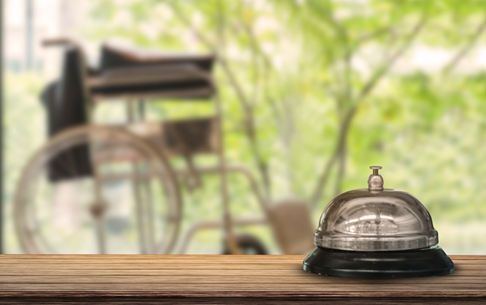
The American Association of Retired Persons (AARP) published an article called “How to Find the Best Hotels for Wheelchair Users,” offering expert tips for determining if a property is accessible. It covers planning considerations, questions to ask, and actions to take following a trip. Read the article.
Remote Work Made Life Easier for Many People with Disabilities
CNN, 8-10-21
Major Blind Charity Brings Its Full Talking Books Library to Amazon Alexa
Forbes, 8-10-21
Ross County Fair Improves 4-H Accessibility Through New Fair 4 All
Chillicothe Gazette, 8-10-21
Ohio State Duo Teams Up to Tackle Limb Differences, Ride in Pelotonia
WCMH, 8-9-21
Undefeated: Champion Wheelchair Basketball Player Turned Coach Gives Kids Opportunities He Wished He Had
Spectrum News, 8-9-21
Local Sheriff’s Office Prioritizes Helping People with Disabilities
WKBN, 8-8-21
All-Inclusive Playground, Pickleball Courts, Pavilion Planned for Sterkel Park
Mansfield News Journal, 8-7-21
Prevent Blindness Offers Back-to-School Resources to Help Keep Children’s Eyes and Vision Healthy
The Highland County Press, 8-6-21
|