|
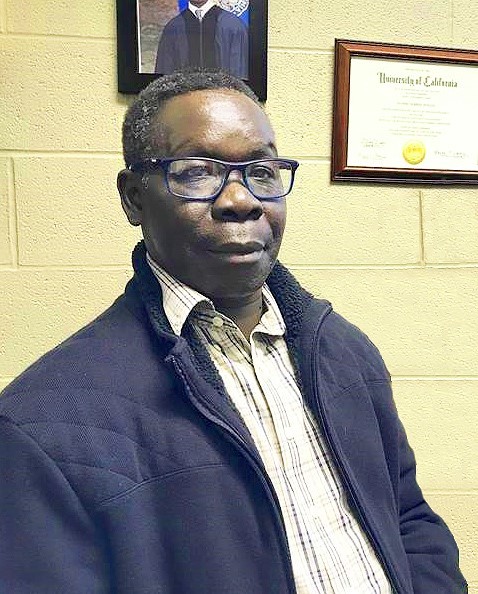
Dr. Scopas Poggo at his office.
Dr. Scopas Poggo was used to living with a visual disability. Born with night blindness, he made a point of completing primary schoolwork before dark in his native Sudan. “My parents taught me not to complain – to do what I can,” Scopas explained. Later as an adult, while working on his Ph.D. in History at the University of California, Santa Barbara, his peripheral vision began to decrease.
In 1999, Scopas accepted a position with The Ohio State University’s Department of African American and African Studies. He sought out a smaller campus, and the Mansfield location fit the bill. “It’s a great responsibility to be of service on the campus and in the community,” Scopas said.
Scopas was diagnosed with glaucoma in 2001 and had laser surgery to reduce pressure. Even with medication therapy, he continued to experience eye floaters (spots in his vision), causing his eyes to hurt and tire. Scopas’ disability continued to progress, and he notified the university that he needed assistance beginning in 2004. He was provided with a student assistant and encouraged to get ideas from staff with Student Disability Services. They suggested Scopas reach out to Opportunities for Ohioans with Disabilities (OOD). The late Sue Steinhour, OOD Vocational Rehabilitation Counselor, introduced Scopas to assistive technology to help navigate reading computer screens and students’ assignments.
By 2008, Scopas was finding it difficult to read fine print and was becoming increasingly concerned because he was working on publishing a book, a key for earning tenure at the university. “I got ZoomText, and I was overjoyed because I could do my work,” Scopas said. His book “The First Sudanese Civil War: Africans, Arabs, and Israelis in the Southern Sudan, 1955-1972,” was published in 2009 by Palgrave Macmillan. Scopas earned tenure, resulting in promotion from Assistant Professor to Associate Professor. His book continues to be used as a textbook for African Studies worldwide.
As Scopas’ vision continued to decrease, he and the Dean implemented creative solutions, including students using audible clickers instead of raising hands in the classroom. He begins every course by explaining his disability and requesting students to introduce themselves as they approach him on campus.
Scopas reconnected with OOD during the past year. Working with Katelyn Glembot, OOD Sr. Vocational Rehabilitation Counselor, Scopas received upgraded technology to maintain independence on campus. OrCam, a wearable assistive technology, helps Scopas by audibly conveying visual information. The small device magnetically mounts to his glasses and reads text, recognizes faces, identifies objects, and responds to voice commands. Scopas stressed how valuable the device has been for him in reading historical documents that cannot be scanned. Training was provided by Tiehan Liu with Ohio Job Connection.
Currently, Scopas is on a sabbatical to focus on writing his second book, “Voices of War and Peace in the Sudan, 1955-2018,” as well as a chapter for an Oxford University Press encyclopedia. In his free time, Scopas works on his autobiography, which details his experience with OOD so that others with visual disabilities are aware of the available support.
If you have a disability and would like to work, visit www.OODWorks.com or call 800-282-4536 to get started.
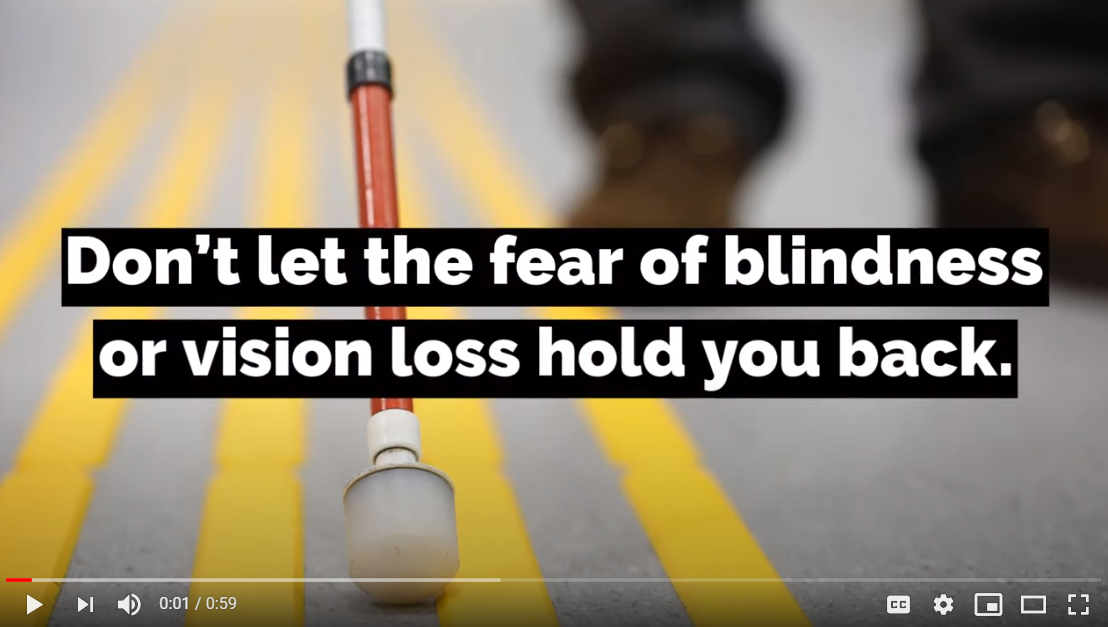
The OOD Bureau of Services for the Visually Impaired (BSVI) is committed to helping people with low vision and blindness succeed in the workforce. BSVI helps eligible individuals prepare for or retain careers consistent with their skills, interests, and abilities.
Watch a video to learn more about BSVI, and read more online.
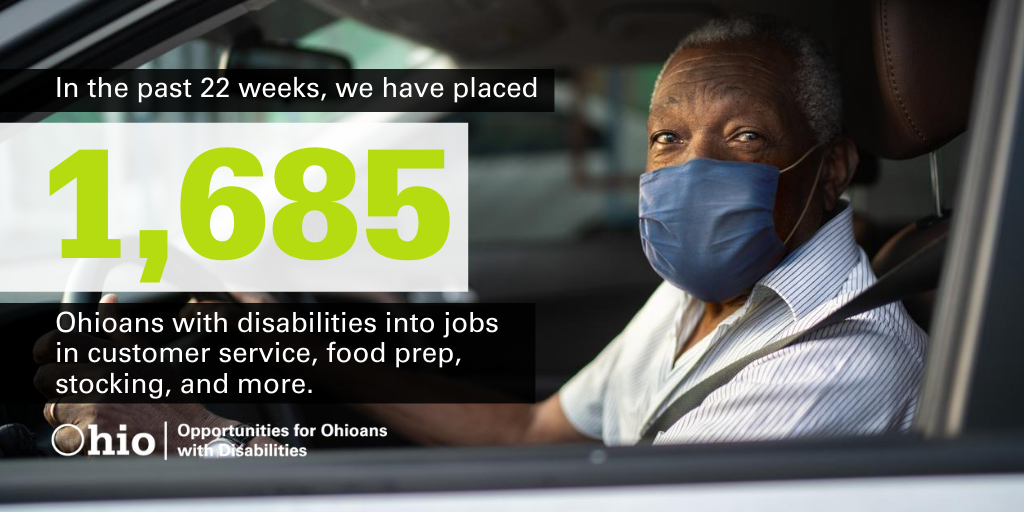 If you have a disability and want to work, reach out to OOD today. Vocational Rehabilitation Counselors can help you explore your options. Visit OODWorks.com or call 800-282-4536 to get started.
Guest Column
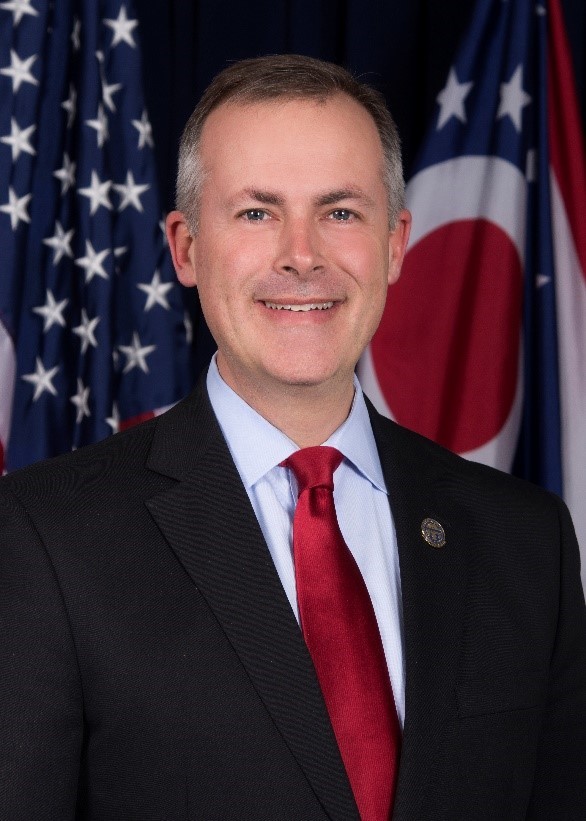
Ohio Treasurer Robert Sprague, guest contributor.
Last month, we celebrated the 30th anniversary of President George H.W. Bush’s signing of the Americans with Disabilities Act (ADA). The bill’s enactment was a defining moment for our country, and the ADA has drastically improved equality of opportunity for people with disabilities. July also marked the fifth anniversary of Ohio House Bill 155, which authorized the creation of the STABLE Account program.
Now is the time to build on the legacy of those important pieces of legislation. August is #ABLEtoSave Month, which is dedicated to increasing the awareness and usage of ABLE accounts nationwide.
Following the passage of the federal Achieving a Better Life Experience (ABLE) Act, Ohio’s STABLE Account program became the nation’s first ABLE program. During this month of advocacy and outreach, I want to reiterate our commitment to growing the STABLE program and working to further establish specialized investment accounts as a mainstream financial tool.
STABLE accounts are an incredibly powerful tool for increasing financial security and greater independence for people with disabilities. Before, people living with disabilities could only save a total of $2,000 before losing their benefits. However, that’s no longer the case. Earnings on a STABLE account grow tax-free and are not subject to federal income tax, so long as they are spent on Qualified Disability Expenses. Qualified Disability Expenses include education, housing, transportation, healthcare, assistive technology, basic living expenses, and many other items.
Our team started off 2020 by venturing to every corner of the state to share the benefits of STABLE accounts. While COVID-19 required a quick pivot to virtual outreach, it didn’t slow down our efforts. Since May, we have seen a record-breaking day, a record-breaking week, and two consecutive record-breaking months, adding 839 new accounts in June alone.
We are proud to now serve nearly 18,000 STABLE account-holders who have made more than $150 million in total contributions. Today, our program accounts for 25 percent of account-holders nationally – proving that Ohio leads the way in creating opportunities for people with disabilities.
Opening a STABLE Account is easy – it only takes about 20 minutes and can be done from the safety and comfort of home. For more information, or to sign-up, please visit the STABLE Account website at StableAccount.com, or call our team directly at 1-800-439-1653.
The Buckeye State is fortunate to have an ever-growing advocacy network that does a tremendous job of ensuring people with disabilities have every opportunity to thrive, and I’m proud of the work our STABLE team does every day to support that goal. Together, we're breaking down barriers to build a more inclusive state that benefits from the talents of all Ohioans.
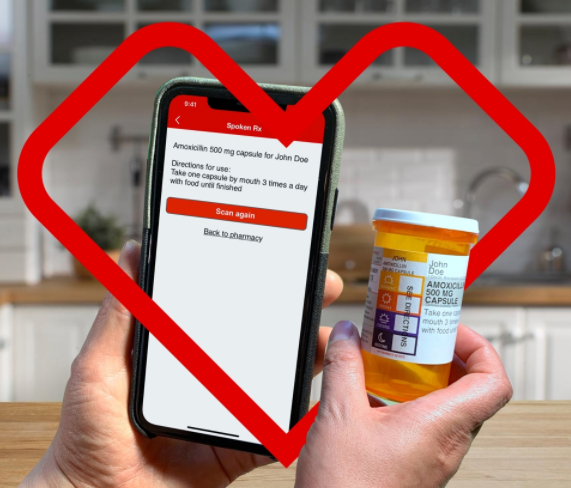
Coming to all CVS stories by the end of 2021, Spoken Rx is a smart tagged prescription label that works with an app to read prescirption information aloud in English or Spanish. In order to use Spoken Rx, an iPhone or Android smartphone, the smart tagged prescription, and the app are needed. A stand-alone speaker device option is also expected soon. To check availability and sign up, call your local CVS pharmacy or 800-SHOP CVS.
For trusted information on coronavirus (COVID-19) in Ohio, visit coronavirus.ohio.gov or call 1-833-4-ASK-ODH (1-833-427-5634). Recent additions include Continued Business Closures, a Face Shield FAQ, and a Travel Advisory.
A Blind Musician Can Feel a Conductor's Movements, Thanks to a High Tech Baton
CNN, 8-19-20
Deaf Filmmaker Uses Vibrating Suit to "Feel' Music
CNN, 8-19-20
How Entertainment Professionals with Disabilities are Fighting for Inclusion
Los Angeles Times, 8-18-20
Blind Ohio Woodworker Creates Pieces of Art, Teaches Others His Craft
WSYX, 8-17-20
|