OhioMHAS Announces Recruitment and Retention Bonuses for Great Minds Program Graduates
Up to $10,000 Available to Individuals Who Work At Least
One Year in Community Behavioral Healthcare
As part of the state’s ongoing efforts to increase the number of Ohioans working in the behavioral health field, OhioMHAS announced this week that eligible graduates of the Great Minds Fellowship program are now able to apply for recruitment and retention bonuses totaling $10,000.
Under this initiative, eligible Great Minds Fellowship program graduates will receive:
- A $5,000 sign-on bonus upon accepting a position at a OhioMHAS-licensed community behavioral health center (CBHC)
- An additional $5,000 bonus after completing one year of employment at a CBHC
OhioMHAS is partnering with Health Impact Ohio (HIO) to administer the recruitment and retention bonus initiative. Applications for the recruitment and retention bonuses went live: Nov. 1. Great Minds Fellowship program graduates working at CBHCs are encouraged to apply.
The recruitment and retention bonuses represent the third phase of the Great Minds Fellowship program. Created by Governor DeWine with the support of the Ohio General Assembly, the aim of the Great Minds initiative is to incentivize college students to pursue careers in behavioral health fields like social work, therapy, counseling, and psychiatric and mental health nursing. Funding for this latest phase comes from the $85 million in one-time American Rescue Plan Act (ARPA) resources dollars set aside at the initial launch of the Great Minds initiative.
For more information on the program and how to apply, visit https://www.healthimpactohio.org/great-minds-fellows or email greatmindsfellows@healthimpactohio.org.
|
Recovery Housing Residence Registry Update
In accordance with Ohio law (R.C. 5119.394), OhioMHAS has established a registry of recovery housing residences that are accredited (or its equivalent) by certain accreditation organizations or, if newer (in operation for not more than 18 months), are actively engaged in efforts to obtain such accreditation. The registry includes certain information from the registration form recovery housing residence operators must submit to OhioMHAS, as described in R.C. 5119.391, information regarding any complaints that have been investigated and substantiated, and any other information OhioMHAS considers appropriate.
Beginning Jan. 1, 2025, community addiction services providers and community mental health services providers are prohibited from referring clients to a recovery housing residence if the residence is not on the registry on the date the referral is made. Community addiction services providers and community mental health services providers must maintain records of all referrals made to recovery housing residences (R.C. 5119.396).
Regional Meetings Announced
The OhioMHAS Bureau of Recovery Supports will host five regional meetings to provide an overview of recovery housing residence accreditation requirements, the registration form, registry, complaints, and prohibitions in Ohio Revised Code sections 5119.39 through 5119.396 . The meetings are open to operators of recovery housing residences, community behavioral health providers, and any interested stakeholders.
Click the links below to reserve your seat:
Southwest Region | Nov. 15 - 10:00 a.m.-Noon | Middletown Community Room at MidPointe Library Middletown — 125 S. Broad St., Middletown, OH 45044 | Register
Southeast Region | Nov. 19 - 10:00 a.m.-Noon | Large Meeting Room at Athens Public Library — 30 Home St., Athens, OH 45701 | Register
Northeast Region | Nov. 22 - 1:00-3:00 p.m. | Akron Summit County Public Library — 60 S. High St., Akron, OH 44326 | Register
Northwest Region | Nov. 25 - 10:00 a.m.-Noon | Lima Public Library — 650 W. Market St., Lima, OH 45801 | Register
Central Region | Nov. 26 - 10:00 a.m.-Noon | State Library of Ohio Board Room — 274 E. 1st Ave., Columbus, OH 43201 | Register
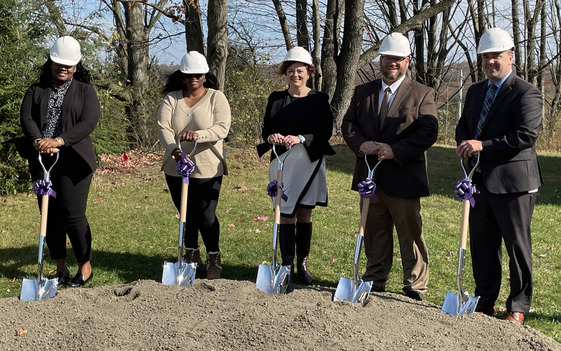 OhioMHAS Staff Attend Geauga County Groundbreaking
On Monday, several OhioMHAS staff members joined local and county officials for a groundbreaking ceremony for the expansion of Ravenwood Health's Transitional Living Center (TLC) in Chardon. TLC is the only Class 1 residential facility providing crisis stabilization services in Geauga County and is a critical resource in the county's continuum of care. The facility serves adults with serious mental illness. Services offered include counseling, medication management, case management, peer support, and linkage to community supports.
The $2.8 million renovation and expansion project will increase TLC's capacity from nine beds to 16 and more than double the square footage. OhioMHAS contributed more than $1.1 million in capital funding toward the project. Additional funding support was provided by the Geauga County Board of Mental Health and Recovery Services.
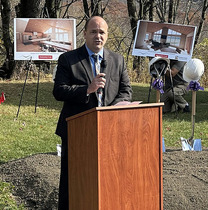
Pictured (l-r): Alicia Cody, Northcoast Regional Liaison, OhioMHAS; Kelli Glover, Project Manager, OhioMHAS Bureau of Capital Planning and Management; Christine Lakomiak, Executive Director, Geauga County Board of Mental Health and Recovery Services; Curtis Smith, Chief, OhioMHAS Bureau of Capital Planning and Management; and Jonathan Baker, Chief Business Officer, OhioMHAS (also pictured speaking, inset).
|
Ohio Voters Approve All 12 Local ADAMH Levies

Ohio voters approved all 12 Alcohol, Drug Addiction and Mental Health Services board levies on Tuesday's ballot. Results are below:
Allen/Auglaize/Hardin | 10-year, 0.5 mill renewal | 63% Yes
Butler | 5-year, 0.5 mill additional | 55% Yes
Erie | 5-year, 0.5 mill renewal | 68% Yes
Fairfield | 10-year, 0.75 mill renewal | 58% Yes
Guernsey | 10-year, 1 mill renewal | 63% Yes
Jefferson | 10-year, 0.5 mill replacement | 56% Yes
Lake | 10-year, 0.9 mill renewal | 58% Yes
Lorain | 10-year, 1.2 mill renewal | 64% Yes
Ottawa | 5-year, 0.5 mill renewal | 67% Yes
Putnam | 5-year, 0.7 mill renewal | 64% Yes
Trumbull | 10-year, 1 mill renewal | 66% Yes
Wood | 10-year, 1.6 mill renewal | 64% Yes
|
 Leaders Gather to Learn About 911/988 Interoperability

Last week, members of the OhioMHAS 988 leadership team attended the Clear Pathways – 988/911 Crisis Response Pilot Convening presentation in Columbus. The gathering served as a forum to report on the findings of a pilot study involving interoperability of select 988 call centers and 911 Public Safety Answering Points (PSAP’s) throughout Ohio conducted by Clear Pathways. Ohio 988 Administrator Doug Jackson participated in a panel discussion along with 911 Program Administrator Patrick Brandt. The pilot program focused on the issues of governance, standard operating procedures (SOP’s), technology, training, and communications.
Pictured top (l-r): Doug Jackson, Ohio’s 988 Administrator, Cal Jenkins, Manager of Research and Evaluation for the Clear Pathways Initiative, and Patrick Brandt, Ohio’s 911 Administrator, celebrate a productive day of gathering Ohio stakeholders to discuss 911/988 interoperability.
Pictured inset: OhioMHAS staff, representatives from Peg’s Foundation, and Ohio 988 Contact Center leaders participate in a tabletop exercise to discuss challenges and opportunities in facilitating local 911/988 interoperability.
|
Season 2: School Wellness Podcast Available
Mini-Grant Opportunity: Localizing SAMHSA's “Talk. They Hear You.” Messaging Campaign

The Ohio Center of Excellence for Behavioral Health Prevention and Promotion has announced a mini-grant opportunity to localize SAMHSA’s Talk. They Hear You. campaign across Ohio. This national campaign empowers parents, caregivers, and trusted adults to foster open, honest conversations with youth about substance use, reinforcing the powerful influence adults have on young people’s choices.
The Center will award up to 29 mini-grants of $10,000 each to help local organizations across Ohio implement and tailor the Talk. They Hear You. campaign to meet community needs. This initiative has been made possible with support from OhioMHAS and is funded by the American Rescue Plan Act (ARPA). The deadline to submit an application is 11:59 p.m. on Nov. 24.
|
New NIMH Resource: Seasonal Affective Disorder
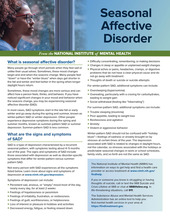
The National Institute of Mental Health (NIMH) has published a new resource on Seasonal Affective Disorder (SAD). With daylight saving time ending Sunday, many people may feel a shift in their mood. It's common to experience feelings of sadness or the "winter blues" as days get shorter. For some, these mood changes can be more serious and may indicate seasonal affective disorder (SAD). Symptoms typically begin in late fall or winter and improve in spring. If you notice significant changes in your mood during this time, it’s important to learn more about SAD—its signs, diagnosis, causes, and treatment options.
|
Become the Future of Prevention: Apply to Become the Next Great Lakes PTTC BOLD Fellow
Are you an early career prevention professional passionate about making a difference in substance misuse prevention? The Great Lakes Prevention Technology Transfer Center (PTTC) is seeking ambitious, early career professionals ready to become the next generation of substance misuse prevention leaders to apply for its Building Our Leadership and Diversity (BOLD) fellowship program.
The BOLD Fellowship is focused on increasing the number of prevention scientists working within Black/African American communities and building their capacity to identify and chronicle programs, practices, and policies proven effective in reducing substance misuse risk factors and consequences and promoting mental health and protective factors or assets in Black/African American communities.
The BOLD Fellow will perform about 50% of their work onsite with Youngstown UMADAOP and 50% remote with the Great Lakes PTTC. The selected candidate will learn directly from experienced substance misuse prevention professionals, have an opportunity travel to major conferences and training events ,and receive competitive pay. The deadline to apply is Nov. 14.
Youth Vaping Prevention ECHO, Nicotine, Cannabis, Vape: A Complex Relationship — Nov. 13
The Ohio Center of Excellence for Behavioral Health Prevention and Promotion invites those working in youth vaping prevention to participate in its upcoming ECHO session, Nicotine, Cannabis, Vape: A Complex Relationship, on Nov. 13. This session will delve into the interconnected use of nicotine and cannabis, particularly among youth, and examine the rising trend of cannabis being used in vape devices. Participants will gain insights into the unique effects of each substance and the heightened risks when these substances are used together, posing new challenges to prevention efforts.
ECHO Sessions are interactive and are a great place to share successes or “workshop” ideas with subject matter experts and colleagues. CEs for Prevention, Social Work, Health Education, Nursing and Psychology will be available.
|
Overview of Clinical High Risk for Psychosis Webinar — Nov. 19

The Substance Abuse and Mental Health Services Administration (SAMHSA) National Training and Technical Assistance Center for Early Serious Mental Illness (ESMI TTA Center) is hosting an Overview of Clinical High Risk for Psychosis webinar on Nov. 19 from noon-1:00 p.m. The webinar will provide an overview of clinical high risk for psychosis, address key considerations and challenges in program implementation, and discuss available technical assistance resources to support clinical high risk for psychosis programs.
|
Building Recovery-Friendly Communities — Nov. 20
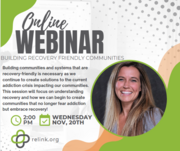
Relink.org will host a Building Recovery-Friendly Communities webinar on Nov. 20 at 2:00 p.m. The session will be led by Stephanie Robinson, Founding Executive Director of Hope Recovery Community (HRC). Located in Medina, HRC is a recovery community organization (RCO). An RCO is an independent, non-profit organization led and governed by the recovery community. These organizations organize recovery-focused policy advocacy activities, carry out recovery-focused community education and outreach programs, and/or provide peer-based recovery support services. Questions? Email info@relink.org.
|
HPIO Webinar: Promoting ACEs Protective Factors and Supporting Ohio Families — Dec. 10
The Health Policy Institute of Ohio is hosting a Promoting ACEs Protective Factors and Supporting Ohio Families webinar on Dec. 10 from 1:00-2:00 p.m. The webinar will highlight how protective factors help children and families build resilience and examine how financial security influences the health and well-being of children and families. Speakers from the Ohio Children’s Trust Fund and the Ohio Department of Education and Workforce will describe programs and policies at their agencies that encourage protective factors among Ohio children and families.
|
In the News...
Major grant supports mental health services for children in crisis
Spectrum News1, November 5, 2024
Seven graduate from court-mandated drug program
Hillsboro Times-Gazette, November 5, 2024
More bystanders are stepping up to prevent opioid overdoses. But it's not nearly enough.
The Ohio Newsroom, November 4, 2024
Bonuses being offered for mental health workers who stay in Ohio
WFMJ-TV, November 4, 2024
At a Crossroads: Clinicians and law enforcement, a partnership to protect mental health
Psychiatric Times, November 4, 2024
Reducing stigma: St. Rita's social worker talks behavioral health
Lima News, November 4, 2024
From incarcerated to independent
The Daily Standard, November 2, 2024
Rhodes State College hosts conference on mental health
WLIO-TV, November 1, 2024
Jefferson County receives $180,000 grant for youth substance abuse prevention
WTOV-TV, October 31, 2024
Tri-County Board selects mixed-media work for Director's Award
Sidney Daily News, October 29, 2024
|