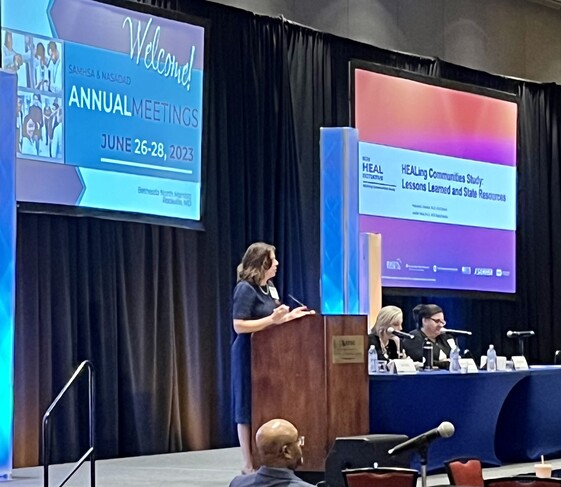
 Director Criss Highlights Ohio's Integrated Behavioral Health Data Dashboards and Naloxone Distribution Efforts at 2023 NASADAD Annual Meeting
On Monday, OhioMHAS Director Criss moderated a panel at the 2023 SAMHSA and NASADAD Annual Meeting on the HEALing Communities Study. During this session, state agency directors and prevention and treatment coordinators from around the country heard from experts on new data dashboards to better track and report on overdose deaths and substance-use measures. Ohio recently launched these new data dashboards for all 88 Ohio counties, which were adopted and expanded from dashboards created through the National Institutes of Health-funded HEALing Communities Study – the largest implementation study ever conducted in addiction research – aimed at investigating how tools for preventing and treating opioid misuse, opioid use disorder (OUD), and opioid overdose are most effective at the local level. Director Criss also provided an update on Ohio's naloxone distribution strategies.
New OhioMHAS Research Examines Disparities in Behavioral Health Services Among Deaf and Hard-of-Hearing Ohioans
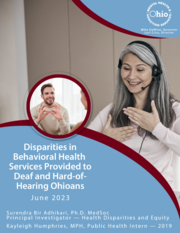
OhioMHAS Principal Investigator on Health Equity Research, Surendra Bir Adhikari, Ph.D. MedSoc led the recently published Disparities in Behavioral Health Services Provided to Deaf and Hard-of-Hearing (DHOH) Ohioans. Finding accurate estimates of the DHOH population in Ohio is challenging. This research recruited providers within the publicly funded behavioral health system to explore: (a) who, across Ohio, is providing services to the deaf and hard-of-hearing population? (b) where are these services located across Ohio? and (c) what services are being provided? Research offers several policy recommendations, a few are noted. First, it is critical to address communication disparities in DHOH communities by increasing the number of American Sign Language proficient clinicians. Secondly, E-therapy (a remotely delivered treatment via web-based videoconferencing) seems to be effectively utilized in communication with DHOH clients. Lastly, availability of culturally and linguistically competent mental health services to the DHOH clients is important.
|
Coalition Releases 2023 Franklin County Suicide Report
The Franklin County Suicide Prevention Coalition (FCSPC), hosted by Mental Health America of Ohio (MHAOhio) and funded by the Alcohol, Drug and Mental Health Board of Franklin County (ADAMH), has released its 2023 Franklin County Suicide Report. The report is the result of collaboration amongst several Franklin County organizations, including ADAMH, Center for Community Solutions, Columbus Public Health, the Franklin County Coroner’s Office, Franklin County Public Health, MHAOhio, Netcare Access, and The Ohio State University. In additional to data, the report includes recommendations from the Franklin County Suicide Fatality Review Team.
|
NIDA Research: Xylazine Appears to Worsen the Life-Threatening Effects of Opioids in Rats
A new study, led by researchers at the National Institute on Drug Abuse (NIDA),suggests that xylazine, the active ingredient in a non-opioid veterinary tranquilizer not approved for human use, can worsen the life-threatening effects of opioids. The findings imply that when used in combination with opioid drugs such as fentanyl and heroin, xylazine may damage the ability of the brain to get enough oxygen, which is one of the most dangerous effects of opioid drugs and can lead to death. The study, is published in Psychopharmacology.
|
SAMHSA Releases Practical Guide for Implementing a Trauma-Informed Approach
The Substance Abuse and Mental Health Services Administration (SAMHSA) has issued a new practical guide on trauma-informed approach (TIA). The primary goal of this guide is to expand the discussion presented in SAMHSA’s previous resources on trauma (Concept of Trauma and Trauma-Informed Care in Behavioral Health Services). The guide specifically focuses on tools and strategies for implementing a TIA. This guide highlights the need for organizational assessment of readiness and capacity before implementing TIA and describes strategies for such assessments. The guide describes implementation strategies across the following 10 domains: Training and Workforce Development; Governance and Leadership; Cross Sector Collaboration; Financing; Physical Environment; Engagement and Involvement; Screening, Assessment, and Treatment Services; Progress Monitoring and Quality Assurance; Policy; and Evaluation. The guide is intended for anyone involved in organization-level change, including practitioners, state and local officials, policy makers, federal and non-federal funders, peers, and family members.
5 Takeaways from Associated Press' Series on Health Disparities Impacting Black Americans

The Associated Press (AP) spent a year examining how racial health disparities have harmed generations of Black Americans. From birth to death, Black Americans fare worse in measures of health compared to their white counterparts. They have higher rates of infant and maternal mortality, higher incidence of asthma during childhood, more difficulty treating mental illness as teens, and higher rates of high blood pressure, Alzheimer’s disease and other illness as adults. Here are key takeaways from each story from the AP.
|
MACC, Inc. Cultural Coalition Quarterly Meeting — June 29
The Multiethnic Advocates for Cultural Competence (MACC), Inc., Cultural Coalition will host its quarterly meeting on June 29 from 5:30-7:00 p.m. at the MACC offices located at 2323 W. Fifth Ave., Suite 160, Columbus. (Virtual participation is also available). The purpose of the Cultural Coalition is to reach out to organizations around the state that represent minority/marginalized communities and invite them to the table as part of an advocacy effort. All organization members can bring to the table issues of their respective constituencies and MACC will lead and support in identifying appropriate responses and to whom any requests for redress should be directed. The objective is to elevate and amplify the concerns of all member organizations through the collective and expanded voice of the Coalition.
|
Prevention Exchange: Sharing Success, Shaping Solutions Virtual Forum — June 29
As part of its ongoing, virtual "Prevention Exchange: Sharing Success, Shaping Solutions" series, the Ohio Center of Excellence for Behavioral Health Prevention & Promotion will host Celebrating Coalitions: Utilizing Science and Leveraging Resources for Maximum Impact on June 29 from 1:00-2:00 p.m.
Coalitions harness the power of passionate people, are fueled by science, and leverage resources to improve their community. By bringing people together from different sectors of the community, we can build comprehensive approaches to the complex issues faced by our community. Through collaboration we increase the knowledge, skills, and services involved in our efforts, but this takes intentional work. This process isn’t always easy, but thanks to the ongoing evaluation of prevention work we understand effective strategies for building community ownership of the process and sustaining our results. The aim of coalitions, especially those receiving Drug Free Communities Support Program support, is to achieve and sustain population level change.
This session will feature a conversation about how science and resources go hand in hand to foster community level change, and highlight the successes of the Cincinnati H.O.P.E Coalition, which has received Drug Free Communities funding since 2018. Future sessions are planned for July 27 and Aug. 31. Register for the entire series using the button below.

As part of its ongoing, virtual "Prevention Exchange: Sharing Success, Shaping Solutions" series, the Ohio Center of Excellence for Behavioral Health Prevention & Promotion will host Celebrating Coalitions: Utilizing Science and Leveraging Resources for Maximum Impact on June 29 from 1:00-2:00 p.m.
Coalitions harness the power of passionate people, are fueled by science, and leverage resources to improve their community. By bringing people together from different sectors of the community, we can build comprehensive approaches to the complex issues faced by our community. Through collaboration we increase the knowledge, skills, and services involved in our efforts, but this takes intentional work. This process isn’t always easy, but thanks to the ongoing evaluation of prevention work we understand effective strategies for building community ownership of the process and sustaining our results. The aim of coalitions, especially those receiving Drug Free Communities Support Program support, is to achieve and sustain population level change.
This session will feature a conversation about how science and resources go hand in hand to foster community level change, and highlight the successes of the Cincinnati H.O.P.E Coalition, which has received Drug Free Communities funding since 2018. Future sessions are planned for July 27 and Aug. 31. Register for the entire series using the button below.
|
Triple P Workshop: Implementing a Collaborative Approach to Parenting — June 30
The Ohio Children's Alliance is hosting a Triple P Workshop: Implementing a Collaborative Approach to Parenting on June 30 from 9:00-11:00 a.m. This workshop will explore elements of a community wide approach to supporting parents and caregivers involved in the behavioral health system using the Triple P model. Triple P is the world’s most widely researched parenting program with over 40 years of research, demonstrating its effectiveness in preventing and treating behavioral, emotional, and developmental concerns in children. Consultants from Triple P America will provide an overview of the continuum of program options and resources, discuss key partners and systems needed to support a comprehensive parenting model, and highlight the current Triple P work happening in Ohio. Cost, which includes 2 CEUs, is $19 for Alliance members and $29 for general admission.
|
21st Annual NADD State of Ohio MI/ID Conference — July 10-11
 |
|
Time is running out to register for the 21st Annual NADD State of Ohio MI/ID Conference scheduled for July 10-11 at the Columbus Marriott Northwest in Dublin. Click here to view the registration brochure for a list of all registration options as well as pricing, conference agenda, and continuing education information. |
Person Centered Thinking and Charting the LifeCourse in Ohio — July 14
The Ohio State University Nisonger Center will present the sixth installment of its Bridging Mental Health and Developmental Disabilities webinar series — "Person Centered Thinking and Charting the LifeCourse in Ohio" — on July 14. This free professional development series focuses on supporting the mental health needs of adults with intellectual and developmental disabilities.
34th Annual Statewide UMADAOP Conference — Oct. 4-6
The Urban Minority Alcoholism and Drug Abuse Outreach Program (UMADAOP) of Dayton will host the 34th Annual Statewide UMADAOP Conference on Oct. 4-6 at the Marriott University in Dayton. This year's theme, "Upendo" (Love): Restoring Hope, Rebuilding Lives, and Strengthening Value in Our Communities, highlights the restorative power of hope and the value invested in that which we love. The theme and the sessions planned, continue the UMADAOP Federation's long tradition of working to ensure that communities of color benefit from culturally specific prevention, treatment, recovery and mental health services. The group hotel room rate is $109 per night, plus taxes and fees. The rate is available through Sept. 8. Click HERE to book your room(s). Questions? Please call the UMADAOP of Dayton at 937.276.2176.
|
Ohio Children's Alliance Fall Conference — Oct. 17-18
In the News...
Clark County promotes screenings, preventative care for Men's Health Month
Springfield News-Sun, June 27, 2023
Ohio Senate budget would reverse Columbus ban on menthol-flavored tobacco products
Columbus Dispatch, June 27, 2023
Pet therapy helps inmates with drug addiction recovery
WDTN-TV, June 27, 2023
Help those who might have ideas of suicide
Sandusky Register, June 27, 2023
Summit County judge receives recertification for Valor Court Program
WEWS-TV, June 27, 2023
Sen. John Fetterman is 'grateful' to be alive and back in the fight
The Washington Post, June 26, 2023
Local organizations raising awareness about the ongoing opioid epidemic
WEWS-TV, June 26, 2023
Is Long COVID linked to mental illness?
SLATE, June 26, 2023
Second women's recovery house opens
Tiffin Advertiser-Tribune, June 25, 2023
College students among Ohio problem gambling spike since sports betting legalization
WCMH-TV, June 23, 2023
Teaming up to tackle mental health in Seneca County
WTVG-TV, June 23, 2023
Study: Animal sedative in fentanyl makes life-threatening opioid effects even worse
Cincinnati Enquirer, June 22, 2023
Franklin County Drug Court graduate says h.a.r.t. program saves lives
Columbus Dispatch, June 22, 2023
He had debilitating anxiety and panic attacks. Here's how he dealt with it.
The Washington Post, June 22, 2023
Big Story: Behavioral Health
WTVG-TV, June 22, 2023
Addressing the mental health challenges LGBTQ+ youth face
SpectrumNews1, June 22, 2023
HHS Issues Advisory on Mental Health Symptoms and Conditions Related to Long COVID
SAMHSA, June 21, 2023
Doctors urged to regularly screen patients for anxiety
People, June 21, 2023
Local mental health experts lead suicide prevention discussion at Boys & Girls Club event
WCMH-TV, June 20, 2023
Boys & Girls Club to get $3.5M facelift
Youngstown Vindicator, June 19, 2023
Xenia addiction-to-workforce program opens to first cohort of men in recovery
Dayton Daily News, June 16, 2023
|