In This Issue:
On July 30, 1965, President Lyndon B. Johnson signed the Medicare and Medicaid Act, also known as the Social Security Amendments of 1965, into law. It established Medicare, a health insurance program for the elderly, and Medicaid, a health insurance program for people with limited income.
Following is an excerpt of President Johnson's remarks shared at the signing the Medicare and Medicaid Act:
No longer will older Americans be denied the healing miracle of modern medicine. No longer will illness crush and destroy the savings that they have so carefully put away over a lifetime so that they might enjoy dignity in their later years. No longer will young families see their own incomes, and their own hopes, eaten away simply because they are carrying out their deep moral obligations to their parents, and to their uncles, and their aunts.
This month we join hands with you and our partners across the state to celebrate 60 years of caring for Ohioans!
We had a great turnout for the June EVV Stakeholder Workgroup where we reviewed updates to the EVV webpage and heard from participants about different ways to improve our web content and resources so it’s easier to find the information you need. For those who missed the meeting, you can see the presentation here.
Save the date for the July EVV Stakeholder Workgroup being held on July 28, 2:30-4 p.m. The meeting is an opportunity to engage in discussion about ways Ohio Medicaid and our EVV partner Sandata can improve the EVV program in Ohio.
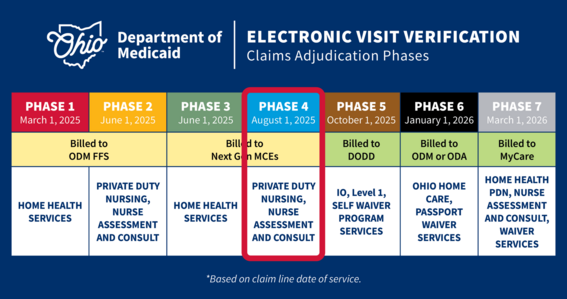
On August 1, Phase 4 claims validation requirements begin for providers offering private duty nursing or nurse assessments and consultation billed to managed care entities. To help these and all providers avoid payment disruptions related to claims processing requirements, ODM strongly encourages all to:
Review your EVV match rate – Ensure all visits are properly captured and aligned with claims.
Review the EVV Provider Look-Up Dashboard for issues that may delay claims payment.
Use Available Resources – We’ve compiled key materials to help you navigate claims validation.
Claims Validation Process Flow Chart
Guide to Handling Claims Validation Denials
Getting Started Checklist
Attend HHA/Sandata Office Hours for one-on-one support. You can register here.
Take advantage of upcoming claims validation readiness training sessions tailored to providers affected by the August 1 implementation.

Whether you need a refresher on meeting EVV claims validation requirements or you’re preparing for a future go-live, Sandata offers a series of pre-recorded, on-demand virtual training webinars to help all providers successfully meeting claims process requirements.
Visit Sandata’s Claims Readiness On-Demand trainings webpage to view all options or select from the topics listed below to sharpen your knowledge of what’s required and ways you can ensure your claims comply with Ohio Department of Medicaid specifications. Access these sessions on your own schedule and at your own pace.
|
Claims Readiness On-Demand Trainings
|
Training Link
|
|
Get Ready for Claims Matching
|
Replay
|
|
Mastering Data Entry
|
Replay
|
|
Visit Maintenance
|
Replay
|
|
Aggregator for Alt EVV Providers
|
Replay
|

With the July 2024 Electronic Visit Verification rules update, Ohio Medicaid wants to remind you of two rules that must be followed:
-
Signature and validation from the individual receiving services is not required for EVV. Keep in mind that providers may have different requirements to obtain signatures for service delivery validation based on program requirements and services rendered. Please check your service and program specific rules to determine the signature requirement for your service documentation.
- Use of global position services (GPS) requires the consent of the individual receiving services.
|

The Ohio Department of Medicaid is updating two Ohio Administrative Code (OAC) rules and is looking for input from independent providers regarding interest in using an alternate electronic visit verification (EVV) system for logging visits.
Currently, any provider subject to EVV requirements can use the Sandata EVV system at no cost. That option will continue. However, if you are an independent provider interested in finding an alternate solution that better aligns with your needs and capabilities, despite potential costs, we’d like to hear from you.
Please take a moment to complete this brief survey by July 15 to let us know if you’re considering an alternate system once the rule changes take effect later this year.
|
 July 1 marks the one-year anniversary of the Ohio Medicaid EVV system transition. During the year, with the help of providers like you, we’ve gained insights and short cuts that can help you support EVV processes, reporting, and requirements.
Check out this month's EVV Program Tips and Tricks and get a better handle on meeting electronic visit verification claims and system criteria.
Medicaid and Sandata receive and track provider inquiries each month to understand where support or education is needed most.
Throughout June our system and support teams fielded a variety of technical questions from you, the most common of which are addressed and answered here.
Sandata regularly updates its EVV software via releases to ensure it runs smoothly. To see if any updates affect you, see the summary of June releases for the Sandata system.
Questions about releases or the system should be directed to the Sandata EVV Provider Hotline at 855-805-3505 or emailed to ODMCustomerCareEmail@sandata.com.
Stay updated on ODM EVV program communications. Subscribe to Medicaid news on the Ohio Medicaid website.
Ohio Medicaid and Sandata Technologies stand ready to assist providers and agencies in meeting claims validation requirements and more.
Click here to see who to contact regarding specific topics.
|