In This Issue:
Fee-for-service claims submitted to Ohio Department of Medicaid (ODM) are processed by the Fiscal Intermediary (FI) and return a remittance advice (RA) to the sender when the claim is processed - PAID or DENIED. Claims submitted via Electronic Data Interchange (EDI) to ODM are in a file called the “837.” The response received by the provider or trading partner is called the “835” or an electronic remittance advice.
The remittance advice is accessible to providers in the Medicaid Provider Network Management (PNM) module after the claim is adjudicated for all claims, both submitted directly in the PNM portal and submitted via EDI.
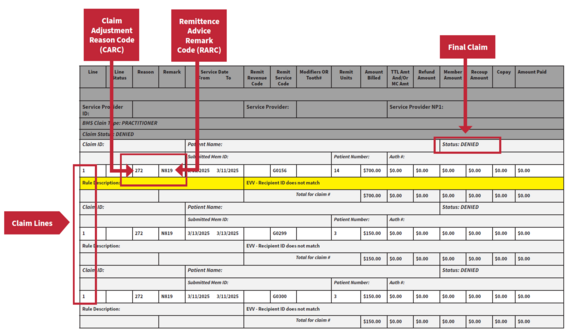
If a claim is denied, the remittance advice displays the Claim Adjustment Reason Code (CARC) and Remittance Advice Remark Code (RARC) and a description of the denial in the “Rule Description” section. The RA does not include any internal FI edit codes or descriptions.
Providers can review Accessing Remittance Advice for more insight.
Rule Description
|
RARC
|
CARC
|
What Does This Mean?
|
|
Provider ID does not match
|
N521 Mismatch between the submitted provider information and the provider information stored in our system.
|
272 Coverage or program guidelines were not met
|
The provider Medicaid ID on the claim request does not have an EVV account in Sandata’s system.
|
|
Recipient ID does not match
|
N819 Patient not enrolled in EVV system
|
272 Cover or program guidelines were not met
|
The recipient Medicaid ID on the claim is not in the provider’s EVV account.
|
|
Procedure code does not match
|
N56 Procedure code billed is not correct or valid for the services billed, or for the date of the service billed.
|
272 Cover or program guidelines were not met
|
A verified visit was not found in the provider’s EVV account with the following details from the claim: recipient Medicaid ID, date of service, payer, and service.
|
|
Unmatched Unites
|
N820 EVV system units do not meet requirements of visit
|
272 Cover or program guidelines were not met
|
A verified visit was found but has less units than what was on the claim.
|
The image below calls out where to find important indicators to understand your remittance advice.

The April 28 Electronic Visit Verification Stakeholder Workgroup meeting invited attendees to share candid feedback on experiences and challenges with the program, processes, and supports made available to you. It was a lively session, with members voicing thoughts regarding EVV rules currently under review, obstacles obtaining live-in caregiver exemption approvals, call center support encounters and more.
During the coming weeks we will organize feedback and begin prioritizing efforts to resolve your issues or concerns. Changes and improvements made as a results of your feedback will be communicated too.
We very much appreciate your participation in these working sessions and look forward to our next meeting, scheduled for Thursday, May 29, 2:30 – 4 p.m.
You can listen-in on the discussion by registering here.
|
Providers with issues or concerns that need to be escalated for urgent response should follow the steps below to expedite assistance.
- Email the Ohio Department of Medicaid Integrated Helpdesk at IHD@medicaid.ohio.gov.
- Type “ESCALATION” in the email subject line.
- Include the following details in the message:
Provider Information
- Provider’s National Provider Identifier (NPI) or Ohio Medicaid Provider ID #
- PNM Registration ID (if applicable)
- OH|ID number (if applicable)
Issue Details
- Previous IHD ticket numbers or call reference numbers related to the issue
- Claim numbers and examples
- Error message screenshots, if applicable
- Notation indicating whether assistance is needed with individual or group enrollment

Whether you’re preparing for upcoming claims validation requirements, a new provider using an alternate system to manage electronic visit verification requirements, or you want a refresher, we’re offering several learning opportunities during the month of May.
MAY 14 - ALTERNATE ELECTRONIC VISIT VERIFICATION TRAINING
If your agency uses an alternative EVV system to connect your data with the Sandata aggregator, please join a one-hour training session designed just for you. Provider administrators, operational and billing teams who manage claims and EVV submissions are encouraged to attend.
During the training we’ll walk you through how to successfully compare your current EVV platform to Sandata. You’ll also learn:
- Steps to prepare your EVV data for submission
- Common issues and how to avoid them
- Best practices for ensuring claims validate successfully
Alt EVV Training
Wednesday, May 14, 11 a.m. ET
Register here to attend.
MAY TRAINING SERIES - CLAIMS VALIDATION READINESS
Three claims readiness training courses are offered in May to help Phase 2 and Phase 3 providers successfully meet new claims validation requirements on June 1. The sessions highlighted below are designed for administrators, billing team members, and agency operations leaders. Content is not intended for Direct Care Workers.
SESSION #1 – May 6: Mastering Data Entry Training
Participants will learn the ins and outs of setting up recipients, managing authorizations, creating employee profiles and exporting data. Training is ideal for Sandata system users.
Training: Tuesday, May 6, 11 a.m. Eastern
Follow-up Q&A: Thursday, May 8, 11 a.m. Eastern
Register here to attend one or both sessions
SESSION #2 – May 20: Mastering Visit Maintenance
This one-hour session will cover how to review, edit, and correct visits to ensure they validate against claims—helping you reduce errors and avoid denials. Training is ideal for Sandata system users.
Training: Tuesday, May 20, 11 a.m. Eastern
Follow-up Q&A: Thursday, May 22, 11 a.m. Eastern
Register to attend one or both sessions
SESSION #3 – May 29: Get Ready for Claims Matching
Participants will learn practical tips, easy-to-follow solutions, and direct links to helpful resources to confidently and accurately match provider visit data with claims requirements to successfully meet new validation criteria. All EVV provider types can benefit from this session.
Training: Tuesday, May 29, 11 a.m. Eastern
Register here to attend
As a reminder, if you’ve been issued a Sandata device to support your work in providing services, please ensure that both the device box and charger are stored in a safe place. These components are essential for proper maintenance, troubleshooting, and any future return or exchange.
If the device is no longer needed due to a role change, a program transition or other cause, it must be returned with all original accessories. These device return instructions will guide you through the process.
If you have questions about device returns or replacements, our Customer Support Team is here to help. Contact us at ODMCustomerCareEmail@sandata.com.
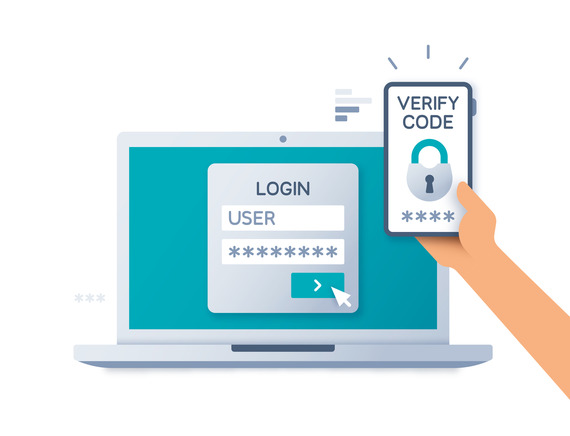
Beginning May 4, EVV providers signing into the Provider Network Management (PNM) secure web portal will require multifactor authentication (MFA). MFA is a two-factor authentication process that goes beyond the State of Ohio ID (OHID) and password by using a second source of validation to verify your identity before granting access to state resources.
If you are an existing PNM portal user and already have MFA set up for the OHID used to sign into the PNM portal, no action is required.
Resources to Assist You
In addition to an MFA user guide offering instructions on setting up the two-factor authentication, the following virtual learning sessions are offered to give you opportunity to ask questions and get help with enrolling in MFA.
Post Go-Live "Ask Me Anything" Sessions: Additionally, we will have Post Go Live sessions on:
- Monday, May 5
- Tuesday, May 6
- Wednesday, May 7
See the instructions on how to enroll in and join the “Ask Me Anything” sessions.
If you need assistance setting up MFA or have questions about user roles in the PNM system, please contact the Integrated Helpdesk (IHD) at 800-686-1516 or email IHD@medicaid.ohio.gov. Representatives are available Monday – Friday, 8 a.m.–4:30 p.m. Special helpdesk hours also will be available on Sunday, May 4, from 8 a.m.–4:30 p.m. and again on Saturday, May 10, from 8 a.m.–4:30 p.m.
Thank you for your immediate attention to this critical security update.
To help Department of Developmental Disabilities providers understand the EVV claims work flow, Ohio Medicaid introduced a new visual tool to walk you through each step of the process. You can find the form on Medicaid's Electronic Visit Verification webpage.

Now that Ohio Medicaid has completed the backlog of paper-based requests for live-in caregiver exemptions, we have comparative evidence that reveals quantifiable benefits that come with using the online EVV Exemption Request Form versus the manual, paper-based request process.
If you or your staff are seeking exceptions from specific recording requirements for direct care workers (DCW) who share households with individuals receiving Medicaid services, now there’s even more reason to go digital!
To date, more than 2,476 online requests have been received by the department, a testament to its simplicity and ease of use. The online form has the following benefits and improvements to reduce errors and increase approvals:
- Auto-generated emails upon submission for better tracking of each request.
- Auto-generated emails with the tracking number of the request when a determination is completed. This results in quicker notification to the provider.
- Restrictions on the information entered prior to submission can avoid the following errors:
- Requests missing required information
- Requests missing supporting evidence
- Requests submitted before the EVV account, recipient, or DCW are created in the Sandata Aggregator
- Requests submitted with invalid EVV payer and service code combinations
- Allows providers to easily submit requests to change or terminate an already approved exemption.
For more information on how to complete the request form, visit ODM’s Electronic Visit Verification webpage. If you have trouble accessing or submitting the online form, please reach out to EVV@medicaid.ohio.gov for help.

Sandata recently received several great questions from providers. Below are a few common questions we’re answering related to claims matching and billing through the EVV system.
Question: If I fix something in my EVV system, do I need to resubmit the claim?
Answer: Yes. Make sure your visit is corrected and verified in the EVV system before sending the claim again.
Question: Will I get an error if I bill fewer units than what’s recorded in the EVV system?
Answer: No. It’s okay to bill fewer units than what's recorded, as long as everything matches the actual service provided.
Question: Do I need to adjust a visit if the recorded units are more than what I plan to bill?
Answer: No. You can bill equal to or fewer units than what’s on the visit — just don’t bill more than what's recorded.
The following trainings are available on an ongoing basis and can be accessed through Sandata Learn. Providers will need to log in to the learning system to select specific sessions.
Electronic Visit Verification System Enhancements Training
Description: This two-hour course will guide agencies and independent providers through enhancements made to the EVV system.
Intended Audience: Agency administrative staff and independent providers using the Sandata system. This training is not intended for agency-employed direct care workers or participant-directed only providers who receive payment through a financial management service.
Aggregator Training
Description: This one-hour course will guide agency providers using an alternate vendor through the recently implemented changes to reporting and sign-in.
Intended Audience: Agency provider administrative staff using an alternate vendor.
Optional Scheduling Training
Description: Scheduling is an optional feature in the Sandata EVV system. This one-hour course will show users how to create and manage schedules for direct care workers. Using this feature reduces the need for direct care workers to enter the client or recipient ID for each participant and allows them to see their schedule directly in the Sandata Mobile Connect application.
Intended Audience: Agency administrative staff and independent providers who use the Sandata EVV system to capture visits.
Please note: Trainings are not intended for agency-employed direct care workers or participant-directed only providers who receive payment through a financial management service.
Ohio Medicaid and Sandata Technologies stand ready to assist providers and agencies in meeting claims validation requirements for the March 1 start and beyond. Click here to see who to contact regarding specific topics, or see the table below.

|