In This Issue:
The Ohio Department of Medicaid recently introduced the Electronic Visit Verification (EVV) Stakeholder Workgroup -- a new forum for providers, members, and agencies to give ODM and Sandata feedback on the Electronic Visit Verification (EVV) program.
The workgroup kicked off on March 20, using the time to introduce participants and gather input on topics important to you. Participants were joined by representatives from the Ohio Departments of Aging and Developmental Disabilities as well as delegates from several stakeholder associations such as Leading Age, Ohio Council for Home Care and Hospice, Arc of Ohio, Ohio Statewide Independent Living Council, and more. The opening presentation is available here for your review.
Going forward, the group will meet monthly, delving into topics important to you, including:
- Exploring your experience and issues with claims validation
- Reviewing outreach efforts and effectiveness
- Identifying your needs for further training and resources
- Discussing potential updates to current policies
The next EVV Stakeholder Workgroup meeting will be held virtually on Monday, April 28, from 2:30 – 4 p.m. If you or someone you know is interested in attending in listen-only mode, please reach out to InteragencyPolicy@medicaid.ohio.gov or register here to attend.
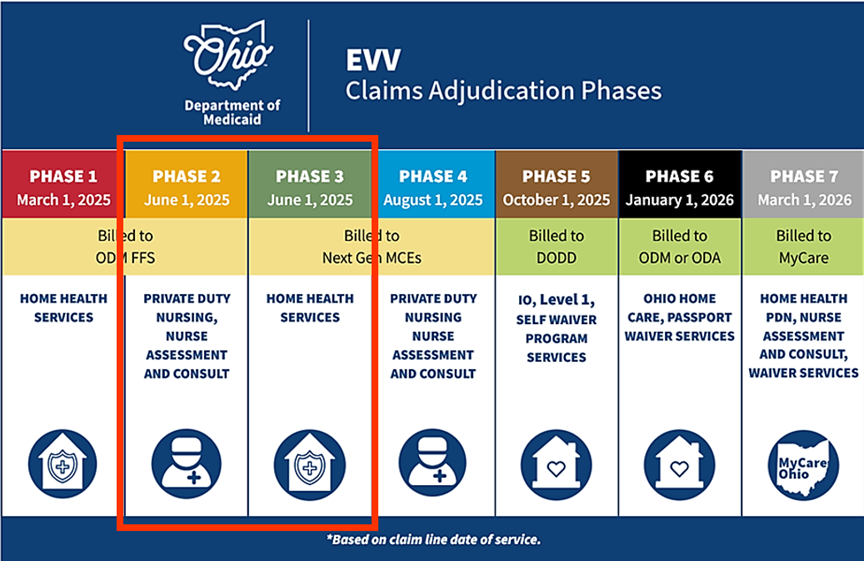 The Ohio Department of Medicaid (ODM) and Sandata are preparing for the June 1 roll out of EVV claims validation requirements for Phase II and Phase III providers. Meeting these new claims validation obligations will ensure complete and accurate EVV data is matched to each claim submitted for reimbursement.
To help Phase II and III providers successfully comply, we have made a variety of resources available, including:
As June 1 approaches, ODM and Sandata will offer additional tools and training to help ensure your success. Stay tuned to Ohio Medicaid’s Electronic Visit Verification webpage for more updates.
We know that getting started with EVV requirements can be confusing for some, confounding for others. That’s why we created a high-level flowchart to help you understand the steps needed to get started and comply with state and federal EVV policies.
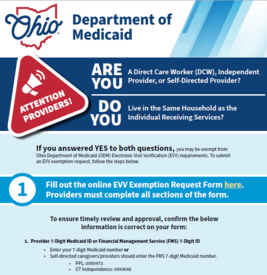
Providers, employees and direct care workers who are eligible and interested in requesting live-in caregiver EVV exemptions now have a new, easy-to-follow infographic describing the process and materials needed for a request to be approved.
As outlined in Ohio Administrative Code Rule 5160-32-02, visits in which the direct care worker (DCW) is a resident of the same household as the individual receiving services can be exempt from visit logging requirements. The EVV system must reflect approval from ODM has been granted.
For more information on live-in caregiver exemptions, go to the “Information for Providers” resource add on Ohio Medicaid’s Electronic Visit Verification webpage.
|

All Providers
QUESTION: How do I bill base units correctly?
ANSWER: Base units are still used in some services. Many of those services are subject to EVV. The units on the claim must match the visit data captured to be verified.
The base rate will be paid for the initial 35-60 minutes of service. ODM will pay claims with either 3 or 4 units of service at the base rate for the following services:
|
State Plan Services
|
Ohio Home Care Waiver Services
|
|
|
|
|
|
|
|
|
|
|
|
|
The table below shows unit and rate calculations for the first hour of these services.
EVV Calculation
|
Claims Payment
|
|
00:01-15:59 mins = 1 unit
|
15-minute rate
|
|
16:00-34:59 mins = 2 units
|
15-minute rate
|
|
35:00-45:59 mins = 3 units
|
Base unit rate
|
|
46:00-60:59 mins = 4 units
|
Base unit rate
|
Home health therapy services are paid at the base rate for the first four units.
Please check your billing practices to ensure your claims accurately reflect the time worked to increase your successful EVV claims validation.
QUESTION: Do I have to adjust my time if it doesn’t match my claim?
ANSWER: Yes, but ONLY if your EVV time is less than what you billed. For example, if you billed for 1 hour but your EVV shows only 45 minutes, the claim may be denied. It is important to determine which is correct: the EVV visit or the claim. If the claim is incorrect, then the claim needs to be resubmitted with the correct number of units. If the EVV visit is not correct, you’ll want to adjust the EVV time to reflect when services were provided.
NOTE: If your EVV claim shows more time than you billed (e.g., 1.5 hours for a 1-hour claim), no adjustment is needed. The claim will match.
Visit time and unit instructions to learn more.
QUESTION: Why am I getting an unauthorized service exception using Sandata EVV?
ANSWER: The most common reason providers see an EVV unauthorized service exception is the lack of a service or authorization that should be added to the recipient’s profile.
If you are a provider using Sandata EVV, to solve this, you will want to edit the recipient's profile and then create an EVV authorization. This will help ensure that there are no unauthorized service exceptions going forward.
To fix the unauthorized service exceptions currently in the Sandata EVV system, go to the Visit Maintenance screen and follow the steps for how to resolve an unauthorized service exception.
If you are a provider using a third party or alternate EVV system, you will want to follow the process for updating the service or EVV authorization in your third-party system and then resubmit the recipient and EVV visit data to the Sandata Aggregator.

The following trainings are available on an ongoing basis and can be accessed through Sandata Learn. Providers will need to log in to the learning system to select specific sessions listed below.
|
Electronic Visit Verification System Enhancements Training
Description: This two-hour course will guide agencies and independent providers through enhancements made to the EVV system.
Intended Audience: Agency administrative staff and independent providers using the Sandata system. This training is not intended for agency-employed direct care workers or participant-directed only providers who receive payment through a financial management service.
Aggregator Training
Description: This one-hour course will guide agency providers using an alternate vendor through the recently implemented changes to reporting and sign-in.
Intended Audience: Agency provider administrative staff using an alternate vendor.
Optional Scheduling Training
Description: Scheduling is an optional feature in the Sandata EVV system. This one-hour course will show users how to create and manage schedules for direct care workers. Using this feature reduces the need for direct care workers to enter the client or recipient ID for each participant and allows them to see their schedule directly in the Sandata Mobile Connect application.
Intended Audience: Agency administrative staff and independent providers who use the Sandata EVV system to capture visits.
Please note: Trainings are not intended for agency-employed direct care workers or participant-directed only providers who receive payment through a financial management service.
|
Sandata regularly updates its EVV software via releases to ensure it runs smoothly. Below are the changes introduced in the Sandata EVV web portal and Sandata Mobile Connect app in February and March.
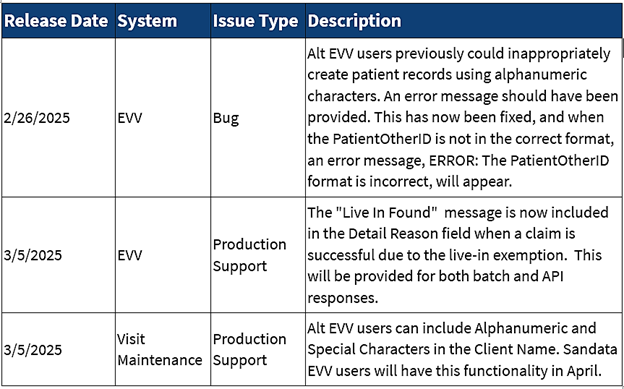 Sandata Release Notes are available but require a Zendesk EVV account to view.
Questions about releases or the system should be directed to the Sandata EVV Provider Hotline at 855-805-3505 or emailed to ODMCustomerCareEmail@sandata.com.
Stay updated on ODM EVV program communications. Subscribe to Medicaid news on the Ohio Medicaid website.
Ohio Medicaid and Sandata Technologies stand ready to assist providers and agencies in meeting claims validation requirements for the March 1 start and beyond. Click here to see who to contact regarding specific topics or see the contact details in the table below.

|