In This Issue:
Ohio Medicaid and Sandata Technologies stand ready to assist providers and agencies in meeting claims validation requirements for the March 1 start and beyond. Click here to see who to contact regarding specific topics or see the table below.
The March Roll Out Impacts Home Health Services Claims Billed to Ohio Medicaid.
Over the past several months, Ohio Medicaid has been working with Sandata, ODM’s Electronic Visit Verification (EVV) vendor, to prepare providers for changes coming to the EVV claims adjudication process.
Beginning this month, home health fee for service claims billed to ODM consisting of the following codes and requiring EVV must have a matching EVV visit record.
Claims that do not match will be denied.
|
Service Code
|
Service
|
|
G0156
|
Home health aide
|
|
G0151
|
Home health physical therapies
|
|
G0152
|
Home health occupational therapies
|
|
G0153
|
Home health speech language pathology therapies
|
|
G0299
|
Home health nursing registered nurse (RN)
|
|
G0300
|
Home health nursing licensed practical nurse (LPN)
|
Seven-Phase Roll-Out
To make this transition as smooth as possible for providers, the department is staggering the roll out of claims validation requirements in seven phases as outlined in the chart.
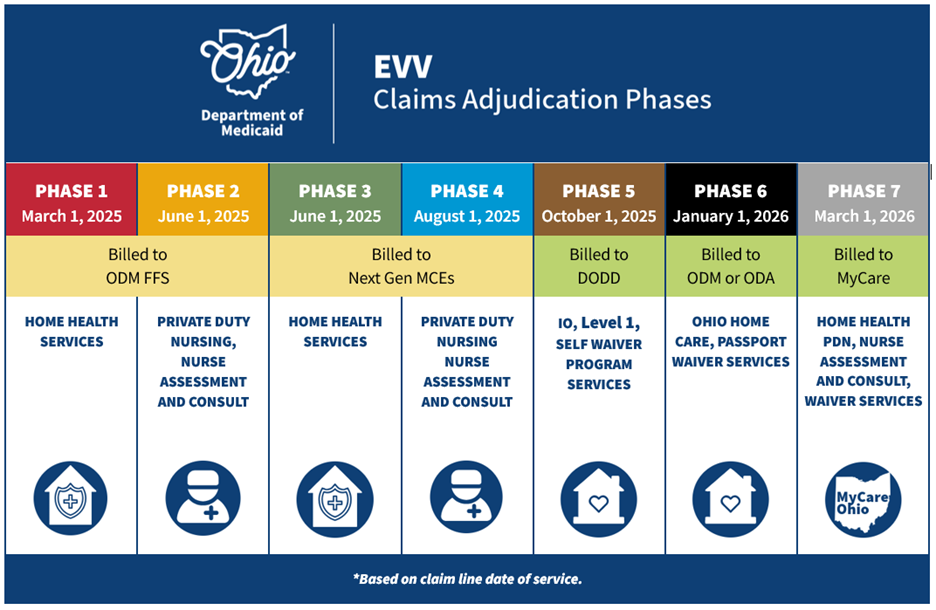 Please review the full December 5 email notice shared with EVV providers for details. A list of services subject to EVV is available at ODM EVV Program and Service Code Guide.
NOTE: If you are using an Alternate EVV vendor, your vendor may not be sending modifiers with the service codes on visits. Please check the Aggregator and review your visits to ensure any service code that should have a modifier added was sent over to the Aggregator correctly.
ODM is working with Sandata, our EVV vendor, to make sure you are ready for this change. Office hours are available daily on Zoom for 1:1 assistance. Look for more communication about training sessions and resources from ODM as the phases progress.
In addition to taking a measured approach in implementing EVV claims validation requirements, ODM and Sandata have provided a series of resources and learning opportunities to prepare you, including:
Throughout the month ODM and Sandata will have teams available to assist the Phase 1 home health services providers meet EVV claims validation requirements. With each upcoming phase we will share lessons learned to help you smoothly transition to this new process.

Sandata is offering dedicated office hours daily to provide support with electronic visit verifications as we move closer to claims validation. Providers can attend to get help with visit maintenance, data entry, getting started, general program inquiries, and more.
Providers are strongly encouraged to take advantage of this help. These office hours will continue to be offered for each phased implementation ahead.
Please click here to register for a session.
|
Ohio Medicaid introduced a Live-In Caregiver Exemption Request Form to ease the burden on providers. As the preferred method to request live-in caregiver exemption approvals for DCWs or employees it significantly streamlines the application process providing checks to ensure required fields are completed prior to submission.
If you have already submitted the paper-based Form 10374, it is currently being processed. You do NOT need to submit an online request.
Going forward, Form 10374 should be used only by those with limited or no internet access.
About Live-In Caregiver Exemption Requests
Ohio Administrative Code rule 5160-32-01, Electronic Visit Verification (EVV) program, permits an exemption to visit capture requirements when the direct care worker (DCW) is a resident of the same household as the Medicaid waiver recipient receiving services.
Online Exemption Request Form
The online exemption request form is designed to simplify the application and approval process for providers.
- Fields are visually flagged with red asterisks to quickly denote data requirements needed prior to submission.
- Service Procedure Codes are included for all applicable supports subject to this exemption.
- Upon submission, providers will receive an automated email confirming that an application has been submitted and is in queue for ODM review.
- Following ODM’s review, the provider will receive follow-up email notices, based on the completeness of the application. The responses may:
- Notify the provider of reason ODM is unable to process the request for exemption and to resubmit the request.
- Verify that the request has been approved and remind the provider to validate the live-in caregiver exemption within the EVV system.
Requirements Prior to Approval
Prior to submission of this form, the provider must ensure the DCW, and the Medicaid recipient records are in the EVV system.
For those using an alternate EVV vendor, a Fiscal Management Services entity, or both, the DCW record, and the Medicaid recipient record must both be documented in the state’s Aggregator system.
PLEASE NOTE: Direct care workers seeking live-in caregiver exemptions must continue to log all services subject to EVV until ODM officially approves the exemption request. Additionally, any paper-based request forms already submitted to ODM do not have to be resubmitted electronically.
For More Information
Details on the live-in caregiver process can be found on the Ohio Medicaid EVV webpage under the “Information for Providers” resource card. Scroll down to find “Live-in Caregiver Exemption view.”
Ohio Medicaid kicked off its first Self-Direction Advisory Council (SDAC) meeting on February 11, welcoming 45 newly nominated members to help us grow and improve the state’s self-direction program. Participants represent a broad swath of advocates, policymakers, and citizens including:
- 17 Ohioans with lived experiences
- Representatives from organizations like Disability Rights Ohio, Arc of Ohio, Ohio Olmstead Task Force, Ohio Self-Determination Association and others.
- Ohio Departments of Aging and Developmental Disabilities representatives
Potential first-year goals for the council include:
- Maintaining consistent terminology across programs and agencies.
- Providing stronger support to care managers from an information and assistance perspective.
- Aligning or expanding the following services:
- Transportation
- Specialized medical equipment
- Assisted technology
- Peer support
- Behavioral health
- Expanded self-directed goods and services
If you’re interested in joining a future meeting as a listen-only participant, visit Self-Direction Advisory Council and fill out the interest form to receive information about future meetings. Meetings are held virtually every three months.

Ohio Medicaid continues to update its EVV webpage to offer providers and vendors clearer guidance on the Sandata EVV system and enhancements. Under the “Provider News” section, web visitors can now view:
The following trainings are available on an ongoing basis and can be accessed through Sandata Learn. Providers will need to log in to the learning system to select specific sessions listed below.

Electronic Visit Verification System Enhancements Training
Description: This two-hour course will guide agencies and independent providers through enhancements made to the EVV system.
Intended Audience: Agency administrative staff and independent providers using the Sandata system. This training is not intended for agency-employed direct care workers or participant-directed only providers who receive payment through a financial management service.
Aggregator Training
Description: This one-hour course will guide agency providers using an alternate vendor through the recently implemented changes to reporting and sign-in.
Intended Audience: Agency provider administrative staff using an alternate vendor.
Optional Scheduling Training
Description: Scheduling is an optional feature in the Sandata EVV system. This one-hour course will show users how to create and manage schedules for direct care workers. Using this feature reduces the need for direct care workers to enter the client or recipient ID for each participant and allows them to see their schedule directly in the Sandata Mobile Connect application.
Intended Audience: Agency administrative staff and independent providers who use the Sandata EVV system to capture visits.
Please note: Trainings are not intended for agency-employed direct care workers or participant-directed only providers who receive payment through a financial management service.
|
|