April Newsletter
Dear Neighbor,
The Ohio House has been hard at work developing the House's version of the budget and passing legislation that benefits Ohioans. I am pleased that the budget passed out of the House, and I am eager to continue working on legislation that supports parental rights, Ohio families, and finding solutions to lowering Ohio’s property taxes.
Jean Schmidt
State Representative
Ohio's 62nd House District

THE HOUSE AT WORK
The Ohio House has been very busy. Committees have been meeting weekly and more legislation continues to be passed on the House floor. Here is a look at some of the highlights so far:
House Bill 28 – Eliminate Replacement Property Tax Levies
In a step towards fixing the property tax issues in Ohio, the House passed H.B. 28, 62-30. The bill now heads to the Senate for further consideration. This legislation eliminates the authority of political subdivisions to levy replacement property tax levies, beginning with elections held on or after October 1, 2025. Unlike a renewal levy which extends a levy at its effective millage (collecting the same amount of revenue), a replacement levy extends a fixed rate levy at its voted millage (collecting more revenue).
Senate Bill 1 – Advance Ohio Education Act
Ohio combats woke ideology in our colleges and universities by passing S.B. 1, 59-34, which was recently signed by the Governor. The bill does the following:
- Ensures uninterrupted education by preventing situations where students cannot graduate or otherwise progress with their studies due to faculty strikes or walkouts.
- Ensures that institutions of higher education remain relevant and connected to Ohio’s workforce needs by eliminating minimally used degree programs.
- Eliminates institutional discrimination and indoctrination through the elimination of DEI programs, trainings, and orientations.
- Ensures a base level of understanding with regards to American Civics and capitalism.
- Promotes equality and ensures that opinions in the minority are not silenced or marginalized without due discussion.
- Safeguards our institutions from interference and influence by the People’s Republic of China.
House Bill 54 – Ohio’s Transportation Budget
The House concurred with the Senate amendments to H.B. 54, which was recently signed by the Governor. The bill allocates funding for Ohio’s extensive transportation system, prioritizing efforts to keep Ohio moving forward. Sub. House Bill 54 is the primary mechanism to fund transportation infrastructure development and maintenance for FY 2026 and 2027. It invests more than $11.48 billion over the biennium into highway construction and maintenance and provides funding for safety upgrades on Ohio roadways. Sub. House Bill 54 includes provisions that aim to preserve Ohio’s vital infrastructure, promote economic development, and boost public safety.
The bill also increases funding for Transportation Improvement Districts (TIDs) to $9 million each fiscal year, promoting economic development through job creation and commits over $4.1 billion for maintenance operations on Ohio’s current highway system, including roadway replacement, culvert inspections, and bridge maintenance, preserving and improving the state’s transportation infrastructure for generations to come.
OHIO'S BUDGET
I recently voted in support of Am. Sub. House Bill 96 – the House’s version of the State Operating Budget. This forward-looking, fiscally responsible budget plan invests in Ohio families and the state’s future – approving over $4 billion in record property tax relief for Ohioans and ensuring that every school district in the state receives an increase in school funding in fiscal years 2026 and 2027.
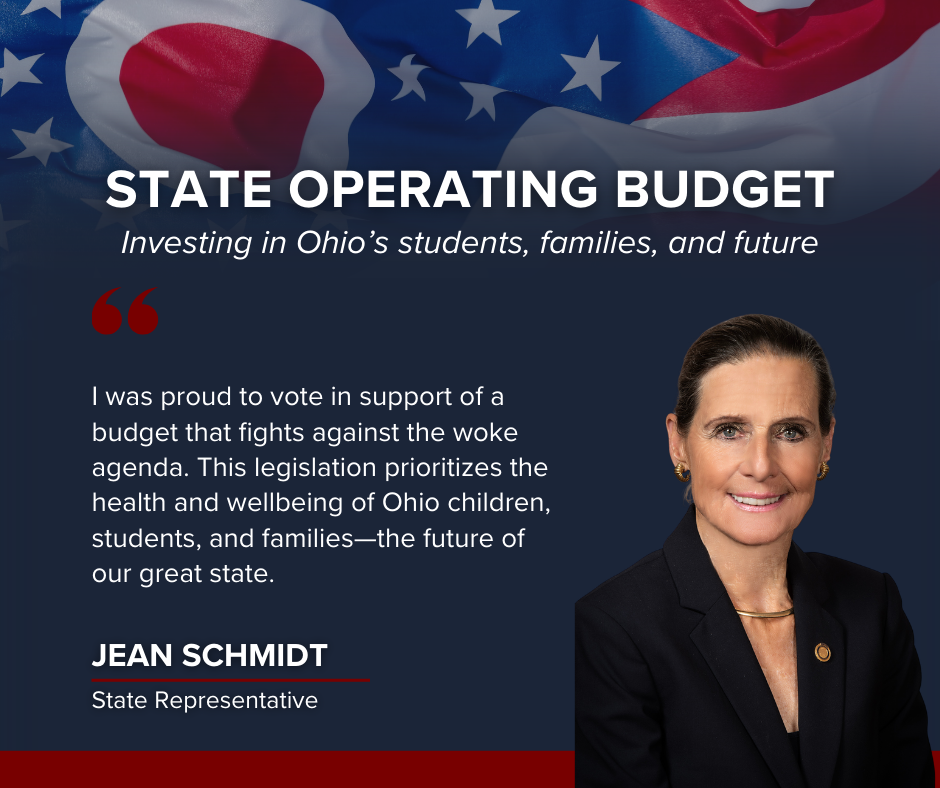 I was pleased to highlight the following provisions incorporated into the House’s budget bill:
- Includes $10 million each FY for the Parenting and Pregnancy Program and establishes a $750 tax credit for pregnancy resource center donations, defending the sanctity of life and supporting pregnant mothers.
- Invests $1 million each FY for Produce Perks, increasing affordable access to nutritious food.
- Directs $500,000 each FY to Child Focus, Inc., supporting workforce development and early learning.
- Earmarks $4 million each FY to People Working Cooperatively for the Safe and Healthy Home Initiative, helping Ohioans remain in their homes safely.
BOOSTING FUNDING FOR OHIO’S SCHOOLS
House Bill 96 prioritizes the education and well-being of students, ensuring that every school district in the State of Ohio receives an increase in funding over the next biennium.
Compared to today, this budget provides public schools with $207.6 million more in FY26 than they received in FY25, and in FY27, that increases to $347.6 million above their FY25 support. This equates to a $555.2 million increase in state aid for public schools over the coming biennium. Under the House plan, every student in Ohio will receive more per-pupil funding from the state.
DELIVERING BILLIONS IN PROPERTY TAX RELIEF TO OHIOANS
In an effort to provide much-needed property tax relief to Ohioans, the bill implements a process for schools that carry forward more than 30 percent in unspent cash at the end of each year to be distributed back to Ohioans in the form of property tax relief, totaling more than $4 billion. District cash carryovers have increased year over year since tracking began in 2012, from $3.6 billion then to $10.5 billion today. In FY24, 486 traditional school districts carried over cash greater than 30 percent of their expenditures for that year.
REVITALIZING LOCAL COMMUNITIES
House Bill 96 will continue and enhance various state initiatives that help solidify Ohio as the best place in the nation to live, work, raise a family and start a business. The bill increases funding for Brownfield Remediation, further improves the Welcome Home Ohio program, and helps address the housing shortage across our state.
SUPPORTING OHIO FAMILIES
To help families who need assistance paying for child care, the budget establishes the Child Care Choice program, providing $100 million each fiscal year for eligible families, helping more Ohioans cover the cost of needed child care services. House Bill 96 also increases funding for the Help Me Grow program, which helps pregnant women, caregivers with new babies, and families with young children and children with developmental delays and disabilities have access to early intervention, developmental screenings, and more.
PRIORITIZING WORKFORCE READINESS AND HIGHER EDUCATION IN OHIO
This budget makes a marked effort to prioritize workforce readiness in Ohio, investing in various higher education programs such as the Governor’s Merit Scholarship, the Choose Ohio First Scholarship, and an increase in the State Share of Instruction by 2%, helping lower costs for students at Ohio’s state institutions of higher education. The bill also continues support for Ohio’s TechCred program, which allows employers to upskill current or future employees at no cost to them.
EMPOWERING SCHOOL CHOICE
House Bill 96 continues the state’s commitment to school choice by increasing the maximum award for the Autism Scholarship and Jon Peterson Special Needs Scholarship while also establishing an option for parents whose children attend a non-chartered non-public school to utilize an education savings account to help with the cost of their education.
PROMOTING MEDICAID TRANSPARENCY
In an effort to promote transparency in the Medicaid program, the bill works to protect taxpayer dollars and eliminate fraud, waste, and abuse through a number of provisions, creating a variety of new reporting requirements that the Ohio Department of Medicaid (ODM) must provide to the Joint Medicaid Oversight Committee (JMOC) for review.
House Bill 96 now goes to the Ohio Senate for further consideration
Information about the budget can found at Ohio’s Legislative Service Commission website. Here a few documents that may be helpful to better understand Ohio’s budget:
Appropriation Spreadsheet – This document provides an overview of the amount budgeted for each agency and its individual line items.
Comparison Document – This document explains the various differences that occurs in the budget as it works its way through various stages of the legislative process. In it you will find brief summaries on policy changes and earmarks found within each line item.
Redbooks – These documents are made for each individual agency within the budget. They describe how each line item is funded and how the money in those line items is to be spent.
|