|
The Franklin County Overdose Fatality Review is committed to reducing the number of overdose deaths experienced by Franklin County residents. This newsletter serves to provide updates on Overdose Fatality Review work and the work of partners that support people who use drugs.
|
|
The Community Action Group |
|
Sowing the Seeds of Prevention
The Franklin County Overdose Fatality Review Committee (FC OFR) launched its first subcommittee, the Community Action Group (CAG), in January 2025. The subcommittee’s main mission is to implement recommendations developed by the FC OFR. Members of the CAG have lived or living experience with substance use, have lost loved ones due to overdose, or are representatives of community organizations that are dedicated to reducing the burden of overdose on the Franklin County community. The CAG assists by providing insight on implementation strategies, such as how to equitably engage with the diverse communities that build Franklin County. You can find the CAG out and about at various outreach events across the county, where our focus is providing education on OFR findings, such as emerging drug trends. The goal of the CAG is to provide resources, information, and a helping hand to anyone fighting the disease of addiction. If you are interested in partnering with and/or joining the CAG, please reach out to Lauren Putz, OFR Coordinator, at LaurenPutz@franklincountyohio.gov.
|
|
Franklin County Overdose Fatality Review |
|
OFR 2024 Annual Report
- he FC OFR has released the 2024 OFR Annual Report. The report is an overview of accomplishments made in the last year, as well as a guide for future work in 2025 and beyond. Below is an executive summary of the report, as well as the full report that highlights 2024 overdose data trends.
- FC OFR met ten times in 2024 and reviewed 13 cases. Of the cases reviewed, all of them included opioids as part of the toxicology. In 2024, a total of 467 Franklin County residents died of an overdose, and 370 of those deaths included opioids as a contributing factor. To continue to combat the impact of the overdose crisis in the community, the FC OFR developed nine recommendations that focus on various factors that may promote further prevention efforts. In 2024, the FC OFR utilized local overdose death data to highlight death disparities seen in African American men, older adults, and individuals who engage in polysubstance use (the use of multiple substances at the same time to increase the euphoric effects). Recommendations include:
- Engaging more equitably with the African American community regarding overdose prevention
- Working to increase linkage to treatment for emergency department patients
- Engaging with local school systems to promote prevention
- Working with transitional housing units to provide further harm reduction support
- Addressing adverse childhood experiences (ACEs) through prevention and strengthening family supports.
- The FC OFR will continue to develop and implement further recommendations in 2025 via the CAG, which is comprised of community members impacted by substance use and organizations that provide prevention and harm reduction services within the county. Future work will also include identifying emerging overdose death trends and using the perspectives of communities most impacted by overdose deaths to guide future recommendations.
- Click here to view the full annual report!
|
|
|
Overdose Death Disparities |
|
How FC OFR members are closing the gap
- The number of overdose deaths in Franklin County were significantly lower in 2024 than in 2023 (467 vs. 688 respectively). However, there are still significant disparities in the number of overdose deaths in the African American community of Franklin County compared to white and Hispanic residents. In 2024, Black, male Franklin County residents experienced a rate of 83.6 overdose deaths per 100,000 population, whereas their white counterparts experienced 44.9 overdose deaths per 100,000 population. This stark contrast highlights the growing need to address the factors that contribute to such a large disparity in death rates.
- The Community Action Group (CAG), a subcommittee of the FC OFR, is committed to transforming health outcomes for the African American community in Franklin County. The group has highlighted the importance of identifying and uplifting community champions who can help spread messages of reducing stigma around substance use treatment, share timely and equitable resources, and have the hard conversations about the devastating impact overdose and substance use has historically had on the African American community. The CAG is working to identify evidence-based community training programs that aim to educate community champions, faith leaders, family, and concerned community members on how to start the conversation about substance use and treatment options. Trust and relationship building are paramount in insuring that residents feel supported and understood throughout their recovery journey.
- Interested community members or organizations should contact Lauren Putz, OFR Coordinator, at LaurenPutz@franklincountyohio.gov or 614-623-0459 for more information regarding the availability of community substance use prevention training.
|
|
- As part of our efforts to reduce stigma and create safe spaces for connection, the Franklin County Coroner’s Office is hosting a new art exhibition titled “Shadow to Light: Breaking the Stigma Against Addiction.” Twenty-nine local artists provided artwork including paintings, photography, and other techniques that are now on display at the Forensic Science Center on Frank Road. This exhibition is open to the community by making an appointment.
- The passion behind each piece of artwork is the story of a life. These life stories share the recovery journeys of courageous individuals who are helping combat stigma and proving that recovery works. The artists stepped up to freely share their work and life experiences through their chosen art. They are making themselves vulnerable to the community so that we can learn and become better advocates to help others. We are grateful to each artist. We truly can reduce the number of overdose deaths through intentional and purposeful prevention work.
- The next phase of this art exhibition is to create a coloring book or line art book from select pieces of the exhibition which will then be revealed at a public reception in August, which is Overdose Awareness Month.
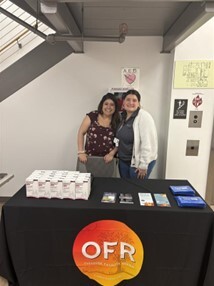
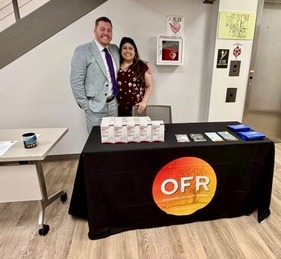
- Pictured Below: Vanessa Gay, Overdose Specialist with the Franklin County Coroner’s Office (left), Lauren Putz, Overdose Fatality Review Coordinator with Franklin County Public Health (right), and Dr. Nate Overmire, Franklin County Coroner (left in second picture).
|
|
Interested in more information? |
|
In addition to data reports provided in this newsletter issue, further reports on overdose in Franklin County from previous years and broken down quarterly can be found via the Franklin County Forensic Science Center. Please click here to access a wide range of helpful reports. |
|
The DEA’s Efforts to Foster Safer Communities During Fentanyl Awareness Month
- The DEA Columbus District Office continues to focus on the most significant criminal organizations and drug traffickers supplying bulk quantities of synthetic drugs in central Ohio. The shift to synthetic drugs has resulted in the most dangerous and deadly drug crisis in the history of the United States. We know that nearly 70% of all drug poisonings and overdose deaths involve fentanyl, and roughly 30% involve methamphetamine. As such we are not only targeting the local bulk distributors of these deadly drugs, but also their sources of supply outside of Ohio, in Mexico, and across the globe. At the DEA we are focusing our resources on investigating the entire supply chain and bringing those responsible to justice.
- Since January of 2025, the DEA Columbus District Office has seized 6 kilograms of fentanyl, 3 kilograms of crystal methamphetamine, and 66 kilograms of cocaine as part of ongoing investigations. Multiple fentanyl exhibits seized in Columbus also contained carfentanil, which is even more potent and deadlier than fentanyl. In addition to traditional drug trafficking organizations, DEA is also targeting suppliers of synthetic drugs on social media and the web. In late 2024, DEA Columbus began an online investigation into users of social media sites advertising the sale of fentanyl. Investigators identified a social media and web account advertising the sale of blue and white fentanyl “M30” pills. Investigators conducted undercover purchases of fentanyl and traced the distributor to the Denver, Colorado area. On February 24, 2025, members of the DEA Columbus and Denver Officers executed federal search and arrest warrants on the supplier’s residence, resulting in the seizure of 1,787 gross grams of fentanyl (12,000 pills) and 152 grams of fentanyl powder of varying colors, amongst other drugs.
- In addition to our enforcement efforts, DEA continues to partner with community and public health organizations to promote awareness regarding the synthetic drug crisis. These collective outreach efforts and increased public awareness play a major part in the 2024 decrease of fatal drug poisonings across the country. For the first time since 2021, DEA has also seen a decrease in the potency of fentanyl pills. Current DEA laboratory testing indicates 5 out of 10 pills tested in 2024 contain a potentially 2 mg dose of fentanyl. This is down from 7 out of 10 pills in 2023.
- Despite this progress, the work is far from over and too many Americans become victims of this crisis. DEA is monitoring new chemicals and other additives appearing in the illicit drug supply. Xylazine is an animal tranquilizer that DEA continues to see increasingly mixed with fentanyl. Xylazine has been found mixed in 30% of the fentanyl powder seized by DEA and 5.7% of the pills. Medetomidine, a synthetic sedative, has emerged as an additional additive appearing in seized fentanyl exhibits in Ohio.
- For questions, please contact DEA Community Outreach Specialist, Wendie Jackson at Wendie.L.Jackson@dea.gov.
|
|
|
Working Together for Positive Change |
|
- The FC OFR, the Alcohol Drug and Mental Health (ADAMH) Board of Franklin County, the Central Ohio Hospital Council (COHC), and central Ohio’s hospitals are partnering to support better health outcomes in Franklin County. In 2024, the FC OFR identified the need to increase linkage to care opportunities for individuals presenting to the emergency department with a substance use related concern. Since this identification, COHC, ADAMH, Ohio State Wexner Medical Center, Ohio Health, and Mount Carmel Health System have held multiple meetings to update a best practices document specifically for these individuals. Meetings have included discussions about hospital capacity, needs of the community, and how to best support individuals who are ready to access treatment. From increasing provider education on stigma to prescribing 3-day medication for opioid use disorder (MOUD) packs to help transition patients into treatment, these best practices aim to increase whole-health for patients who use drugs. The guidelines are still in the development phase, however, the hospital systems across central Ohio recognize the important role they play in connecting individuals to care and life-saving harm reduction tools.
|
|
|
|
|