|
Spigot News
Division of Drinking and Ground Waters
Winter 2024
|
|
|
Asset Management Screening
By: Allan Hurtt
During any public water system’s (PWS) operation, it will create and implement improvement plans to increase its systems’ size, quality, and resiliency. These improvements can be used for service line and water main replacements, all the way to the installation of new water towers or water retention reservoirs. A critical consideration while creating a capital improvement plan is the availability of funding and the strategic allocation of resources to maximize value. To assist PWSs with the substantial upfront costs associated with these improvements, Ohio EPA offers loans for approved water and sewer projects.
The most common source of funding for drinking water planning and improvement loans are available through the Water Supply Revolving Loan Account (WSRLA). Prior to approving a WSRLA loan application, Ohio EPA conducts a thorough review of various documents submitted by the PWS. One important yet lesser-known requirement is the asset management program (AMP) review, commonly called an asset management screening.
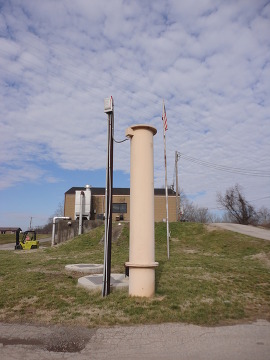
An asset management program is required for all community and non-transient non- community PWSs (Ohio Administrative Code (OAC) 3745-87). These rules are designed to assist PWSs in maximizing the lifespan of each asset while minimizing costs, all while ensuring the expected level of service. Although there are several triggers for AMP reviews, a screening assessment is mandatory before approving any WSRLA loan. This screening evaluates the system's technical, managerial, and financial (TMF) capabilities. Asset management coordinators will coordinate with PWS representatives to perform the review. AMP screenings include a review of various materials, such as a water system overview, schematics, and inventory mapping of treatment, storage, and distribution assets. An adequate asset inventory should document all assets along with their material, age, condition, location, and unique identifiers.
|
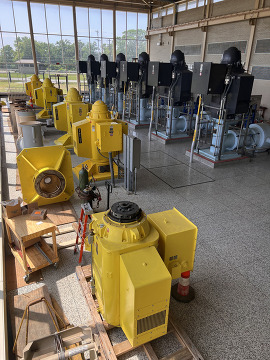 During an AMP screening, the coordinator will review the required documents to ensure the dates of maintenance, condition assessments, maps, and standard operating procedures for daily operations are up to date.
Common deficiencies identified during these screenings often include inadequate maintenance programs and incomplete distribution system maps. Robust maintenance programs should include elevated storage tank cleaning and filter media sampling, maintaining an accurate distribution system map and inventory, and implementing preventative measures such as valve exercise programs.
It is essential to update distribution mapping whenever new installations or repairs are made. A GPS/GIS system can be invaluable
for PWSs in creating an accurate inventory map.
Ohio EPA recommends exercising all critical and noncritical valves annually at least once every five years. The location of each valve and the date it was last exercised should be recorded so the PWS can easily determine which valves have been exercised and which are due to be exercised.
If your system needs assistance establishing or updating an asset management plan, Ohio EPA has guidance and template materials available on the asset management webpage.
Additional assistance may be received through Ohio EPA’s technical assistance partners: Great Lakes Community Action Partnership/Rural Community Assistance Program (RCAP) and Ohio Rural Water Association (ORWA). Ohio EPA’s technical assistance partners aim to help underserved communities reach and maintain compliance with Ohio EPA’s regulations, including helping PWSs establish a comprehensive AMP.
|
|
|
Common Deficiencies Found During a Sanitary Survey
By: Madelyn Votypka
Ohio law (OAC 3745-81-60(A)) requires all public water systems (PWS) to conduct sanitary surveys for community systems once every three years and for noncommunity systems once every five years. These surveys evaluate crucial components, including source, treatment, storage, distribution, management, operation, and maintenance to provide safe drinking water to the public and compliance with regulations.
During the sanitary survey, Ohio EPA inspectors often find a few common deficiencies.
Community systems
• Insufficient or missing contingency plan. OAC 3745-85-01 requires all community systems to develop and annually update a contingency plan for when routine methods of delivery or treatment are compromised. This plan must include actions to protect public health, alternate water sources, and service restoration. Ohio EPA provides a template for systems to use to develop their plan.
• Insufficient or missing asset management plan. As per OAC 3745-87-03, every public water system must develop an asset management program (AMP), which must be reviewed and updated at least annually. Ohio EPA provides a template for systems to build their plan.
• Insufficient valve exercise program and maintenance. According to OAC 3745-87- 03(B)(4)(b)(vi) and 3745-83-01(H)(1), critical distribution valves must be exercised at least annually, while all other valves must be exercised at least once every five years. A tracking system should maintain their condition and exercise history.
• Backflow device inspections. According to OAC 3745-95-06(C)(3), all backflow devices must be inspected and tested once every 12 months by a certified plumber, and the testing results must be kept within the PWS’s files.
Transient and non-transient noncommunity systems
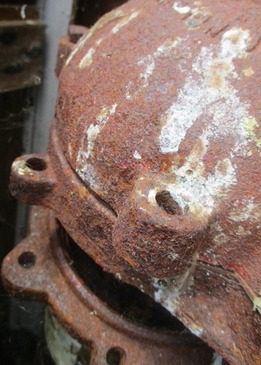
• Yard hydrants. According to OAC 3745-95- 09(A)(1), yard hydrants with weep holes used for human consumption installed on a public water system is prohibited unless the weep holes are sealed.
• Inadequate air gaps. OAC 3745-95-05(A)(1) requires that there must be an air gap between the drain/sink and the discharge lines. The air gap must be at least twice the diameter of the drain line measured vertically above the drain or lip of the sink, in no case less than one inch.
• Inadequate well protection. OAC 3745-9- 05(17)(a) requires the casing and top of the well must be protected against contamination or inadvertent damage.
• Treatment chemical certification. Per OAC 3745-83-01(D), chemicals used for treatment (i.e. softener or chlorination) must meet National Sanitation Foundation (NSF) certification standards.
• The well cap integrity. According to OAC 3745-9-05(13)(b) the well cap or seal should fit securely to the casing and be secured with screws or other appropriate connections and vent to the atmosphere.
Adhering to these regulations is vital for providing safe drinking water to the public. PSWs must regularly review and address these common deficiencies to remain compliant and protect community health.
|
Meet Our Staff
“Knowing that my work helps keep Ohioans safe is great motivation and incredibly satisfying.” - Mathias Wagner
|
|
 Lauren Stevenson
Position: Environmental Specialist II
Years/when did you start at Ohio EPA?
I started working for Ohio EPA in July 2024.
Where did you go to study?
I received a bachelor's degree in civil engineering from the University of Evansville and a masters in humanitarian engineering and science from Colorado School of Mines.
What attracted you to Ohio EPA?
I was drawn to the chance to work with communities in Ohio. I also love the ability to work with drinking water because it is so important and impactful.
Favorite hobby?
I enjoy doing fiber art, like knitting and
cross-stitching.
Favorite travel destination?
I’ve been to three of the Great Lakes (Lake Erie, Michigan, and Superior). I’m hoping to make plans to get to the other two.
Rulemaking Activities
Below is a summary of recent and upcoming rule changes. For more details, including notice of opportunities to comment on draft rules, sign up for our electronic mailing list, or visit us on the web at: DDAGW's Rule-making Process
Coming Up
Record Maintenance Early Stakeholder Outreach
Monitoring requirements Early Stakeholder Outreach
Proposed Rules
Asset Management
Underground Injection Control
Please submit all comments to ddagw_rulecomments@epa.ohio.gov by close of business, as stated in the respective announcement.
|
 Mathias Wagner
Position: I’m a drinking water inspector, currently for Madison and Pickaway counties.
Years/when did you start at Ohio EPA? I joined Ohio EPA working on pollution prevention and Recycle Ohio grants in February 2022 and came over to Drinking & Ground Waters in the spring of 2023.
Where did you go to study?
I got my undergraduate degree at The Ohio State University in evolution and ecology.
What attracted you to Ohio EPA?
I really like the intersection of environmental protection and public health which the agency oversees. I have a background in public health and love that I’ve been able to continue in that career direction with the agency. Knowing that my work helps keep Ohioans safe is great motivation and incredibly satisfying.
Favorite hobby?
I’ve gotten really into gardening these past few years. I grow lots of veggies and native plants for pollinators/wildlife. I’ve enjoyed seeing how many animals have started coming to my yard now that it’s planted with milkweeds, asters, and more! The challenge of starting native plants from seeds is a lot of fun for me, especially for species which require specific care or conditions to thrive.
Favorite travel destination?
In college, I spent a month traveling around France and loved it. Paris was incredible, and we got to go to a couple small beach towns on the Mediterranean, which were gorgeous with tons of great seafood. I’d go back in a second!

|
|
|
Receive the Spigot News and More
The Spigot News is sent only to subscribers! Sign up to receive it, and the latest information on other topics including:
• Resiliency and Water Security: Emergency Management Information for Public Works
• Harmful Algal Blooms eMailing List: Updates for Public Water Systems and Laboratories
• Underground Injection Control: Rulemaking Activity and Program Notification Operator Certification Program: Drinking Water and Wastewater
• Electronic Reporting: Lab Reporting or Water System Reporting
|
|
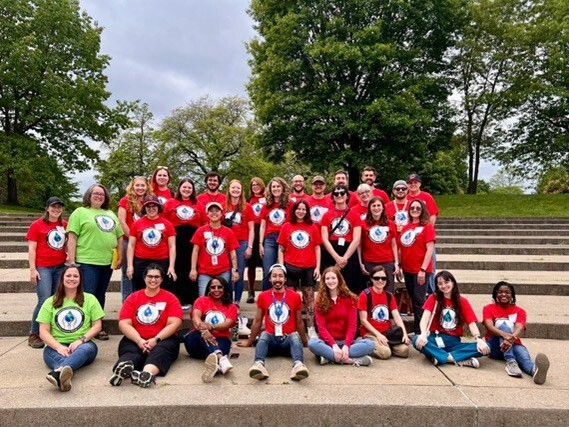 Ohio EPA staff volunteers at the Columbus Water Fest
|
|
|
24-Hour Emergency Hotline
For emergencies occurring after 5 p.m. on a weekend or holiday, please call Ohio EPA’s emergency hotline at 800.282.9378.
|
|
Ohio EPA’s Spigot NEWS
Mike DeWine, Governor
Jon Husted, Lt. Governor
Anne M. Vogel, Director
Editor: Brooke McLoughlin
Writers: Allen Hurtt, Madelyn Votypka, Lauren Stevenson, and Mathias Wagner
|
|
Ohio EPA is committed to providing access and inclusion and reasonable accommodation in its services, activities, programs, and employment opportunities in accordance with the Americans with Disabilities Act (ADA) and other applicable laws. To request a reasonable accommodation due to a disability please contact Ohio EPA's ADA Coordinator at 440.975.6801 (call or text) or naquetta.porter@epa.ohio.gov, no later than 14 days before participating in the online or in-person event. |
|
|
|
|