|
Having trouble viewing this email? View it as a Web page.
Table of Contents:
 By SIMA MERICK
Executive Director
Ohio Emergency Management Agency
I happened to take a look at a Situation Report dated March
10, 1997 that started with…
Beginning on or about February 28th,
1997, severe storms spread across the state of Ohio dumping 6 to 10 inches by
March 1, 1997. The entire state was
under a flood watch, with many areas under flood warnings. As a result of the heavy rains a state of
emergency was declared in five counties.
With the continuation of rain, nine additional counties were added to
the Governor’s declaration. On March 5,
1997, two more counties were added for a total of 16 counties now included
in the Governor’s declaration, all in southern and southeastern Ohio, for severe
flooding.
This situation report also
reminded me that we had seven fatalities in four counties by March 10th. Preliminary Damage Assessments reported 883
homes destroyed, 1,647 with major damage, 2,390 with minor damage and another 1,662
listed as affected. In total, 6,582
structures were impacted by this flood with 2,530 structures (38 percent) being
destroyed or heavily damaged. Schools
were forced to close, five water treatment plants were inoperable with 13 systems on “boil alerts”, 800 homes were still without power, there were
Recovery Centers open in six counties and the list goes on and on.
Reading this SitRep, as we
approach the 20 year anniversary of the Ohio River Flood, got me thinking about
how our roles as Emergency Managers have changed in many ways while still remaining
the same. We now have our eyes on and involvement
with cyber, anti-terrorism, school shootings, high profile protests, drinking
water issues, Ebola, etc. We have gone
from weekend and off-hour duty officer coverage to a 24/7 watch office. However, we still plan, prepare and train to
respond to all emergencies from all-hazards. We are a unique and caring group
of individuals who demonstrate flexibility and compassion in this growing
diversity of mission.
Moving forward, as we meet with
people across the state in wake of future disasters, let us all keep the memory
of those victims and survivors from
previous events in our every thought and action. Providing compassionate,
caring, professional assistance to the people of Ohio in their most trying of
times.
Back to Top
|
 |
|
. |
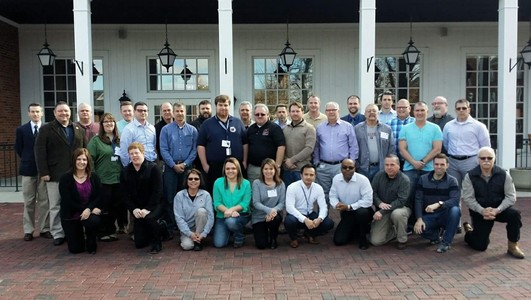
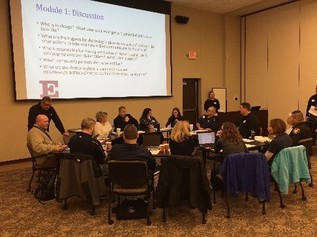
The annual delivery of the OH230
Introduction to Emergency Management class was held February 13-16,
2017. This three-and-a-half day course covers nine different units and three
additional presentations by Ohio Homeland Security, the Ohio National Guard and
Local Emergency Planning Committees. This course has been offered for
nearly 30 years and the various units cover important topics on the branches
and programs of Ohio EMA as well as a legal discussion, all phases of emergency
managements and a series of exercises to keep the class engaged. This
year there were 31 people registered with 21 presenters throughout the
course. This was an excellent opportunity for attendees to not only learn
about how emergency management works in Ohio but also for networking and
partnership building.
Each year about 800 incidents occur in Ohio that
involve the release of hazardous materials, according to the Ohio EPA. County Local Emergency Planning
Committees or LEPCs are responsible under Ohio Revised Code 3750 to plan for
the release of such dangerous chemicals. A critical part of that planning
includes a requirement that these local plans be exercised.
Over a
four-year period, each county must demonstrate that their plans adequately
address 13 different objectives such as public protective actions, initial
incident notifications, and community warning procedures. These objectives are
demonstrated during their annual exercises that are evaluated by regional staff
of the Ohio EMA on behalf of the State Emergency Response Commission (SERC).
Ohio EMA
regional staff are currently in the midst of the “exercise season” as these
annual drills are to be completed by June 30th each year. Within the
next 120 days, more than 60 exercises will be conducted across the state and
will involve local, regional and state resources demonstrating their abilities
to carry out the procedures established in each local plan. Fourteen counties
have already conducted their exercises for SFY17.
Back to Top
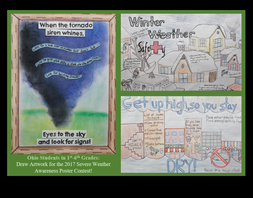 The Ohio Committee for Severe Weather Awareness is looking for
students in first through sixth grades, including specialized instruction
classes, to participate in its annual poster contest. The purpose of the severe
weather awareness poster contest is to engage Ohio’s youth in learning the
importance of severe weather safety and to demonstrate through illustrations,
actions they can take before, during and after severe weather events to protect
themselves and others.
Tornadoes, floods, thunder and lightning storms, extreme heat, and winter
storms are weather conditions that typically affect the state.
“As educators, parents and mentors, we are committed to teach safety and
preparedness to our students – our children,” said Sima Merick, executive
director of the Ohio Emergency Management Agency. “Because Ohio has had mild
winters two years in a row, it kind of opens us up to more rain and wind
events. We’ve seen multiple days of 60-degree weather this winter. So, we
really need to be prepared for anything: heavy rain, snowstorms, even
tornadoes. This poster contest provides the perfect opportunity for students to
learn about Ohio weather and severe weather safety and preparedness.”
Ohio schools have until Monday, April 17 to send their first-place
posters (per grade) to their regional National Weather Service offices. The NWS
offices will judge all poster entries and choose their top regional winners,
per grade. Then in early May, the Severe Weather Awareness Committee will judge
the top regional posters to determine the state and overall state winners.
Schools will be notified of their regional winners by the end of May. All
regional winners will be invited to attend the poster contest awards ceremony,
which will be held at the Ohio State Fair’s Janis Center on Saturday, July 29.
The prizes are big and the day’s event is fun. All regional winners will
receive two entry passes for the day at the Ohio State Fair. All
regional-winning students will receive a host of prizes, certificates and
awards. State-level winners for each grade will receive additional prizes, and
the overall state winner will receive even more, along with a personalized
trophy. The overall winner’s school will be loaned a “traveling trophy” to
showcase during the school year.
For complete rules and forms to participate in the poster contest, visit
the Ohio Committee for Severe Weather Awareness website at www.weathersafety.ohio.gov or click here.
The Ohio Committee for
Severe Weather Awareness is comprised of 16 organizations and state agencies
that are dedicated in teaching Ohioans severe weather safety and preparedness.
Back to Top
|
In a coordinated effort with
the Ohio Committee for Severe Weather Awareness (OCSWA), Governor John R.
Kasich is proclaiming March 19-25 as Severe Weather Awareness Week and
encourages all Ohioans to learn what to do to protect themselves from spring
and summer weather hazards and home emergencies.
As part of Severe Weather
Awareness Week, as coordinated by OCSWA, the state of Ohio will participate in
a statewide tornado drill and test its Emergency Alert System (EAS) on
Wednesday, March 22 at 9:50 a.m. During this time, Ohio counties will sound and
test their outdoor warning sirens. Schools, businesses and households are
encouraged to practice their tornado drills and emergency plans.
According to Ohio Fire Code
409.2, schools must conduct tornado drills at least once a month whenever in
session during the tornado season. Ohio’s “tornado season” is April 1 – July 30.
See the State Fire Marshal’s letter and emergency/drill
form. Schools
that participate in the statewide drill in March can usually credit that date
as their required April tornado drill. Administrators can verify with their
local fire chiefs.
The
Ohio Insurance Institute (OII) has severe weather safety material ready for
distribution to all Ohio elementary schools. Based on suggestions by county EMA directors, OII has provided schools with a link that lists county
EMA directors and encourage schools to contact their local directors with any
questions they have pertaining to severe weather preparedness and/or to review
schools’ emergency procedures.
The
OII is shipping severe weather safety materials to all Ohio schools (public and
private), instructing grades 1-6. This equates to more than 3,200 school
buildings across the state. Included will be: two
posters; a coloring/activity sheet; a teacher’s guide; and instructions
on how to download these tornado safety materials from OII's Website (links for
teacher’s guide and coloring sheet are at the bottom of this message).
As the EMA Director, you may order the following OII materials to
distribute in your county: up to 250 coloring sheets; 25 posters; 25 Teacher’s
Guides.
To order materials, e-mail Deborah
Lawlor (deborahl@ohioinsurance.org) with your desired quantities.
Back to top
The Ohio EMA Security Grants for Nonprofits program provides funding to nonprofit organizations for eligible security improvements that assist the organization in preventing, preparing for, and responding to acts of terrorism. Deadline for submission: March 20, 2017.
House Bill 384 of the 131st General Assembly authorizes the Ohio EMA to provide grant funding to nonprofit organizations for eligible security improvements that assist the organization in preventing, preparing for, and responding to acts of terrorism. Each nonprofit may apply for up to $100,000 to expend on eligible program costs. The full grant solicitation can be found below. A reminder all three documents (solicitation, product list, and tiered document) will be required to download and use to fully complete the application. The application/assessment requires the use of the tiered document and product list.
For more information, click here. After reading that page, if you still have questions, email securitygrants@dps.ohio.gov.
Back to Top
The
annual update of the Ohio EMA Assistance Toolbox is complete. The
February 2017 version can be found at the Disaster Recovery Branch website http://www.ema.ohio.gov/Recovery_DAToolbox.aspx.
There were no significant revisions to the document. If you have any
questions about the Toolbox, damage assessment or recovery programs, please
contact Laura Adcock, Disaster Recovery Branch Chief, at 614-799-3667 or ladcock@dps.ohio.gov.
Back to Top
Ohio EMA is hosting the Annual Spring Emergeny Management Conference on April 18th and 19th. The agenda has been finalized, and includes presentations on: The Flint Michigan Water Crisis, Orlando Night Club Shooting, Emergency Management Response to Ohio’s Opiate Crisis and more.
To register for the conference please register via the Ohio Department of Public Safety Training Campus, search for “EMA-OH-200Spring” in the PSTC. Registration questions can be directed to Susan Traylor at 614-799-3666 or sctraylor@ohio.dps.gov.
If you do not have an account, call the PSTC Help Desk at 614.752.6487.
Back to Top
Youth across the nation have the opportunity to make a
difference and transform the resilience and preparedness of their communities
and beyond. Students in 8th-11th grade who have engaged in
community services or are interested in emergency preparedness, are encouraged
to apply to serve on the U.S. Department of Homeland Security’s Federal
Emergency Management Agency’s (FEMA) Youth
Preparedness Council.
Formed in 2012, the Council engages members in local and
national emergency preparedness projects. Members are selected to serve
two-year terms. Members represent the youth perspective on emergency
preparedness and share information with their communities. They also meet with
FEMA on a regular basis to provide ongoing input on strategies, initiatives,
and projects throughout the duration of their term.
Adults working with youth or emergency management are
encouraged to share the
application with youth who might be interested in applying. Applicants must
submit a completed application form, two letters of recommendation, and
academic records.
Applications are due March 31, 2017. For more information
and to see the projects current members are working on, visit the Youth
Preparedness Council website.
To submit an application, visit the application website.
Back to Top
 Edgewood City School District, with support from Butler
County EMA, conducted a Hazardous Materials Tabletop Exercise in January. The exercise involved Edgewood
High School and Edgewood School District with support from the Butler County
Educational Services Center and other Butler County school districts. The exercise tested the district’s Emergency
Operations Plan; particularly, shelter in place, communications, evacuation and student reunification.
The exercise was supported by more than 60 participants including
emergency responders from Butler County law enforcement, fire departments, and state and county emergency management agencies. The exercise identified areas of improvement
that will be applied to future planning considerations and training
opportunities. This is an important step
in creating a comprehensive emergency management program for all schools and
districts in Butler County.
With the evolving Administrative Code for school plans and
exercises, all schools and districts are required to establish an exercise
cycle. More exercises are planned for
2017 with the schools and districts and the EMA will support all community
partners in developing a comprehensive emergency management program.
Back to Top
|
L101 Foundations of
Emergency Management Course, September 18 - 22, 2017 (Week 1) and November 13 –
17, 2017 (Week 2),
Ohio
Emergency Management Agency
FEMA recognizes the
need to tie training programs to an established set of emergency management
competencies and to a Career Development Program through a progressive training
and education system that includes the entry-level academy, called the National
Emergency Management Basic Academy. Training objectives for this course are
based on the newly established emergency manager competencies that the National
Emergency Management Association; the International Association of Emergency
Managers; and state, local, territorial, and tribal emergency management
professionals have established in coordination with EMI.
The
following topics in emergency management are covered in this course: history;
legal issues; intergovernmental and interagency context; influencing and
organizing; social vulnerability issues; managing stress; collaboration,
preparedness, and team-building; mitigation, response, prevention, and
protection; ethical decision-making; recovery; technology; administration; and
the future.
L102 Science of
Disaster Course, March 19 - 21, 2018,
Ohio Emergency Management Agency
This course
provides the participants with an overview of scientific principles and
concepts that shape our increasingly dangerous world. The contents of the
course include the following: •Introduction to Science of Disaster provides a
definition and benefits of science •Earth Science describes how the Earth's
design sets the stage for the world's natural hazards including earthquakes,
volcanic eruptions, tsunamis, and landslides/sinkholes •Climatology describes
the scientific basis of common atmospheric hazards including convective storms,
tropical cyclones, and other hazardous weather •Chemical and biological basics
identifies the scientific basis of chemical and biological threats •Explosive,
radiological, and nuclear fundamentals identify the scientific basis of those
threats.
L103 Planning: Emergency
Operations Course, March 22 – 23, 2018,
Ohio Emergency Management Agency
This course is
designed to give basic concepts and planning steps to those new to the field of
emergency management so that they may apply planning discipline and skills to
challenges in their jobs. The course content includes Emergency Management
Planning doctrine and steps to take to accomplish writing plans and using them
to deal with special events, which are common challenges for all jurisdictions.
The content also derives from the Comprehensive Preparedness Guide 101, developing
and maintaining state, territorial, tribal and local government emergency plans,
and its six-step planning process and inclusive whole community philosophy.
Likewise, doctrine from the Comprehensive Preparedness Guide 201, Threat and
Hazard Identification and Risk Assessment (THIRA), is included in the course.
Special event planning is then explained in the course, and table group
activities to analyze plans for special events are conducted.
L104 Exercise Design
Course, June 18 – 19, 2018,
Ohio
Emergency Management Agency
This two-day course
is designed to introduce participants to the fundamentals of exercise design.
Emergency managers, emergency services personnel and individuals who are part
of the emergency preparedness communities at all levels of government, private
sector, or volunteer organizations need to be able to use the fundamentals of
exercise simulation and design as an integrated system of resources and
capabilities. This course is designed to develop exercising skills in the
following areas: Components of the Homeland Security Exercise and Evaluation
Program (HSEEP); Exercise process application; comprehensive exercise program
(exercise program management) application; exercise design steps application; major
accomplishments in designing and implementing an exercise; purpose and
application of various exercise documents; tabletop, functional, and full-scale
exercises; and exercise
design applications for tabletop, functional, and full-scale exercises.
L105 Public
Information and Warning Course, June 20 – 21, 2018,
Ohio Emergency Management Agency
This course
introduces participants to what the Public Information Officer (PIO) does in emergency
management, along with basic information about the Integrated Public Alert and
Warning System (IPAWS).
The
PIO topics covered include the role of the PIO; communication tools and
resources encompassing social media; effective communication; preparing the
community through outreach and other means; and communication in an incident.
The IPAWS topics covered include what the system is and does, preparing alert
and warning messages, and writing common alerting protocol messages. This is a
2-day classroom course that gives participants time to perform activities and
exercises to reinforce the knowledge and build basic skills.
Back to Top
L449 Incident Command
System (ICS) Train-the-Trainer Course,
May 2 - 5, 2017, Ohio Emergency Management Agency
L-449
Incident Command System (ICS) Curricula Train-the-Trainer (MGT906) prepares
participants to deliver EMI's ICS curricula. Enhance your instructional skills
and prepare to deliver FEMA's Incident Command Systems (ICS) curriculum. While
ICS-100 and ICS-200 courses are addressed, the major emphasis is on ICS-300 and
ICS-400. Students will learn from training professionals how to use
adult-learning techniques to get the best out of the classes you teach.
Students will develop and deliver a training module during the course. This
course is 32 hours (4 days) and is scheduled through the State Administrative
Agency in cooperation with the Emergency Management Institute.
L110 National
Emergency Management Basic Academy (TtT),
May 22 - 26, 2017, Ohio Emergency Management Agency
The Federal Emergency Management Agency (FEMA) recognizes the need to tie training
programs to an established set of emergency management competencies and to a
career development program through a progressive training and education system
that includes the foundational-level Basic Academy. The Basic Academy provides a structured and
progressive framework for acquiring the knowledge, skills and abilities to meet
the challenges of an ever-changing emergency management environment.
L-962 Planning
Section Chief (PSC) Course, June 12 - 15, 2017,
Nathanael Greene Lodge, 6394
Wesselman Road, Cincinnati, Ohio 45248
This
four-day course design provides local and state-level emergency responders with
a robust understanding of the duties, responsibilities and capabilities of an
effective Planning Section Chief (PSC) on an All-Hazards Incident Management
Team. These responsibilities fall into two categories: PSC duties 1) managing
the planning cycle and 2) tracking resources and incident status. Exercises,
simulations, discussions and a final exam enable students to process and apply
their new knowledge (there is no charge to attend this course).
L950 Incident
Commander Course, June 19 - 23, 2017,
Ohio Emergency Management Agency
This
five-day course provides local- and state-level emergency responders with a
robust understanding of the duties, responsibilities and capabilities of an
effective Incident Commander (IC) on an All-Hazards Incident Management Team
(AHIMT). These responsibilities fall into two categories: 1) responding to the
incident and command needs of the incident, and 2) effectively fulfilling the
position responsibilities of an IC on an All-Hazards ICS IMT. Exercises,
simulations, discussions and a final exam enable participants to process and
apply their new knowledge.
EMA-G289 Public Information Officer (PIO) Awareness Course, March 7, 2017, Licking
County Regional Communications Center (911 Center), 119 E. Main Street, Newark,
OH 43055
The Public Information Officer (PIO)
Awareness Course (G0289) is a “Free” course designed to familiarize
participants with the concepts underlying the PIO role. The material provides a
basic understanding of the PIO function for those new to the position. It
orients the participants to the public information function and the role of the
PIO in the public safety / emergency management environment. This training forms the foundation for more
advanced training that takes participants from the awareness level to the
mastery level in their public information careers. Additionally, it provides
those in Executive Level roles the necessary knowledge of PIO roles and
responsibilities during an emergency.
G205 Recovery from Disaster: A Local
Government Role, March 15 - 16, 2017, Ohio Emergency Management Agency
This updated two-day course is
designed for local government disaster recovery professional (elected
officials, city/county administrators, emergency management coordinators,
public works directors, building inspectors, community planners, and unmet
needs committee coordinators). The G205: Recovery from Disaster: The Local
Government Role course replaces the G270.4 Recovery from Disaster Course and
meets the G270.4 course requirement for the Advanced Professional Series
Certificate. This course also meets the Ohio Administrative Code County
Director training requirements. The goals of this course are: To increase understanding of local government
responsibilities and challenges associated with disaster recovery, provide a
forum for discussion of lessons learned in disaster recovery at the local level
and prepare participants to develop and implement a pre-disaster recovery plan. This is a
“Required” course for the FEMA Advanced Professional Series (APS) program.
G288 Local Volunteer & Donations
Mgmt., April 3-4, 2017,
Defiance County Emergency Management Agency, 22491 Mill
Street, Defiance
This free training event supports
local governments and their emergency management partners in preparing for,
responding to, and recovering from disaster events at the local level. The
course is designed to strengthen the abilities of local jurisdictions to
successfully prepare for and handle volunteer and donations management issues
that may arise. The course content and activities may also serve as a template,
thereby enhancing uniformity in addressing areas of donated unsolicited goods,
unaffiliated volunteers, and undesignated cash. This training also provides
information regarding the state’s volunteer and donations management
responsibilities, which are designed to help build relationships between
government and non-governmental organizations.
This is an “Elective” course in the Advanced Professional Series (APS)
program.
G191 ICS/EOC
Interface Course, April 10, 2017, North East Ohio Regional Sewer District, 4747
E. 49th St. , Cuyahoga Hts. OH. 44125
This course is designed for
personnel associated with On-Scene Incident Command, EOCs and Multiagency
Coordination (MAC) System entities. The goal of the course is to provide state
and local emergency management officials with the knowledge and skills they
need to operate an Emergency Operating Center (EOC) and interface it with an
Incident Command System (ICS) field operation. It enables the participants to
begin developing an ICS/EOC interface for their community by applying Incident
Command System (ICS) principles. The
course reviews ICS and EOC responsibilities and functions and depends heavily
on exercise and group discussions to formulate the interface. This is a
“Required” course in the FEMA Advanced Professional Series (APS) program and
meets the minimum requirements set forth by the Ohio Peace Officer Training
Commission for eight continuing education course hours.
G272 Warning Coordination, May 2-3, 2017, Licking County Regional
Communications Center (911 Center), 119 E. Main Street, Newark, OH 43055
Severe weather is on the way … how do
you effectively work with the National Weather Service and your local media to
develop and discriminate effective warnings your community? This 2 day course
is the latest in the hazardous weather series of courses produced in
partnership with the National Weather Service (NWS). This course is intended to
help facilitate that process. Course topics include: The Social Dimensions of
Warning Response; Developing Effective Warning Messages; Developing an
Effective Community Warning Process; and Working with the News Media to Create
a Weather Warning Partnership. In addition to lecture and discussion, the
course includes case studies, exercises, and an opportunity for interaction
with representatives of the local news media.
Target Audience: Emergency
management personnel, municipal and corporate, who share some responsibility
for or play a role in planning for a disaster. This is an “Elective” course for the
FEMA Advanced Professional Series (APS) program.
Back to Top
All current trainings are listed on the Ohio EMA training
calendar located at: https://webeoc.ema.state.oh.us/TrainingAndExercise/courselist.aspx.
ICS-300 Intermediate ICS, March 1 – 3, Hamilton County
ICS-400 Advanced ICS, March 4 - 5, Gallia County
ICS-300 Intermediate ICS, March 6 – 8, Columbiana County
ICS-300 Intermediate ICS, March 6 – 8, Cuyahoga County
G289 Public Information Officer (PIO)
Awareness Course, March 7, Licking County
ICS-400 Advanced ICS (MGT-905), March 7 – 8, Ohio EMA
ICS-400 Advanced ICS, March 7 – 8, Lake County
ICS-400 Advanced ICS, March 9 – 10, Columbiana County
G775 EOC Interface, March 9 – 10, Jackson County
ICS-300 Intermediate ICS, March 13 – 15, Union County
G386 Mass Fatalities Incident Response, March 14 – 15, Hamilton County
ICS-400 Advanced ICS, March 15 - 16, Union County
G205 Recovery from Disaster Course, March 15 –16, Ohio EMA
G191 ICS / EOC Interface, March 23, Union County
ICS-400 Advanced ICS, March 27 - 28, Cuyahoga County
G402 ICS for Executives and Senior Leaders, March 29, Warren County
L146 Homeland Security Exercise and Evaluation program
(HSEEP), March 29 - 31, Franklin County
OH-605 IA Damage Assessment, March 30, Allen County
G288 Local Volunteers and Donations
Management, April 3 – 4, Defiance County
OH-605 IA Damage Assessment Workshop, April 5, Cuyahoga County
ICS-400 Advanced ICS, April 4 – 5, Hamilton County
G191 ICS/EOC Interface Course, April 10, Cuyahoga County
ICS-300 Intermediate ICS, April 10 – 12, Columbiana County
ICS-300 Intermediate ICS, April 11 - 13, Franklin County
OH-606 Recovery from Disaster, April 12, Portage County
ICS-400 Advanced ICS, April 13 – 14, Columbiana County
ICS-400 Advanced ICS, April 13 – 14, Franklin County
ICS-300 Intermediate ICS, April 17 - 19, Fulton County
ICS-300 Intermediate ICS, April 17 - 19, Warren County
OH-606: Recovery from Disaster: A Local Government Role, April 18, Hamilton County
OH-200 Spring Conference, April 18 – 19, Ohio EMA
ICS-400 Advanced ICS, April 19 - 20, Fulton County
ICS-400 Advanced ICS, April 19 - 20, Warren County
G358 Evacuation and Re-Entry Training, April 25 - 26, Franklin County
G288 Local Volunteers and Donations
Management, April 27 - 28, Cuyahoga County
G272 Warning Coordination, May 2 - 3, Licking County
ICS-300 Intermediate ICS, May 2 - 4, Summit County
L449 ICS Curricula Train the Trainer Course, May 2 – 5, Ohio EMA
ICS-400 Advanced ICS, May 9 – 10, Summit County
G386 Mass Fatalities Incident Response, May 9 – 10, Wayne County
L146 Homeland Security Exercise and Evaluation program
(HSEEP), May 9 – 11, Hamilton County
G557 Rapid Needs Assessment, May 11, Stark County
OH607 PA Cost Documentation / Damage Assessment, May 16, Hamilton County
OH-606 Recovery from Disaster, May 18, Vinton County
G358 Evacuation and Re-Entry Training, May 18-19, Cuyahoga County
L110 Emergency Mgmt. Basic Academy (Train the Trainer), May 22 – 26, Ohio EMA
G251 Emergency Management Amateur Radio
Resources, June 6, Licking County
L-962 Planning Section Chief (PSC), June 12 - 15, Hamilton County
L950 Incident Commander Course, June 19 – 23, Ohio EMA
ICS-300 Intermediate ICS, September 12 - 14, Hamilton County
G428 CERT Train-the-Trainer Course, September 15 - 17, Ohio EMA
ICS-300 Intermediate ICS, September 19 - 21, Franklin County
ICS-400 Advanced ICS, September 21 - 22, Franklin County
ICS-400 Advanced ICS, October 10 - 12, Hamilton County
ICS-300 Intermediate ICS, October 24 - 26, Summit County
ICS-400 Advanced ICS, October 31 - November 1, Summit County
L102 Science of Disaster, March 19 - 21, 2018, Ohio EMA
L103 Planning: Emergency Operations, March 22 – 23, 2018, Ohio EMA
L104 Exercise Design, June 18 – 19, 2018, Ohio EMA
L105 Public Information and Warning, June 20 – 21, 2018, Ohio EMA
Back to Top
|