From the deputy directors . . .
We come to you under a new alignment. The thing that was discussed for some 40 years has now occurred as six counties are now part of a different ODOT district.
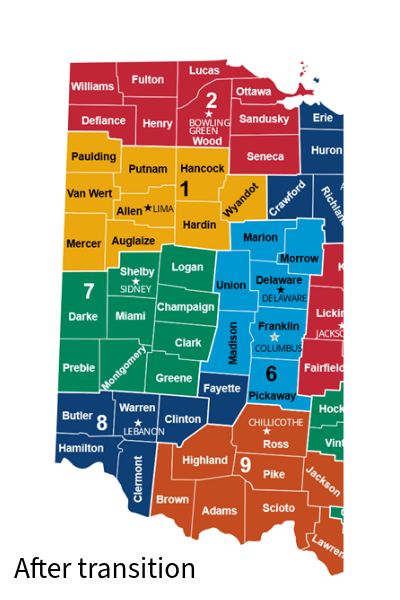
As you'll read below, the change is logical. The six counties involved -- Auglaize, Defiance, Fayette, Greene, Mercer, and Preble -- are now in the ODOT district that most closely aligns in geography, population served, and logical borders.
Why now? Because it made too much sense not to. The discussions around the idea have occurred over many years, but we're glad it happened now during our time to see it through.
To our new partners and communities in Auglaize, Defiance, and Mercer counties, welcome to District 1 and District 2.
What's in this issue - June 2026:
- Six counties move into different ODOT districts
- New face in northwest Ohio Jobs & Commerce
- ODOT construction initiates e-ticketing
- Ohio among best in nation for work zone data
ODOT districts realign to create logical borders
Six counties change districts
The Ohio Department of Transportation (ODOT) operates within 12 districts, each
encompassing from three to nine counties depending on density of population. In February, the department announced a realignment of certain districts to create more logical
boundaries, provide continuity for maintenance responsibilities, and bring counties
with similar population and geography together.
The reason
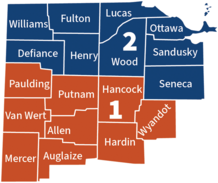
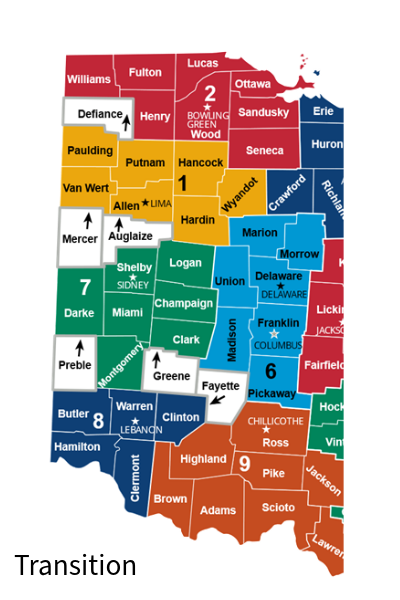
The realignment involves shifting six counties -- Auglaize, Defiance, Fayette, Greene, Mercer and Preble counties -- into a neighboring district (see map at left).
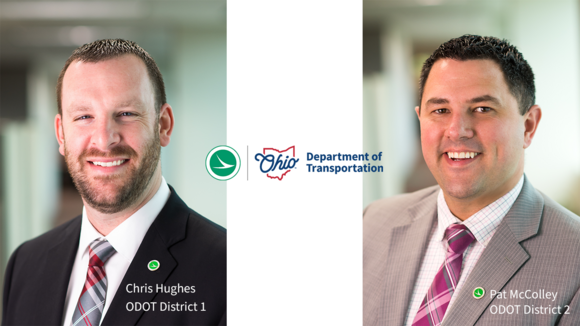
"The main driver for realignment was the Dayton area, where an illogical structure existed that resulted in two different ODOT districts maintaining sections of Interstate 675 and Interstate 70," said Chris Hughes, ODOT District 1 deputy director. "Now, all of I-675 and the western portion of I-70 is within District 7 creating less confusion and a logical maintenance divide," said Hughes. The realignment distributes the workload for better balance, he said.
|
The after
The change resulted in District 1 gaining Auglaize and Mercer counties. "These counties are very similar in population and terrain to our existing counties in District 1 and we're excited to serve those communities," said Hughes.
For District 2, Defiance County is now part of a four-county region it's already closely aligned with. "When we speak of the four-county region in local government, non-profit organizations, and education, we refer to Defiance, Fulton, Henry, and Williams counties. It's logical to have Defiance be part of District 2 that already encompasses its closest partnership counties," said Pat McColley, ODOT District 2 deputy director.
The six counties are now largely operating within their new assigned district, but the complete transition will be in July when the fiscal year begins.
|
|
 |
Miller serving northwest Ohio as economic development representative
Role connects project stakeholders with available funding
Ohio is in good standing nationally for its economic growth potential. The number one reason: infrastructure.
ODOT realizes the importance of linking economic development with infrastructure. In northwest Ohio, that connection is made through Amanda Miller, regional manager with ODOT’s Office of Jobs & Commerce. Miller’s territory is the 18-county area that comprises ODOT Districts 1 and 2. She began her role in late February.
Miller works as a liaison between stakeholders and ODOT to facilitate projects and identify funding opportunities. She works mainly with counties and communities where new businesses or expansions are occurring and where infrastructure improvements are needed.
Miller’s background includes working for economic development associations, most recently in Van Wert County where she resides.
“Coming into this role, I quickly realized there are far more projects under way than I ever expected. I’ve worked with many economic development projects over the years, but what sets this job apart is the opportunity to be in the various communities themselves—partnering directly on projects that make a real impact. That hands-on involvement is incredibly rewarding,” said Miller.
The most surprising thing for Miller has been the range of projects related to ODOT. “The projects are broad and large-scale, but I am also dealing with projects that are a small dock expansion, or redoing 2,000 feet of a portion of roadway,” she said. While large projects are in Wood and Lucas counties, several are in more rural communities and will have big impacts there. “The scales are different and I love that diversity,” she said.
The overall goal of Miller’s position is simple. “I’m really acting as an advocate for northwest Ohio and for what our needs are here from the Jobs & Commerce and economic development standpoint to get the representation and the funding we need,” she said.
E-ticketing in highway work zones creates safer environment for workers
ODOT tops in nation in the process
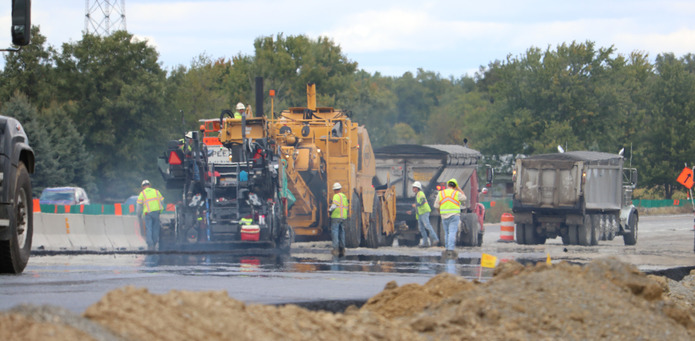 ODOT's e-ticketing process eliminates the need for project inspectors to retrieve paper tickets from material delivery drivers in a work zone. The process keeps inspectors safely away from some work zone equipment to reduce risk of backing and runover injury and deaths.
(Image is of a highway work zone on I-75 in Allen County.)
Within a typical highway construction zone, project inspectors retrieve paper tickets from the truck drivers delivering materials to the jobsite so quantities can be documented.
This simple act resulted in the death of an Iowa Department of Transportation employee, sparking a national effort to change the process.
Data from the Federal Highway Administration (FHWA) shows 48% of work zone fatalities are caused when workers are run over or backed over, as was the case in the Iowa incident. “When you have personnel close to trucks, there is a huge safety concern,” said Janet Treadway, administrator for ODOT's Office of Construction Technology and Digital Innovation.
ODOT is in its second year of electronic ticketing, or e-ticketing. Introduced during the COVID-19 pandemic to avoid passing paper tickets, e-ticketing eliminates paper ticket collection within work zones. Instead, the ticket is initiated by the material supplier and electronically disseminated. The process keeps project inspectors out of situations where runover and backover accidents typically occur and allows them to remain with the operations they’re inspecting. “Now they can stay with the pavers, for instance, to make sure everything is being placed correctly from a safe distance, and they don’t have to run back and forth to get the paper tickets,” said Treadway.
In addition to Iowa, the states of Delaware, Louisiana and Ohio have recorded fatalities in work zones attributed to backing or runover.
ODOT first began e-ticketing with asphalt materials in 2020 through HaulHub, the state’s vendor for the system. This year, e-ticketing is used with concrete and aggregate materials as well. ODOT’s specifications book requires material suppliers to participate in e-ticketing.
According to Treadway, Ohio is currently a national leader in e-ticketing among the 43 states that have adopted it. In 2025, ODOT processed 185,815 tickets across 273 projects growing 88% year over year – 23 points above the national average. All 12 ODOT districts participate in e-ticketing.
An e-ticket can also send notification to Waze, Google, WZDx and HERE navigation systems alerting drivers they are approaching a work zone and workers are present. The notification is sent when equipment in the zone equipped with the proper telematics has activated its strobes. In 2025, 6.27 million drivers were reached by work zone safety alerts via Waze.
The intent is to also expand e-ticketing to zones where ODOT’s own maintenance garage forces are working. “Our goal is to be as active as possible in reporting, to inform the traveling public that yes, this is an active work zone, with actual workers there,” said Treadway.
Work zone management system alerts public of ODOT work zones, workers
ODOT data being utilized by Google, Waze, and Apple
Users of Google Maps, Waze, and Apple Maps are beginning to see ODOT's work zones on their displays -- the result of a significant system development that allows ODOT's data to be ingested by third parties.
ODOT inputs highway construction information, such as where a road will be restricted or closed, into its relatively-new work zone management system. The information is then displayed on OHGO.com -- the state's real-time source for highway and traffic information.
Prior to the work zone management system, the data could only be displayed on OHGO. "Now, ODOT's data is provided in the universal Work Zone Data Exchange (WZDx) format, making it compatible with navigation feeds, such as Google and Waze," said Harshi Tera, ODOT's project manager for the system. Ohio is one of approximately 30 states with a registered feed with the United States Department of Transportation, said Tera. The navigation apps have been using ODOT's data since March of last year, she said.
Other systems within or utilized by ODOT also use the universal WZDx format which provides other benefits to ODOT and the traveling public:
- E-tickets, generated when materials are delivered to an ODOT project, send notification to third-party applications to alert drivers to upcoming work zones, and also the presence of workers.
- In-cab information systems, such as Fleetworthy, use the WZDx feed to provide information to truck drivers about work zones, dangerous slow-downs, or height restrictions on the road ahead.
- During winter, ODOT's trucks now appear on the Waze navigation app. A truck icon will appear on the app along the route when the truck's strobe lights are on, indicating the truck is actively engaged in snow and ice control.
The advancement in data sharing is significant for ODOT and motorists as the agency continues to find ways to protect its workers and the public. "In our meetings with them, the representatives of our partner navigation apps continue to praise ODOT for providing them good data. If we didn't, they wouldn't use it. We are consistently at approximately 96% in providing data they can use," said Tera.
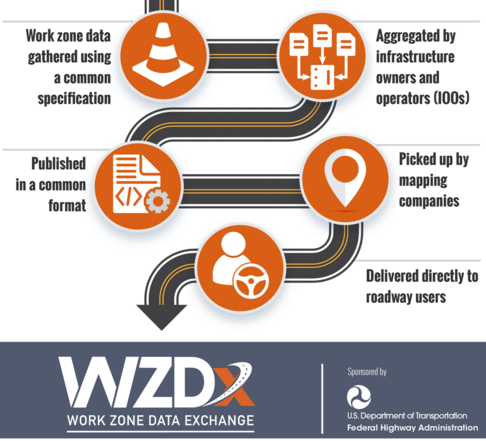
Graphic depicts the flow of information in the Work Zone Data Exchange (WZDx) format:
1. Work zone data gathered using a common specification
2. Aggregated by infrastructure owners and operators (100s)
3. Published in a common format
4. Picked up by mapping companies
5. Delivered directly to roadway users
|