Separated Bicycle Lanes Help Reduce Crashes
When designing our transportation infrastructure, a primary goal is to increase the safety of all road users. Because resources are limited, there is a need to install safety improvements or countermeasures that give the highest level of benefit possible for each dollar invested. Crash Modification Factors (CMFs) are an important tool in making these decisions, and the Federal Highway Administration (FHWA) recently released CMFs for Separated Bike Lanes (SBLs). Read on to learn what exactly this means and how these can be incorporated into your planning and design for active transportation.
 What are Crash Modification Factors (CMF)?
According to the Crash Modification Clearinghouse, a CMF is a multiplicative factor that “reflects the safety effect of a countermeasure, whether it is a decrease in crashes (CMF below 1.0), increase in crashes (CMF over 1.0), or no change in crashes (CMF of 1.0).”1 In other words, a CMF of 0.4 would predict that installing the given countermeasure would result in 40 percent of the estimated crash frequency, or a reduction by 60 percent. The CMF Clearinghouse provides guidance on how to use CMFs to inform infrastructure countermeasure selection.
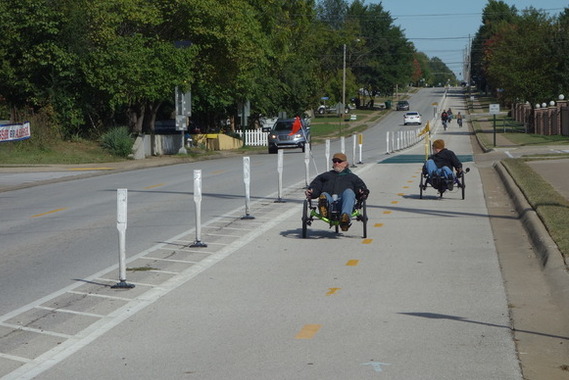
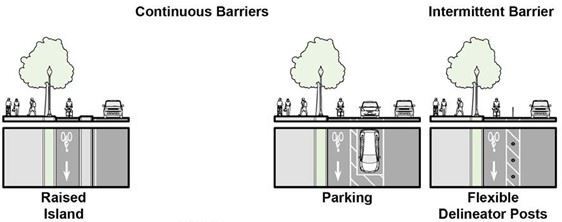
Separated bicycle lanes are exclusive bikeways that are physically separated from motor vehicle traffic. Separated bicycle lanes provide horizontal separation from motor vehicle traffic as well as vertical barriers such as flexible delineators or a curbed median.2 Bicycle lanes are a Proven Safety Countermeasure recommended by FHWA, and the new CMFs have been incorporated into their recommendations. (Read our previous Groundwork issue on Proven Safety Countermeasures).
The study examined bicycle lanes in Cambridge MA, San Francisco CA, and Seattle WA that were converted from traditional or buffered bike lanes with no vertical separation, to separated lanes with vertical buffer elements. CMFs were developed both for SBLs with flexible posts and SBLs with a blend of flexible posts and other vertical elements. The CMFs were also validated in Austin, TX and Denver, CO.
The research “indicates a decrease in bicycle crashes of approximately 52 percent should be expected when bicycle lanes that are traditional or buffered are converted to SBL facilities” (p. 88), indicating a “clear safety benefit” (p. 104) of this treatment. The study also found that using only flex posts had a slightly greater effect on safety than a blend of vertical elements on the corridor, stating that “a more consistent application of flex posts will provide an additional measure of safety” (p. 103). These CMFs are only for separated bike lane segments and do not factor in intersections due to the wide variety of intersection approaches and risk factors that prevented CMF modeling for intersections or entire corridors (p. 104).
The recommended CMFs for converting bike lanes to separated bike lanes are as follows from Table 66 on page 104 of the study:
|
Significance Level
|
Before Condition
|
After
Condition
|
Crash Modification Factor
|
Standard
Error
|
|
0.01
|
Traditional bicycle lane
|
SBL with flexible posts
|
0.498
|
0.173
|
|
0.01
|
Flush buffered bicycle lane
|
SBL with flexible posts
|
0.441
|
0.297
|
|
0.01
|
Transitional or flush buffered bicycle lane
|
SBL with flexible posts
|
0.468
|
0.297
|
|
0.05
|
Traditional bicycle lane
|
SBL with blend of flexible posts and other vertical elements
|
0.640
|
0.203
|
|
0.05
|
Flush buffered bicycle lane
|
SBL with blend of flexible posts and other vertical elements
|
0.567
|
0.253
|
|
0.05
|
Traditional or flush buffered bicycle lane
|
SBL with blend of flexible posts and other vertical elements
|
0.602
|
0.212
|
If you’re ready to start designing separated bicycle lanes in your community, check out Chapter 6 of ODOT’s Multimodal Design Guide for guidance.
 [1] https://www.cmfclearinghouse.org/faqs.php#q1
[2] 6.3.7 Separated Bicycle Lanes https://www.transportation.ohio.gov/working/engineering/roadway/manuals-standards/multimodal/06/06
 Announcements
- Congratulations to all the Ohio communities that received nearly $8 Million in funding to make their streets safer for all!. Read the announcement of all 2023 SS4A Grantees.
- And for all those getting ready to start their comprehensive safety action plans… Communities across Ohio are committing to reaching zero traffic deaths and serious injuries through Vision Zero plans, policies, and strategies. The Active Transportation Academy will hold a free two-part training on the fundamentals of traffic safety and the information needed to create a Vision Zero Action Plan. January 22 and 29, 2024, 1 – 2:30PM. Register here.
- Join ODOT for a webinar on select topics included within ODOT’s forthcoming Sidewalk/Bikeway Snow & Ice Removal Toolkit, specifically teaching communities how to develop a winter maintenance & management plan with a focus on routes for walking and biking. Participants will learn about best practices for clearing snow and ice on sidewalks and bikeways, including key areas to clarify responsibility within the public right-of-way. February 15, 2024, 1 – 2:30PM. Register here.
- The US Department of Transportation is accepting applications for $1.5 billion in grant funding through the Rebuilding American Infrastructure with Sustainability and Equity (RAISE) discretionary grant program for 2024. Half of the funding will go to projects in rural areas, and half of the funding will go to projects in urban areas. At least $15 million in funding is guaranteed to go towards projects located in Areas of Persistent Poverty or Historically Disadvantaged Communities, and projects located in these areas will be eligible for up to 100 percent federal cost share. The Department is encouraging applicants to consider how their projects can address climate change, ensure racial equity, and remove barriers to opportunity. See the NOFO and apply by February 28.
|