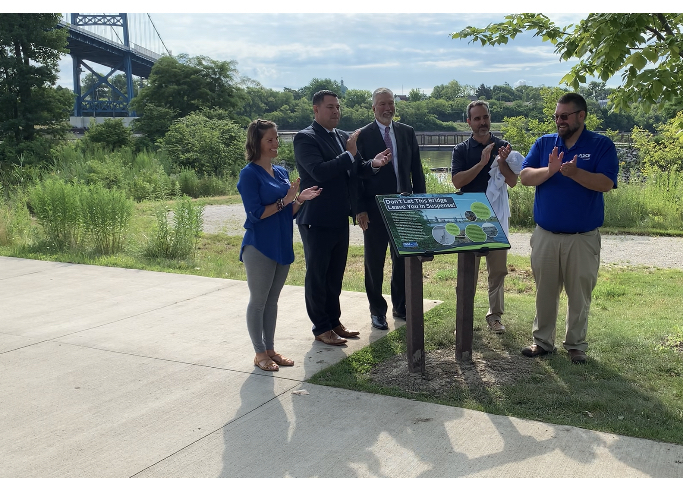
 An educational display regarding the iconic Anthony Wayne Bridge was unveiled today at Middlegrounds Metropark during an event organized by the American Society for Civil Engineers Toledo Section (ASCE). In honor of its 100th anniversary, ASCE Toledo chose to honor the bridge by designating it a historic civil engineering landmark. Pictured are (from left) Dr. Shannon Hughes, Metroparks Toledo director of education and programming; Pat McColley, Ohio Department of Transportation District 2 deputy director; Gary Byers, Lucas County Commissioners president; Fernando Camargo, ASCE Toledo president; and Mike Pniewski, Lucas County engineer.
ASCE Toledo honors Anthony Wayne Bridge
Iconic bridge designated a historic civil engineering landmark in honor of ASCE's 100th year
(BOWLING GREEN, Ohio, Wednesday, July 13, 2022) - The iconic Anthony Wayne Bridge in Toledo was designated a historic civil engineering landmark today during a ceremony at Middlegrounds Metropark.
The American Society of Civil Engineers Toledo Section (ASCE Toledo) chose to recognize the bridge in honor of their 100th anniversary. A permanent educational display about the iconic structure was unveiled during the ceremony. ASCE Toledo partnered with Metroparks Toledo and the Ohio Department of Transportation (ODOT) to develop the display.
The bridge was the run-away choice for the honor.
“We sought nominations from ASCE members, as well as the county engineers from the 17 Ohio counties that make up the Toledo section. Eligible landmarks needed to be technically and socially significant, built at least 50 years ago, and still intact. Nominations spanned a broad range of amazing infrastructure projects, from canals to courthouses, monuments to skyscrapers, and of course bridges. The Anthony Wayne Bridge was the overwhelming favorite,” said Brian Randolph, ASCE Toledo board member.
“The Anthony Wayne Bridge is often the image you see in representations of the city of Toledo. Honoring it in this way is certainly fitting given it is so integral to the city and this area. Its captivating, historic look endears it to many,” said Pat McColley, ODOT District 2 deputy director.
The bridge is a suspension bridge, as are the Golden Gate and Brooklyn bridges. It differs in design from the city’s Veterans Glass City Skyway bridge, which is a cable-stayed bridge. Its design and age have required special maintenance techniques to maintain the unique character of the bridge over its 90-year life.
“ODOT has invested an extensive amount of resources into the Anthony Wayne Bridge over the past 10 years to extend the life of this historically significant and locally iconic structure well into the future,” said Dave Geckle, bridge engineer for ODOT District 2.
The bridge was dedicated October 27, 1931. It is the last remaining suspension bridge in ODOT’s inventory.
The Anthony Wayne Bridge, also referred to as the High Level Bridge, carries State Route 2, 51, and 65 over the Maumee River in Toledo. The bridge is named after General Anthony Wayne, a United States Army officer and statesman who had mounted an assault on the Indian confederacy at the Battle of Fallen Timbers in modern-day Maumee. It was a decisive victory for United States forces, ending the war and eventually leading to a treaty that gave most of what is now Ohio to the United States.
Facts about the bridge:
- The bridge carries four lanes of traffic plus sidewalks on a 60-foot wide roadway deck.
- The main cable-supported span is 785 feet long (over 2½ football fields) between the towers, with two side spans that are each 233.5 feet long.
- The total length of the bridge, including the two sloping, elevated approaches, is 3,215 feet (over 10 football fields).
- The vertical steel suspender ropes between the main cables and deck are spaced at approximately 20-foot intervals.
- The two main cables are 13-5/16 inches in diameter and contain 19 strands of galvanized steel wires compressed into a circular bundle. Each strand contains 186 galvanized steel wires that are each 0.192 inches in diameter. There are 3,534 wires in each of the two main cables. To protect them from corrosion the strands were originally coated in a lead paste and wrapped with galvanized steel wires, which were then painted.
|