Local Leader Highlight – Chillicothe’s Sidewalk Mayor
Local governments are responsible for planning, constructing, and maintaining streets, bridges, and active transportation networks within their jurisdictions. Given Ohio’s home rule status, they play a primary role in implementation of the projects and programs most visible to everyday Ohioans. Local leaders across Ohio have embraced the benefits of promoting, funding, and building active transportation networks in their communities.
We recently spoke with Mayor Luke Feeney to learn more about what he is doing to help make walking and biking more accessible to residents and visitors in Chillicothe, and what advice he had for other local officials looking to do the same. Mayor Feeney served as the City Auditor for Chillicothe in 2013, was elected mayor in 2015 and is now serving his second term. Responses have been edited for length and clarity.
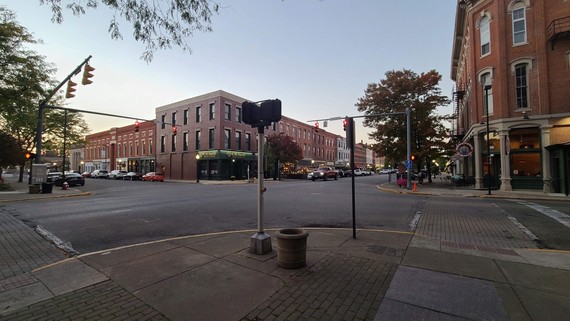 Why is it important to you to promote active transportation in Chillicothe? How do you think it will benefit your constituents?
It's difficult for me to think of a downside to walking and biking more and driving less. Designing around active transportation is great for physical and mental health and for people who have no other means of transportation as well.
I also believe it's an economic development tool and helps make our community more attractive over time. A single bike lane, or curbside recycling or a dog park – none of those things individually will make someone say “I’m going to move to Chillicothe”. But as you weave those things together, you start to strengthen the fabric of the community, which increases the tax base, makes it more attractive. If you do it well, it's community wide and helps with equity. I’m hearing with COVID that if people can work from anywhere, it’ll be less about incentivizing business to come to you, and more about creating livable communities where people enjoy the amenities. For visitors – if it’s easy to get around, easy to park, walk, and bike, that has impacts. For locals, if you want to walk to a grocery store, it should be an easy thing to do if you want to or have to. Active transportation really has a big impact. You can tell me a topic – health, wellness, tourism – and I could talk a while about how it is a benefit to the community. When you are not in an urban center, people might not talk so much about these things, but it’s all about getting people to be comfortable to express what is important to them. Active transportation might be a pathway that someone just hadn’t thought of as a solution to some of their concerns – to be healthier, to get to school, or anything else.
What is your biggest accomplishment to date for active transportation?
There was a pretty big project on Rt 50 through Chillicothe that had already been designed when I got into office. It improved signalization and added a turn lane at a dangerous intersection. A large section of the corridor has pretty regular pedestrian and bike traffic but there were no pedestrian facilities at all, and even before I was in government, I recognized it as a place that really needed a sidewalk. After matching up several funding sources and considerable help from everyone at ODOT, the sidewalk came to fruition. I really thought it was a once-in-a-generation chance to get it done because of the safety project that ODOT was doing in the area and the great expense, as it is adjacent to a pond and needed considerable design work. It would have been next to impossible for the city to pull the project off alone.
What is the biggest thing you would like to accomplish in the future for active transportation?
I think the biggest thing would be changing mindsets and behaviors such that active transportation is thought of as a real method of getting from point a to point b in the city. We're working on the lowering the barriers to make those changes easier. That said, I realize that the biggest role the city can play in the long term is building that physical infrastructure – if we don’t, no one will. If we are thinking about it consistently, it shouldn’t be the case that it creates a lot of extra work. So it may be the City or some other entity that plays the role of doing that marketing piece.
 What is the role of elected officials in championing/advancing active transportation in their communities?
Elected officials need to stand up for our priorities and be active in expressing a vision for the community. Sometimes projects are just done by default or using the path of least resistance. But when elected officials get engaged and work to develop partnerships, the impact relative to the effort has been really significant. With the Rt 50 example, I asked partners to go a little out of their way to ask for more help to make the project happen, and it was successful. On another project, I went with partners to make the project presentation and showed up at meaningful moments in the process. I even drove around taking pictures for a funding application, talked to the community, and got feedback. It’s important to show interest and be engaged, and to be strategic and speak up for the needs of bicyclists and pedestrians whenever possible.
How do you empower City staff and departments to make decisions that will support active transportation?
I think the key is to pause to think about things in a different light and consider the "whys" of our current design. Why is that a stoplight instead of a four way stop? Why are those streets so wide? etc. I think when our employees ask these questions it helps get past previously held assumptions.
It’s also important to make those plans and identify those priorities so that no matter who is in office, you can keep momentum moving. In next year’s budget we are really prioritizing hiring planning and development staff and doing our fist master plan in a while. If we are putting this energy into making the community better, institutionalizing the vision and creating systems is important. It’s also about making sure the design of city operations has someone in charge of connection with the zoning commission, seeing the bigger picture as to what the community vision is, not just passing things by the letter of the law. If we institutionalize a vision, then we better invest in that.
 Have you found unique ways to pay for active transportation projects?
It starts with knowing your available resources and how you can spend them. Chillicothe has a ten-year renewable income tax levy for paving and one for transit. They were passed in 2015 so for 5 years we’ve had a dedicated funding stream for paving. The general fund mostly goes to police & fire. There is no specific funding source now for sidewalks and it’s hard to say let’s use general funds for sidewalks. However, if we are working on a project with ODOT and there is a local match requirement, we can use our paving tax to match for the paving part, and the other sources can be used to cover the sidewalks. And if you are already repaving, it is easy to add a bike lane. Sidewalks are happening where the paving and stormwater projects are happening.
What’s your best piece of advice to other elected officials who would like to bring the benefits of active transportation to their community?
I think I would say take your wins where you can get them. I think our first active transportation-related project was something like two city blocks of bike lanes. It would be awesome if it was five miles of bike lanes within the city, but that wasn't feasible, financially, or politically. So we made an improvement, albeit small, and gave people an idea of what those improvements could look like and have continued to build momentum based on those small wins. It can be really daunting to find more funding, but if you take a pause to think about opportunities in what we are already doing, there can be lots of wins to be had now with just the money we do have. Even something as simple as changing the timing of your walk signals – which is something we are looking at right now.
 Announcements
-
May 5th is National Bike to School Day! Check out these resources for ideas no matter where learning is happening. Register schools that are celebrating either on May 5th or any day in May!
- The 2021 Miami Valley Cycling Summit, hosted by Bike Miami Valley and the City of Kettering, will be held virtually on May 7th, with the option to participate in a self-guided ride of Kettering. The event welcomes elected officials, government staff, local leaders and cycling advocates. This year’s theme is “Safe Streets for All.” Content experts will detail how cycling can improve the transportation, health, and economic vitality of the Miami Valley. Register now!
- The Federal Highway Administration (FHWA) has published a proposed rulemaking for comment that includes a full update of the National Manual on Uniform Traffic Control Devices. FHWA will consider feedback from state and local traffic engineers and other traffic control device stakeholders, and the public in general until May 14th, 2021. Chapter 9 includes signs and pavement markings specifically related to bicycle operation on roadways, separated bikeways, and shared-use paths. Learn more and comment here.
- Join ODOT’ AT Academy for a 1-hour webinar on Mobility Solutions: Transit’s First and Last Mile on May 25th at 11 AM. Learn how your community can fill the literal gap in active transportation infrastructure and services so that people may conveniently and safely use transit. View additional details and register here!
- $1 billion in funds made available through the FY 2021 RAISE Transportation Discretionary Grants program (formerly BUILD/TIGER) are to be awarded on a competitive basis for planning and capital projects that will have a significant local or regional impact. See the Notice of Funding Opportunity (NOFO) and related information, including initial FAQs, on the RAISE website. The application deadline is July 12th, 2021 at 5 PM EDT. A series of informational webinars are scheduled in April and May – register here.
- Ohio LTAP is hosting a FREE, four-part webinar course on Designing for Pedestrian Safety from the National Highway Institute. Three options are available in April, June and July. Please visit https://ltap.enrollware.com/schedule to access the online registration system.
- ODOT’s AT Academy now has an online, eLearning course on Safe Routes to School Basics. Take this training to learn more about the concept of Safe Routes to Schools overall, the principles and processes for planning, designing, and programming to support SRTS efforts, and as a pre-requisite for requesting a School Travel Plan Development workshop.
|