ODOT introduces northwest Ohio newsletter
A message from the deputy directors . . .
We would like to introduce you to our new semi-annual northwest Ohio transportation newsletter, the Crossroad. Whether you are a local government representative, business leader, media member, elected official, or one of the many other transportation stakeholders in the region, we all have an interest in transportation in northwest Ohio and across the state.
At the Ohio Department of Transportation, we are focused on meeting the transportation needs of Ohio and ensuring that the necessary infrastructure is in place to allow our communities to grow and thrive. This responsibility doesn’t just include the state highway system, but must also include local roadways, public transportation, and alternative modes of transportation such as walking and biking.
This newsletter is designed to provide transportation stakeholders information on resources available to help meet all of the transportation needs in the region. The Crossroad will include information on funding programs and grants available to local governments, expertise from our staff to assist in making decisions, news on what projects are happening in northwest Ohio, and success stories from our local partners.
We hope you will find this newsletter to be a helpful resource and we welcome your feedback on topics or stories that you may want to see included in future editions. It’s up to all of us to do our part to continue to make northwest Ohio a great place to live and work.
Chris Hughes, ODOT District 1 Pat McColley, ODOT District 2
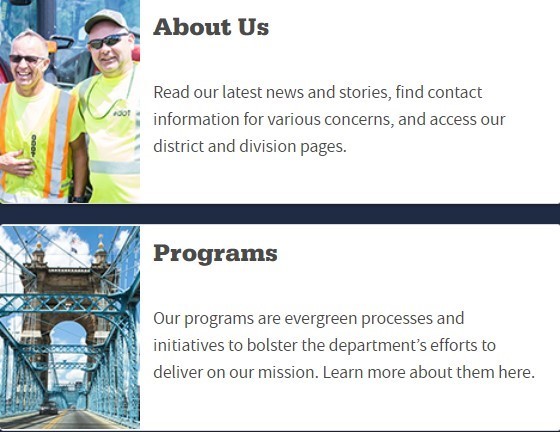
The new ODOT public website, launched last year, promotes proactive project communication in one place at transportation.ohio.gov/projects.
Dedicated pages for individual projects are published into the library as they become relevant to the public – for example, when they enter a public involvement commitment in the planning stages or as they near construction. Each page will contain basic information, like when a project is expected to be constructed and our plans to maintain traffic.
The library contains projects from across the state, but it can be filtered by county, project status, cost, and work type. The website’s optional geolocation feature helps customize users’ experiences, automatically displaying the projects nearest them.
The public website’s project library supplements existing ODOT systems like OHGO, Ellis Proj, and the Transportation Information Mapping System (TIMS). All these online tools are available to the public for free and offer more in-depth information about our future highway projects.
-
OHGO is a map-based website and mobile app that displays current construction work zones and incidents as pinpoints along state, federal, and interstate routes. It also displays live traffic cameras, weather conditions, and traffic speeds.
-
TIMS provides web map and spreadsheet results for upcoming projects, as well as standard PDF maps for common needs like mile markers and annual construction work plans. Filter by county and calendar year to see upcoming projects. Results can be exported to a spreadsheet or placed on an interactive web map.
-
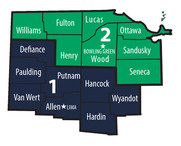
Ellis Proj summarizes information from Ellis, the agencywide platform that our team of engineers and project managers use to manage the planning of our projects. Results must be narrowed by district, county, and project identification (PID) number. (Hint: In northwest Ohio, you are served by ODOT Districts 1 and 2!)
|
ODOT’s Citizen’s Guide to Transportation Funding in Ohio was recently developed to provide general information about recent funding sources and how they are made available across the state.
The color-coded charts provide revenue sources and additional funding mechanisms available to ODOT, counties, cities, rail, transit, and other entities.
The following link provides access to the electronic version: transportation.ohio.gov/funding.
For complete funding resources, visit the ODOT funding page: Funding | Ohio Department of Transportation
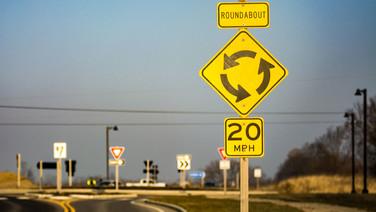
Every public official at some point will have an important roadway safety project they wish to pursue for their community. How to begin to address the issue can be a daunting task for anyone new to the process.
ODOT’s Highway Safety Improvement Program (HSIP) is a good place to begin. The program aims to achieve a significant reduction in traffic fatalities and serious injuries on all public roads, including local roads. The program offers $158 million annually for engineering improvements at locations where a high number of crashes or severe crashes occur.
Chris Waterfield, ODOT District 2 traffic engineer, suggests beginning the application process by clearly defining the problem. “We need to diagnose what’s wrong, where to start looking for data, and who is responsible for maintaining the road. That is typically the jumping-off point. In some cases, we can help leverage safety funding to improve traffic safety on local roads,” said Waterfield.
Below are helpful links to begin a roadway safety improvement project.
Highway Safety | Ohio Department of Transportation
Safety coordinators in each ODOT district
|
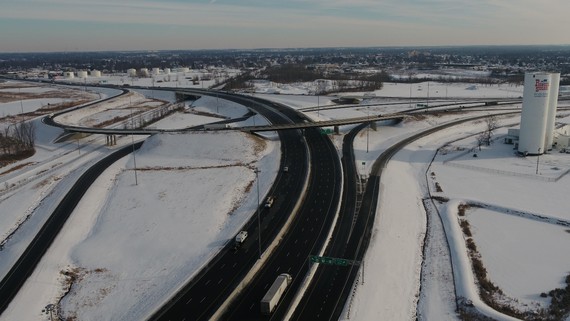 Interstate 75 through Findlay and Hancock County in February of this year. The four-year, $115 million reconstruction and expansion of I-75 was completed last year.
A significant 2020 accomplishment for ODOT is the completion of the expansion and reconstruction of Interstate 75 through Findlay and Hancock County. The $115 million project reconstructed five miles of the existing two lanes of I-75 and constructed an additional lane of travel in each direction from south of the U.S. 68/state Route 15 interchange on the south end to county Road 99 on the north end.
The completion of I-75 in Hancock County marks the end of an era for ODOT District 1. Here, Chris Hughes, ODOT District 1 deputy director, talks of the significance of the project (view drone footage of the project from October 2020).
In Wood and Lucas counties, two abutting projects between Buck Road and Dorr Street continue and saw good progress in 2020. The $343 million project began in late 2018 and is on schedule for completion in 2023 (view a gallery of video of I-75 construction in Toledo; visit the project website).
On one hand, it’s perplexing that traffic deaths compared to 2020 are up, despite a sharp drop in traffic due to lockdowns precipitated by the COVID pandemic. But talk to law enforcement officials and they will tell you motorists who were driving saw open roads as an opportunity to speed and multitask, leading to crashes.
According to Michelle May, program manager for ODOT’s highway safety program, travel in Ohio was down about 12.5% in 2020 and traffic deaths rose 7% compared to 2019. Ohio ended the year with 1,231 traffic deaths – 76 more than the 1,155 deaths reported in 2019. When you factor in lower travel, Ohio’s fatality rate will be at least 20% higher.
According to the National Safety Council, only nine states saw a drop in traffic-related deaths: Alaska (-3%), Delaware (-11%), Hawaii (-20%), Idaho (-7%), Maine (-1%), Nebraska (-9%), New Mexico (-4%), North Dakota (-1%) and Wyoming (-13%).
As of early March, 180 deaths were recorded in Ohio compared to 166 for the same period last year. Fatalities involving pedestrians and intersections are trending higher - a continuation of 2020 trends.
For more information regarding traffic crash trends and safety, visit the ODOT website: Crash Trends & Resources | Ohio Department of Transportation
 |
|
The Crossroad is a production of the Ohio Department of Transportation’s public information staff in the northwest region, encompassing ODOT District 1 and District 2. To receive this and other ODOT communications directly to your email, sign up here. We would sincerely like to know what you’d like to know, so please contact us with questions or feedback: rhonda.pees@dot.ohio.gov |
|