|
Issue 51: December 23, 2025 |
|
For Your Awareness
Click the image above to view a special holiday message from DCY.
Wear Blue for Human Trafficking Awareness on January 7
This January, Ohio observes Human Trafficking Prevention Month with a focus on supporting survivors. Across the state, communities are working together to raise awareness, strengthen prevention efforts, and ensure that survivors receive the care, resources, and respect they deserve.
To show your support, we encourage you to wear blue on Wednesday, January 7. Please consider taking a photo of your team that day and emailing it to DCY Communications so we can share it on January 11, Human Trafficking Awareness Day.
By supporting survivors, we not only honor their resilience but also build safer pathways for children, families, and communities.
Pilot Program to be Announced During Human Trafficking Webinar
On January 15, 2026, from 10 a.m. – 12 p.m. EST, the Governor’s Human Trafficking Task Force in partnership with DCY and Gracehaven will be hosting a webinar for child-serving professionals. The webinar, Serving Child & Youth Survivors: Updates on Ohio’s Response to Human Trafficking in the Child Protection System, will cover:
- The announcement of a new pilot program in three regions of the state
- Ohio’s response to human trafficking in the child protection system
- Ohio’s response to missing and exploited youth
- Panel discussion focused on promising practices
➡️Register now!
|
|
Maternal & Infant Wellness |
|
|
Programs focus on improving birth outcomes, and improving the health status of pregnant women, infants, and children to ensure moms and babies celebrate the child’s first birthday.
|
|
Free In-Home Nurse Visits Help Newborns and Families Thrive
Family Connects Ohio (FCO) is an evidence-based nurse home visiting model that provides support for families with newborns during a period of life-changing transition. FCO connects families to healthcare providers who will nurture the whole family and support a newborn’s health and well-being.
Find out more and make a referral here.
|
|
|
Early Childhood Development |
|
|
The Early Childhood Development programs provide technical assistance, education, and referrals for families and youth with evaluations regarding specific needs and disabilities.
|
|
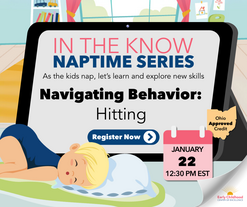
In the Know Naptime Series: Navigating Behavior: Hitting
Parents and educators, join us as we explore practical, developmentally informed strategies to understand and respond to hitting in young children. In this webinar, we will unpack what a child could be communicating through hitting, learn proactive strategies to reduce hitting behavior, and practice responsive approaches that support safety and emotional regulation. Real-life examples will be shared to illustrate how to turn moments of hitting into opportunities for connection, learning, and growth.
Don't miss this great opportunity to spend 30 minutes with us on January 22 at 12:30 p.m.
➡️ Register now!
|
Glossary of Terms a New Resource For Families
The Center for the Young Child has launched a new resource. What does this mean? Understanding Early Intervention and Special Education Terms is a glossary of common words and acronyms families may hear when starting out on their early intervention or special education journey. You can access it here.
|
|
A Sibling's Holiday Survival Guide: How to Support Every Child During the Season
The holidays can be a time of joy for many families; however, it can also be a stressful time, particularly families that have a child with a disability. This guide offers common scenarios and tips to help take all family members' needs into account. Tips include:
- Plan for holiday quality time with your neurotypical child.
- Set clear expectations about roles.
- Encourage compassion and flexibility.
Share this source with the families you serve.
Help Me Grow: Early Support Makes All the Difference
Laura L. Sorg, MD
Referring early for services like Help Me Grow is crucial for a child's development. Early Intervention can significantly improve outcomes for children with developmental delays or disabilities. The earlier a child receives support, the more effective it can be in shaping their brain's development through neuroplasticity—the brain’s ability to form new neural connections. Early intervention takes advantage of this critical period, helping to address concerns before they become more deeply rooted.
Delaying support with a “wait and see” approach can hinder the brain’s natural developmental process. This may make it harder for a child to reach key milestones and potentially increase the need for more intensive, long-term services later.

Help Me Grow offers a range of services, including Early Intervention (EI) and Home Visiting programs, designed to assist children and families in the early stages of development. Early Intervention services focus on addressing developmental delays or disabilities in children from birth to three years old. These services are tailored to the child’s needs and can include speech, physical, and occupational therapies.
Home Visiting provides families with the support they need to enhance their child’s development at home. Trained professionals visit families to offer guidance on parenting strategies, child development, and health, helping to create a nurturing and supportive environment for the child’s growth. Newborn home visiting through Family Connects Ohio supports mother/infant pairs in the first month of life.
To refer to Help Me Grow, parents or professionals can contact the local Help Me Grow program or visit the Ohio Department of Children & Youth referral link at https://ochids.childrenandyouth.ohio.gov/public/refer.
Prompt referrals help ensure children receive the early support they need. Together, we can help Ohio’s families and children thrive!
Need more information? Check out Help Me Grow at https://www.helpmegrow.org/.
Dr. Laura Sorg is the medical director for Early Intervention and Family Connects Ohio, both part of the Help Me Grow system of supports.
|
|
|
|
Initiatives work to connect educators, families, and youth to education
services and supports.
|
|
New Way to Access Infant and Early Childhood Mental Health (IECMH) Consultation Services – Starting January 1, 2026
Dear Early Care and Education Providers,
The Department of Child and Youth (DCY) is announcing an important update in its Infant and Early Childhood Mental Health (IECMH) consultation services. These changes are designed to streamline support and ensure timely access to consultation when you need it most.
-
What’s changing? Effective January 1, 2026, ECE providers will now contact IECMH providers directly to request consultation services.
If your program is experiencing an urgent situation—such as a recent traumatic event or a child at risk of expulsion—please share this when reaching out. If personnel are available, the IECMH provider will activate the HOPE Crisis Protocol to respond quickly.
|
|
Understanding the Prior Written Notice (PWN)
Prior Written Notice (PWN), sometimes referred to as a PR-01, is a key procedural safeguard required by the Individuals with Disabilities Education Act (IDEA). Parental rights include the right to receive a formal written letter (Prior Written Notice) from the educational agency each time the educational agency proposes to take (or refuses to take) certain actions with respect to the provision of FAPE (Free Appropriate Public Education). The written notice ensures that you’re part of the decision-making process and that changes aren’t made without your knowledge. It allows you to ask further questions, request changes, and agree or disagree with the decision.
In Ohio, a Prior Written Notice (PWN) is a required special education form. It is a written summary of the meeting and proposed actions of the educational agency that is to be written in language understandable to the general public.
|
|
Family Support & Stabilization |
|
|
Focuses on enhancing the resources and supports available to parents and families.
|
|
Annual Report Shows How State and Federal Funds Provide Services to Families Caring for Multi-Needs Children
The Ohio Family and Children First (OFCF) Cabinet agencies are committed to continuing efforts to improve programs, services, and supports for children with multiple systemic issues. One way this commitment is shown is through Family-Centered Services and Supports (FCSS) funding. FCSS funds are comprised of federal Title IV-B funds that are matched with state general revenue funds from the Ohio Department of Behavioral Health, Ohio Department of Developmental Disabilities, and Ohio Department of Children and Youth.
Each youth funded with FCSS funds receives service coordination or wraparound as a support provided by the local Family and Children First Council (FCFC). This includes planning and system collaboration that provide individualized services and supports to families who have needs across multiple systems. One of the key components of the service coordination process is fully involving families and youth in decision-making.
The total number of cases closed during SFY 2025 was 848. Of these, 91% of youth were able to remain in their own home and communities. FCSS funds along with the FCFC service coordination/wraparound process are leading to a cost-effective method of obtaining better outcomes for the youth and families being served. Spending an average of $1,511 per youth in FCSS services while being able to keep 91% of youth served in their communities shows an excellent return on investment, and, most importantly, positive outcomes for the youth and families served. For additional information on how these funds were utilized in SFY25, read the full report.
|
|
Child Abuse Prevention Training Available for Mandated Reporters
The Ohio Children’s Trust Fund (OCTF) staff is furthering its mission as Ohio's branch of Prevent Child Abuse America by facilitating Child Abuse Prevention trainings.
The training navigates best practices in child abuse and neglect in mandated reporting, integration of critical family supports, and identification of key risk indicators in identifying instances of child maltreatment. The training explores the Strengthening Families Protective Factors Framework, emphasizing the importance of increasing protective factors for adolescents, including navigation of healthy relationships and boundaries, internet safety, and exploring processes to empower youth to take action to remove themselves from risky situations or distance themselves from risky people.
Prevention Action Alliance in Columbus hosted a recent training where OCTF staff engaged with 13 training participants, exploring this strength-based, holistic approach to child abuse and neglect prevention.
For more information about Child Abuse Prevention trainings, contact Maggie Sanders.
Families Flourish Expands to Miami Valley
Families Flourish, a three-year program supporting low-wage families with rent assistance, coaching, and monthly workshops, now serves 168 children ages 0–15 in Central Ohio. With strong results—including improved child behavior, tailored school supports, and families moving into safer housing—the program has proven its impact.
Backed by state funding and leadership support, Families Flourish announced its expansion to the Miami Valley in September 2025. The program continues to seek partners across Ohio interested in bringing this research-based model to their communities.
About Families Flourish: Families increase income by an average of 58% ($17,000), improve health, and gain stability through career and financial coaching paired with partial rental support. Together, families set and achieve personal goals that help children and parents thrive.
Family and Children First Councils Set Future Priorities
Local Family and Children First Councils (FCFCs) are required by statute to use a shared planning process to identify priority areas to improve the well-being of families and children in their communities. Shared Plans (per ORC121.37) are developed through a process that evaluates and prioritizes services, fills service gaps and develops new approaches to achieve better results for families and children. Shared Plans are part of each FCFC’s broader effort to build community capacity, coordinate systems and services, and engage families.
For state fiscal years 2026-2028 (July 1, 2025-June 30, 2028), FCFCs created a new three- year Shared Plan. While each plan reflects local needs, many councils are focusing on similar priorities. Statewide, the top five priority areas are:
- addressing services and supports for multi-system youth (67 counties),
- increasing school readiness (27);
- reducing the number of youth in congregate care (21);
- strengthening mental health supports (21); and
- increasing access to prevention programs (14).
All of these priorities align with the Department of Children and Youth’s three Bold Goals:
- reducing infant mortality,
- increasing kindergarten readiness,
-
and reducing the number of youth in children services custody.
Less than six months into implementation, many FCFCs are already making meaningful progress. Below, we spotlight one of Butler County’s shared planning priorities. Look for future Tuesday Times issues to see how other FCFCs across the state are making a positive impact in their communities.
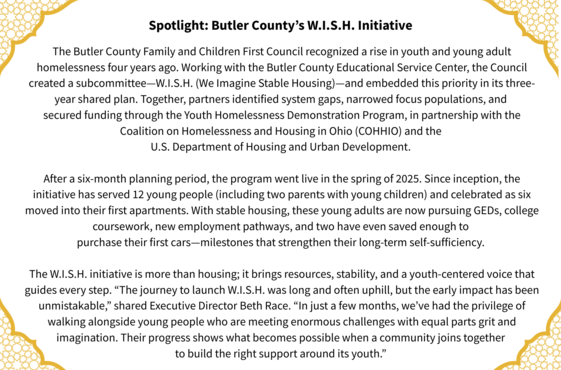 For questions about W.I.S.H. (We Imagine Stable Housing) please reach out to Beth Race, Butler County FCFC Director, at beth.race@bcesc.org or (513) 887-5534.
|
|
Children Services, Foster, Kinship, and Adoption |
|
|
Children Services, Foster, Kinship, and Adoption programs provide caregivers with support via resources for their individualized needs.
|
|
Ohio START Data Training set for January 13
DCY is offering a virtual Ohio START Data Training on January 13, 2026, from 1 – 2:30 p.m. This session will guide PCSA administrators, staff, and fiscal teams through proper data entry and coding in Ohio SACWIS, RMS, and CFIS to ensure compliance with Family First eligibility requirements. Registration is available through CAPS LMS with supervisor approval. Email any questions about training registration.
2025 Adoption Tax Credit: Key Changes Families Should Know
For the 2025 tax year, the adoption tax credit has been enhanced with a higher maximum amount and a new partially refundable feature, offering greater financial support to adoptive families.
The federal adoption tax credit has long helped families offset the high costs of adoption, but for 2025, several key changes make it more accessible and impactful:
🧾 Increased Maximum Credit
The maximum adoption tax credit for 2025 is $17,280 per child, up from $16,810 in 2024. This credit applies to qualified adoption expenses such as agency fees, legal costs, home studies, and travel. The increase reflects an adjustment for inflation and is part of a broader effort to make adoption more financially feasible.
💰 Partial Refundability Introduced
One of the most significant updates is the new partial refundability of the credit. Families can now receive up to $5,000 as a refundable credit, even if they owe little or no federal income tax. This change is especially beneficial for lower- and middle-income families who previously couldn’t fully benefit from the non-refundable credit.
📈 Indexed to Inflation
Both the maximum credit amount and the income phase-out thresholds are now indexed to inflation. For 2025, the credit begins to phase out at a modified adjusted gross income (MAGI) of $259,190 and is completely phased out at $299,190.
🧒 Applies Per Child
The credit is available per child adopted, which means families adopting sibling groups or twins can claim multiple credits. It covers adoptions through foster care, domestic private agencies, and international channels.
📅 Effective Starting 2025
These changes apply only to adoptions finalized in the 2025 tax year and are not retroactive. Past credits from earlier years remain nonrefundable, although unused credits may still be carried forward for up to five years under previous rules.
Families can find out more at irs.gov.
Menu of Supports Funding Opportunity is Reopening to Licensed Treatment Foster Homes
The Menu of Supports Funding Opportunity is administered by the Ohio Department of Children and Youth (DCY) through a contract with Ohio Children's Alliance. This funding opportunity offers financial support to address the needs of both new and existing treatment foster homes. Using a financial incentive approach, it focuses on supporting Treatment Foster Parents with the goal of retaining treatment foster homes for youth involved with an Ohio public children services agency.
|
|
Rules Amended by House Bill 315
The following rules will be effective January 1, 2026, and will be posted to the Official Letters & Guidance | Department of Children and Youth website. (Transmittal Letter 54) at that time. These rules were amended as a result of House Bill 315 of the 135th General Assembly and updated to question-and-answer format for increased clarity. The rules included in Chapter 42 are also being readopted under new numbers.
- OAC 5180:2-9-07 - Emergency planning and preparedness.
- OAC 5180:2-9-34 - Building approval.
- OAC 5180:2-9-37 - Information to be provided by residential facilities.
- OAC 5180:2-9-38 - Community engagement plan for residential facilities.
- OAC 5180:3-13-65 - Caseworker visits and contacts with children in substitute care.
- OAC 5180:3-13-65.2 - Visitation and placement review for children in residential facilities.
- OAC 5180:3-13-66 - Administrative procedures for comprehensive health care for children in placement.
- OAC 5180:3-13-66.1 - Comprehensive health care for children in placement.
- OAC 5180:3-13-90 - Information to be provided to children, caregivers, school districts and juvenile courts.
Five-Year Rule Reviews
5180:2-47-07
The Ohio Department of Children and Youth (DCY) is currently undertaking a five-year review of one Title IV-E foster care maintenance rule, in accordance with Ohio law.
This rule ensures that a Title IV-E agency has the same opportunity to request and participate in a state hearing as any other applicant or recipient of public assistance. It requires that the affected agency receive proper notice and copies of all materials related to the hearing process, thereby safeguarding transparency and fairness.
If you would like to review the existing rule and offer feedback and suggestions, please complete this form by January 5, 2026.
5180:2-5-33
The Ohio Department of Children and Youth (DCY) is currently undertaking a review of one foster care training rule.
This rule requires agencies document successful completion of all preplacement training before certifying individuals as foster caregivers. The training varies depending on the type of foster home being certified. Once certified, caregivers must also complete continuing education and training relevant to the type of foster home they operate, unless a waiver is granted. The rule emphasizes accountability by requiring agencies to maintain records of training completion and compliance. In essence, it ensures that foster caregivers are properly prepared before placement and remain up to date with ongoing training standards, thereby safeguarding the quality of care provided to children in foster homes.
If you would like to review the existing rule and offer feedback and suggestions, please complete this form by January 5, 2026.
|
|
|
Programs are designed to provide support for teens and young adults who either are in foster care or have aged out of foster care systems and need assistance.
|
|
No Decisions About Me, Without Me: How Youth Centered Permanency Roundtables Give Youth a Voice
DCY implements Youth Centered Permanency Roundtables (YCPRT) through a contract with Kinnect to enhance youth voice and permanency for older youth in foster care. YCPRT targets the recruitment of youth who are 12 years of age and older and in foster care more than a year. The model is current used in 10 public children services agencies (PCSAs) and focuses structured, strength-based, youth focused meetings towards permanent connections. Kinnect provides coaching, technical assistance, and support to the implementing counties to serve as many eligible youths as possible. This article explores the voices of Muskingum County youth who participate in YCPRT.
Now more counties can participate in YCPRT! The Statewide Facilitator can help PCSAs launch YCPRTs using a Kinnect trained facilitator to support youth led permanency planning and the identification of key adults to build lasting connections and permanency.
Interested PCSAs can reach out to ycprt@kinnectohio.org.
|
|
|
|
|