|
Issue 50: December 9, 2025 |
|
For Your Awareness
Encourage Your Local Schools to Sign Up for the Team Tressel Fitness Challenge
Are schools in your area participating in the Team Tressel Fitness Challenge? This free, statewide initiative designed to help students build lifelong healthy habits through fitness, nutrition, and sleep has extended the deadline for schools to sign up for its second round.
About the Team Tressel Fitness Challenge
- Open to all students in grades 3–8.
- Designed as a 30-day, highly flexible program schools can implement whenever fits their calendar,
- Built around five activity groups: cardio, strength, flexibility, nutrition, and sleep
- Includes grade-specific workbooks for every student (free of charge) to support age-appropriate goal setting.
- Can be completed before, during, or after school, depending on the school’s preference.
Sign-up NOW
-
Schools should sign up for Round 2 ASAP at Ohio.gov.
- Round 2 of the Team Tressel Fitness Challenge begins February 2, 2026.
- The sign-up window for Round 2 will close December 12!
Over 700 schools and 183,000 students are participating in Round 1 of the challenge. Participating schools report strong engagement from students, excitement from staff, and positive feedback from families. The challenge provides a unifying, districtwide initiative that strengthens school culture and fosters healthier routines for students.
For more information, view the flyer.
|
|
Maternal & Infant Wellness |
|
|
Programs focus on improving birth outcomes, and improving the health status of pregnant women, infants, and children to ensure moms and babies celebrate the child’s first birthday.
|
|

Governor DeWine Announces $5 Million for Pediatric Cancer Research
Ohio Governor Mike DeWine and Ohio Department of Children and Youth Director Kara Wente announced a $5 million statewide investment in multiple pediatric cancer research studies aimed at improving the detection and treatment of cancer in children.
Established as part of the state fiscal year 2026-2027 state biennial budget, this grant is awarded to the following Ohio-based healthcare and non-profit research organizations:
- Cincinnati Children’s Hospital Medical Center
- Cleveland Clinic
- Dayton Children’s Hospital
- Maple Tree Cancer Alliance
- Research Institute at Nationwide Children’s Hospital
The announcement took place December 4 at Nationwide Children’s Hospital. The next day, Governor DeWine, Ohio Department of Health Director Dr. Bruce Vanderhoff and DCY Director Kara Wente held press events in Cincinnati and Cleveland to share the news locally.
"Pediatric cancer research is vital to improve survival rates and understand the unique biology of childhood cancers," said Governor DeWine. "Funding research that is driven by Ohio’s best and brightest children’s hospitals and researchers demonstrates once again that Ohio is a leader in caring for, prioritizing, and supporting children and families."
|
|
|
Early Childhood Development |
|
|
The Early Childhood Development programs provide technical assistance, education, and referrals for families and youth with evaluations regarding specific needs and disabilities.
|
|
 |
|
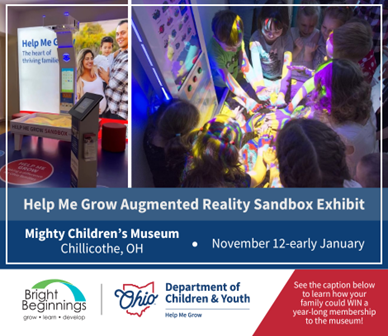
Augmented Reality Sandbox on Display on Chillicothe
Bright Beginnings, the statewide contractor for the Department of Children and Youth’s (DCY’s) Help Me Grow program, has created an educational traveling exhibit that features an augmented reality sandbox! The exhibit offers play opportunities with new technology for kids; and information about developmental milestones and Help Me Grow services for parents and caregivers.
|

The Mighty Museum in Chillicothe, Ohio is the second location to host the exhibit. It was previously at the Children's Museum of Cleveland. It is available for play on the first floor of The Mighty (just inside the entry) through early January. Visit the Mighty Children's Museum website for hours and admissions information.
Bright Beginnings is giving away a one-year Mighty Museum membership for a family of four. Entrants must:
- Be an Ohio resident.
- Complete at least one Ages and Stages Questionnaire (ASQ) with their child, through age 5, via the Sparkler: Play for Parenting app.
- Submit an entry form on our website.
Click here for details on the Museum Membership Giveaway. The entry deadline is January 2, 2025.
|
|
|
|
Initiatives work to connect educators, families, and youth to education
services and supports.
|
|
 |
|
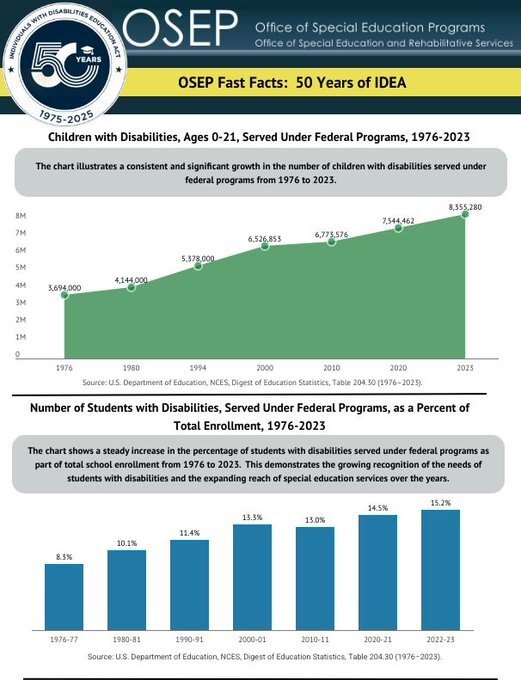
Individuals with Disabilities Education Act Turns 50
Do you know how many millions of students have been helped under the Individuals with Disabilities Education Act (IDEA)? Check out some of the facts behind this life changing law as the U.S. Department of Education celebrate 50 years of IDEA.
Click the image on the left to explore more information about IDEA.
|
Understanding the Preschool Least Restrictive Environment Continuum: Supporting High-Quality Individual Education Program Team Decisions
Ensuring that every preschool child with a disability is educated in the least restrictive environment (LRE) is a critical part of the Individual Education Program (IEP) team process. To support this work, the Department of Children and Youth offers tools to help teams understand and apply the Preschool Continuum of LRE Placement Options.
Ohio’s Operating Standards require IEP teams to begin by considering the general education setting the child would attend if they were not disabled. All placement options must be available, and any decision to remove a child from peers or typical routines must be individually justified in the IEP. This ensures decisions are based on each child’s unique needs.
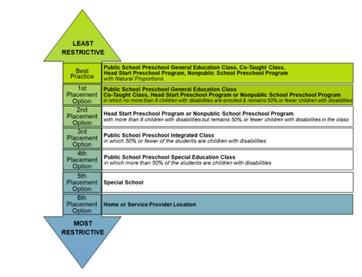
To assist teams, three helpful resources are available:
These tools can help teams make informed decisions that best support each child’s learning and development.
|
Training Designed to Strengthen Your Positive Classroom Environment
The Ohio State University Crane Center for Early Childhood Research and Policy, in partnership with the Ohio Department of Children and Youth, is excited to launch the third module in their new webinar series, Making Every Moment Count: Proactive Classroom Management.
This series of high-impact, 30-minute sessions is designed for early care and education professionals who want to make every moment count in their classrooms. Each session delivers a specific, research-based strategy that can be easily integrated into any curriculum to enhance children’s learning.
This session focuses on practices for shaping a positive classroom climate proactively - helping you teach with intention while reducing conflict and behavior challenges.
Join us on January 6 at 1 p.m. for: Making Every Moment Count: Proactive Classroom Management.
Missed earlier sessions? On-demand video versions are available!
👉 Register today by clicking here. Questions? Contact Amanda Grady at the Crane Center.
|
|
|
Family Support & Stabilization |
|
|
Focuses on enhancing the resources and supports available to parents and families.
|
|
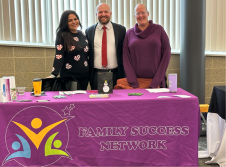
Opportunities for Social Work Students on Display at Youngstown Expo
The Ohio Children's Trust Fund (OCTF) attended the National Association of Social Work Ohio Region 4 Networking Expo last week at Youngstown State University.
OCTF Assistant Executive Director Eric Gonzalez supported Help Network of Northeast Ohio in their presentation of Family Success Network. The expo was designed to exhibit various work opportunities for social work students in the Mahoning Valley. Eric presented on the opportunity for social work students to enter the prevention space, noting that social work often requires crisis prevention but that the skillset and passion of social workers can also benefit prevention positions, such as those offered by the Family Success Network.
Pictured: From left to right, Sonnie Mikulka, FSN Program Manager Help Network, Eric Gonzalez, OCTF, Holly Sala, Trumbull County Family Coach
|
|
|
Children Services, Foster, Kinship, and Adoption |
|
|
Children Services, Foster, Kinship, and Adoption programs provide caregivers with support via resources for their individualized needs.
Medicaid Ohio Benefits (OB) Interface Town Hall Set for January 12
Public children services agencies are invited to attend the next Medicaid OB Interface Town Hall on Monday January 12, 2026, from 10 - 11:00 a.m. This one-hour session provides an opportunity to discuss ongoing concerns and ask practical questions about the OB Interface system.
To help guide the discussion, agencies may submit questions in advance to the Medicaid Technical Assistance inbox at Customer Care Center.
|
|
Five-Year Review: Children Services Rules
The following children services rules will be effective December 15, 2025, and have been posted to the Official Letters & Guidance | Department of Children and Youth (Transmittal Letter 53). These rules are being rescinded under their previous rule numbers at their five-year rule review, updated to question-and-answer format for increased clarity, and readopted under new numbers.
- OAC 5180:3-7-02 - Protective Supervision by Public Children Services Agencies (PCSAs): Outlines PCSA responsibilities when filing a complaint and complying with an order of protective supervision.
- OAC 5180:3-7-03 - Protective Supervision by Private Child Placing Agencies (PCPAs): Outlines PCPA responsibilities for filing a complaint and complying with an order of protective supervision
- OAC 5180:3-7-06 - Required Contents of a PCPA Case Plan Document: Specifies required elements in case plans developed by PCPAs. Changes the age for Independent Living requirements from 16 to 14.
- OAC 5180:3-7-20 - PCSA Requirements for Providing Ongoing Services in Alternative Response: Details case planning and review expectations in alternative response cases, including an extension of case review frequency from 90 to 180 days. Changes the age for Independent Living requirements from 16 to 14.
The following children services rules will be effective December 15, 2025, and will be posted at that time to the Official Letters & Guidance | Department of Children and Youth (Transmittal Letter 46).
- OAC 5180:2-5-09.1 - Background checks for college interns, subcontractors, volunteers, employees, board presidents, officers, administrators, and foster caregivers: This rule provides guidance on conducting criminal checks for individuals listed in this rule regarding foster homes and agencies. Language is being added to address conditional hiring of agency employes and the background checks of household minors who reach the age of eighteen.
- OAC 5180:3-27-11.1 - Reimbursement for Title IV-E foster care maintenance (FCM) costs for a qualified residential treatment program (QRTP) certified after October 1, 2020: Replacing the now rescinded rule 5180:2-47-11.1, this rule outlines the cost report requirements for a Qualified Residential Treatment Programs (QRTP) certified after October 1, 2020 as part of the Family First Prevention Services Act of 2018. It also sets parameters for claiming Title IV-E foster care maintenance payments.
Additional Five-Year Reviews
5180:2-5-17 and 5180:2-5-35
The Ohio Department of Children and Youth (DCY) is currently undertaking five-year reviews in accordance with Ohio law.
These two rules focus on ensuring the well-being and rights of children in foster care. Rule 5180:2-5-17 outlines the requirement for a discharge summary when a child leaves a foster or residential care setting, ensuring that key information about the child’s care, services received, and future needs is documented and shared with the appropriate custodial agency. Meanwhile, Rule 5180:2-5-35 establishes the Foster Youth Bill of Rights, which guarantees children in care the right to safety, dignity, privacy, and participation in decisions affecting their lives. Together, these rules aim to support continuity of care and uphold the fundamental rights of youth in Ohio’s child welfare system.
If you would like to review the existing rules and offer feedback and suggestions, please complete this form by December 22, 2025.
5180:2-39-03
This rule governs the emergency removal of a child from a substitute care setting when the child is in immediate danger of serious harm or poses a risk to others in the same setting. It requires public children services agencies (PCSAs) to notify all relevant parties within 24 hours, both verbally and in writing, about the reason for removal and key case details. If the child is in the custody of another agency, the initiating PCSA must immediately notify that agency and follow up in writing within three business days. The rule also mandates that the custodial agency update the child’s family case plan and document all actions taken in the case record to ensure accountability and continuity of care.
If you would like to review the existing rule and offer feedback and suggestions, please complete this form by December 15, 2025.
5180:2-42-18
This rule governs how public children services agencies (PCSAs) and private child placing agencies (PCPAs) can approve placements for children in their custody. Specifically, it allows these agencies to place children with relatives by blood, adoption, or marriage—or with nonrelatives who have a significant relationship with the child or family—even if these caregivers are not certified through the Ohio Department of Children and Youth.
If you would like to review the existing rule and offer feedback and suggestions, please complete this form by December 22, 2025.
5180:2-42-87
Rule 5180:2-42-87 outlines the process for determining when a child should remain in or be discharged from substitute care, requiring regular assessments and planning to support reunification or other permanency outcomes. It also mandates advance notice to caregivers and transitional services to help children and families prepare for changes in custody.
If you would like to review the existing rule and offer feedback and suggestions, please complete this form by December 22, 2025.
5180:2-48-15 and 5180:2-48-21
These two rules focus on ensuring that adoptive placements are well-informed and thoughtfully planned. Rule 5180:2-48-15 requires agencies to provide prospective adoptive parents with comprehensive information about the child they are matched with, including the child’s background, special needs, behavioral expectations, available supports, and any relevant legal or medical history. This helps families make informed decisions and prepare for the adoption. Rule 5180:2-48-21 outlines the requirements for creating and maintaining a Child Study Inventory (CSI) for children in permanent custody of a child welfare agency. It is used to support adoption planning and placement by providing detailed, non-identifying information about the child.
If you would like to review the existing rules and offer feedback and suggestions, please complete this form by December 22, 2025.
|
|
|
Programs are designed to provide support for teens and young adults who either are in foster care or have aged out of foster care systems and need assistance.
|
|
Independent Living 101 – Now Available Online
The updated Independent Living training held in September was recorded and is now available as asynchronous training in the Child & Adult Protective Services Learning Management System (CAPS LMS).
Whether you're new to working with older youth in custody or simply need a refresher on independent living requirements, this training is designed to support your work and enhance your understanding.
To access the training or view the accompanying materials—such as the PowerPoint PDF or the cumulative Q&A document from the live session—log in to the CAPS LMS tile in My Ohio and search for “Independent Living 101 – 2025 Updates.”
🔔 Be sure to mark each section of the training (video, QA, slides etc.) in order for each to be marked “Complete.” This step is required to get to the post-test and receive training credit.
For questions about working with youth 14 years old and older in custody or young adults that have emancipated from agency custody, please contact the DCY IL team mailbox.
For any questions about the CAPS LMS functioning, please e-mail: capslms@childrenandyouth.ohio.gov
|
|
|
|
|