|
Issue 47: November 11, 2025 |
|
Updates by Program Area
For Your Awareness
|
|
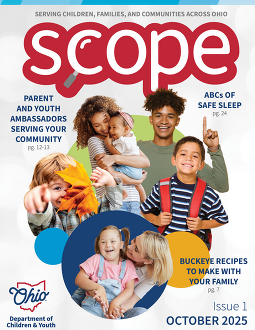
Check Out the First Issue of Scope!
DCY invites you to "flip" through our brand-new publication Scope. This e-magazine replaces Kids' Corner and was designed with intention and heart for the families we serve. The magazine was emailed to nearly 50,000 recipients last month and is posted on the DCY website. Please share Scope with your networks and the families you serve.
To subscribe, click here.
|
|
 |
|
|
Maternal & Infant Wellness |
|
|
Programs focus on improving birth outcomes, and improving the health status of pregnant women, infants, and children to ensure moms and babies celebrate the child’s first birthday.
|
|
November is Prematurity Awareness Month
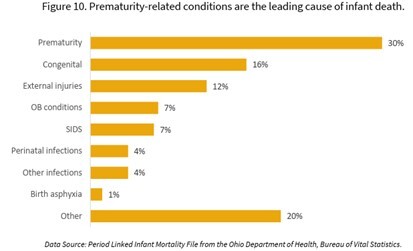
November is Prematurity Awareness Month, a time to recognize the thousands of babies and families affected by preterm birth each year; and to renew our commitment to ensuring that every Ohio newborn has the healthiest possible start.
In 2023, prematurity-related conditions were the leading cause of infant death in Ohio, accounting for 30% of all infant deaths. Similar to previous years, prematurity-related conditions were the leading contributor to Ohio’s 2023 infant mortality rate of 7.1 deaths per 1000 live births.
|
|
|
Reminder! The Launch of the DCY Systems Support Customer Care Center
As a reminder, the new DCY Systems Support Customer Care Center (CCC) is live! As of October 24, the DCY CCC is the primary tool for you to request DCY Program technology system support. The DCY CCC provides streamlined support to users with quick resolutions through Live Service Desk agents. It also has access to a centralized hub known as the Information Station that includes knowledge articles, training materials, and other key resources to support users with system-related issues.
Want to learn more? Check out the DCY Systems Support CCC Knowledge Articles available on the Information Station within the Customer Care Center for more information and resources.
Questions? Please visit the DCY Systems Support Customer Care Center for any questions or concerns regarding the new DCY Sytems Support CCC.
Invitation to Medicaid Ohio Benefits (OB) Interface Town Hall
Public children services agencies are invited to attend the next Medicaid OB Interface Town Hall on December 3, from 10 - 11 a.m. This one-hour session provides an opportunity to discuss ongoing concerns and ask questions about the OB Interface system.
To help guide the discussion, agencies may submit questions in advance to the Medicaid Technical Assistance inbox through the Customer Care Center.
|
|
Early Childhood Development |
|
|
The Early Childhood Development programs provide technical assistance, education, and referrals for families and youth with evaluations regarding specific needs and disabilities.
|
|
Home Visiting Prioritizing Families in the Children Services System
Help Me Grow Home Visiting is a two-generational approach that provides pregnant and parenting families with necessary resources and skills to raise children who are healthy, happy, and ready to learn. Program goals include improving maternal and child health; preventing child abuse and neglect; encouraging positive parenting; and promoting child development and school readiness.
With the passage of House Bill 7 earlier this year, DCY must specify in the rule that families involved in the children services system are priority recipients of Help Me Grow. As a result, DCY amended rules: 5180:8-3-10 Central Intake and Referral System and 5180:8-3-05 Provision of Home Visiting Services, with an effective date of November 24, 2025.
If you have any questions about this prioritization process, please contact your DCY Help Me Grow Home Visiting Program regional consultant.
|
|
|
Initiatives work to connect educators, families, and youth to education
services and supports.
Story Stretchers and STEAM Starters Kicked Off Learning Series for Educators
Free Activity Box for Participants at Regional Events
COSI made STEAM (Science, Technology, Engineering, Art, and Math) come alive last week for more than 250 early care and education (ECE) professionals during the first of several trainings supported by DCY.

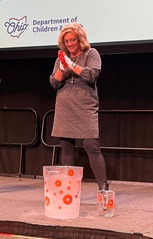
Story Stretchers and STEAM Starters featured an opening training with an exciting science demonstration, followed by five stations where attendees participated in hands-on activities connecting STEAM and literacy development.
ECE professionals earned Ohio Approved (OA) Professional Development credit in Curriculum and Assessment for participating. ECE students from two career centers came to gain valuable knowledge.
Additional trainings will be offered in the spring and the COSI team is developing online options to be available as well.
|
The next training in the series, STEAM Starts Here: Integrating Math, Science, and Inquiry in Early Childhood, will be offered November 14 in Gallia County at the Holzer Leadership and Innovation Building (ST 10158145) and on November 17 in Dayton at America's Packard Museum (ST 10158146). This regional training is different from the one offered at COSI, so participants who came to Columbus last week are welcome to join COSI in their own area of the state for additional learning and OA credit!
Register for this interactive and engaging program that blends science and literacy and is designed for ECE professionals working with infants through early school-age children.
In addition to earning three hours of OA Professional Development credit, participants at each regional event will receive a free COSI STEAM activity box.
This dinosaur-themed box is designed especially for your youngest learners. It reads like a storybook with plenty of activities throughout.
|
|
|
New Step Up To Quality Training and Guidance Materials
Available on DCY Website
To support early care and education programs with earning, maintaining, or increasing their Step Up To Quality (SUTQ) rating, DCY has created five new guidance documents and a new SUTQ Overview Training.
The SUTQ Guidance Documents provide detailed information on program standards for each level, Bronze, Silver, and Gold, including verification details, frequently asked questions, and implementation tips.
Click on each to read more:
Learning and Development Guidance Document
Administration and Leadership Practices Guidance Document
Staff Qualifications and Professional Development Guidance Document
Family and Community Partnerships Guidance Document
Staff/Child Ratio Guidance Document
DCY is also offering Step Up To Quality Essentials: Standards, Verification and Implementation training (ST10158355) through the Ohio Professional Registry (OPR). The training covers program standards and how implementation of the standards is verified. It also provides an overview of the registration process, answers frequently asked questions, and provides tips and best practices for implementation. Information on how to create a user profile and register for the training is found in the Profile User Guide.
More information about SUTQ including the links referenced above can be found on the DCY website.
Making Every Moment Count
OSU Crane Center is launching a Making Every Moment Count series in partnership with the Ohio Department of Children and Youth. These high-impact, 30-minute sessions for early care and education professionals on how to make every moment count in your classroom! Each session delivers a specific research-based strategy that can be easily integrated into any curriculum to enhance children’s learning.
Please join us for our first webinar on November 18, Teaching with Intent: Goal. Guide. Grow.
Teaching with intent is used across the day to target explicit learning goals for children.
-
Goal: Have a learning goal in mind.
-
Guide: Guide children towards the learning goal.
-
Grow: Grow children’s skills through everyday intentional interactions.
To register, click here. Questions should be referred to Amanda Grady at the Crane Center.
|
|
Virtual Training Opportunities
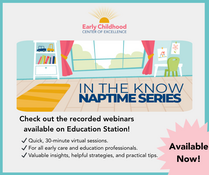
The In the Know Naptime webinars are recorded and available on the Education Station. The modules are Ohio Approved and eligible for 0.5 unit hours for Early Intervention (EI) developmental specialist/supervisor and EI service coordinator/supervisor through the Ohio Department of Developmental Disabilities. Catch up on the webinars today!
|
|
 |
Preschool Special Education Indicator 12 Compliance: Transition from Early Intervention to Preschool Special Education
Every year, districts receive a Special Education Profile that details progress over time in meeting goals for students with disabilities. The design of the Special Education Profile enables districts to utilize data on the academic growth of student groups, thereby continually improving their special education programs.
Indicator 12, one of the federal compliance indicators, measures the percentage of children referred by IDEA (Individuals with Disabilities Education Act) Part C (Early Intervention) who are found eligible for Part B (Preschool Special Education Services), and who have Individualized Education Programs (IEPs) developed and implemented by their third birthdays. IDEA requires that 100% of the children enrolled in Part C (Early Intervention) and found eligible for Part B (Preschool Special Education) have Part B services in place and implemented by each child’s third birthday.
The legal district of residence (DOR) is to report the events that occur when a child transitions from Part C to Part B into the Education Management Information System (EMIS). The dates of these reported events are what are used to calculate compliance with Indicator 12.
Within EMIS, the IEP Time Lines section includes IEP Effective Dates. The “Start” line is where the date of implementation should be recorded. Remember, this is the date that all identified services begin.
If an IEP is not implemented on or before a child’s third birthday for any child transitioning from Part C Early Intervention to Part B Preschool Special Education, then the district must enter a noncompliance reason code into the EMIS system.
Planning for instances such as weekend birthdays, leap year birthdays, and birthdays during breaks or holidays should be considered as the IEP Outcome Beginning Date (effective start date), occurring after the third birthday is considered late and requires the use of a noncompliance code and a Prior Written Notice (PR-01) documenting the reason for lateness.
More information and guidance can be found on the DCY website.
Indicator 12: Early Childhood Transition
Early Care and Education Training Rules Updates
5180:2-12-10, 5180:2-13-10, 5180:2-14-03, 5180:2-18-08, 5180:37-04 and 5180:32-03
The Ohio Department of Children and Youth (DCY) is currently undertaking a review of six early care and education training rules.
Ohio’s early care and education regulations require consistent training standards across various program types, including child care centers, family child care homes, in-home aides, day camps, preschool, and school-age programs. Staff and providers in these settings must complete age-appropriate CPR and first aid training and maintain current certifications.
Most programs also mandate training in child abuse recognition and communicable disease management to ensure health and safety. In-home aides and school-age program staff receive additional instruction in child development and guidance. Day camps emphasize emergency procedures. While all programs must document and renew training as part of ongoing compliance and quality assessments, these requirements help ensure that all early care and education environments in Ohio are safe, responsive, and developmentally appropriate.
If you would like to review the existing rules and offer feedback and suggestions, please complete this form by November 24, 2025.
DCY Memos and Resources
|
|
Family Support & Stabilization |
|
|
Focuses on enhancing the resources and supports available to parents and families.
|
|
Responsible Fatherhood Initiative Grant Applications Due Soon
The Ohio Commission on Fatherhood (OCF) will accept grant applications for its Responsible Fatherhood Initiative (RFI), Strong Fathers, Strong Families, until 1 p.m., November 20, 2025.
OCF seeks to award funding to organizations to implement the Responsible Fatherhood Initiative to strengthen father engagement across Ohio. The initiative will provide fathers with resources, support, and encouragement to enhance their parenting role.
DCY will award a total of $1.8 million annually to support services across 12 counties. Funding is set at $150,000 per county, per state fiscal year. Each application must clearly identify the specific county to be served. Future phases will expand the Responsible Fatherhood Initiative to include all counties across Ohio.
You can find the application and instructions here.
You can email questions about the RFGA-RFI here.
|
|
Children Services, Foster, Kinship, and Adoption |
|
|
Children Services, Foster, Kinship, and Adoption programs provide caregivers with support via resources for their individualized needs.
|
|
Northwest Treatment Foster Care Pilot Returns $4 to taxpayers and Community for Every $1 Invested
The Northwest Treatment Foster Care Collaborative, led by Sandusky County Job and Family Services, in partnership with Seneca, Wyandot, Ottawa, Hancock, and Wood counties, licensed its first treatment foster home in December 2022. Since then, the Collaborative has placed more than 70 youth in treatment foster care homes where specially licensed and trained foster parents provide a higher therapeutic level of care.
Research by Ohio University’s Voinovich School of Leadership and Public Service shows that the innovative approach taken by the Northwest Treatment Foster Care Collaborative saved taxpayers roughly $1.9 million in placement costs, staff time, healthcare spending, and special education costs. Review the study results published by PCSAO here.
In 2024, the Ohio Department of Children and Youth awarded funding to 36 other counties that formed 10 additional collaboratives to increase access to treatment level foster homes across Ohio.
Adoption Month Shines Light on Permanency
Ohio Governor Mike DeWine and Lt. Governor Jim Tressel signed a proclamation declaring November Adoption Recognition and Recruitment Month and highlighting the need for meaningful connections and lasting bonds.
“Adoption has changed my life in so many ways. It’s taught me more than I ever thought I could know about unconditional love and patience. He (son she adopted with significant medical needs) is the biggest blessing to have ever come my way, and I thank God every day for each moment I have with him. Adoption has changed my life forever and I couldn’t be more grateful 💚” – Adoptive Mom, Wood County.
Of the 14,200 Ohio children currently in foster homes or other out-of-home settings, 3,200 of them are waiting to be adopted. More than half of those are age 13 and older.
Prospective parents looking for information about adoption can find many helpful resources at DCY's Foster, Adoption, and Kinship website. Profiles of older youth are available here.
There are additional resources for families after the adoption is final.
Families interested in receiving more information should fill out the Foster and Adoptive Parent Inquiry Form.
Obtaining a Social Security Card: Accepted Documents
Agencies have recently raised questions about documentation that can be used to obtain a Social Security Card for a child or youth when the Social Security Administration (SSA) requires two forms of identification. Historically, many agencies relied on the Medicaid card report as one of the acceptable documents. However, with the transition to Ohio Benefits (OB) as the system determining Medicaid eligibility, the format and accessibility of that report have changed.
As a result, the previous Medicaid card report is no longer considered a valid form of identification for SSA purposes. Agencies must now refer to SSA’s current guidelines for acceptable identity documents. These include:
-
Primary documents: U.S. passport, state-issued ID, or driver’s license (for the child, if applicable)
-
Secondary documents: Certified birth certificate, medical records, school records, or adoption records — all must be originals or certified copies issued by the appropriate agency
SSA requires that all documents be either originals or certified by the issuing agency. Photocopies, notarized copies, or receipts showing an application for a document are not accepted.
Agencies are encouraged to consult SSA’s official documentation list to ensure compliance and avoid delays in processing Social Security Card requests.
For information on replacing a Social Security Card, click here. For additional information, click here.
Five Year Adoption Rule Review
5180:2-48-03, 5180:2-48-06, 5180:2-48-08, 5180:2-48-09, 5180:2-48-12.1, 5180:2-48-12.2 and 5180:2-48-19
DCY is currently undertaking a five-year review of seven adoption rules, in accordance with Ohio law.
The rules require agencies to gather and share a child’s social and medical history with prospective adoptive families, ensure qualified assessors conduct all adoption-related activities, and establish procedures for handling inquiries and applications from prospective adoptive parents, including required pre-service training. The rules also outline the procedures for completing, updating, and amending adoption home studies when family circumstances change, and they establish standards for sharing or transferring home studies between agencies while ensuring confidentiality and prohibiting discrimination.
If you would like to review the existing rules and offer feedback and suggestions, please complete this form by November 24, 2025.
|
|
|
Programs are designed to provide support for teens and young adults who either are in foster care or have aged out of foster care systems and need assistance.
|
|
Governor DeWine Expands Access to Driver Training Scholarships
Public children service agencies, private child placing agencies, and caregivers supporting safe driving for teens, please review Governor DeWine’s announcement regarding expanded access to driver training in Ohio and visit Drive to Succeed 2023-2025 | Ohio Traffic Safety Office for more information about available supports for our current and former foster youth and young adults.
Driver’s training is a critical component of foster youths’ normalcy, independent living skills, and self-sufficiency, so we are excited to share this resource.
OHIO Youth Advisory Board (YAB): Empowering Foster Youth through Advocacy and Elevating Youth Voice
The OHIO Youth Advisory Board (YAB), a statewide voice for youth with lived experience in out-of-home care, continues to lead impactful initiatives and advocacy efforts across Ohio.
Youth (14+) in agency custody and young adults (18-24) with foster care experience are encouraged to attend quarterly OHIO YAB meetings.
Quarterly meetings are held on the third Thursday in January, April, July, and October from 11 a.m. - 2 p.m. at OCCRRA (Ohio Child Care Resource and Referral Association), located at 2469 Stelzer Rd. Columbus, OH 43219.
Add 2026 meeting dates to your calendar now!
- January 15, 2026
- April 16, 2026
- July 16, 2026
- October 15, 2026
Anyone interested in connecting with the Ohio Youth Advisory Board for stakeholder feedback can reach out to DCY’s Independent Living team at transitional-youth-programs@childrenandyouth.ohio.gov.
|
|
|
|
|