|
For Your Awareness
 ‘Here for Ohio Kids’ Digital Advertising Campaign Launches
We’re getting the word out about DOING WHAT’S RIGHT FOR KIDS! The DCY Team is excited to announce the launch of a new awareness campaign that invites Ohio families to learn about and use the life-changing programs and services available through DCY.
A variety of campaign ads (social media, native, and display) is designed to appeal to Ohio families and children from prenatal care through age 21. The campaign’s associated landing page at childrenandyouth.ohio.gov/here offers Ohioans additional pathways to information and a fast, easy way to connect with DCY. Feel free to share the landing page URL (and its highlighted resources) with your clients.
Strategic support for DCY’s efforts to make Ohio the best place in the nation for families
Campaign ads combine family-friendly, relatable imagery with conversational, optimistic copy to increase awareness of DCY and available programs and services. This warm, welcoming campaign positions DCY as a trusted resource for Ohio parents and caregivers and communicates the department’s readiness and ability to help Ohio families thrive. Look for these ads in your Meta feed and other online adventures!
Login Changes for Citizens Using Ohio Benefits Self-Service Portal
The Ohio Benefits Program Self-Service Portal (SSP) has moved to a Single Sign-On that requires users to log in using their OHID credentials. Individuals who have an existing Self-Service Portal account began receiving communications about this change last month. New SSP users after March 28, 2025, are required to use their OHID to access the SSP. New SSP users without an OHID will need to create a login.
What is OHID Single Sign-On?
- OHID is the State of Ohio’s digital identity solution for both citizens and State agency employees. OHID Single Sign-On (SSO) refers to a single set of unique login credentials (OHID and password) used to access different State agency services and applications. Having one unique username and password to access multiple state agencies helps minimize security risks and simplifies the login process.
- If you have an existing OHID to access other agency applications (e.g. BMV, OJI, etc.), you will not need to create a new OHID to access Ohio Benefits Program applications.
More Information and Helpful Resources:
|
|
Maternal & Infant Wellness |
|
|
Programs focus on eliminating health disparities, improving birth outcomes, and improving the health status of pregnant women, infants, and children to ensure moms and babies celebrate the child’s first birthday.
|
|
Ohio Pregnancy Assessment Survey Data New Available
Data from the 2023 Ohio Pregnancy Assessment Survey (OPAS) is now available on the OPAS Dashboard. OPAS is administered by the Ohio Department of Children and Youth and the Ohio Department of Medicaid with the assistance of the Ohio Colleges of Medicine Government Resource Center (GRC). OPAS is a statewide, ongoing, targeted population-based survey that utilizes the Centers for Disease Control and Prevention (CDC) Pregnancy Risk Assessment Monitoring System (PRAMS) methodology to collect information on the experiences and attitudes of current Ohio residents who recently gave birth in Ohio. OPAS is an important surveillance and assessment tool that:
- Provides data to improve maternal and infant health (MIH)
- Allows for the monitoring of changes to specific key MIH indicators in areas such as prenatal care, substance use, breastfeeding, safe sleep for infants, violence, and nutrition
- Enables a population-based profile of mothers with a live birth
- Enables comparisons between states relating to maternal and infant health statuses.
If you are interested in learning more about OPAS or have questions about the data, please reach out to Andrea Arendt or Bria Oden.
|
|
Early Childhood Development |
|
|
The Early Childhood Development programs provide technical assistance, education, and referrals for families and youth with evaluations regarding specific needs and disabilities.
|
|
Save the Date for Help Me Grow Home Visiting Conferences
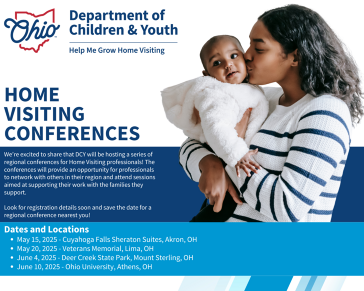
We are excited to announce that DCY will host a Help Me Grow Home Visiting regional conference for 2025. The event will be held on four different dates and locations for all Help Me Grow home visiting professionals. We are looking forward to home visiting professionals having a day of learning, collaborating, and sharing experiences of the important work being done to support Ohio families. Please click on the photo above to see the available dates. Additional registration information will be sent out soon to all home visiting supervisors and program managers.
|
|
|
|
Initiatives work to connect educators, families, and youth to education
services and supports.
|
|
Trainings Available to Teach Littles About Nutrition, Agriculture, and Gardening
The Ohio State University Extension offers trainings to give young children increased exposure and access to gardening and food-based education.
Farm to Early Care and Education is innovative and evidence-based. The training is free and 2.0 Ohio Approved (OA) credit hours on OCCRRA's OPR.
For more information, click here.
|
|
Ohio Early Care and Education Market Rate Survey 2024
The Ohio Department of Children and Youth (DCY) has released the final Ohio Early Care and Education Market Rate Survey (MRS) Analysis Report for 2024. Conducted approximately every two years, this survey is a federal requirement that helps DCY establish market rates across Ohio by child care provider type, child age group, and region.
The 2024 survey was developed with input from key stakeholders and designed to gather the most relevant data to inform Ohio’s child care policies.
You can access the full Market Rate Survey report and learn more about its findings here. Thank you to all providers who participated in this important effort!
|
|
Family Support & Stabilization |
|
|
Focuses on enhancing the resources and supports available to parents and families.
Free Webinars Offered for Child Abuse Prevention Month
The Ohio Children’s Trust Fund (OCTF) is excited to share that for National Child Abuse Prevention Month, we will be hosting five webinars every Wednesday in April that highlight various statewide and localized programs and initiatives throughout Ohio. These webinars are free and will be held via zoom at 11a.m. on the dates listed on this flyer. Please note, if you are interested in attending, you will need to register separately for each webinar.
You can also find out more information about each webinar and register here.
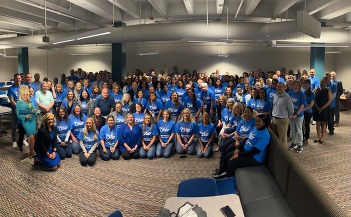
Wear Blue to Support Child Abuse Prevention Efforts
Grab your colleagues and take a selfie showing everyone your blue for Child Abuse Prevention awareness. Don’t forget to post on your social media accounts with #OhioWearsBlue.
April 4 – Prevent Child Abuse America (National)
April 9 - Public Children’s Services Association Ohio (State)
(Photo from Wear Blue Day 2024)
|
|
|
Telehealth offered for Children and Youth Behavioral and Mental Health
Behavioral and Mental Health Telehealth is now available through a new vendor, A&R Clinical Services Crisis Management (ARCSCM). This initiative is aimed at increasing timely access to behavioral and mental health supports to better meet the needs of children, youth, and families. The telehealth service provides immediate virtual mental and behavioral health support. It can help fill gaps, such as waitlists, that may exist until ongoing services can be provided.
Through access to telehealth sessions, behavioral and mental health concerns can be stabilized for a short-term duration while long-term services are being established for the family. To access Behavioral and Mental Health Telehealth, a child, youth, or family must be referred by a Public Children Services Agency (PCSA), Family and Children First Council (FCFC), or Infant and Early Childhood Mental Health (IECMH) Consultant. Additional communication will be sent to PCSAs, FCFCs, and IECMH Consultants with further information and instructions for referral.
For more information, please contact Telehealth@childrenandyouth.ohio.gov.
|
|
Children Services, Foster, Kinship, and Adoption |
|
|
Children Services, Foster, Kinship, and Adoption programs provide caregivers with support via resources for their individualized needs.
|
|
DCY to Introduce New QRTP Monitoring Tools at April 16 Kick-Off Event
The Ohio Department of Children and Youth (DCY), Division of Regulatory Compliance, is excited to introduce the DCY Certified Qualified Residential Treatment Program (QRTP) Monitoring Guide.
Are you ready to learn more? We will be holding a Stakeholder Kick Off Event on April 16, 2025, from 1:00 - 2:30 p.m. for certified agencies and related partners to learn more about DCY’s monitoring approach and the new QRTP Monitoring Guide. For more information, please reach out to your DCY Foster Care Licensing Specialist today!
|
|
|
Programs are designed to provide support for teens and young adults who either are in foster care or have aged out of foster care systems and need assistance.
|
|
Special Occasions Like Prom Even More Special for Youth in Care
Click the video to hear Lyric, a member of the Ohio Youth Advisory Board talk about Normalcy for foster youth.

With prom season right around the corner, now is a good time for counties to be thinking of ways to encourage, or even initiate, normalcy opportunities for youth in their custody. Normalcy activities, like prom, are not only a cultural rite of passage, but also prompt life lessons and help build self-sufficiency.
As a young person, it is easy to just think about the prom outfit, the food, pictures, and dancing with friends. But there are many life skills that are practiced in preparation. Youth can practice developing a budget for prom expenses, learn to place an order for a boutonniere or corsage, research finding an outfit they like in their price range, research a place to get hair/nails done within their budget, coordinate logistics with friends on where to eat and learn to make reservations, navigate peer relationships, and practice time management skills.
Independent Living (IL) funding can be used for normalcy activities for youth in foster care age fourteen and older. IL funds are allocated to counties and are to be used to support the youth’s independent living goals, which includes normalcy activities. IL funds are flexible and must be used in a way to support a goal in the independent living plan. We encourage counties to utilize their spending of the Chafee and TANF-IL funds on services for young people 14 and older in agency custody and for young adults that emancipated from agency custody 18 years old to their 21st birthday.
PCSAs can reach out to the DCY transitional age programs team with questions about IL plan goals and examples of activities/normalcy opportunities that can be supported using IL funds.
In September 2024, DCY staff facilitated a training entitled “Normalcy & the Reasonable and Prudent Parent Standard – 10 years later.” This online class is available in the Child and Adult Protective Services Learning Management System (CAPS LMS) through the My Ohio tile and is a good overview of the legislation to encourage normal activities for children and teens in agency custody. The training discusses the strides that have been made in the past 10 years towards normalcy and the significant work that still needs to be done.
If counties need clarification on the use of IL funds or how to tie a normalcy activity to a goal on a youth’s independent living plan, the DCY transitional age programs team can help.
|
|
|
New Warm Handoff Specialists Help Young Adults Move from Foster Care to Bridges
DCY is pleased to announce the new Bridges Warm Handoff (WHO) Specialist positions. These positions have been created to work with foster youth and agencies as they prepare to emancipate from foster care to create a more seamless enrollment for young adults entering the Bridges program. Starting in April, the Warm Handoff (WHO) Specialist will launch in 9 counties (Cuyahoga, Medina, Summit, Franklin, Licking, Pickaway, Montgomery, Miami, and Greene) that were selected based on the number of youth aging-out of foster care and resource needs. Please see the DCY memo 25-025 below for additional details.
|
|
|
|
|