|
Issue 25: January 7, 2025 |
|
For Your Awareness
Join Us January 13 for the Second Stronger Together Session
Team members from the Department of Children and Youth and the Department of Medicaid will host the second webinar in the Stronger Together series, titled Medicaid: Children, Youth, and Managed Care. This presentation will review Medicaid and the role of Managed Care Plans – including application process, services, and how to get help. It will be held from 10:00 - 11:00 a.m. To learn more and get the Teams Live link, view the flyer here.
Click here to watch the first Stronger Together presentation.
Tuesday Times Has a New Format
Welcome to our new layout! We are now organizing our articles within the same categories we use to present information on our website. Our goal is to make it easier for you, our partners and stakeholders, to find the information you need.
If you have feedback or story suggestions, please contact DCY Communications. Happy New Year!
|
|
Maternal & Infant Wellness |
|
|
Programs focus on eliminating health disparities, improving birth outcomes, and improving the health status of pregnant women, infants, and children to ensure moms and babies celebrate the child’s first birthday.
|
|
Learn More About Family Connects Ohio
What is the Family Connects Ohio Program?
Family Connects Ohio (FCO) is a universal home visiting program that kicked off in Summer 2024 with the start of the Family Connections International Academy trainings and technical assistance for DCY team members and our local implementing partners. FCO is designed to meet the needs of new families across Ohio and directly supports the Ohio Department of Children and Youth’s (DCY) three big goals, which are to reduce Ohio’s infant mortality rate and ensure babies in Ohio live to see their first birthdays, empower families with needed resources and supports before, during, and after a need, as well as investing in community resources to enable support along the continuum of ages, stages, and services to help children and youth succeed. FCO aims to help children and families thrive, impacting the health, safety, and school-readiness of children, maternal health, and family stability and financial security.
Who Does Family Connects Ohio Serve?
Through FCO, every family in participating counties – regardless of income – is eligible to receive a nurse home visit around three weeks after they bring their new baby home to ensure that new moms and babies are both doing well. These services come at no cost to new families and include a physical exam for both mom and baby. The nurse answers any questions about caring for the new baby and provides referrals to other services and resources to support the family.
Currently, services are available in Darke, Erie, Fayette, Greene, Guernsey, Hamilton, Huron, Mahoning, Noble, Shelby, and Trumbull counties as part of the initial roll out of FCO, with the aim of expanding to additional Ohio counties in the future. The first FCO home visit was held in Mahoning County on December 23.
How Do I Provide Services with Family Connects Ohio?
FCO partner/provider agencies were selected to provide services through a solicitation process. DCY may release an additional competitive solicitation for additional providers in the future.
Want to Learn More About Family Connects Ohio?
Click here for more information about FCO or to refer someone to the program.
|
|
Early Childhood Development |
|
|
The Early Childhood Development programs provide technical assistance, education, and referrals for families and youth with evaluations regarding specific needs and disabilities.
|
|
Trauma Informed Care Series: Responding to Early Childhood Trauma, Part Two
It’s about understanding what early childhood trauma is! Early childhood trauma occurs when a young child experiences an event that causes actual harm or poses a serious threat to the child’s emotional and physical well-being. Exposure to Adverse Childhood Experiences (ACEs) such as child abuse, family violence, parental/caregiver incarceration, or substance abuse can significantly disrupt a child’s sense of safety and security. These potentially traumatic events can lead to chronic stress, affecting brain development and contributing to a child developing a range of emotional and behavioral challenges. Trauma is different from regular life stressors...
|
|
|
Initiatives work to connect educators, families, and youth to education
services and supports.
|
|
Mental Health H.O.P.E. Line Starts Taking Calls January 8
Starting tomorrow, licensed early education programs, including family child care sites, can call a "warm line" when kids, from birth to age eight, in their care could benefit from Infant and Early Childhood Mental Health (IECMH) Consultative Services.
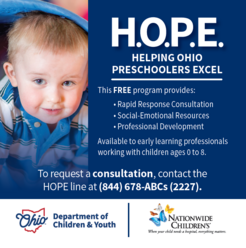
Any provider/administrator can call (844) 678-ABCs (2227) to request assistance to be provided within 48 hours. This assistance includes classroom observations, resources, professional development, and when appropriate, referral for behavioral health treatment for children who could benefit from additional support. Providers and administrators may also submit an online request form. Nationwide Children's Hospital receives these requests and then routes them to the local IECMH consultant within the behavioral health agency that is contracted by DCY to provide services. The local consultant makes contact with the site and goes there to provide observations, resources, suggestions, and other consultative services.
The H.O.P.E. Line is a relaunch of the Ohio Preschool Expulsion Prevention Partnership (OPEPP) with the goal being to get the centers connected to resources to help children before they are in danger of suspension or expulsion.
|
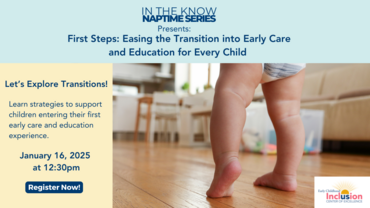
Webinar Teaches Strategies to Make Those First Early Education Experiences Less Scary
Join us Thursday, January 16, 2025 at 12:30 p.m. for a discussion on First Steps: Easing the Transition into Early Care and Education for Every Child.
Entering a new child care or preschool experience can be uncomfortable—even scary—for parents and children. Participants in this session will identify strategies to support children entering their first early care and education experience. Learn more and share your own tips on how to: include families, introduce and reinforce new routines, and consider adaptations for children with special circumstances.
The In the Know Naptime Series is a free webinar presented monthly that is open to educators and professionals working with young children, as well as parents, family members, and caregivers. The first 50 Ohio registrants who attend will receive a free All About Me Toolkit.
|
|
|
Family Support & Stabilization |
|
|
Focuses on enhancing the resources and supports available to parents and families.
|
|
Human Trafficking Prevention Training/Resources Available to Child-Serving Professionals
January is National Human Trafficking Prevention Month, a time to increase public awareness about human trafficking, and how we can improve our ability to identify and respond to human trafficking. In 2023, the Ohio Department of Children and Youth (DCY) became a subgrantee of the Improving Outcomes for Child and Youth Victims of Human Trafficking grant, awarded to the Governor’s Human Trafficking Task Force by the Office for Victims of Crime. DCY accepted funding to enhance the Ohio child welfare system’s ability to identify and respond to child and youth victims of human trafficking and increase access to benefits for foreign national victims.
Children and youth involved with the systems we work in often possess unique experiences and characteristics that increase their vulnerability to human trafficking. In most cases, they are trafficked by people they know and trust: family members, intimate partners, and employers. It is uncommon for victims to recognize their experiences as human trafficking and ask for help; therefore, it is important that we have the knowledge and skills needed to identify human trafficking among children and youth, and that we are prepared to respond.
In collaboration with other members of the grant team and task force, DCY is providing field-specific technical training to child-serving professionals. DCY is also providing technical assistance to public children’s services agencies to aid in developing a multi-disciplinary, trauma-responsive approach to human trafficking. Training and technical assistance can be requested by contacting DCY’s Anti-Human Trafficking Coordinator, Haleigh Young, at haleigh.young@childrenandyouth.ohio.gov.
Traffickers exploit the vulnerabilities of the children and youth we serve, as well as the gaps that exist when we fail to collaborate. The DCY Bureau of Professional Development’s motto for this year is, “And who else?” By asking this question and fostering a multi-disciplinary approach across systems and jurisdictions, we aim to provide comprehensive training and education to communities and connect victims and survivors to the services and resources they need for safety and healing.
Additional Resources
|
|
DCY Memos and Resources
No updates to share at this time.
|
|
Children Services, Foster, Kinship, and Adoption |
|
|
Children Services, Foster, Kinship, and Adoption programs provide caregivers with support via resources for their individualized needs.
|
|
New Guidelines Announced for Individual Training Needs Assessment
DCY Memo #25-003 provides an overview of recent updates to the Individual Training Needs Assessment (ITNA) process for assessing the training needs of caseworkers and supervisors under OAC 5101:2-33-55. It outlines the transition from using hire dates to the "training compliance date" field for ITNA assignments. This round of assignments will be delayed until March 2025. Additionally, it highlights key responsibilities for county training liaisons and RTC Coordinators in maintaining accurate compliance data.
|
|
|
Programs are designed to provide support for teens and young adults who either are in foster care or have aged out of foster care systems and need assistance.
|
|
No updates to share at this time. |
|
DCY Memos and Resources
No updates to share at this time.
|
|
|
|
|