
Hudson River Almanac 9/26/14 - 10/2/14
The New York State Department of Environmental Conservation sent this bulletin on 10/10/2014 11:36 AM EDTYou are subscribed to receive updates from DEC. Links to receive help or to change your preferences are provided below. Having trouble viewing this email? View it as a Web page.

September 26 – October 2, 2014
Compiled by Tom Lake, Hudson River Estuary Program Naturalist
OVERVIEW
This might have been the last week of ruby-throated hummingbird sightings, and the bulk of the broad-winged hawk migration was over at the Chestnut Ridge Hawk Watch. Mature American eels in the watershed were turning silver in preparation for the journey back to their Sargasso Sea birthplace. Winging southward from far northern climes, a rare wheatear showed up on a Brooklyn beach.
HIGHLIGHT OF THE WEEK
9/29 - Greene County, HRM 118: For the second time in a week I got to enjoy a migration event. Early this morning, shortly after the fog lifted, the swallows began descending, flying very low over the water and then into their chaotic, zipping around feeding routine. And they just kept coming, seemingly out of nowhere. Getting an accurate count was not possible but my best estimate was two to three thousand birds, almost all tree swallows. I stopped paddling my kayak and allowed the current to carry me through the flock. This was on the edge of a marsh where I assumed they would seek cover and stay during the day. What a great way to start my week!
- Michele Tarsa
NATURAL HISTORY NOTES
9/26 - Bedford, HRM 35: Deep blue skies made spotting raptors difficult at the Chestnut Ridge Hawk Watch. When the occasional cloud provided cover, the silhouettes of migrating birds were reliably revealed. A red-shouldered hawk was active throughout the day. After one dive to the southeast in mid-morning it was seen carrying a small bird. Also sighted were two monarchs and one ruby-throated hummingbird. Current selected season totals were 6,052 broad-winged hawks and 642 sharp-shinned hawks.
- Dan Schniedewind
9/26 - Ossining, HRM 33: I noticed two wild tom turkeys wandering around the worker's garage at Mariandale this morning, seemingly oblivious to the activity going on around them. When I was leaving later in the afternoon, I spotted them in the large vegetable garden. Since they were much closer now, I could clearly see their long beards and beautiful iridescent feathers. As I watched, they suddenly became alert and quickly darted away into the nearby woods.
- Dorothy Ferguson
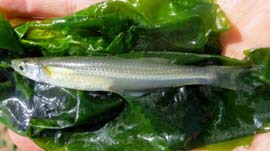 9/26 - Sandy Hook, NJ: We hauled our seine through some dense beds of sea lettuce (Ulva latuca) on the bay side of the Hook, looking to discover "who" was using the vegetation for cover. As our net completed the circle we felt the resistance of many fish. A meter from the beach it stalled - we could haul it no further. Two idle windsurfers aided us and we partially beached the seine with more than 500 Atlantic silversides 60-110 millimeters [mm] long, sparkling in the sunlight. We quickly scooped up a dozen for measurements and slid the rest back into the water. A subsequent haul netted mummichogs (45-50 mm), sand shrimp (Crangon septemspinosa), fiddler crabs, and comb jellies. The water was 66 degrees Fahrenheit. [Photo of Atlantic silverside on sea lettuce courtesy of Tom Lake.]
- Tom Lake, A. Danforth
[Sandy Hook, New Jersey, borders on the Lower Bay of New York Harbor and is either the beginning or the terminus of the Hudson River watershed, depending upon your perspective. Migrants, from fish to songbirds to raptors to butterflies, closely follow the coastline in autumn and springtime, making Sandy Hook an important way station in and out of the watershed Tom Lake.]
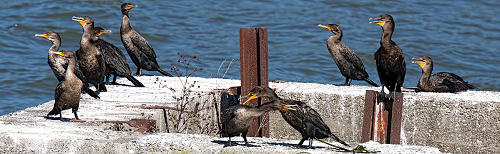
9/27 - Charles Point, HRM 43: I was delighted to see many double-crested cormorants, including young birds, hanging out on a cement structure near the shore at Charles Point. Cormorants usually hang out in the river on the rocky base of light towers. It was fun watching them interact with each other. [Photo of double-crested cormorants courtesy of Terry Hardy.]
- Terry Hardy
 9/27 - Bedford, HRM 35: Except for the start and the end of the day at the Chestnut Ridge Hawk Watch, birds were very high. Nine ospreys took the season total to 195. Also sighted were four monarchs and two ruby-throated hummingbirds. Current selected season totals were 6,071 broad-winged hawks and 678 sharp-shinned hawks.
- Dan Schniedewind
9/27 - Croton Point, HRM 35: The shore-bound anglers on the sea wall were having a ball catching a mixed bag of white perch, channel catfish, and numerous small bluefish ("snappers"), as well as some number one Jimmy blue crabs. When the fish and crabs are around, the bait you use matters little.
- Christopher Letts
9/27 - Sandy Hook, NJ: As the sun peeked over the horizon and lit a path across the Lower Bay of New York Harbor, packs of marauding "tailor" blues (3-6 pound bluefish) were attacking schools of menhaden. Overhead, gulls and terns were in a state of pandemonium, dipping and diving into fragments of fish, looking to avoid the slashing teeth just below the surface. A strong surf was crashing on the beach, creating a high-energy zone. Smooth dogfish and clearnose skates were busy cleaning up on mollusks, crustaceans, and other shellfish. From first light to sun-up, there are few finer places on earth to be than on an east-facing ocean beach.
- Tom Lake
9/28 - Denning's Point, HRM 60: The carp fishing continued to be good despite a lot of "nibbles" from bait-stealing fish (probably white perch). The largest of the two that I hooked, landed, and released today measured 30 inches long and weighed nearly fifteen pounds.
- Bill Greene
9/28 - Bedford, HRM 35: It was a pretty slow day at the Chestnut Ridge Hawk Watch until the winds started from the south/southeast in the final 90 minutes of the count. This brought a burst of activity including five peregrine falcons (a total of eight for the day). Also sighted were two common loons, seven monarchs, and two ruby-throated hummingbirds. Current selected season totals were 6,084 broad-winged hawks and 716 sharp-shinned hawks.
- Tait Johansson, Chet Friedman, Christina Lupoli, Steve Ricker, Wes MacKenzie
9/28 - Croton Point, HRM 35: Modest amounts of wild celery leaves (Vallisneria americana) were being left all along the swimming beach at the high tide mark twice a day. There were large windrows in some areas. The effects of Sandy were less here in these sheltered waters, or else recovery of the vegetation has been more rapid.
- Christopher Letts
9/29 - Town of Wappinger, HRM 67: This was the last day I would find ruby-throated hummingbirds at my feeders. Two females took a long, last drink and were on their way. Last year their final appearance came on September 25.
- Tom Lake
9/29 - Bedford, HRM 35: As it was yesterday, we had a slow day at the Chestnut Ridge Hawk Watch until the afternoon when we counted all of our kestrels (68), harriers (nine), and peregrine falcons (three). Also sighted were seventeen common nighthawks, 21 monarchs, and one ruby-throated hummingbird. Current selected season totals were 6,092 broad-winged hawks and 752 sharp-shinned hawks.
- Tait Johansson, Christina Lupoli, Wes MacKenzie
9/29 - Croton Point, HRM 35: Following thirteen days with no rain, the salinity just off the beach was 7.0 parts per thousand [ppt]. We hauled our seine through the diminishing beds of wild celery (aquatic vegetation gives up its leaves in autumn just as upland deciduous trees do). Atlantic silversides (90-95 mm), a fish that appreciates some salt in the water, dominated the catch. Mixed in were young-of-the-year [YOY] striped bass (81-110 mm) and bay anchovies (49-51 mm), northern pipefish (50-140 mm), and dozens of shore shrimp (Palaemonetes pugio). This late-summer, early fall has been a time for blue crabs and we caught many from penny-size to market-size. Conspicuous by their absence were YOY herring, including Atlantic menhaden. The river was 70 degrees F.
- Tom Lake, Gino Garner
9/29 - Croton Point, HRM 34: I counted three kestrels as well as phalanxes of robins and cedar waxwings (several hundred birds) shaking the canopies in the trees on the south side of the Point.
- Christopher Letts
9/30 - Hyde Park, HRM 82: Today was the fourteenth anniversary of the closing, after 392 days, of the Hyde Park mastodont excavation site from an old oxbow of Fallkill Creek. Family groups of this extinct "elephant" roamed the Hudson Valley until about 10,500 years ago. Adults were estimated to have stood nearly ten feet high at the shoulder and weigh almost 10,000 lb. The Hyde Park mastodont was the most complete skeleton of a mastodont ever unearthed in the Northeast. Because the excavation took thirteen months, hundreds of students, from elementary to graduate school, from Michigan to Virginia to Canada and all of New England, had the opportunity to help as they entered a "time machine" back to a Dutchess County of 11,500 years ago. While no direct evidence at this site linked the mastodont to the first humans in the Hudson Valley, there is little doubt that they had crossed paths during the 34 years of the animal's life.
- Tom Lake
9/30 - Beacon, HRM 61: The inshore shallows at Long Dock were coated with the tiny, free-floating aquatic plants known as duckweed (Lemna sp.). More than 50 Canada geese were foraging less than a hundred feet offshore. We cautiously hauled our short seine (20-footer) and caught many YOY striped bass (59-62 mm). Despite two weeks with no rain, and the salt front (measurable salinity) more than four miles upriver, the salinity was still stuck at 2.5 ppt. The river was 71 degrees F.
- Tom Lake, T.R. Jackson
[For up-to-date information on the salt front's location, go to the U.S. Geological Survey's Hudson River salt front website. Steve Stanne]
9/30 - Bedford, HRM 35: Only eleven migrants were spotted today at the Chestnut Ridge Hawk Watch. Among them were an adult bald eagle and a peregrine falcon flying very close and low. Also sighted was a single monarch butterfly. Current selected season totals were 6,092 broad-winged hawks and 756 sharp-shinned hawks.
- Dan Schniedewind, Christina Lupoli
9/30 - Croton-on-Hudson, HRM 35: The landscape was dry and warmly golden. It was "Indian Summer" even though there hadn't been a frost. Thirsty trees were dropping their browned leaves, not even bothering to let them turn brilliant. Ground covers like ivy that never show thirst were withering. It's been a week since I saw hummingbirds at the feeders. Too bad the cardinal flower vine that took three tries to germinate was finally blooming - tiny little scarlet trumpets, just right for hummingbird beaks.
- Robin Fox
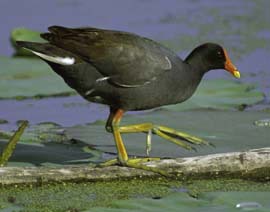 10/01 - Dutchess County, HRM 86: Yesterday, Adrienne Popko reported seeing common gallinules while walking on the Hudson Valley Rail Trail in Amenia. This morning Barb Mansell and Liz Martens reported seeing one adult and one immature and Carena Pooth spotted two adults and two immatures this afternoon. [Photo of common gallinule courtesy U.S. Fish and Wildlife Service.]
- Deb Tracy-Kral
[The common gallinule, sometimes called common moorhen, is duck-like but not a duck. It is a member of the rail family (Rallidae), and has very long toes that help the bird balance on floating aquatic vegetation. Though they lack webbed feet, gallinules can swim and dabble like a mallard, and dive underwater too. While they are known to nest in Orange County, they are considered rare in Dutchess County. Tom Lake.]
10/01 - Bedford, HRM 35: We got a late start at the Chestnut Ridge Hawk Watch because of low visibility and rain (a brief suspension of the watch occurred in midday because of rain).There was intermittent drizzle later in the afternoon and fog continued to limit visibility. Migrants, including five northern harriers, were mostly flying low in the afternoon. Also sighted was a single monarch butterfly. Current selected season totals were 6,092 broad-winged hawks and 759 sharp-shinned hawks.
- Dan Schniedewind, Christina Lupoli
10/2 - Columbia County, HRM 111: We traveled to the Roeliff Jansen Kill at the Robinson Pond dam in Copake. Among an array of common fishes we caught were two species of note. We collected a pair of YOY rudd. Robinson Pond was the original site where rudd were introduced into the Hudson River watershed in the 1920s and they are still there today. We also collected three American eels. One of these was a large female that was beginning to "silver" (become sexually mature), and a second was a behemoth. We did not get to look closely at this really large eel because it would not fit in our dip net. We did not expect to see eels at this site because it is far up in the watershed and there are several large barriers between Robinson Pond and the tidal Hudson River.
- Bob Schmidt, Bryan Weatherwax, Jeremy Wright
[Rudd are large minnows - up to eighteen inches long - native to Europe. While they have been known primarily from the Roeliff Jansenkill watershed they have become rather widespread along a 30 mile reach of the Hudson from Catskill south to Esopus Island. While closely resembling a golden shiner, they grow much larger. Their most distinguishing characteristic is their blood-red fins. Their brassy-to-silvery sides have earned them the colloquial name of "pearl roach." John R. Greeley collected four specimens in the Roeliff Jansenkill in his 1936 faunal survey of the lower Hudson watershed. Tom Lake.]
10/2 - Town of Fishkill, HRM 62: In mid-afternoon I watched a bobcat run across the Lime Kiln Road exit ramp off Interstate Route 84. I wished I was able to take a picture.
- Heather White
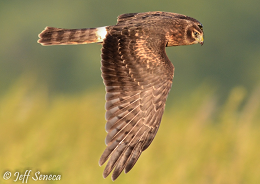 10/2 - Croton Point, HRM 34.5: I counted as many as four northern harriers hunting the landfill at Croton Point. [Photo of female northern harrier courtesy of Jeff Seneca.]
- Jeff Seneca
10/2 - Brooklyn, New York City: A quick tip from Rob Bate of the Brooklyn Bird Club about a northern wheatear had Park Superintendent Jen Nersesian and I scouring Plumb Beach in Southern Brooklyn. A complex and under-appreciated site with a beautiful wetland miraculously sheltered from the Belt Parkway, it was the perfect backdrop for a real rarity. We found the bird in an open sandy area on the northeastern tip of the site. In winter plumage, sparrow-sized but with a different set of proportions, the bird retained its eye stripe and beautiful black and white tail markings. If it was bothered by our presence, it certainly did not show it, tail bobbing as it returned again and again to a perch on a derelict boat after chasing after the abundant insects on the beach and along of the edges of the Spartina marsh. I've had two in many years of birding, both in Brooklyn.
- Dave Taft
[On September 6, 2011, Charlie Roberto and Christopher Letts watched a northern wheatear forage along the tide line of the lower Croton River. It was theorized that this uncommon-to-rare species may have been brought there by Hurricane Irene. Tom Lake.]
[Note: See 9/23 at Norrie Point in the last issue. In the sidebar on the northern logperch (Percina caprodes semifasciata), the fish was first described (type site) from Lake Champlain, not Ohio, by DeKay (1842). Tom Lake.]
FALL 2014 NATURAL HISTORY PROGRAMS
October 16
Twelfth Annual Day in the Life of the Hudson River Estuary. This event affords us the opportunity to engage thousands of eager students in sampling the watershed at many locations along a 200 mile reach of the river. We collect and share water quality and wildlife data as a one-day "snapshot" that allows each participating class to compare their results and piece of the river with results from a range of sites. For information contact Chris Bowser chris.bowser@dec.ny.gov or visit the Day in the Life website http://www.ldeo.columbia.edu/edu/k12/snapshotday/.
HUDSON RIVER MILES
The Hudson is measured north from Hudson River Mile 0 at the Battery at the southern tip of Manhattan. The George Washington Bridge is at HRM 12, the Tappan Zee 28, Bear Mountain 47, Beacon-Newburgh 62, Mid-Hudson 75, Kingston-Rhinecliff 95, Rip Van Winkle 114, and the Federal Dam at Troy, the head of tidewater, at 153. The tidal section of the Hudson constitutes a bit less than half the total distance – 315 miles – from Lake Tear of the Clouds to the Battery. Entries from points east and west in the watershed reference the corresponding river mile on the mainstem.
TO CONTRIBUTE YOUR OBSERVATIONS OR TO SUBSCRIBE
The Hudson River Almanac is compiled and edited by Tom Lake and emailed weekly by Steve Stanne, education coordinator at DEC's Hudson River Estuary Program. Share your observations by e-mailing them to trlake7@aol.com.
To subscribe to the Almanac (or to unsubscribe), go to DEC's Email Lists page, enter your email address, and click on "Submit." A page listing available subscription topics will appear. Scroll down; under the heading "Natural Areas and Wildlife" is the section "Lakes and Rivers" with a listing for the Hudson River Almanac. Click on the check box to subscribe. While there, you may wish to subscribe to RiverNet, which covers projects, events and actions related to the Hudson and its watershed, or to other DEC newsletters and information feeds.
The Hudson River Almanac archive allows one to use the DEC website's search engine to find species, locations, and other data in weekly issues dating back to October 2003.
Discover New York State Conservationist - the award-winning, advertisement-free magazine focusing on New York State's great outdoors and natural resources. Conservationist features stunning photography, informative articles and around-the-state coverage.
USEFUL LINKS
The National Oceanic and Atmospheric Administration's high and low tide and tidal current predictions are invaluable for planning boating, fishing, and other excursions on and along the estuary.
The Hudson River Environmental Conditions Observing System [HRECOS] provides near real-time information on water and weather conditions at monitoring stations from Manhattan to the Mohawk River.
Information on the movements of the salt front is available on the U.S. Geological Survey's Hudson River Salt Front website.
Information about the Hudson River Estuary Program is available on DEC's website at http://www.dec.ny.gov/lands/4920.html.
New smartphone app available for New York outdoor enthusiasts!
DEC, in partnership with ParksByNature Network®, is proud to announce the launch of the New York Fishing, Hunting & Wildlife App for iPhone and Android. This FREE, cutting-edge mobile app gives both novice and seasoned outdoorsmen and women essential information in the palm of their hands. Powered by Pocket Ranger® technology, this official app for DEC will provide up-to-date information on fishing, hunting and wildlife watching and serve as an interactive outdoor app using today's leading mobile devices. Using the app's advanced GPS features, users will be able identify and locate New York's many hunting, fishing and wildlife watching sites. They will also gain immediate access to species profiles, rules and regulations, and important permits and licensing details.
NY Open for Hunting and Fishing Initiative
Governor Cuomo's NY Open for Fishing and Hunting Initiative is an effort to improve recreational opportunities for sportsmen and women and to boost tourism activities throughout the state. This initiative includes streamlining fishing and hunting licenses, reducing license fees, improving access for fishing and increasing hunting opportunities in New York State.
In support of this initiative, this year's budget includes $6 million in NY Works funding to support creating 50 new land and water access projects to connect hunters, anglers, bird watchers and others who enjoy the outdoors to more than 380,000 acres of existing state and easement lands that have gone largely untapped until now. These 50 new access projects include building new boat launches, installing new hunting blinds and building new trails and parking areas. In addition, the 2014-15 budget includes $4 million to repair the state's fish hatcheries; and renews and allows expanded use of crossbows for hunting in New York State.
This year's budget also reduces short-term fishing licenses fees; increases the number of authorized statewide free fishing days to eight from two; authorizes DEC to offer 10 days of promotional prices for hunting, fishing and trapping licenses; and authorizes free Adventure Plates for new lifetime license holders, discounted Adventure Plates for existing lifetime license holders and regular fee Adventure Plates for annual license holders.
Copies of past issues of the Hudson River Almanac, Volumes II-VIII, are available for purchase from the publisher, Purple Mountain Press, (800) 325-2665.