
Hudson River Almanac 7/16/14 - 7/23/14
The New York State Department of Environmental Conservation sent this bulletin on 08/01/2014 01:08 PM EDTYou are subscribed to receive updates from DEC. Links to receive help or to change your preferences are provided below. Having trouble viewing this email? View it as a Web page.

July 17 - 23, 2014
Compiled by Tom Lake, Hudson River Estuary Program Naturalist
OVERVIEW
While successful broods are highlighted this week, among them loons, herons, eagles and ospreys, we also are reminded of the presence of alien invasives such as mitten crabs and water chestnut. There is also a delightful look back at a visitor from three years ago. A reminder: the Great Hudson River Estuary Fish Count will take place at fourteen sites this Saturday, August 2. Check out the schedule at the end of the Almanac for a fish count program near you.
HIGHLIGHT OF THE WEEK
7/18 - Newcomb, HRM 302: We have been watching five common loon nests this summer and have recorded two of them as being abandoned due to flooding in June. Sadly, another nest also flooded but the pair continues to incubate the eggs even though the eggs will not hatch (28-30 days of incubation are required; the birds have been on the nest for 45 days). We plan on collecting the eggs next week; they will be used as part of a study looking at mercury accumulation in the common loon. The good news is that we confirmed today that two nests have been successful and each pair has two chicks.
- Charlotte Demers
NATURAL HISTORY NOTES
7/17 - Newcomb, HRM 302: I spotted my first monarch butterfly of the year in a roadside milkweed patch. They have most certainly been declining in numbers the past two years. Two Lepidopteran species that have been abundant this year are the white admiral (Limenitis arthemis) and the luna moth (Actias luna). In addition to milkweed, some other plants in bloom this week included St. John's wort (Hypericum perforatum), oxeye daisy (Leucanthemum vulgare), black-eyed susan (Rudbeckia hirta), yarrow (Achillea millefolium), slender ladies' tresses (Spiranthes gracilis), and eyebright (Euphrasia americana). On a scale of poor - fair - good - excellent, the ground strawberry and raspberry crops were excellent and the blueberry crop was good.
- Charlotte Demers
7/17 - Town of Poughkeepsie: I noticed today for the first time that the NY62 eagle fledglings were flying off with their food instead of gobbling it down wherever the parents leave it. Today I watched one depart quickly with a "trophy-size" pumpkinseed sunfish before the other immature could grab it.
- Bob Rightmyer
7/17 - Town of Wappinger, HRM 67: We heard our first katydids of the summer today. This was the exact average date, reported by several people, over the last five years.
- Phyllis Lake
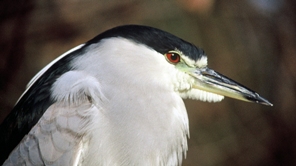 7/17 - Crugers, HRM 39: This evening, as we searched for the Ogilvie Pond great blue heron, something on the far side caught our attention. It was a black-crowned night heron with its stocky build, yellow legs, and black crown, perched on a snag lying in the shallow water. The heron preened its feathers for quite a while, occasionally shaking its body and revealing the long white plumes on the back of its head. The bird finally spread its wings wide and then settled back down. Since it was not quite dusk, the night heron probably wasn't ready to hunt for dinner. [Photo of black-crowned night heron by Lee Karner, courtesy U.S. Fish & Wildlife Service.]
- Dorothy Ferguson, Bob Ferguson
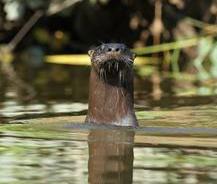 7/18 - Greene County, HRM 112.2: During an early morning guided interpretive kayak paddle on the RamsHorn Creek, in addition to seeing three different beavers, we were treated to an uncommon sighting: three river otters! They seemed as curious about us as we were of them, rising out of the water to get better views, chattering to each other the whole time. They submerged a short time later and then one surfaced with something in its mouth, either an eel or a water snake. It was a magical moment for sure. [Photo of river otter courtesy of Larry Federman.]
- Larry Federman
7/18 - Indian Kill, HRM 85: We were collecting American eels in the Indian Kill at Norrie Point State Park when Alysse Estes spotted something odd in a bunch of roots and debris. She pulled out the first live Chinese mitten crab of the year! The crab was a female, its carapace 51.0 millimeters [mm] wide. It had shed recently, as it was a soft-shell. Although these invaders have been scarce in the Hudson for the past four years, they are not gone at all.
- Bob Schmidt, Alyssa Estes, Nate Shoobs, Sarah Mount, Zoraida Maloney.
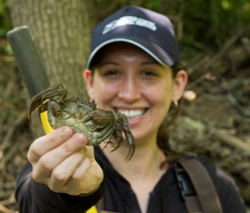 [The Chinese mitten crab (Eriocheir sinensis) is native to the estuaries of China where it is highly regarded in the market. Mitten crabs are catadromous, meaning that they spend much of their life in freshwater, then return to higher salinities in the lower estuary (15-20 parts-per-thousand [ppt] salt) to reproduce. The salinity gradients of east coast estuarine systems like the Chesapeake Bay, Delaware Bay, and Hudson River are nearly ideal for them. Adult mitten crabs have a carapace width of about 75 mm (3"), but six of its eight legs are almost twice as long, giving them an almost "spider crab" look. Unlike the native blue crab, a swimming crab, mitten crabs are burrowing crabs, similar to our mud crabs only many times larger. They have a generalist diet and their potential ecological impact on east coast estuaries is still unknown. If you encounter a mitten crab in New York State, please notify Sarah Fernald, NYSDEC Hudson River Estuary Program, (845) 889-4745 ext: 111, or sarah.fernald@dec.ny.gov. Do not release them live. If you take photos, make certain that you take both dorsal and ventral views so we can determine its sex. Tom Lake. Photo of Chinese mitten crab courtesy of Bob Schmidt.]
7/18 - Bedford, HRM 35: Today's visit to the great blue heron rookery was at times quiet, while at other times the usual chatter was interrupted with some loud squawk-like vocalizing. I did not see any adults but at various times I saw six or more fledglings circling around the rookery, sometimes flying to a nest or a nearby tree. There were eight immatures that stayed either in their nest or were perched on a nearby branch. They appeared to be fully able to fly but I think they were just content to stay in the nest and wait to be fed.
- Jim Steck
7/19 - Town of Poughkeepsie: Even though the nest tree (NY62) remained a favorite perch, the eagle fledglings (probably time to start referring to them as immatures) were now flying out over the river. Mom arrived at midday with a gizzard shad and, as has been the case recently, one fish - one bird. The other immature had eaten its own fish earlier.
- Tom McDowell
7/19 - Town of Wappinger, HRM 67: After two years of little luck attracting much with our butterfly bushes, a full and healthy-looking monarch landed today on the purple flowers for a long, long, drink.
- Phyllis Lake
7/20 - Hyde Park, HRM 82: Three years ago today a gray seal showed up at the Rogers Point Boat Club and stayed for two months, delighting onlookers as he performed daily acrobatics among the piers and offshore. His tenure at Hyde Park coincided with Hurricane Irene and tropical storm Lee, adding to the drama. His favorite trick was to catch a fish (catfish were his favorite), toss it in the air, have it bounce off his head, and then grab it before it struck the water. His most famous performance was with a 30-inch-long shortnose sturgeon (federally endangered species). When autumn came, the seal seemed to know it was time to move on, and left as quietly as he had arrived. For 63 days, we enjoyed one of the most incredible wildlife experiences of our lives.
- Tom Lake, Chris Bowser, Jesse Jaycox
[This gray seal, five feet long, 70-75 lb, was a healthy yearling. He was likely "pupped" in January or February 2011. Adult males can reach ten feet in length and weigh 880 lb. Kim Durham, Riverhead Foundation for Marine Research & Preservation.]
7/20 - Dutchess County, HRM 67: Every summer since we moved to Stormville Mountain in 1974, we have seen many bats darting this way and that over the house, keeping the insect population down. Their numbers have been dwindling in recent years. Two finally showed up today.
- Frank Bergman
7/20 - Croton-on-Hudson, HRM 35: I was clearing away some fallen branches and uncovered a large patch of Indian pipes (Monotropa uniflora). What a wonderful, strange plant, oddly white, glowing without sunlight, rising up out of the dark, heavily leaf-blanketed ground.
- Robin Fox
7/21 - Wappinger Creek, HRM 67.5: The low tide shallows were so thick with water chestnut that two young white-tailed deer were able to slowly walk across the matted vegetation, foraging as they went. I watched for a while with binoculars but could not determine what they were finding that was so special.
- Tom Lake
7/21 - Crugers, HRM 39: As I was watering my garden this evening when a "murder of crows" (approximately 60) flew over the house, headed south to their nightly roost.
- Dianne Picciano
["Murder" is a collective noun for a congregation of crows. Though not often heard, others include a charm of goldfinches, an exaltation of larks, a chain of bobolinks, a wake of buzzards, a convocation of eagles, a squabble of seagulls, a cloud of bats, a prickle of porcupines, and an army of frogs. Tom Lake.]
7/22 - Town of Poughkeepsie: It has been a month since the eagle nestlings fledged. While the NY62 immatures were still hanging out a lot of the time in the nest tree, they were regularly taking longer and longer trips out to the river. There is some growing concern that no one has had any recent confirmed "Dad sightings."
- Terry Hardy
[The adult male has a long history - fourteen years - to call on in an analysis of his behavior. Early on he had what seemed to be a cavalier attitude when it came to parenting. Mom (N42) was the primary care-giver for several years. Dad (not banded) would frequently eat the best parts of fish before delivering the rest to the nestlings. In the last four years, he has shown a greater level of "maturity" regarding his mate and their offspring. However, one trait that has persisted over time is his predilection to disappear for extended periods once the dependent fledglings have become more independent immatures. Tom Lake.]
7/22 - Denning's Point, HRM 60: The wineberries were really ripening on the trail out to the Point. On my way back out, I ran into a black rat snake lying motionless on the side of the trail. I stopped and it moved off into the nearby cover, vibrating its tail rapidly against the leaves, creating a faint buzzing sound like several species of snakes will do when alarmed.
- Jesse Jaycox
7/22 - Putnam County, HRM 55: Later, at Clarence Fahnestock State Park, I came upon a northern ringneck snake moving across a path and into the leaf litter. Not long after, I ran into another black rat snake that also moved off into dense vegetation when it saw me.
- Jesse Jaycox
7/22 - Croton-on-Hudson, HRM 34: The osprey nest atop the cell tower at the Croton-Harmon Train Station was very active this afternoon. One of the adults was perched on a post near the nest and one of the nestlings was standing on the edge of the nest. Another head popped up and down behind the nestling. The other adult arrived and both of them flew away in tandem, circling and then flying off in different directions, leaving the juveniles alone in the nest.
- Dorothy and Bob Ferguson
7/23 - Town of Wappinger, HRM 67: We are still amazed at the variety of birds (17 species) that have been coming to the railings on our deck for the generous spread of seed (a mix of peanuts, pumpkin seeds, dried raisins and cranberries, sunflowers and safflower). Recently, young-of-the-year cardinals and cowbirds have joined the buffet line. This has been possible only because we have not seen a gray squirrel since late winter; we have not had a single squirrel assault in almost five months. Poor nesting year? Cooper's and red-tailed hawks?
- Tom Lake
7/23 - Kowawese, HRM 59: It was a sultry summer morning with the air temperature already in the 90s. In advance of a cold front, a strong breeze was whipping up through the Hudson Highlands, pushing rollers up on this south-facing beach. Anticipating multitudes of young-of-the-year [YOY] fishes, we made a short haul to limit mortality. Even then as we beached our net it pulsed with hundreds of silvery fish. The majority were YOY river herring (35-58 mm) and striped bass (40-61 mm). We quickly eased the seine back into the swash. The salinity was barely measurable about 1.0 ppt; the water temperature was 79 degrees Fahrenheit.
- Tom Lake, A. Danforth
[We collected a sample of mixed-size river herring. We anticipated that among them there would be blueback herring, alewives, and possibly American shad. However, under the microscope, all of them were blueback herring with a dark, spotted lining in the body cavity (peritoneum). Tom Lake.]
GREAT HUDSON RIVER FISH COUNT – Saturday, August 2
The public is invited to join naturalists from the Capital Region to New York City for the third annual Great Hudson River Estuary Fish Count, exploring amazing variety of slippery, wriggly, and fascinating creatures usually hidden below the river's surface. The programs themselves are free, but some parks may require an entrance fee. For more information, email hrep@dec.ny.gov or call (845)256-3077.
Manhattan - East River Park, Pier 42: Lower East Side Ecology Center. 12:00 noon-2:00 p.m
Manhattan - Hudson River Park, Pier 84: Hudson River Park Trust. 1:00-4:00 p.m.
Manhattan - Inwood Hill Park, tidal basin: Hudson River Estuary Program. 10:00-11:30 a.m.
Yonkers - Habirshaw Park: Sarah Lawrence College Center for the Urban River (formerly Beczak Environmental Education Center). 10:30-11:30 a.m.
Piermont - Piermont Pier: Lamont-Doherty Earth Observatory of Columbia University.11:00 a.m.-1:00 p.m.
Sleepy Hollow - Kingsland Point Park/Kathryn W. Davis RiverWalk Center: Teatown Lake Reservation & Strawtown Art and Garden Studio. 10:00 a.m.-12:00 noon
Cold Spring - Little Stony Point, Hudson Highlands State Park: Hudson River Estuary Program. 11:00 a.m.-12:30 p.m.
Beacon - Long Dock Park: Scenic Hudson. 11:00 a.m.-12:00 noon
New Windsor - Kowawese Unique Area: Hudson River Estuary Program. 9:30-10:30 a.m.
Staatsburg - Norrie Point Environmental Center: Hudson River National Estuarine Research Reserve. 10:00-11:00 a.m.
Kingston - Kingston Point Beach: City of Kingston Parks and Recreation/Forsyth Nature Center. 11:30 a.m.-12:30 p.m.
Coxsackie - Riverfront Park: Hudson River Estuary Program. 12:30-1:15 p.m.
Castleton - Schodack Island State Park: Hudson River Estuary Program. 2:00-3:30 p.m
Waterford - Peebles Island State Park: Hudson River Estuary Program. 10:00-11:30 a.m.
SUMMER 2014 NATURAL HISTORY PROGRAMS
August 9: 10:00 a.m. - 1:00 p.m.
Family Fishing Day at Norrie Point Environmental Center, Staatsburg [Dutchess County]. All ages welcome to this free program; rods, reels, and bait provided. Wheelchair accessible. For information: 845-889-4745 x109.
August 16: 1:30 p.m.
The Hudson Valley in Deep Time - Ice Age to European Contact with a focus on some local First American sites. Presented by Tom Lake, NYSDEC Hudson River Estuary Program naturalist, at Stonykill Farm, Wappingers Falls [Dutchess County]. For information, email Denise Schirmer.
August 18: 7:00 p.m.
Hudson Valley Bald Eagles: An Amazing Comeback with Tom Lake, NYSDEC Hudson River Estuary Program naturalist, at the East Fishkill Public Library [Dutchess County]. For information, email Cindy Dubinski.
HUDSON RIVER MILES
The Hudson is measured north from Hudson River Mile 0 at the Battery at the southern tip of Manhattan. The George Washington Bridge is at HRM 12, the Tappan Zee 28, Bear Mountain 47, Beacon-Newburgh 62, Mid-Hudson 75, Kingston-Rhinecliff 95, Rip Van Winkle 114, and the Federal Dam at Troy, the head of tidewater, at 153. The tidal section of the Hudson constitutes a bit less than half the total distance – 315 miles – from Lake Tear of the Clouds to the Battery. Entries from points east and west in the watershed reference the corresponding river mile on the mainstem.
TO CONTRIBUTE YOUR OBSERVATIONS OR TO SUBSCRIBE
The Hudson River Almanac is compiled and edited by Tom Lake and emailed weekly by Steve Stanne, education coordinator at DEC's Hudson River Estuary Program. Share your observations by e-mailing them to trlake7@aol.com.
To subscribe to the Almanac (or to unsubscribe), go to DEC's Email Lists page, enter your email address, and click on "Submit." A page listing available subscription topics will appear. Scroll down; under the heading "Natural Areas and Wildlife" is the section "Lakes and Rivers" with a listing for the Hudson River Almanac. Click on the check box to subscribe. While there, you may wish to subscribe to RiverNet, which covers projects, events and actions related to the Hudson and its watershed, or to other DEC newsletters and information feeds.
The Hudson River Almanac archive allows one to use the DEC website's search engine to find species, locations, and other data in weekly issues dating back to October 2003.
Discover New York State Conservationist - the award-winning, advertisement-free magazine focusing on New York State's great outdoors and natural resources. Conservationist features stunning photography, informative articles and around-the-state coverage.
USEFUL LINKS
The National Oceanic and Atmospheric Administration's high and low tide and tidal current predictions are invaluable for planning boating, fishing, and other excursions on and along the estuary.
The Hudson River Environmental Conditions Observing System [HRECOS] provides near real-time information on water and weather conditions at monitoring stations from Manhattan to the Mohawk River.
Historical information on the movements of the salt front is available on the U.S. Geological Survey's Hudson River Salt Front website.
New smartphone app available for New York outdoor enthusiasts!
DEC, in partnership with ParksByNature Network®, is proud to announce the launch of the New York Fishing, Hunting & Wildlife App for iPhone and Android. This FREE, cutting-edge mobile app gives both novice and seasoned outdoorsmen and women essential information in the palm of their hands. Powered by Pocket Ranger® technology, this official app for DEC will provide up-to-date information on fishing, hunting and wildlife watching and serve as an interactive outdoor app using today's leading mobile devices. Using the app's advanced GPS features, users will be able identify and locate New York's many hunting, fishing and wildlife watching sites. They will also gain immediate access to species profiles, rules and regulations, and important permits and licensing details.
NY Open for Hunting and Fishing Initiative
Governor Cuomo's NY Open for Fishing and Hunting Initiative is an effort to improve recreational opportunities for sportsmen and women and to boost tourism activities throughout the state. This initiative includes streamlining fishing and hunting licenses, reducing license fees, improving access for fishing and increasing hunting opportunities in New York State.
In support of this initiative, this year's budget includes $6 million in NY Works funding to support creating 50 new land and water access projects to connect hunters, anglers, bird watchers and others who enjoy the outdoors to more than 380,000 acres of existing state and easement lands that have gone largely untapped until now. These 50 new access projects include building new boat launches, installing new hunting blinds and building new trails and parking areas. In addition, the 2014-15 budget includes $4 million to repair the state's fish hatcheries; and renews and allows expanded use of crossbows for hunting in New York State.
This year's budget also reduces short-term fishing licenses fees; increases the number of authorized statewide free fishing days to eight from two; authorizes DEC to offer 10 days of promotional prices for hunting, fishing and trapping licenses; and authorizes free Adventure Plates for new lifetime license holders, discounted Adventure Plates for existing lifetime license holders and regular fee Adventure Plates for annual license holders.
Copies of past issues of the Hudson River Almanac, Volumes II-VIII, are available for purchase from the publisher, Purple Mountain Press, (800) 325-2665.