
Hudson River Almanac 6/19/14 - 6/25/14
The New York State Department of Environmental Conservation sent this bulletin on 07/03/2014 10:47 AM EDTYou are subscribed to receive updates from DEC. Links to receive help or to change your preferences are provided below. Having trouble viewing this email? View it as a Web page.

June 19 - 25, 2014
Compiled by Tom Lake, Hudson River Estuary Program Naturalist
OVERVIEW
There were black bears but no monarchs this week. If nest NY62 was any example, our Hudson River Valley skies were likely far richer this week with fledgling bald eagles.
HIGHLIGHT OF THE WEEK
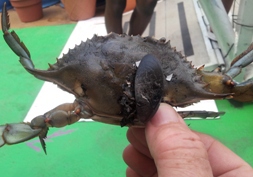 6/22 - Yonkers, HRM 18: We started crabbing off the gangway at the Science Barge today, using chicken wings for bait. The second trap we pulled had a male blue crab (nearly five-inch carapace width) with a mussel attached to its shell. [Photo of blue crab with blue mussel attached courtesy Bob Walters.]
- Bob Walters
[A photo revealed that the bivalve was a blue mussel (Mytilus edulis). These shellfish are native to salt and brackish waters along the Atlantic coast. They attach themselves to substrate (including crabs, it seems) by strong byssal threads. This mussel may soon lose its home the next time this blue crab moults and sheds its present shell. Tom Lake]
NATURAL HISTORY NOTES
6/19 - Greene County, HRM 113: Colgate Lake is one of my favorite places to go in the Catskills when the weather is warm and humid. The mountain air is so much cooler. While paddling my canoe close to shore with Loki (my dog and loyal companion), up reared a huge black bear. I always knew I'd see one here. Loki's nose was in high gear and as he stood up in the canoe, we started to wobble. I managed to get him to sit back down - I was happy that I had learned how to paddle backwards. That handsome, lovely, wonderful, spectacular giant raised its head, and just watched my little canoe trembling on the water.
- Fran Martino
6/19 - North Germantown, HRM 109: The tide was high but ebbing when we stopped by the DEC boat launch to pull a seine. Our catch consisted of about 100 young-of-the-year [YOY] river herring, the largest of which was about two inches long and clearly an alewife - deep body and large eyes. The many smaller individuals could not be identified without a microscope, but were probably blueback herring. The smallest was still transparent and was barely retained in our net. The only other fish collected was an inch-long largemouth bass.
- Bob Schmidt, Nate Shoobs
6/19 - Dutchess County, HRM 98.5: At the Saw Kill we came upon Chinese mitten crabs, the first reported for 2014 in the Hudson. We found a leg in one location and various body parts (remnants of a shed exoskeleton) about 45 feet away, so two individuals. There was no carapace, so we could not measure them. However, they were intermediate-sized crabs, not new immigrants.
- Bob Schmidt, Nate Shoobs
6/19 - Town of Poughkeepsie: Day 81. The pair of nestlings in NY62 was quite active (branching) all morning until Mom brought food at noon. After feeding they settled down. Later in the afternoon both nestlings climbed to higher and larger limbs. Mom stopped by at 5:00 p.m. with a fish. When one of the eaglets began sliding down toward her, she took off. Dad made a food drop at 6:00 p.m. at which time both nestlings were pretty active with wing-flapping, jumping, and climbing around.
- Bob Rightmyer, Terry Hardy
[Heavy-bodied tulip-trees afford eagle nestlings plenty of space to explore. Watching them reminds me of children at play on the climbing equipment of modern playgrounds. Of the three nests this pair has used over the last fourteen years, two were in tulip-trees, the other, the original, in a white pine. Tom Lake.]
6/19 - Croton Point, HRM 35-34: Cedar waxwings and bobolinks were making morning walks a joy. Small pleasures, but not to taken for granted; there were years when they did not nest here.
- Christopher Letts
6/19 - Town of Indian Lake, HRM 257: Just a note on the sighting of Karner blue butterflies near North Creek (see June 3). These were most likely either spring azures or eastern tailed blues, or possibly silvery blues that are almost identical to Karner blues but much more widespread and not specialized on their food plants. This sighting occurred about 50 miles northwest of Queensbury, the northern limit of our Karner blue sites. While in flight all of these species look blue; they are different on the underside of the wings. The azures and silvery blues have no orange crescents, and eastern tails have only two tiny dots.
- Kathleen O'Brien, NYSDEC
[The Karner blue butterfly (Lycaeides melissa samuelis) is both a New York State and federally-listed endangered species. Within its range, the Karner blue is restricted to dry sandy areas with open woods and clearings supporting wild blue lupine. A sighting of this species far outside its known range would be extraordinary; though one learns never to say "never" with wildlife, such records require extraordinary evidence – a sharp, close-up photograph for example. Tom Lake.]
6/20 - Town of Poughkeepsie: Day 82. Our first fledge. One of the nestlings, the larger of the two, became a fledgling at 2:15 PM. We wait all spring, since March 30 this year, for this moment.
- Eileen Stickle, Tom McDowell
6/20 - Storm King Mountain, HRM 57: While hiking down from the Storm King summit to Route 218, we saw a brilliantly red male scarlet tanager. The bird was surprisingly on the low branches, flying from tree to tree.
- Straat T., Eleanor T.
6/20 - Town of Poughkeepsie: Day 83. I spent all day monitoring the remaining NY62 nestling. Yesterday's first fledge was still eluding us. However, when I came back at noon from a search of the nearby forest, the nest was empty. The second nestling had become a fledgling, but no one saw it go. Two baby eagles out there now, but where?
- Terry Hardy
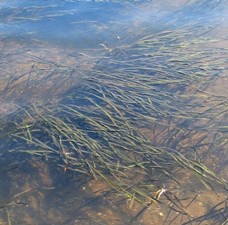 6/20 - Croton Point, HRM 35: In preparation for education programs at Clearwater's 36th annual Great Hudson River Revival, we seined the inshore shallows to get a feel for what to expect. The river was not quite "briny," with salinity at 3.0 parts per thousand [ppt] - about 10% seawater - and the water a warm 76 degrees Fahrenheit. The beds of submerged aquatic vegetation [SAV] - wild celery, water milfoil, and pondweed - that we long associated with this beach were missing. While their disappearance over the last two years has been attributed to tropical storms Irene and Lee, the mechanism is not clear. Beds of SAV provide critical nursery habitat for many small fishes, and there is concern about the impacts of their loss on fish production in the estuary. After several hauls we found only one species present, albeit in great numbers: hundreds of YOY white perch. They ranged in size from 23-26 millimeters [mm], with many less than an inch long. [Photo of wild celery, a species of SAV, by Steve Stanne.]
- Tom Lake, T.R. Jackson
[At this latitude on the east coast of North America, seawater salinity averages 32-35 ppt. Throughout the year, the Hudson estuary's salinity is diluted depending upon the volume of freshwater flowing from the watershed and – to a lesser extent – the vagaries of wind, tide and current. On this day, the U.S. Geological Survey placed the salt front (the very dilute leading edge of seawater entering the estuary) at HRM 46.2, near the Bear Mountain Bridge. Earlier in the month it had been as far north as HRM 66, well north of the Newburgh-Beacon Bridge. Tom Lake, Steve Stanne.]
6/21 - Croton Point Park, HRM 35: For a city dweller (Manhattan), one of the many joys of Clearwater's Great Hudson River Revival is being awakened in a tent at dawn by a robin's lusty singing. Another is finding among many plants familiar from northern Manhattan, one that's new to me: moneywort, a little creeper with yellow flowers. I also saw some sensitive fern; that's pretty common, but I've never seen it, or almost any other fern, at Inwood Hill in Manhattan.
- Thomas Shoesmith
6/21 - Croton Point, HRM 35: Summer arrived (summer solstice) at 6:51 a.m., bringing perfect weather for the Clearwater Revival. Fishermen must always have ready-made excuses for poor catches and we had ours today. We seined the little beach at Mother's Lap, sharing the narrow expanse with kayaks, Whitehall work boats, and many eager sailors. We wove our seine though the obstacles three times and caught just one fish, a YOY striped bass (34 mm). But we had a backup plan for presentation to the gathered onlookers. At low tide we collected a rock encrusted with bay barnacles, a testament to saltier times, as well as some ancient oyster shells, hand-shucked by Algonquian people on Croton Point 4,000 years ago.
- Olivia McKee, Tom Lake
["Mother's Lap" is a colloquial name for a small, sheltered cove on the north end of Croton Point. When commercial fishing was in its heyday in the mid-20th century, fishermen knew they could find refuge from wind and tide in this little bay as their nets worked offshore. In that regard, it reminded them of the calm and solace of sitting in mother's lap. Tom Lake.]
6/22 - Town of Poughkeepsie: Two days after it fledged, the larger of the two fledglings was located in an oak tree about 300 feet east of the NY62 nest. The immature eagle appeared content and was not calling out.
- Tom McDowell, Terry Hardy, Bob Rightmyer
[Newly-fledged eagles, particularly over the first day or two, will constantly call out for the adults. These are critical days in which the birds must adapt to food delivery and consumption in an unfamiliar setting outside the nest. Tom Lake.]
6/22 - Town of Poughkeepsie: The unofficial list of nest monitors for NY62, all sworn to secrecy, is quite long. Most of us met this morning for a celebratory breakfast, figuratively in the shadow of the nest tree, to raise our cups to this pair's fourteenth season. They have now successfully fledged fourteen young in fourteen seasons. One interesting topic of discussion was the variety of food items brought to the nest this spring. They included cottontails, snakes, squirrels, fish such as eels, catfish, herring, and striped bass, and one duck.
- Tom Lake
6/22 - Croton Point, HRM 35-34: With fantastic weather for the Clearwater festival, I took the opportunity to twice walk the landfill. Highlights were numerous including bobolinks, two grasshopper sparrows, and a meadowlark (I've heard as many as four). I am not sure where else in Westchester County those species breed. Good birding, and thank you Pete and Toshi Seeger.
- Larry Trachtenberg
6/22 - Croton Point, HRM 35: On Day Two of the Clearwater Revival, we teamed up two 30-foot-long nets, like a sixty-foot seine net with a little space in the middle, at Mother's Lap. Still, the catch was meager: two "snapper" bluefish (50-70 mm); two striped bass (100 mm); and one small shore shrimp. Luckily it was more than enough for a good shore-side talk.
- Chris Bowser
["Snappers" are YOY bluefish (Pomatomus saltatrix), one of several colloquial names given to bluefish as they grow older and larger. One-year-olds, or yearlings, are known as "cocktail" or "tailor" blues. Some names refer to the strength of their jaws. Once they reach the 10-12 lb. range, anglers speak of "choppers," or "slammers." Names like "alligator" and "gorilla" are reserved for the very largest and meanest of bluefish, 20 pounds or more. Tom Lake.]
6/22 - Brooklyn, New York City: The staff and volunteers from the Brooklyn Bridge Park Conservancy held a seining program for the local community at the Empire Fulton Ferry in Brooklyn Bridge Park. This beach is along the East River between the Brooklyn and Manhattan bridges. We caught comb jellies (mostly Leidy's), shore shrimp (Palaeomentes pugio), winter flounder, tomcod, and Atlantic silverside. While there was no sign of native crabs, there were plenty of Asian shore crab (Hemigrapsus sanguineus) moults on the beach.
- Cynthia Fowx
[The Asian shore crab, sometimes called the Japanese green crab, is an alien species that probably arrived in the United States in the ballast of cargo ships. It is native to the inshore ocean waters around China and Japan. The Asian shore crab favors rocky intertidal areas and occupies similar habitats to native mud crabs. Adults can grow to 42 mm carapace width. Tom Lake.]
6/23 - Round Top, HRM 113: We were beginning to see hemlock woolly adelgid at 900 feet elevation in the forests around Round Top.
- Jon Powell
[The hemlock woolly adelgid (Adelges tsugae) was first reported in the eastern United States in 1951. Trees infected with this insect have white, cottony egg masses on their branches; they feed on the sap of hemlock branchlets, resulting in the loss of their needles and inhibiting new growth. Restrictions on their range in our area appear limited to the severity of winters, probably linked to elevation and latitude. We are hoping that the current hemlock woolly adelgid population will not cause "significant" mortality above 1,600 feet elevation and 43 degrees latitude. This is a biogeoclimatic effect where elevation, latitude and "continental" condition may alter the threshold. Additionally, we would like to gain knowledge of any known mortality above this elevation. Jerry Carlson, Research Scientist, NYSDEC Lands and Forests.]
6/23 - Town of Poughkeepsie: It was great seeing the two NY62 fledglings perched together near the nest. One fledgling tried to perch right next to the other on a small branch. As the eaglet squeezed in, they did a few "beak bumps," like children pushing each other. Then they both lost their balance; all we saw was wings flapping furiously until they finally settled down.
-Terry Hardy, Bob Rightmyer
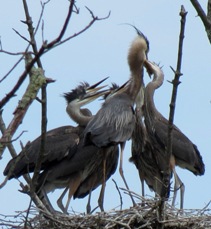 6/23 - Bedford, HRM 35: The great blue heron rookery had more activity going on this week. With a gentle breeze and cooler air temperatures, some nestlings were exercising their wings. It was encouraging that there were two nests with four surviving young and another with five. They were all getting to be almost the size of the adults. The vocalizations were a constant chatter that intensified when an adult appeared with food, resulting in a feeding frenzy as the young birds jockeyed for position. Unlike the bald eagles that can tear off a piece of food, herons swallow theirs whole. The adults then have to regurgitate the food to feed to the young. [Photo of great blue herons in nest by Jim Steck.]
- Jim Steck
6/23 - Croton Point, HRM 35-34: It would still be a week or more until I begin "purpling" my face, but the birds were already lined up for the mulberries. There were no ripe berries yet, but there was no mistaking the birds' enthusiasm for this berry.
- Christopher Letts
6/24 - Town of Poughkeepsie: The house was back in order. After a day on the run, both fledglings had returned to the nest tree (NY62). Both appeared healthy and at ease. Their last two days had been full of exhausting new experiences. This evening, a migrating osprey circled in the sky over the nest. Both fledglings were in the tree and one called out as the osprey circled lower. After two circuits over the nest, the osprey widened its arc and drifted away to the northwest. Mom made a food drop in early evening. The eaglets loved their new freedom, but they also appreciated the food service.
- Bob Rightmyer, Tom McDowell, Tom Lake
6/24 - Town of Wappinger, HRM 67: Our first hummingbird in a month (see June 17), a male, showed up at the feeders. Minutes later a female arrived. In years past we have had nesting nearby, so possibly this was a mated pair.
- Tom Lake
6/24 - Putnam County, HRM 54: A black bear has been wandering around the Copperhead Cut-East Mountain area, hitting the remaining bird feeders. It ambles around, doesn't bother anyone, and reminds us of the wildlife we share the mountain with.
- Connie Mayer-Bakall
6/24 - Croton Point, HRM 35-34: Crowds of carp, clouds of carp, roistering, noisy, wallowing carp. They began this spring's spawning late this year - cooler water? - but were now making up for it. From past years and close observation, I know the rest of the story: Beneath and behind each mob of splashing, spawning carp are the "camp followers," schools of white perch, dining on fresh carp caviar. As I watched this morning, several double-crested cormorants were following the action. Time and again they'd surface with a struggling white perch griped in those serrate mandibles.
- Christopher Letts
6/25 - Kingston, HRM 92: I have not seen a single monarch butterfly this season, which is not a good sign. By now we should be seeing at least a few heading north to breeding locations in the Catskills and Adirondacks.
- Betty Boomer
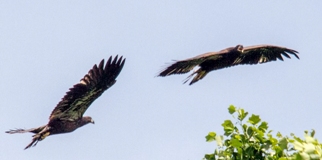 6/25 - Town of Poughkeepsie: Both fledglings were in the NY62 nest tree when I arrived in early afternoon. One of them is missing some tail feathers and we have dubbed him "Raggedy Tail." They both flew easily a short distance north to "Dad's tree," a white pine where the adult male hangs out. [Photo of bald eagle fledglings from NY62 by Bob Rightmyer.]
- Bob Rightmyer
6/25 - Beacon, HRM 61: After six days with no precipitation, and little appreciable rain in twelve days, river salinity became measurable here for the first time this season at 1.5 ppt.
- Tom Lake
SUMMER 2014 NATURAL HISTORY PROGRAMS
July 26: 12:00 noon - 3:00 p.m.
Family Fishing Day at Norrie Point Environmental Center, Staatsburg [Dutchess County]. All ages welcome to this free program; rods, reels, and bait provided. Wheelchair accessible. For information: 845-889-4745 x109.
HUDSON RIVER MILES
The Hudson is measured north from Hudson River Mile 0 at the Battery at the southern tip of Manhattan. The George Washington Bridge is at HRM 12, the Tappan Zee 28, Bear Mountain 47, Beacon-Newburgh 62, Mid-Hudson 75, Kingston-Rhinecliff 95, Rip Van Winkle 114, and the Federal Dam at Troy, the head of tidewater, at 153. The tidal section of the Hudson constitutes a bit less than half the total distance – 315 miles – from Lake Tear of the Clouds to the Battery. Entries from points east and west in the watershed reference the corresponding river mile on the mainstem.
TO CONTRIBUTE YOUR OBSERVATIONS OR TO SUBSCRIBE
The Hudson River Almanac is compiled and edited by Tom Lake and emailed weekly by Steve Stanne, education coordinator at DEC's Hudson River Estuary Program. Share your observations by e-mailing them to trlake7@aol.com.
To subscribe to the Almanac (or to unsubscribe), go to DEC's Email Lists page, enter your email address, and click on "Submit." A page listing available subscription topics will appear. Scroll down; under the heading "Natural Areas and Wildlife" is the section "Lakes and Rivers" with a listing for the Hudson River Almanac. Click on the check box to subscribe. While there, you may wish to subscribe to RiverNet, which covers projects, events and actions related to the Hudson and its watershed, or to other DEC newsletters and information feeds.
The Hudson River Almanac archive allows one to use the DEC website's search engine to find species, locations, and other data in weekly issues dating back to October 2003.
Discover New York State Conservationist - the award-winning, advertisement-free magazine focusing on New York State's great outdoors and natural resources. Conservationist features stunning photography, informative articles and around-the-state coverage.
USEFUL LINKS
The National Oceanic and Atmospheric Administration's high and low tide and tidal current predictions are invaluable for planning boating, fishing, and other excursions on and along the estuary.
The Hudson River Environmental Conditions Observing System [HRECOS] provides near real-time information on water and weather conditions at monitoring stations from Manhattan to the Mohawk River.
Historical information on the movements of the salt front is available on the U.S. Geological Survey's Hudson River Salt Front website.
New smartphone app available for New York outdoor enthusiasts!
DEC, in partnership with ParksByNature Network®, is proud to announce the launch of the New York Fishing, Hunting & Wildlife App for iPhone and Android. This FREE, cutting-edge mobile app gives both novice and seasoned outdoorsmen and women essential information in the palm of their hands. Powered by Pocket Ranger® technology, this official app for DEC will provide up-to-date information on fishing, hunting and wildlife watching and serve as an interactive outdoor app using today's leading mobile devices. Using the app's advanced GPS features, users will be able identify and locate New York's many hunting, fishing and wildlife watching sites. They will also gain immediate access to species profiles, rules and regulations, and important permits and licensing details.
NY Open for Hunting and Fishing Initiative
Governor Cuomo's NY Open for Fishing and Hunting Initiative is an effort to improve recreational opportunities for sportsmen and women and to boost tourism activities throughout the state. This initiative includes streamlining fishing and hunting licenses, reducing license fees, improving access for fishing and increasing hunting opportunities in New York State.
In support of this initiative, this year's budget includes $6 million in NY Works funding to support creating 50 new land and water access projects to connect hunters, anglers, bird watchers and others who enjoy the outdoors to more than 380,000 acres of existing state and easement lands that have gone largely untapped until now. These 50 new access projects include building new boat launches, installing new hunting blinds and building new trails and parking areas. In addition, the 2014-15 budget includes $4 million to repair the state's fish hatcheries; and renews and allows expanded use of crossbows for hunting in New York State.
This year's budget also reduces short-term fishing licenses fees; increases the number of authorized statewide free fishing days to eight from two; authorizes DEC to offer 10 days of promotional prices for hunting, fishing and trapping licenses; and authorizes free Adventure Plates for new lifetime license holders, discounted Adventure Plates for existing lifetime license holders and regular fee Adventure Plates for annual license holders.
Copies of past issues of the Hudson River Almanac, Volumes II-VIII, are available for purchase from the publisher, Purple Mountain Press, (800) 325-2665.