
Hudson River Almanac 6/12/14 - 6/18/14
The New York State Department of Environmental Conservation sent this bulletin on 06/26/2014 04:30 PM EDTYou are subscribed to receive updates from DEC. Links to receive help or to change your preferences are provided below. Having trouble viewing this email? View it as a Web page.

June 12 - 18, 2014
Compiled by Tom Lake, Hudson River Estuary Program Naturalist
OVERVIEW
Most or all of the Hudson Valley bald eagle nestlings were on the verge of becoming fledglings - just days away. The vagaries of springtime were evident as early hummingbird sightings had dwindled and almost no one had seen a monarch butterfly.
HIGHLIGHT OF THE WEEK
6/15 - Warren County, HRM 220: Just after dark this evening, I heard the call of a loon, a tremolo from out on Great Sacandaga Lake. It gave me goose bumps. I was in awe, and felt so fortunate to live where I can hear them.
- Marilyn Arpin
[Loons are one of a handful of iconic species in our watershed whose presence authenticates remnants of wildness. Along with eagles, coyotes, ravens, bobcats, and black bears, the common loon rekindles remembrances of different times, long ago. Tom Lake.]
 NATURAL HISTORY NOTES
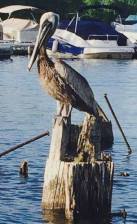
6/12 - Saratoga Lake, HRM 182: Myron Chamberlin and the Saratoga Lake Association sent a digital image of the brown pelican sighted on the north end of Saratoga Lake (see May 29) putting to rest any questions as to this extraordinary sighting.
- Tom Lake
6/12 - Town of Poughkeepsie: Day 74. The eaglets in NY62 were getting their daily workout, climbing (branching) up on limbs over the nest and then jumping (mini-flights) back down.
- Tom McDowell, Sheila Bogart
6/12 - Mystery Point, HRM 47: Riding Metro North today I saw a strange sight just north of the Manitou station. At least five black vultures were crammed onto a tiny tree. I thought it was kind of funny-looking because there was plenty of room nearby but they all seemed to want to be close to each other.
- Glen Heinson
6/13 - Norrie Point, HRM 85: Students from Mercy College, Dobbs Ferry, joined us in enduring the rain, from showers to downpours, as we sampled the south cove. The extremely high tide and rain (1.25 inches) conspired to limit our catch to banded killifish. However, with the recent discussion on the etymology of their name, we had plenty to talk about. The river was 69 degrees Fahrenheit.
- Tom Lake, Brianna Rosamilia, T.R. Jackson
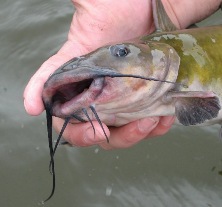 [The students were fascinated by the behavior of a small brown bullhead previously taken in the cove. The catfish searched along the bottom of a small tank with its "whiskers," probing for familiarity. More correctly called barbels, these are small, fleshy organs around the jaws of fish such as sturgeon; carp; and catfish. Sensors for touch and taste are located on barbels, an adaptation allowing fish that frequent habitats with limited or no light to navigate and find food. Tom Lake. Photo of barbels on a channel catfish by Steve Stanne.]
6/13 - Hyde Park, HRM 82: Three of us who live in Hyde Park have been enjoying the hummingbirds at our feeders since the lilacs bloomed [see May 11- Hyde Park]. However, within the past week or two, they seemed to have vanished. We've never experienced this before.
- Barbara Wells
[We had three last month, but now have not seen one in weeks. Often the first spring hummingbirds to arrive are headed north to breeding territories. Summer residents should be here, if not now, then soon. Tom Lake.]
6/13 - Croton-on-Hudson, HRM 35: This is a spring of mock orange (Philadelpus species.). The several varieties around my house were threatening to engulf it. The bushes were so heavily laden with fragrant white blossoms that the birds, accustomed to gathering in their thickets, were lost from sight. I knew the birds were there because the bushes were "singing" from before dawn until after dark.
- Robin Fox
[I would add that mock orange is the most fragrant of spring flowers, but I have also said that about others, so it would be like crying wolf. Tom Lake.]
6/14 - Dunderberg Mountain, HRM 43.5: A recent Almanac noted that "goldfish can grow to 14 inches and weigh a couple of pounds." Here is another tale to add to the story. While trawling in the shadow of Dunderberg Mountain as a fisheries consultant in the summer of 1970, my crew hauled up a very large and very bright-orange goldfish. We were amazed and, with its great girth, we thought at first that it was a carp. However, it lacked barbels - convincing us that it was not a carp, but a goldfish. I do not recall the fish's length but remember that it weighed 20 lb.
- Don Pizzuto
[Carp and goldfish coloration can range from olive-brown to bright-orange, with several shades of burnished-gold in between. Since they hybridize, a close look is required for identification. Carp have two pairs of barbels (4) on their upper jaw, goldfish have none; hybrids have a subset of barbells - that is, 1-3. On some fish they are difficult to locate, leaving us to wonder if Don's fish might have been a hybrid. More than a decade ago, C. Lavett Smith and I caught a foot-long brassy-gold carp-goldfish hybrid in the cove above Danskammer Point (HRM 67) that had two barbels on one side and none on the other. Tom Lake.]
6/14 - Norrie Point, HRM 85: The adjacent water chestnut-covered south cove was volcanic with spawning carp! They were splashing explosively everywhere, from the Environmental Center all the way down river to the Poughkeepsie Yacht Club, more than a mile away. The dozens of Canada geese, several cormorants, and herons perched on floating logs were unfazed by the commotion.
- Dave Lindemann
6/14 - Town of Poughkeepsie: Day 76. The size difference between the two eagle nestlings was obvious as they perched together on limbs around nest NY62.
- Tom McDowell
[Pete Nye offers that size differences among nestlings can occur for a variety of reasons. While a nestling hatched a day or two later may be smaller than an older nest mate, size usually is an indication of gender - female raptors tend to be larger. See http://www.learner.org/jnorth/search/BaldEagle.html. Tom Lake.]
6/14 - Beacon, HRM 61: Good fishing at Long Dock today - I caught and released two carp. One weighed 10 lb. 13 oz., and the other was about the same size. Carp were spawning heavily in the water chestnut growth that had made its annual appearance in the south-side bay.
- Bill Greene
6/15 - Milan HRM 90: A female cardinal did her rendition of the "broken wing" decoy act today. She was standing in the middle of the road causing me to stop. Then she flew up and landed a little farther down the road. She repeated this several times as I moved slowly forward, until finally she moved to the side so that I could pass. All the time she was sounding her distress call.
- Marty Otter
6/15 - Norrie Point, HRM 85: Here is another perspective with regard to the ongoing discussion of the Dutch word "kill" (see May 30, June 5), and its relationship with Hudson River tributaries. I once had the opportunity to speak with Dutch professor Nico Habermann about the Colonial Dutch in the Hudson Valley. He was very interested and mentioned the frequent appearance of the word and how it is translated in American dictionaries as meaning "creek." Professor Habermann said the word meant much more than creek in The Netherlands. Specifically, it referred to a rapidly flowing stream with sufficient volume and enough "head" or pressure from the stream's vertical drop to make it a source of water power, via a waterwheel or turbine.
- Al Gerney
6/16 - Minerva, HRM 284: It was verdant out there! Very green. The nearly four inches of rain we had last week was amazing. Pink ladies-slipper and Indian cucumber-root were in bloom. Our American bittern was back! I heard him out in the marsh a few days ago and tonight I heard that "bad plumbing" sound again. Along with this wonderful call were scattered peepers, a crowd of bullfrogs, and several green frogs. The light was limited at dusk, and as I sought out a large rock I like to sit on, I nearly landed on a DeKay's brown snake, coiled up and enjoying the remaining warmth of the rock.
- Mike Corey
6/16 - Ulster County, HRM 92: Driving on Girard Street in Connolly today, I came upon a black bear. It looked like it was a young adult and reared slightly on its back legs. I think it was a startle response to the braking of my oncoming pickup truck. The bear then decided that getting off the road was a better choice and ran into the brush toward the woods. I've seen lots of different wildlife in my fifty-plus years here, but this is the first black bear sighting I've had this close to my home. Surprised, yes. Concerned, no.
- Lauren Swartzmiller
6/16 - Norrie Point, HRM 85: The water was quiet at low tide, as Norrie Point educators and students seined in the south cove and then by the north dock. The incredible carp spawning activity I'd witnessed two days ago was totally absent.
- Dave Lindemann
[When common carp are in full vigor, their spawning activity is explosive. It often seems like cement blocks are dropping out of the sky. In the early 1980s, video footage purported to be that of "Champ," Lake Champlain's version of the Loch Ness Monster, was given to C.L. Smith, curator of fishes at the American Museum of Natural History, for his evaluation. Champ was described as a large reptilian animal that some believed to be a descendant of the now-extinct ichthyosaur. After a painstakingly careful, frame-by-frame analysis, Dr. Smith concluded that the footage showed scores of common carp, spawning. The fish created such a commotion, swimming and leaping over each other across the water, that the result looked like the undulating neck of a 50-foot-long long sea creature. Tom Lake.]
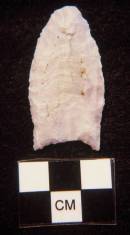 6/16 - Wallkill River, HRM 77: It was fifteen years ago today, as I walked along the edge of a fallow cornfield listening to the "witchity-witchity-witchity" of the common yellowthroat, that I spotted a piece of gray stone (chert) protruding slightly from a crack in the dry earth. It was the thin edge of a small projectile point staring up at me. I had found a very old spear point, later dated to about 12,500 years ago.
- Tom Lake
[This stone artifact was a Barnes-type fluted spear point, a style that originated in southwestern Ontario about 12,500 calendar years ago. They are a diagnostic tool of what archaeologists believe were the first people, called Paleoindians, to enter the Hudson Valley. The Wallkill River Valley was a seasonal passageway for these hunter-gatherers from Ontario, through the Mohawk River Valley, then south through Greene, Ulster, and Orange Counties, stopping at stone quarries and following game herds. Tom Lake. Photo of Barnes fluted spear point by Tom Lake.]
6/16 - Town of Poughkeepsie: Day 78. The NY62 nestlings were eager and showing their impatience with very vocal calling for food! Mom made a food "drop" after which the eaglets busied themselves with eating.
- Terry Hardy, Bob Rightmyer
[The progression from hatch to fledge has been consistent with these adults over the last thirteen years. As the nestlings enter the 72-90 day range (expected fledging), their appetite becomes insatiable and their manners deteriorate. The adults eventually stop landing in the nest with food, and instead drop the items from a safe height. The kids are quite incorrigible. Tom Lake.]
6/16 - Bedford, HRM 35: There was not very much activity at the great blue heron rookery today. With the air temperature in the 80s, it may have been uncomfortable for the fledglings. The nests are in the top of dead trees and there is no shade from the hot sun. Their immature plumage was becoming darker than that of the adults - a dark charcoal gray. There was a continuous chattering but the only activity was the adults flying in to feed the nestlings.
- Jim Steck
6/17- Oscawana, HRM 38.5: We stopped at the mouth of Furnace Brook and spotted a great blue heron standing on a log in the middle of the outlet. It was motionless until a pair of mute swans swam close, at which point the heron held its wings out, cormorant-like. The swans then changed direction and proceeded away. Just before we left, the air became filled with swarms of barn swallows, flitting across the water and into the trees, their deeply forked tails, bright blue heads and backs, and reddish-orange breasts evident in the bright sunlight.
- Dorothy Ferguson, Bob Ferguson
6/17 - Croton-on-Hudson, HRM 35: Has anyone noticed fewer hummingbirds this year? Perhaps I'm just impatient, but I seem to remember that by this time the hummingbird traffic in my yard was in high gear. I have just one male hanging around here so far.
- Robin Fox
6/18 - Lake Luzerne, HRM 224: A morning walk on the River Trail began perfectly peacefully. I had hopes of seeing a monarch butterfly, but none showed. Fish (brown trout?) were rising to a hatch along a flat reach of the river, dimpling the surface. The theme became "red" as I spotted two male scarlet tanagers and several red squirrels, cut my finger on prickly multiflora rose, and began scratching the many mosquito bites. When the black flies joined it, it was time to go.
- Tom Lake
6/18 - Corinth, HRM 220: As I was taking a bird walk near the river, a gray fox crossed the trail not 50 feet in front - being very quiet can make us nearly invisible. The fox was elegant in its graceful movements, very feline-like.
- Tom Lake
6/18 - Green Island, HRM 153: We hauled our seine in the dropping tide, looking for young-of-the-year river herring, and found none. In fact, twice we slipped off a slope and got a good dousing in the river (68 degrees F). Along the rocky shoreline strewn with gray, red, and green Normanskill shale, we collected small chert and quartzite pebbles.
- Tom Lake, A. Danforth
[We were collecting pebbles for a fourth-grade local history class. To foster a commitment to nature in their children, many Native American groups encourage them, at a young age, to walk along beaches and stream beds looking for small water-worn stones shaped like an animal. This is much like seeing images in the clouds - one person's eagle is another's opossum. This search may take a day, a year, a lifetime. When they finally find one, they save the small stone and the symbolic animal becomes their life-long guardian spirit, a totem, a tangible connection to Nature. There is a theory that you will not destroy that which you love. In just half an hour we found three bears, three eagles, four mountain lions, and five turtles. Tom Lake.]
6/18 - West Sand Lake, HRM 149: While weeding the flowers today, I saw a first for me: a lovely snowberry clearwing hummingbird moth. What a wild looking critter! Other highlights included several swallowtails and an incredible evening light show by fireflies in the meadow.
- Audrey Van Genechten
6/18 - Town of Poughkeepsie: Day 80. The wait for fledge day continued. Both NY62 eaglets remained in the nesting tree, fairly quiet for a change. They seemed content, which is not a good sign for an imminent fledge.
- Tom McDowell, Terry Hardy, Bob Rightmyer
SUMMER 2014 NATURAL HISTORY PROGRAMS
July 26: 12:00 noon - 3:00 p.m.
Family Fishing Day at Norrie Point Environmental Center, Staatsburg [Dutchess County]. All ages welcome to this free program; rods, reels, and bait provided. Wheelchair accessible. For information: 845-889-4745 x109.
HUDSON RIVER MILES
The Hudson is measured north from Hudson River Mile 0 at the Battery at the southern tip of Manhattan. The George Washington Bridge is at HRM 12, the Tappan Zee 28, Bear Mountain 47, Beacon-Newburgh 62, Mid-Hudson 75, Kingston-Rhinecliff 95, Rip Van Winkle 114, and the Federal Dam at Troy, the head of tidewater, at 153. The tidal section of the Hudson constitutes a bit less than half the total distance – 315 miles – from Lake Tear of the Clouds to the Battery. Entries from points east and west in the watershed reference the corresponding river mile on the mainstem.
TO CONTRIBUTE YOUR OBSERVATIONS OR TO SUBSCRIBE
The Hudson River Almanac is compiled and edited by Tom Lake and emailed weekly by Steve Stanne, education coordinator at DEC's Hudson River Estuary Program. Share your observations by e-mailing them to trlake7@aol.com.
To subscribe to the Almanac (or to unsubscribe), go to DEC's Email Lists page, enter your email address, and click on "Submit." A page listing available subscription topics will appear. Scroll down; under the heading "Natural Areas and Wildlife" is the section "Lakes and Rivers" with a listing for the Hudson River Almanac. Click on the check box to subscribe. While there, you may wish to subscribe to RiverNet, which covers projects, events and actions related to the Hudson and its watershed, or to other DEC newsletters and information feeds.
The Hudson River Almanac archive allows one to use the DEC website's search engine to find species, locations, and other data in weekly issues dating back to October 2003.
Discover New York State Conservationist - the award-winning, advertisement-free magazine focusing on New York State's great outdoors and natural resources. Conservationist features stunning photography, informative articles and around-the-state coverage.
USEFUL LINKS
The National Oceanic and Atmospheric Administration's high and low tide and tidal current predictions are invaluable for planning boating, fishing, and other excursions on and along the estuary.
The Hudson River Environmental Conditions Observing System [HRECOS] provides near real-time information on water and weather conditions at monitoring stations from Manhattan to the Mohawk River.
Information on the movements of the salt front is available on the U.S. Geological Survey's Hudson River Salt Front website.
New smartphone app available for New York outdoor enthusiasts!
DEC, in partnership with ParksByNature Network®, is proud to announce the launch of the New York Fishing, Hunting & Wildlife App for iPhone and Android. This FREE, cutting-edge mobile app gives both novice and seasoned outdoorsmen and women essential information in the palm of their hands. Powered by Pocket Ranger® technology, this official app for DEC will provide up-to-date information on fishing, hunting and wildlife watching and serve as an interactive outdoor app using today's leading mobile devices. Using the app's advanced GPS features, users will be able identify and locate New York's many hunting, fishing and wildlife watching sites. They will also gain immediate access to species profiles, rules and regulations, and important permits and licensing details.
NY Open for Hunting and Fishing Initiative
Governor Cuomo's NY Open for Fishing and Hunting Initiative is an effort to improve recreational opportunities for sportsmen and women and to boost tourism activities throughout the state. This initiative includes streamlining fishing and hunting licenses, reducing license fees, improving access for fishing and increasing hunting opportunities in New York State.
In support of this initiative, this year's budget includes $6 million in NY Works funding to support creating 50 new land and water access projects to connect hunters, anglers, bird watchers and others who enjoy the outdoors to more than 380,000 acres of existing state and easement lands that have gone largely untapped until now. These 50 new access projects include building new boat launches, installing new hunting blinds and building new trails and parking areas. In addition, the 2014-15 budget includes $4 million to repair the state's fish hatcheries; and renews and allows expanded use of crossbows for hunting in New York State.
This year's budget also reduces short-term fishing licenses fees; increases the number of authorized statewide free fishing days to eight from two; authorizes DEC to offer 10 days of promotional prices for hunting, fishing and trapping licenses; and authorizes free Adventure Plates for new lifetime license holders, discounted Adventure Plates for existing lifetime license holders and regular fee Adventure Plates for annual license holders.
Copies of past issues of the Hudson River Almanac, Volumes II-VIII, are available for purchase from the publisher, Purple Mountain Press, (800) 325-2665.