
Hudson River Almanac 3/21/14 - 3/27/14
The New York State Department of Environmental Conservation sent this bulletin on 04/03/2014 10:53 AM EDTYou are subscribed to receive updates from DEC. Links to receive help or to change your preferences are provided below. Having trouble viewing this email? View it as a Web page.

March 21 - 27, 2014
Compiled by Tom Lake, Hudson River Estuary Program Naturalist
OVERVIEW
We begin our twenty-first year of the Hudson River Almanac with this issue. The scores of wintering eagles we had counted over the last two months were now largely absent, having left for northern breeding areas. The spring migration of snow geese was also underway. As the ice dissipates on the river and in the tributaries, fish will soon become the featured fauna.
 HIGHLIGHT OF THE WEEK
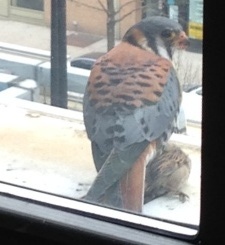
3/27 - Manhattan, HRM 8: A stunning male kestrel brought a dead sparrow to my neighbor's sixth floor air-conditioning unit on West 109th Street. The little falcon decapitated the sparrow and then flew off with the body, leaving the tiny head behind on the air conditioner. The neighborhood has plenty of old buildings with broken cornices where kestrels like to nest. I'm hoping it flew off to bring the carcass to a mate nearby. [Photo of male American kestrel and house sparrow courtesy Janet Rassweiler.]
- Melissa Cooper
NATURAL HISTORY NOTES
3/21 - Town of Poughkeepsie, HRM 70: For several weeks now, we've been fortunate to have daily visits from flickers at both our suet and seed feeders. Yesterday, there were three at one time, two males and a female. The brilliant gold coloring on the underside of their wings is a welcome sight on dreary days.
- Doreen Tignanelli, Jim Beretta
3/21 - Town of Poughkeepsie: On incubation Day 25 at eagle nest NY62, the switch-over (female relieving the male) occurred at 4:40 p.m. After more than three weeks, their routine has become, routine. Often the relieving adult has not even reached the nest before the relieved adult is heading out.
- Tom McDowell
[Incubating eggs can be a tricky proposition and there is no substitute for experience. This mated pair is in its fourteenth year and they can probably sense how long their eggs can be uncovered without risk. On bitter cold days with severe wind-chills, there is almost no margin for error. Tom Lake.]
3/22 - Selkirk, HRM 135: A flock of 30 snow geese, among many flocks of Canada geese, went over the Henry Hudson Park in Selkirk today.
- John Kent (Hudson Mohawk Bird Club)
3/22 - Peekskill, HRM 44: We usually see vultures soaring over Peekskill, but today seven black vultures were on the ground cleaning up roadkill as six more were watching from nearby trees.
- Dianne Picciano, Phil Picciano
3/22 - Peekskill to Ossining, HRM 44-33: Great black-backed gulls were showing up daily in increasing numbers. We see a few during the winter months but not dozens at a time. Are they waiting for the river herring? As scavengers, it seems to me that they follow the herring as they move north through the estuary.
- Christopher Letts
3/22 - Croton-on-Hudson, HRM 35: I sat outside for lunch today but finally had to give it up as the breeze cooled and bees arrived. They circled me, hovering and buzzing at my food. I wondered what else they could be finding to feed on with the snow and frozen leaves covering grass and early flowers. I decided to see if snowdrops were hiding under their winter cover and found a patch ready for sunlight. That's what the bees had found too. I bent to pick a few and ended up with a handful of bee-covered snowdrops.
- Robin Fox
3/23 - Stillwater, HRM 171.5: There were hundreds of snow geese, with many "blue morphs" mixed in, along with a thousand or more Canada geese in a farm field across the river today.
- Pat Newman (HMBC)
[While snow geese are typically snowy white except for their black wing tips, some have a darker genetic color variation. Their bodies tend to be bluish-gray with white heads. These are referred to as "blue geese" or "blue morphs." Tom Lake.]
3/23 - Town of Poughkeepsie, HRM 68.5: A strong west wind had pushed the remaining river ice to the east side. Several red-tailed hawks and a couple of immature bald eagles were "kiting" in the wind. The river temperature was hovering at the freezing mark.
- Tom McDowell
3/23 - Town of Wappinger, HRM 67: From the edge of the woods, upwind from a clearing, I froze in place. For me, there are few moments more iconic of wildness than watching a coyote gingerly walk across a field unaware he is being watched. It's step, step, step, pause, sniff the ground, sniff the air, step ... They can travel so lightly it almost seems as if they are floating. I tired first, moved, and the coyote sprinted away.
- Tom Lake
3/23 - Verplanck, HRM 40.5: A pair of adult eagles caught my eye, perched near the boat launch in Lent's Cove, side by side, less than three feet up in a maple. As I watched from a distance, a splotchy brown-and-white youngster dropped from a tree nearby and plopped into the water to grab a floating fish. It then used its wings to row to shore where it dragged the fish onto a large rock and began feeding. By the time I arrived at a better vantage, the youngster had been ousted by one of the adults. The adult fed for about fifteen minutes. Once all three had left, I beat the gulls to the fish. It was a gizzard shad, about fifteen inches long, and the anterior half had been devoured. I left the take-home to the gulls.
- Christopher Letts
3/23 - Croton Point, HRM 35-34: There was good birding at Croton Point this weekend, including two snipe within ten feet of the road, gray catbird, green-winged teal, American wigeon, red-headed woodpecker, falcons (merlin and kestrel) and, for me, a first-of-year osprey.
- Larry Trachtenberg
3/24 - Hudson Valley: This winter, ten of the eleven counties in Region 8 had confirmed snowy owls. Warren County had several reported, but no photos or birds that hung around. Albany Airport had the most birds, with up to five present at a given time. The Fort Edward area held two to three much of the winter and the Coxsackie area also had two long-staying owls. At the invasion's peak, there may be been close to two dozen snowy owls in the region, and who knows how many passed through to land in areas to our south.
- Will Raup (HMBC)
[Region 8 is a regional reporting area designated by the New York State Ornithological Association. This designation groups together counties with similar temperate zones, arrival dates, habitat, and geographic orientation. The maps of each region can be found at http://www.nybirds.org/RecordsEditors.htm. Region 8 (Hudson-Mohawk) includes Fulton, Montgomery, Schoharie, Saratoga, Warren, Schenectady, Albany, Greene, Columbia, Rensselaer, and Washington counties. Will Raup.]
3/24 - Milan, HRM 90: Noisy crows brought my attention to a raptor that was flying eastward away from my home and toward Pine Plains. I thought at first that it was the usual red-tailed hawk that frequents the area but then noticed that some things about the bird were different: size, color, wing-beats, and a slight dihedral soar. I was able to get my binoculars on the bird long enough to notice a very distinctive white patch on the underside of each wing, a distinctive field mark (but not always present) of an immature golden eagle. The bird flew across the Taconic Parkway and up over a ridge that is one of the highest in Milan. The bird seemed to be flying toward Stissing Mountain, about four miles due east, where wintering golden eagles are frequently seen.
- Frank Margiotta
3/24 - Rosendale, HRM 86: This afternoon I was delighted to be welcomed home by an eastern phoebe, a flycatcher, perched on a low branch just by my path, bobbing its tail up and down - the first I've seen this spring.
- Kali Bird
3/24 - Hyde Park, HRM 82: I spotted a female hooded merganser swimming in the pond at Val-Kill this afternoon. She was alone and her cinnamon crest was flat. She was remarkably nonplussed by my presence, binoculars in hand, and she did not dive while I watched.
- Pat Joel
[Val-Kill was Eleanor Roosevelt's personal home from 1945-1962 and is now a National Historic Site managed by the National Park Service. Tom Lake.]
3/24 - Beacon, HRM 61: This was another sub-freezing "spring day" so we walked the beach in the lee of the point at Long Dock, where the air was noticeably warmer. A huge splash caught our attention and moments later we watched a large carp move languidly through the shallows. The open river was 34 degrees Fahrenheit; the shallow near-shore waters were 39. A raft of Canada geese out in the bay suddenly became very anxious, honking loudly. It was not totally unexpected when an immature bald eagle made its presence known by lifting off from a shoreline cottonwood.
- Tom Lake, T.R. Jackson
[Windward and leeward are terms that are often used to provide color and accuracy to the description of a location or condition under which a sighting is made. These are sailing terms used to denote wind exposure: windward being in the face of the wind; leeward meaning sheltered, as in the lee of a point or an island. Tom Lake.]
3/24 - Croton River, HRM 34: Tree swallows were alternately swooping and gathering in a dense knot on a portion of the sandbar just outside the railroad bridge in Croton Bay. At the same time, a dozen immature bald eagles were playing some sort of keep-away, or tag, sometimes right over the swallows.
- Christopher Letts
3/25 - Red Hook, HRM 98: I spotted about 50 snow geese mixed in with several hundred Canada geese, all taking a rest in a farm field off Rockefeller Lane. We stopped to take a few pictures and were honked at several times, not by the birds, but by other motorists intent on missing a rare opportunity.
- Dan Miller, Hudson Miller
3/25 - Hyde Park, HRM 82: A return to Val-Kill from yesterday found a magnificent male hooded merganser in the front pond, his crest fully open. He quickly swam away to the back pond where he repeatedly dove. Yesterday's female was not seen.
- Pat Joel
3/25 - Furnace Woods, HRM 38.5: Neighbor and outdoorsman Jack Hoye is lucky enough to have a vernal pond behind his house. Today, he enjoyed the first spring peeper chorus of the season.
- Christopher Letts
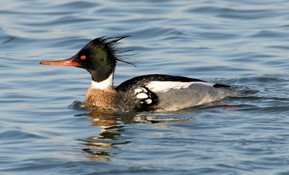 3/25 - Manhattan, HRM 2: I came upon a pair of adult red-breasted mergansers yesterday, swimming together off Pier 49. I returned today with a camera hoping to find them feeding again. And sure enough, there they were! [Photo of male red-breasted merganser by Peter Massas from Wikimedia Commons.]
- Andrew Salcius
3/25 - Westchester County, HRM 38.5: It was 13 degrees F in our driveway this morning, putting ice back on the half-thawed backwaters and ponds that the hooded mergansers seem to favor, and pushing them back out into big water.
- Christopher Letts
3/26 - Minerva, HRM 284: Local birds today included purple finches everywhere I stopped and red crossbills, four at one stop. As I got out of the car, I immediately heard a calling bird - a female red crossbill that I briefly observed before it flew to an area that I believe is a likely nesting location. A bit later, a group of three calling red crossbills flew over and landed too far away for me to see them.
- Joan Collins
3/26 - Town of Poughkeepsie: A frigid and gusting northwest wind combined with a 20 degree F air temperature had the wind chill hovering near zero degrees. A nor'easter was sweeping up the coast with snow and winds in excess of forty-five mph. The switch-over at NY62 occurred at dawn amidst snow flurries as the adult male literally "blew" into the nest.
- Tom Lake
[The overnight air temperature fell to 15 degrees F, within two degrees of the record low for the date. Tom Lake.]
3/27 - Minerva, HRM 284: Essex County birds today included at least five boreal chickadees at a stop along Route 28N, a brown creeper singing non-stop near the Roosevelt Truck Trailhead, many purple finches at every stop, and four red crossbills at three different stops (including two new locations). Once again, red crossbills are nesting along the Route 28/28N corridor in Hamilton and Essex Counties, as they did two winters ago. I also heard several evening grosbeaks as they flew nearby.
- Joan Collins
3/27 - Rosendale, HRM 86: I slowed on a blind turn on Creek Locks Road and was confronted by a magnificent tom turkey in the middle of the road in full regalia (display). He appeared to take umbrage with my presence including stamping, gobbling, and rushing at my stopped vehicle. I moved slowly forward and he finally gave way, jumping at my fender and pecking my front wheel before strutting into the roadside growth, never closing down that magnificent tailpiece. Showing off? Potential mates nearby? Startled into a defensive display?
- John Miller
3/27 - Town of Poughkeepsie: This was incubation Day 31, and we were confident that it was the same for a score or more of other eagle nests along the tidewater Hudson. With the higher sides on the nest, observing behavior had become more difficult. Following a midday switch-over, the male began acting "unsettled," dividing his time between hunkering down on an egg and moving around as if attending to a hatchling. Had there been a hatch of one but not of another?
- Bob Rightmyer, Tom Lake
[In the thirteen years of this pair's nesting, there have been two occasions where a successful hatch was attended by an un-hatched egg as well. Tom Lake.]
3/27 - Washingtonville, HRM 56: For about two weeks, a flock of 20-30 common mergansers (mostly male) and a pair of common goldeneyes have taken up residence on the Otterkill. I have lived here for 37 years and this is the first time I've seen these ducks here. I'm hoping they stick around for a while.
- Eenika Cruz
[The mergansers might stay; according to the New York State Breeding Bird Atlas they do occasionally nest on Hudson Valley streams, and more commonly in the Catskills. The goldeneyes will probably head north; there are a few breeding records in the Adirondacks and along Lake Champlain. Steve Stanne.]
REQUEST FOR APPLICATIONS: "LOCAL HUDSON RIVER FISH ADVISORY OUTREACH INITIATIVES"
In 2008, the Hudson River Fish Advisory Outreach Project began a twenty-year initiative with a goal that all Hudson fish and crab consumers know about, understand, and follow the New York State Department of Health Hudson fish advisories. Through a Request for Applications titled "Local Hudson River Fish Advisory Outreach Initiatives," Health Research, Incorporated and the Department of Health announce the availability of a total of $75,000 to $90,000 per year to develop partnerships with local groups for projects to promote progress towards that goal. The maximum amount per applicant is $15,000 per year. The project area extends 192 miles along the Hudson River from Baker's Falls in Hudson Falls [Washington County] to the southern tip of the Manhattan Battery in New York City. Applications must serve populations that fish or are likely to eat fish from the Hudson River in Albany, Bronx, Columbia, Dutchess, Greene, New York, Orange, Putnam, Rensselaer, Rockland, Saratoga, Ulster, Washington and/or Westchester counties in New York State. Applications are due on April 9, 2014 by 5:00 p.m. For more information, visit http://www.healthresearch.org/funding-opportunities/hrfa-14-01
SPRING 2014 NATURAL HISTORY PROGRAMS
April 5: 10:00 a.m.
Tivoli North Bay Walk. Join NYSDEC Naturalist Jim Herrington on a two-mile guided walk along Stony Creek to the edge of Tivoli North Bay on the Hudson River and return. Participants will meet at the Kidd Lane parking area near the Stony Creek Bridge crossing. Kidd Lane is off Route 9G, just south of the Village of Tivoli [Dutchess County]. For information, call 845-889-4745 x109.
April 26: 1:00 - 4:00 p.m.
Family Fishing Day at Norrie Point Environmental Center, Staatsburg [Dutchess County]. All ages welcome to this free program; rods, reels, and bait provided. Wheelchair accessible. For information: 845-889-4745 x109.
HUDSON RIVER MILES
The Hudson is measured north from Hudson River Mile 0 at the Battery at the southern tip of Manhattan. The George Washington Bridge is at HRM 12, the Tappan Zee 28, Bear Mountain 47, Beacon-Newburgh 62, Mid-Hudson 75, Kingston-Rhinecliff 95, Rip Van Winkle 114, and the Federal Dam at Troy, the head of tidewater, at 153. The tidal section of the Hudson constitutes a bit less than half the total distance – 315 miles – from Lake Tear of the Clouds to the Battery. Entries from points east and west in the watershed reference the corresponding river mile on the mainstem.
TO CONTRIBUTE YOUR OBSERVATIONS OR TO SUBSCRIBE
The Hudson River Almanac is compiled and edited by Tom Lake and emailed weekly by Steve Stanne, education coordinator at DEC's Hudson River Estuary Program. Share your observations by e-mailing them to trlake7@aol.com.
To subscribe to the Almanac (or to unsubscribe), go to DEC's Email Lists page, enter your email address, and click on "Submit." A page listing available subscription topics will appear. Scroll down; under the heading "Natural Areas and Wildlife" is the section "Lakes and Rivers" with a listing for the Hudson River Almanac. Click on the check box to subscribe. While there, you may wish to subscribe to RiverNet, which covers projects, events and actions related to the Hudson and its watershed, or to other DEC newsletters and information feeds.
The Hudson River Almanac archive allows one to use the DEC website's search engine to find species, locations, and other data in weekly issues dating back to October 2003.
Discover New York State Conservationist - the award-winning, advertisement-free magazine focusing on New York State's great outdoors and natural resources. Conservationist features stunning photography, informative articles and around-the-state coverage.
USEFUL LINKS
The National Oceanic and Atmospheric Administration's high and low tide and tidal current predictions are invaluable for planning boating, fishing, and other excursions on and along the estuary.
The Hudson River Environmental Conditions Observing System [HRECOS] provides near real-time information on water and weather conditions at monitoring stations from Manhattan to the Mohawk River.
Information on the movements of the salt front is available on the U.S. Geological Survey's Hudson River Salt Front website.
NY Open for Hunting and Fishing Initiative
Governor Andrew Cuomo's NY Open for Hunting and Fishing Initiative is an effort to improve recreational activities for in-state and out-of-state sportsmen and sportswomen and to boost tourism opportunities throughout the state. This initiative includes the streamlining of sporting licenses and reduced fees along with improved access for outdoor pursuits at various sites across the state. In support of this initiative, Governor Cuomo this year has proposed the creation of 50 new land access projects, which will connect those who enjoy the outdoors to more than 380,000 acres of existing state and easement lands that have gone untapped until now. These 50 new access projects include building new boat launches, installing new hunting blinds and building new trails and parking areas. In addition, the Governor's budget includes $4 million to repair the state's fish hatcheries.
Copies of past issues of the Hudson River Almanac, Volumes II-VIII, are available for purchase from the publisher, Purple Mountain Press, (800) 325-2665.