
Hudson River Almanac 7/24/13 - 7/30/13
The New York State Department of Environmental Conservation sent this bulletin on 08/08/2013 10:21 AM EDTYou are subscribed to receive updates from DEC. Links to receive help or to change your preferences are provided below. Having trouble viewing this email? View it as a Web page.

July 24 - 30, 2013
Compiled by Tom Lake, Hudson River Estuary Program Naturalist
OVERVIEW
As July ended there were hints that autumn and seasonal change were not far away. In the air birds were flocking and in the river young-of-the-year [YOY] fishes, bound for the sea, were appearing in great numbers.
HIGHLIGHT OF THE WEEK
7/28 - Croton River, HRM 34: We spotted a pair of Caspian terns on a sand spit to the left (east) of the boat launch at the mouth of the Croton River.
- Larry Trachtenberg, Charlie Roberto, Karalyn Lamb, John Grant, Anne Swaim
[The Caspian tern is the largest of its kind, nearly the size of a herring gull. In New York State, it nests on islands in eastern Lake Ontario and in Lake Champlain, but is seen in the Hudson Valley only during its migration to and from wintering grounds in the southeastern U.S. and the Gulf Coast. About a previous sighting September 3-4, 2003, at Croton Bay, Christopher Letts commented "Through my binoculars I could see that the birds of interest were largely white and gull-sized, but they were not just dipping for baitfish. These birds were making head-first, plummeting dives from 30 feet, and throwing as much water as an osprey when they hit." Tom Lake.]
NATURAL HISTORY NOTES
7/24 - Columbia County, HRM 116: We were collecting land snails just south of Hudson when we uncovered a small slimy salamander (Plethodon glutinosus) among the limestone rocks. These are hard to find in Columbia County. As it walked across our hands, it left tiny slimy footprints behind - an aptly named amphibian.
- Bob Schmidt, Kathy Schmidt, Esther Koslow
7/24 - Millbrook, HRM 82: I had a giant swallowtail in the Peckam Quarry while I was checking the bluebird boxes. It is amazing that they are successfully breeding right in the midst of an active quarry with both tree swallows and bluebirds having successful fledges as well.
- Deb Kral
7/24 - New Paltz, HRM 78: There were several giant swallowtails on the monardas in one of the fields being surveyed during the Mohonk Preserve and John Burroughs Nature Society's 2013 Bio-decathlon Biodiversity Exploration Days in the Humpo Marshland Area.
- Deb Kral
7/24 - New Hamburg, HRM 67.5: At midday the western horizon was black as night as a cold front approached with much rumbling of thunder and the occasional flash of lightning. In the marsh at the mouth of the tidal Wappinger I was looking for a "heron grand slam," but once again fell short. I counted three great blue herons slowly stalking the half-filled shallows; a green heron sat motionless in the phragmites; a great egret positively glowed against the dark sky; and a black-crowned night heron was perched in a deadfall over a pool filling up with the rising tide. All that I lacked was a snowy egret to have seen our five most common herons.
- Tom Lake
7/24 - Cold Spring, HRM 54: We've been seeing a number of copperhead snakes lately after an absence of twenty years on East Mountain Road South. Seems they have been using our woodpile to hang out due to a dearth of chipmunks. Their coloring is so beautiful and they were not at all aggressive upon being moved with DEC assistance. We've also been seeing a fair number of hummingbird hawk moths this summer. I don't remember seeing them so frequently in the past. A number of friends have mentioned the same. Their buzzing alerts one to their presence. The ruby-throated hummingbirds are still avidly foraging on our feeders and plants.
- Connie Mayer-Bakall
7/24 - Manitou, HRM 47: Th is has been quite a summer for beetles. The Japanese beetles have been abundant and eating holes in everything. There are many leaf skeletons under our gray birch from their appetite. An infestation of blister beetles attacked the Japanese anemone and ate almost all the leaves in just two days. I have also been dodging two green June beetles in the vegetable garden. As a child, we used to catch them, tie a string to their legs, and fly them around. There have been many butterflies at the butterfly weed, mostly eastern tiger swallowtails but also giant swallowtails and eastern black swallowtails.
- Zshawn Sullivan
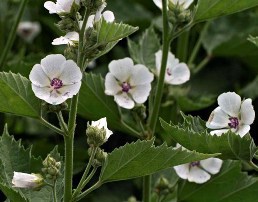 7/24 - Westchester County, HRM 44: I saw the first marsh mallow in bloom today in the tide marsh by Camp Smith at Annsville Bay. [Photo of marsh mallow © Dan L. Perlman/EcoLibrary.org.]
- Zshawn Sullivan
[Marsh mallow (Althaea officinalis) is native to Africa and has become, over time, naturalized in the Hudson Valley. A type of candy made from its roots in Africa has evolved into our campfire treats of today. Tom Lake.]
7/25 - Town of Newcomb, HRM 300: I drove 230 miles north and more than a thousand feet higher in the watershed to find the Hudson River fourteen degrees cooler (68 degrees Fahrenheit). Although midsummer, I could see where autumn was nipping at the edges of the forest. I failed to find the trout and small northern pike I was looking for but did manage to catch several gorgeous red-breasted-sunfish, males in breeding regalia.
- Tom Lake
7/25 - Boreas River, HRM 294: I spent more than an hour this morning sitting on a trail along the Boreas River, a small Hudson River tributary, watching pairs of cedar waxwings systematically strip the fruit off alternate-leaf dogwood trees. Before long I had observed four of the seven thrushes that nest in New York: American robin, veery, wood thrush, and hermit thrush. With a bit of luck I might also have found an eastern bluebird, Swainson's thrush, and - closer to the nearby summits - Bicknell's thrush.
- Tom Lake
7/25 - Poughkeepsie, HRM 75: I was leaving Marist College in late afternoon, heading south, when I saw something by the Water Street exit that made me pull over. It was a dead mink, presumably hit by a car. It was only a few hundred yards away from both the Fall Kill and the Hudson River. In fact, the reach of the Fall Kill as it approaches the train station is one of the wilder, more forested portions within the city, at least for a hundred yards or so.
- Chris Bowser
7/25 - LaGrangeville, HRM 72: While driving on this first morning of cooler weather I saw several groups of blackbirds on the telephone wires and feeding in a field. Are they beginning to assemble for fall migration?
- Brian Herbst
[These blackbird flocks often consist of common grackles, but can include red-winged blackbirds, brown-headed cowbirds, and even starlings on occasion. While we are in our mid-summer swoon, migratory birds, having finished their breeding and taking notice of the shortening days, are already beginning to look south. Tom Lake.]
7/26 - Newcomb, HRM 302: After a heavy dose of summer along the estuary, it was refreshing to feel the chill of evening in the High Peaks of the Adirondacks. Dawn was magical, awaking to the call of ravens, the flute songs of the hermit thrush, the intoxicating fragrance of balsam fir, and a 42 degree F air temperature. At first light I was on a beach along the river when out of the heavy mist came a raven, low over the water, gliding like a raptor, and then lost to sight again.
- Tom Lake
7/26 - Boreas River, HRM 294: Each early morning and evening the eastern kingbirds were out "catching the hatch" (mayflies, caddisflies) as they emerged off the river. As much as I expected to see many trout rising in swirls to the hatches, I saw only two or three in the hour or more that I watched. Either food was plentiful, the trout were few, or the hatch was not the preferred species (trout can be very picky).
- Tom Lake
7/26 - Town of Poughkeepsie, HRM 67.5: They're back. Three black-capped chickadees made an appearance at our feeders after many months' absence. Though they are only three, I am hopeful that they're a harbinger of more to come, as I've missed the sprightly, chatty little birds.
- Donna Lenhart, Bill Lenhart
7/26 - Crugers, HRM 39: This morning we saw the great blue heron fly out of Ogilvie's Pond to the top of a very tall tree overlooking the water. He looked like a star atop a Christmas tree, perched in the middle of the highest branch. A group of four juvenile wood ducks swam by, the same little ducklings we had seen a few weeks ago.
- Dorothy Ferguson, Bob Ferguson
7/27 - Norrie Point, HRM 85: Our July public fishing day drew nice weather and 42 anglers, but did not attract many fish. One of the charms of sport fishing lies in its unpredictability. Of the dozen fish caught across three hours, two were notable by their size, both eighteen-inch-long channel catfish. The best show was put on by a two-foot-long northern water snake that made regular passes by the dock for more than an hour. The river was 80 degree F.
- Ryan Coulter, Tom Lake
7/27 - Town of Poughkeepsie, HRM 67.5: Initially I thought I was seeing things, but then there it was again: a little brown bat flitting about, silhouetted against a lovely evening sky. I could not see its face to tell if it had white-nose syndrome symptoms, but I was very excited to see it. I absolutely love bats.
- Donna Lenhart
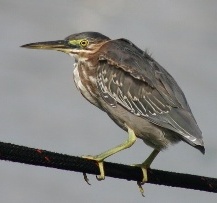 7/27 - Crugers, HRM 39: We were delighted to spot a juvenile green heron perched on one of the curved branches on Ogilvie's Pond . A female wood duck watched it from another curved branch. At one point, the heron, with feet firmly grasping the edge of the branch, poked its head down toward the water, almost hanging upside down. Then it righted itself and began scratching its body with its yellow feet. [Photo of young green heron by Mike Pogue.]
- Dorothy Ferguson, Bob Ferguson
7/28 - Beacon, HRM 61: The catch from the beach at Long Dock Park has become predictable: resident and native spottail shiners, both adults and YOY 47-49 millimeters [mm] long, and river herring, lately YOY alewives (60-61 mm). As we finished seining and were gathering up our gear a hen mallard and her seven ducklings joined us in the shallows and on the beach, with the young being naively curious. The river was 79 degrees F with no detectable salinity.
- Tom Lake, Phyllis Lake, T.R. Jackson
[Seines are commonly mentioned in Almanac observations pertaining to fisheries research and education. A seine is a net with a line of floats on top, a line with weights on the bottom, and tight meshes in between. The word seine is French, from the Latin sagëna, which means a fishing net designed to hang vertically in the water, the ends of which are drawn together to enclose fish. Those referenced in the Almanac range in length from 15'-250' long, 4'-8' in depth, and mesh size from ¼"-2½" depending upon application. They are an excellent tool used to sample an area and collect aquatic animals without injuring the catch. Haul seines, longer nets that require a boat to set and many strong arms to help haul, were used in Hudson River commercial fishing from colonial times until the last decade of the twentieth century. They have since been outlawed (except for research use). In the hands of competent fishers, they are simply too efficient. Tom Lake.]
7/28 - Putnam Valley, HRM 55.5: Despite garden attractions such as vigorous purple coneflowers, monarchs were few, if any, while swallowtails were obvious. Also, the garden butterfly weed (Asclepias tuberosa) seem fewer and, when present, to have fewer flowers. Roadside, I see pretty, blue-flowered chicory rarely and much less Queen Anne's Lace; perhaps they've been out-competed by mugwort, which abounds.
- Nancy P Durr
7/28 - Croton Point, HRM 34.5: We had four grasshopper sparrows, many bobolinks in various plumage stages - both birds clearly have bred successfully - and savannah sparrow on the Croton Point landfill. We also had a single - seemingly early - kestrel perched on a methane post. Among the butterflies were orange and clouded - maybe cloudless as well - sulphurs, tiger and black swallowtails, our first monarch of the year, and a viceroy.
- Larry Trachtenberg, Charlie Roberto, Karalyn Lamb, John Grant
7/29 - Haverstraw Bay, HRM 41-35: There have been many small blue crabs around, pestering the hook-and-line anglers with their bait-stealing antics. Those who have been crabbing report that just about one in a dozen is legal. One more lunar cycle and another moult and we will have eating-size blue crabs.
- Christopher Letts
[Hudson River blue crab regulations: In order to keep a blue crab, the carapace width cannot be less than less than four-and-one-half inches wide for hard shell blue crabs, three-and-one-half-inches in width for soft shell blue crabs, and three inches for peeler or "shedder" blue crabs. Daily catch limit is 50 crabs. NYSDEC.]
7/29 - Croton Point, HRM 35: The resident red-tailed hawks have shown some bizarre behavior over the years such as wading in vernal pools for long periods of time and feeding on beached fish. This morning I watched as an adult bird flew from garbage can to garbage can, walking around each one. It began to feed on something; I walked over to take a look. These birds seem quite tame; when I was ten yards away it flew about 50 feet and landed on the ground. The "prey item" was a grilled chicken thigh. As I walked away, the bird returned and resumed feeding. On my return trip, I noted that the bird had traveled a hundred yards and was once again feeding at the base of a garbage can, this time on a spare rib. Fish crows and mockingbirds were continually harassing the hawk, but it paid no heed.
- Christopher Letts
7/30 - Kowawese, HRM 59: We were seining for the Hudson Highlands Nature Museum's "Animals and Nature Together" program, for children ages two to four. Today the children got a nice closeup of Hudson River fish including YOY striped bass (54-56 mm) and alewives (54-65 mm). Perhaps the most impressive catch was a six-inch-long smallmouth bass in its multi-hued yellow-green-brown camouflage, a perfect combination of shades to help it disappear in the river shallows. The river was 81 degrees F with no detectable salinity.
- Tom Lake, T.R. Jackson, Pam Golben
7/30 - Croton River, HRM 34: The common loon that has been hanging out here all summer was fishing in midstream, ignoring kyacks and carp fishermen. Two great egrets and a dozen great blue herons were working the flats, and on a sandbar were two Caspian terns, an adult and a young bird. I recalled a similar situation ten years ago. For several days, an adult Caspian teased the young bird with fish, tempting it to fly after the food. I had the pleasure of seeing the young one begin to dive, although I did not see it catch anything. The last sighting that year was of the young following the adult out over the railroad tracks to Croton Bay, still chasing the hoped-for meal.
- Christopher Letts
YOUNG TREES AND SHRUBS LOOKING FOR GOOD STREAMSIDE HOMES
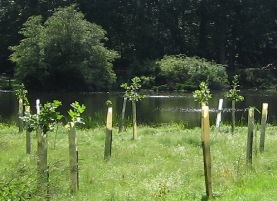 The Hudson Estuary "Trees for Tribs" program is now accepting applications for plantings in October and early November. The initiative provides free native trees and shrubs, planting materials, technical assistance, and site preparation for qualifying sites along streams in the Hudson River estuary watershed. Applicants must provide volunteer labor for planting and long term maintenance. Applications and additional information are available by emailing Beth Roessler, Hudson River Estuary Program Stream Buffer Coordinator, calling (845)256-2253, or visiting the Trees for Tribs website.
SUMMER 2013 NATURAL HISTORY PROGRAMS
August 17: 9:00 a.m. - 12:00 p.m.
Family Fishing Day at the Norrie Point Environmental Center, Staatsburg [Dutchess County]. Family-friendly, all ages, free use of rods, reels and bait; wheelchair accessible. For information: 845-889-4745 x109.
September 14: 1:00 p.m.
Seining for fish at Kowawese Unique Area, New Windsor [Orange County], a program of the 14th Annual Hudson River Valley Ramble. Join Tom Lake, NYSDEC Hudson River Estuary Program naturalist, as we haul a seine in the warm shallows to see who's home in the river today. Wear shorts and sneakers and help us net. Questions? Email Tom Lake.
September 21: 1:00 - 4:00 p.m.
Family Fishing Day at the Norrie Point Environmental Center, Staatsburg [Dutchess County]. Family-friendly, all ages, free use of rods, reels and bait; wheelchair accessible. For information: 845-889-4745 x109.
HUDSON RIVER MILES
The Hudson is measured north from Hudson River Mile 0 at the Battery at the southern tip of Manhattan. The George Washington Bridge is at HRM 12, the Tappan Zee 28, Bear Mountain 47, Beacon-Newburgh 62, Mid-Hudson 75, Kingston-Rhinecliff 95, Rip Van Winkle 114, and the Federal Dam at Troy, the head of tidewater, at 153. The tidal section of the Hudson constitutes a bit less than half the total distance – 315 miles – from Lake Tear of the Clouds to the Battery. Entries from points east and west in the watershed reference the corresponding river mile on the mainstem.
TO CONTRIBUTE YOUR OBSERVATIONS OR TO SUBSCRIBE
The Hudson River Almanac is compiled and edited by Tom Lake and emailed weekly by Steve Stanne, education coordinator at DEC's Hudson River Estuary Program. Share your observations by e-mailing them to trlake7@aol.com.
To subscribe to the Almanac (or to unsubscribe), go to DEC's Email Lists page, enter your email address, and click on "Submit." A page listing available subscription topics will appear. Scroll down; under the heading "Natural Areas and Wildlife" is the section "Lakes and Rivers" with a listing for the Hudson River Almanac. Click on the check box to subscribe. While there, you may wish to subscribe to RiverNet, which covers projects, events and actions related to the Hudson and its watershed, or to other DEC newsletters and information feeds.
The Hudson River Almanac archive allows one to use the DEC website's search engine to find species, locations, and other data in weekly issues dating back to October 2003.
Discover New York State Conservationist - the award-winning, advertisement-free magazine focusing on New York State's great outdoors and natural resources. Conservationist features stunning photography, informative articles and around-the-state coverage.
USEFUL LINKS
The National Oceanic and Atmospheric Administration's high and low tide and tidal current predictions are invaluable for planning boating, fishing, and other excursions on and along the estuary.
The Hudson River Environmental Conditions Observing System [HRECOS] provides near real-time information on water and weather conditions at monitoring stations from Manhattan to the Mohawk River.
Historical information on the movements of the salt front is available on the U.S. Geological Survey's Hudson River Salt Front website.
Copies of past issues of the Hudson River Almanac, Volumes II-VIII, are available for purchase from the publisher, Purple Mountain Press, (800) 325-2665.