
Hudson River Almanac 6/28/13 - 7/3/13
The New York State Department of Environmental Conservation sent this bulletin on 07/11/2013 03:58 PM EDTYou are subscribed to receive updates from DEC. Links to receive help or to change your preferences are provided below. Having trouble viewing this email? View it as a Web page.

June 28 - July 3, 2013
Compiled by Tom Lake, Hudson River Estuary Program Naturalist
OVERVIEW
After a six week run in many areas, the 17-year periodical cicada phenomenon faded away into what seemed like a normal summer's hot weather hum and chatter. Heavy rains and hot, humid days characterized much of the week.
HIGHLIGHT OF THE WEEK
6/28 - Mohawk River, HRM 159: The United States Department of Agriculture rounded up some Canada geese on the Mohawk River and one of them had a neck collar. The tagging records showed that Bryan Swift and I banded the bird as a nestling in 1991 on Stony Creek Reservoir in Saratoga County, making it 24 years old. I did not know they could live that long.
- Sal Cozzolino
NATURAL HISTORY NOTES
6/28 - Mohawk River Valley, HRM 159: I attended a meeting in Albany today, for which I had to traverse the rain-swollen Mohawk River Valley. Five inches of rain had drenched that part of the Hudson River watershed overnight and the river was rising as I passed through. The flood plain was inundated and the New York State Thruway was flooded, causing some delay. I had never seen the Mohawk so high. In places, the chocolate waters were churning with debris, some of which accumulated at the hydroelectric dams. This is one face of climate change that the upper parts of the watershed will become well acquainted with, it seems.
- Karin Limburg
6/28 - Kowawese, HRM 59: We had missed low tide, optimum for seining, but the warm inshore shallows (75 degrees Fahrenheit) still held enough fish to tell us a story of the evolving seasons in the river. We caught many young-of-the-year [YOY] spottail shiners 24-31 millimeters [mm] long, as well as alewives and blueback herring. Most of the river herring measured 46-49 mm. A half-dozen baby blue crabs measured two to three inches carapace width. The most surprising catch was YOY Atlantic menhaden (39-43 mm).
- Tom Lake, C.T. Lake, T.R. Jackson
[Young-of-the-year aptly describes the multitude of recently hatched fauna found in the Hudson River each spring through fall. These progeny of shad, river herring, striped bass, white perch, blue crabs, shrimp, jellyfish, and many others, are present by the millions. The Atlantic menhaden, also called "bunker," is in the herring family along with the alewife and blueback herring, but unlike those river herring, it spawns in salt water offshore. Young of the year menhaden move into the estuary in summer, joining YOY river herring in taking advantage of the nursery habitat here. Tom Lake, Steve Stanne.]
6/28 - Piermont Pier, HRM 25: I spotted a hen long-tailed duck (formerly oldsquaw) at the Pier. Bob Deed's records for long-tailed ducks at Piermont Pier include two sightings from June 15, 1973 and June 16, 1974. Both were females, as was mine. (Bob Deed wrote Birds of Rockland County, NY and the Hudson Highlands, 1844-1976.)
- Linda Pistolesi
6/29 - Ulster County, HRM 78: Near the southern end of Bonticou Crag in the Shawangunks, I saw a black blur run by and a beautiful, glossy juvenile black bear, probably a yearling out exploring since I did not see Mama, went slipping, sliding and scrambling up a talus slope, headed north.
- Deb Weltsch
6/29 - Town of Wappinger, HRM 67: Cicada Day 38. It seemed as though they were nearing the end of their run. At dawn the woods were silent. By midday, however, there was a low and distant hum that sounded not much more than a typical summer day.
- Tom Lake
6/29 - Croton-on-Hudson, HRM 35: We had a second sighting of a gray fox that has apparently moved in our nearby woods. As we sat on the patio at dusk, the gray fox sauntered along a deer trail not 30 feet away. We were able to witness its entire journey as the fox crossed the top of the hill into the woods. The animal appeared to be in no hurry and seemed to be conspicuously ignoring our presence as it steadily moved on.
- Scott Horecky, Kathy Sutherland
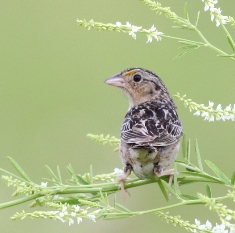 6/29 - Croton Point, HRM 34.5: We searched the Croton Point landfill this evening and had great looks at bobolinks and at least six grasshopper sparrows, perhaps more, meaning there certainly are more around, as well as one lone savannah sparrow.
- Larry Trachtenberg, Kyle Bardwell
[The grasshopper sparrow is an inconspicuous bird found in extensive grassland habitat. The reforestation and development of abandoned farmland across New York has led to a decline in this sparrow's population; it is listed as a species of special concern in the state. Steve Stanne. Photo of grasshopper sparrow by Kyle Bardwell.]
6/30 - Town of Poughkeepsie: The new fledgling from eagle nest NY62, now completing its second week as a free bird, has begun exploring the ground, a precursor to finding its own food. This is an important transition that requires lifting off from the ground, rather than just from a tree limb.
- Bob Rightmeyer, Terry Hardy
6/30 - Town of Wappinger, HRM 67: There has been a profusion of fireflies ("lightning bugs") this month. Perhaps the incredible rainfall has had a positive effect? The display this evening was straight out of my childhood, a sight I had not seen in a very long time.
- Tom Lake
6/30 - Highland Mills HRM 50: We have a mulberry tree in our front yard that has a profusion of fruits this year. Usually it would be mobbed by all manner of birds and squirrels but this year the main recipient of the bounty has been a young white-tailed deer. The deer comes onto the lawn almost every evening and gobbles up the fallen mulberries.
- Alan Groth, Janice Groth
7/1 - Albany, HRM 145: The Albany International Airport recorded 8.68 inches of precipitation for the month of June, making it the third wettest June on record. The precipitation record goes back to 1826. The wettest June on record was in 2006 (8.74 inches); the second wettest was in 1862 (8.70 inches).
- National Weather Service
7/1 - Cheviot, HRM 106: For the last two days, our local flock of Canada geese that graze in the Cheviot riverside park have been joined by a large, drake Muscovy duck. It travels with the geese and seems to be accepted by them with no aggression. It is a handsome duck, black with white front and the strange Muscovy red warty skin around its eyes. This morning it was hunkered down in the rain with its flock, resting on the green grass. Later, the duck began making what appeared to be courting gestures to the juvenile geese that are about his size. He popped his crest up and down, wiggled his tail feathers, and made a low hissing, clacking sound. The geese ignored him and gave him wide berth.
- Jude Holdsworth
[Muscovy ducks (Cairina moschata) are native to Central and South America. They have been introduced and become domesticated in many areas of North America. Tom Lake.]
7/1 - Hyde Park, HRM 82: Torrential downpours over the last two day accumulated six inches in my rain gauge.
- Dave Lindemann
7/1 - Town of Wappinger, HRM 67: Strong overnight thunderstorms persisted into daylight. The deluge at times greatly limited visibility and was so loud that it dulled every other sound in the woods. When it finally relented in midday, three inches of rain had fallen. Were the cicadas still there? Slowly the hum began and within minutes the chatter had resumed. While not at its fever pitch of a couple of weeks ago, it was still there on cicada Day 40.
- Tom Lake
7/1 - Highland Mills, HRM 50: We have had more fireflies around recently, which is a good sign, but fewer squirrels and chipmunks have been seen around our stone walls and bird feeders. We are also not seeing many little brown bats this year. In the past, they would use our shutters for shelter during the day, but not this season.
- Alan Groth, Janice Groth
7/2 - Tivoli Bays, HRM 100: As I sensed that the cicadas were finally ebbing away, I thought back to a month ago, near their beginning, when we took our canoe on the river to paddle at the changing tide down to the bay near Magdalen Island. The air was filled with the noise of cicadas in the trees all along the way. Once inside the bay, we drifted a while taking in the sun and solitude. Farther along the meandering channel, we came upon a cicada struggling in the water, trying to fly. Instinctively we fished it out in a bailing can and let it dry off before releasing it ashore. What an unusual face it had, like a monkey or frog, and how it clung to our hand before clambering with its long legs into the woods. On the return paddle we saw a cicada sitting on a leaf that was drifting south on the outgoing tide. Where would it end up? Meanwhile, another one that we had pulled, drenched, from the bay rode with us all the way back to Tivoli where it got to fly from our car window deep into the trees.
- Jennifer Anderson
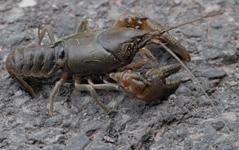 7/2 - Shandaken, Ulster County, HRM 106: We enjoyed watching a large rusty crayfish slowly scuttling along the road, apparently trying to get back into the Little Bushkill in Fox Hollow, a tributary of the Esopus Creek.
- Peter Relson, Carol Anderson
[Rusty crayfish (Orconectes rusticus) are a non-native, invasive species in the Hudson River watershed. They are native to streams in Ohio, Kentucky and Tennessee and have arrived primarily due to releases from anglers' bait buckets. They often out-compete native crayfishes, thus impacting those populations. Tom Lake. Photo of rusty crayfish by Peter Relson.]
7/2 - Town of Clinton, HRM 88: The male eaglet (nest 261) was again comfortably perched at his original nest site, calm but attentive, calling to its parents. This was day twelve since fledging, and he now enjoys surveying his new territory from many different trees and perch sites. His parents remain nearby, but it will not be too long before this youngster will be on his own, generally choosing to find his peer group as summer turns to fall and winter.
- Dave Lindemann
[His less-fortunate sister from eagle nest 261 continues to be treated for leg and talon injuries in an upstate rehabilitation center. She will eventually be trained to fly and to catch food on her own. Dave Lindemann.]
7/3 - Town of Wappinger, HRM 67: It was time to make the call: The major emergence of 17-year periodical cicadas in this area ended on Day 42.
- Tom Lake
7/3 – Hathaway's Glen, HRM 63: Overhead and to the east dark gray clouds were fringed in black. We could hear distant thunder and you could almost feel the electricity in the air. Walking out onto the beach to seine seemed akin to rolling the dice. We were greeted by an odd assemblage of waterfowl: fourteen Canada geese in one group; three drake mallards and a hen common merganser in another. Both groups moved away and the merganser continued to shadow the mallards. Our catch was notable in containing a small school (20-25 fish) of YOY largemouth bass (40-50 mm), something we had never seen here before. The majority of our haul was banded killifish, many of which were males in full breeding regalia. The water exiting Hathaway's Glen, after having tumbled down the fall line, was 68 degrees F. The river was ten degrees warmer at 78.
- Tom Lake, A. Danforth
[There may not be a prettier fish in the river than a courting male banded killifish with iridescent blue, lavender and silver highlights in their bands. A favorite name for the male is "blue-banded mudminnow," a colloquialism coined by riverman Everett Nack. As the females are a drab brownish-green, the species offers a good example of sexual dimorphism among fishes. Tom Lake.]
7/3 - Highland Mills HRM 50: Our abundant bee balm was flowering now, which has brought the hummingbirds back to our gardens. We did have a feeder up but apparently some raccoons were thirsty for the sugar water and removed the feeder twice from the shepherd's crook that serves as a hanger. We'll try to hang it again, maybe from a higher and more secure holder.
- Alan Groth, Janice Groth
SUMMER 2013 NATURAL HISTORY PROGRAMS
July 20-21: Hudson River Days
More than 40 river and riverfront events will be offered, spanning the length of the Hudson from New York City to Albany, during this fifth annual celebration of the river, anchored on Saturday, July 20, by City of Water Day in New York Harbor and Hudson Rising on the Kingston waterfront and uptown. For a full schedule of activities, visit the Hudson River Days website. The following are a few River Days natural history programs likely to be of particular interest to Almanac readers.
July 20: 12 noon - Hudson River Fishes We Have Loved to Eat! on the Pennsy #399 barge at the Hudson River Maritime Museum, 50 Rondout Landing, Kingston [Ulster County].
For at least ten millennia, we have cherished the variety and bounty of Hudson River fishes. Join Hudson River Estuary Program Naturalist Tom Lake on a journey through time to see those species that we loved the best! Sponsored by the Hudson River Estuary Program and Hudson Rising. Questions: email Ann Loeding.
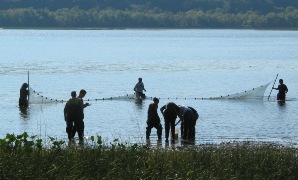 July 20: various times - The Second Annual Great Hudson Estuary Fish Count
At the following sites naturalists will use seine nets, minnow traps, and rods and reels to capture live fish from the Hudson and show visitors these slippery, wriggly, and fascinating creatures usually hidden below the river's surface. During the day the sites will share news of their catches with each other to highlight the diversity of fishes throughout the estuary. The fish are released after participants view them up close. [Photo of seining at Cohotate Preserve by Steve Stanne.]
Brooklyn - Brooklyn Bridge Park (Main St. under Manhattan Bridge): 12:00-1:30 p.m.
Seining the River Wild: Part of City of Water Day. Free but RSVP is required as space is limited; sign up at the Brooklyn Bridge Park Conservancy website.
Manhattan - East River Park at South St. & Montgomery St.: 2:00-4:00 p.m.
Catch-and-release fishing clinic as part of the Pier 42 Exhibits Opening Day and City of Water Day. Bait and tackle will be provided (or bring your own), plus basic fishing instruction and other activities to explore the estuary. Free, but materials are limited. Please register at the Lower East Side Ecology Center website.
Manhattan – Hudson River Park, Pier 25 at North Moore St. 10:00 a.m.-4:00 p.m.
Big City Fishing: catch and release fishing with rods & reels, plus river education activities for the public; look for the striped bass windsock on pier's north side. Part of City of Water Day. Free. For info email the Hudson River Park Trust or call (212)627-2020 and ask for the environment and education department.
Yonkers - Habirshaw Park [Westchester County] 1:00-3:00 p.m.
Seining program offerd by the Beczak Environmental Education Center. Part of City of Water Day. Fee $5.00. For info: (914)377-1900 x12.
Piermont - Flywheel Park [Rockland County] 11:00 a.m.-2:00 p.m.
Seining program with educators from the Lamont-Doherty Earth Observatory and Sparkill Watershed Alliance. Free. For info, email Margie Turrin or call 845-729-8535
Sleepy Hollow - Kathryn W. Davis RiverWalk Center [Westchester County] 1:30-3:30 p.m.
Take part in a seining program with staff from Teatown Lake Reservation and Strawtown Art and Garden Studio, then create art with natural pigments, clay, and crushed sandstone from the river's shores. Free. To make a reservation, call 914-762-2912 x110.
New Windsor - Kowawese Unique Area [Orange County] 5:00 p.m.
Seining program with Tom Lake, Hudson River Estuary Program Naturalist, in cooperation with the Hudson Highlands Nature Museum. Free. For info, email Tom Lake.
Staatsburg - Norrie Point Environmental Center [Dutchess County] 4:00-5:00 p.m.
Seining program with Hudson River National Estuarine Research Reserve staff. Free. For info: 845-889-4745 x105
Kingston - Kingston Point Beach [Ulster County], 11:00 a.m.
Seining program with City of Kingston Parks and Recreation/Forsyth Nature Center staff. Free. For info: 845-481-7336 or email Steve Noble.
Athens - Cohotate Preserve [Greene County], 10:00 a.m.-12:00 noon
Seining program with Cornell Cooperative Extension of Greene County. Sponsored by Columbia-Greene Community College. Fee: $ 5.00. For more information, call 518 622 9820 x 33. To register, call Columbia Greene Community College at (518) 828-4181, ext. 3342.
July 25: 7:00 p.m.
The Bald Eagle: Back from the Brink at the Adirondack Interpretive Center, Newcomb [Essex County].
State University of New York College of Environmental Science and Forestry presents NYSDEC Hudson River Estuary Program naturalist Tom Lake for a look at the journey taken by the bald eagle from near extinction to its flourishing present in the Hudson Valley.
July 27: 1:00 - 4:00 p.m.
Family Fishing Day at the Norrie Point Environmental Center, Staatsburg [Dutchess County]. Family-friendly, all ages, free use of rods, reels and bait; wheelchair accessible. For information: 845-889-4745 x109.
HUDSON RIVER MILES
The Hudson is measured north from Hudson River Mile 0 at the Battery at the southern tip of Manhattan. The George Washington Bridge is at HRM 12, the Tappan Zee 28, Bear Mountain 47, Beacon-Newburgh 62, Mid-Hudson 75, Kingston-Rhinecliff 95, Rip Van Winkle 114, and the Federal Dam at Troy, the head of tidewater, at 153. The tidal section of the Hudson constitutes a bit less than half the total distance – 315 miles – from Lake Tear of the Clouds to the Battery. Entries from points east and west in the watershed reference the corresponding river mile on the mainstem.
TO CONTRIBUTE YOUR OBSERVATIONS OR TO SUBSCRIBE
The Hudson River Almanac is compiled and edited by Tom Lake and emailed weekly by Steve Stanne, education coordinator at DEC's Hudson River Estuary Program. Share your observations by e-mailing them to trlake7@aol.com.
To subscribe to the Almanac (or to unsubscribe), go to DEC's Email Lists page, enter your email address, and click on "Submit." A page listing available subscription topics will appear. Scroll down; under the heading "Natural Areas and Wildlife" is the section "Lakes and Rivers" with a listing for the Hudson River Almanac. Click on the check box to subscribe. While there, you may wish to subscribe to RiverNet, which covers projects, events and actions related to the Hudson and its watershed, or to other DEC newsletters and information feeds.
The Hudson River Almanac archive allows one to use the DEC website's search engine to find species, locations, and other data in weekly issues dating back to October 2003.
Discover New York State Conservationist - the award-winning, advertisement-free magazine focusing on New York State's great outdoors and natural resources. Conservationist features stunning photography, informative articles and around-the-state coverage.
USEFUL LINKS
The National Oceanic and Atmospheric Administration's high and low tide and tidal current predictions are invaluable for planning boating, fishing, and other excursions on and along the estuary.
The Hudson River Environmental Conditions Observing System [HRECOS] provides near real-time information on water and weather conditions at monitoring stations from Manhattan to the Mohawk River.
Historical information on the movements of the salt front is available on the U.S. Geological Survey's Hudson River Salt Front website.
Copies of past issues of the Hudson River Almanac, Volumes II-VIII, are available for purchase from the publisher, Purple Mountain Press, (800) 325-2665.