
Hudson River Almanac 6/15/13 - 6/21/13
The New York State Department of Environmental Conservation sent this bulletin on 06/28/2013 02:08 PM EDTYou are subscribed to receive updates from DEC. Links to receive help or to change your preferences are provided below. Having trouble viewing this email? View it as a Web page.

June 15 - 21, 2013
Compiled by Tom Lake, Hudson River Estuary Program Naturalist
OVERVIEW
The periodical cicada phenomenon reached 30 days this week and elicited predictable reactions from all forms of wildlife. We saw several young eagles fledge from nests along the river and can be fairly certain many more fledged where we were not looking.
HIGHLIGHT OF THE WEEK
6/19 - Greene County, HRM 116: While conducting a program at Cohotate Preserve today, we confirmed the nesting success of the ospreys on green navigational marker 129. We saw one youngster poke its head up several times and estimated it to be around a week old. A message to boaters: the birds are not bothered by motor boats, but kayaks upset them. Respect their nest area and keep your distance [please use binoculars, zoom lenses, and common sense]. From Cohotate, we also saw an osprey on a nest on one of the power towers on the west side of the river just south of Athens, looking like it was brooding eggs.
- Alan Mapes, Larry Federman
NATURAL HISTORY NOTES
6/15 - Cheviot, HRM 106-104: I paddled my kayak down the milky, muddy Hudson from Cheviot south to the Green Flats. Many map turtles were also enjoying the sun, basking on logs, including some huge females. Two were on a free-floating log zipping down river with the current, keeping pace with my boat. The great blue herons were croaking protests and leaving their perches as I passed by. The calm water was littered with dead and fluttering/dying cicadas and I wondered what river residents might feast on this seventeen-year windfall of insect protein!
- Jude Holdsworth
6/15 - Town of Poughkeepsie: On Day 79, the eaglet in NY62 was spending more time out of the nest on branches, venturing a bit higher and farther, but never more than ten feet away. During the time we were there today we saw no food deliveries although Mama made a brief stop before heading over to her favorite perch in a large white pine a couple of hundred feet away.
- Tom McDowell, Terry Hardy
6/15 - Town of Wappinger, HRM 67: Cicada Day 24. Their daily hum, trill, and chatter comes in waves - initially distant and soft, then building in intensity as it draws nearer, sounding much like a troop of howler monkeys coming through the rainforest canopy.
- Tom Lake
6/15 - Furnace Woods, HRM 38.5: My rain gauge has recorded seven-and-a-half inches over the past seven days. Enough!
- Christopher Letts
6/15 - Croton Point, HRM 35: Our seining program at Mother's Lap was a small sidebar to Clearwater's 35th annual Great Hudson River Revival. With about 50 onlookers, we hauled our 75-foot-long net in a river depleted of salt by the preceding week's deluge (measurable salinity had been pushed down to about river mile 18). With no salt, many of the anticipated species were absent. As a result, each haul mirrored the last with a catch dominated by young-of-the-year striped bass 85-95 millimeters [mm] long and alewives 40-43 mm long. Two dozen immature blue crabs (split 50:50 males and females) measured two to three inches carapace width. Despite the lack of salt, several rocks collected below the tide line were studded with bay barnacles.
- Jayden Lombardi Mylod, Tom Lake, Chris Bowser, Eli Schloss
[Bay barnacles (Balanus improvisus) are crustaceans related to shrimp, crabs, and lobsters. Their exoskeleton is a trap-door, calcareous house made of small plates within which the animal lives. While they flourish in salty to brackish water, they can close up shop in times of very low salinity, for a limited period, until conditions improve. Tom Lake.]
6/16 - Germantown, HRM 105: For the last couple of days, I have had large numbers of starlings around. Two days ago they were lined up along the top of my fence and randomly shooting off to snatch cicadas on the wing. They are everywhere since the cicadas are everywhere.
- Mimi Brauch
6/16 - Town of Poughkeepsie: Day 80. While Judy Winter and I missed the exact moment of fledge (the nestling taking that first, totally instinctive, flight from eagle nest NY62); it appears to have occurred sometime before we got there in mid-morning. For more than three hours we watched the nest and never saw the eaglet or the adults. We took a few walks to see if he was in a nearby tree but saw nothing. In mid-afternoon I saw something in a very tall tree, and there he was. He stayed for ten minutes and then took flight, circled around a few times, but the crows were not being very nice. He disappeared from my view for awhile, but later I saw him soaring high with Mama, circling higher and higher until they were just two specks in the sky; then they disappeared from sight.
- Terry Hardy
[This bald eagle pair (NY62) has fledged young in eight of the thirteen years I have watched them. The average fledge date for twelve nestlings across eight years has been 78 days. At their present nest location, over the last three years, the average has been 83 days. This year's 80 days fits nicely. Tom Lake.]
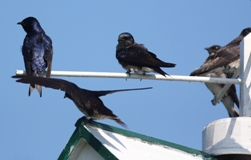 6/16 - Putnam County, HRM 55: As part of the Putnam County breeding bird survey, we made stops at Fahnestock State Park, Stonecrop Garden, and Glynwood Farm. In addition to finding many chestnut-sided warblers, we also came upon many other warblers including Canada, Blackburnian, northern waterthrush, black-throated green, yellow, common yellowthroat, cerulean, and American redstart. At Glynwood Farm we counted 48 purple martins, successfully breeding for the third year in a row. The habitat is well cared for so perhaps the population will be up to a hundred by season's end. [Photo of purple martins by Kyle Bardwell.]
- Larry Trachtenberg, Kyle Bardwell, Charlie Roberto
6/17 - Columbia County, HRM 112.5: Taking a morning ride to see the river's high water and off-color first hand, prior to fishing, we came across an immature bald eagle dead near the railroad tracks at the former Greendale Dock. It was presumably killed by a high-speed passing train since it was within feet of the tracks and appeared to have been dead three to five days.
- Richard Booth, Barry Wolven
[The dead immature eagle was recovered by NYSDEC wildlife staff and will be analyzed to determine cause of death. If you think you have come upon a dead bald eagle, you can e-mail any of these contacts for support and recovery: Sandra Doran at the U.S. Fish and Wildlife Service or Glenn Hewitt, Daniel Rosenblatt, Kevin Hynes at DEC. Bald eagles are protected by state and federal law. Possession, even of a dead bird, without a valid permit, is prohibited. Tom Lake.]
6/17 - Croton Point, HRM 35-34: Hundreds of Canada goose flight feathers attested that the annual moult was on. I have always admired the timing: as the adults are getting new flight feathers, the young are growing a first set. Another sight of the season were the mulberries, having ripened enough to attract wildlife, including me. I visited my favorite trees and breakfasted on the run this morning. Every tree is different: the fruit run from white to almost black, from large to small, from syrupy sweet to bland. Even the ducks and geese were feasting on the dropped fruit beneath the trees.
- Christopher Letts
[Red mulberries are a native plant while white mulberries are an introduced species native to China. They are remnants of a failed nineteenth-century attempt to create a silkworm industry in the Hudson Valley. Eight years ago, fifteen miles upriver at Denning's Point, ripened mulberries attracted an assemblage of large carp that stationed themselves below a tree overhanging the bay. As soon as a ripe mulberry fell into the water several carp would race after it. Tom Lake.]
6/17 - Yonkers, HRM 18: Usually we catch blue crabs, eels, white perch, shrimp, bluefish, striped bass, bay anchovies, and other brackish water fishes in our Beczak Center seine. But today, with a river salinity of 5.0 ppt, our students brought ashore, amidst feisty blue crabs and bouncing shrimp, four tadpoles! This was a first for us. We have put them in a tank at the Beczak Center and they have joined our fish and reptile team.
- Vicky Garufi, Kat Szumny, Vinny El
[Amphibians are not usually found in brackish water; it's possible that these tadpoles were swept into the Hudson from the Saw Mill River in the runoff following recent rains. Steve Stanne.]
6/18 - Town of Wappinger, HRM 67: The cicadas were still going strong on Day 27. They have continued their recent cycle of starting slow and building to a strong, vibrant midday chatter.
- Tom Lake
6/18 - Stony Brook, Suffolk County: Dianne Taggert reported seeing a white pelican in Stony Brook Harbor. It may have been there for the last three days.
- Peter Scully
[This may have been the same white pelican that traveled down the Hudson Valley, June 6-12, last seen at Dobbs Ferry (river mile 23). When white pelicans show up, however infrequently, this is the common route they tend to take, northwest to southeast to the sea. Tom Lake.]
6/18 - Furnace Woods, HRM 38.5: Gray treefrogs were having themselves a year. Many years I have not seen or heard them, but their presence this season has been strong. Is it due to mild winters and wet springs? I hear them often, day and night, and find them in such out-of-the-way places as clinging to the underside of my small kettle grill. Other locations may have cicadas, but we have tree frogs.
- Christopher Letts
6/18 - Croton Point, HRM 35-34: In most years I enjoy a spring and fall migration of cedar waxwings, sometimes thousands of them. But there never seems to be more than one nesting pair here. This year I have found at least four. Such a lovely bird, they never fail to cheer me.
- Christopher Letts
6/19 - Town of Poughkeepsie: I watched the fledgling from eagle nest NY62 for about an hour this evening. He was calling and one of the adults answered three or four times. He took off, circled twice above me, and then headed toward the parent's call.
- Judy Winter
[Adults and their fledglings do a remarkably persistent job of communicating, often at long distance when one or both are in the air or buried deep in the woods. By careful listening we can discern variations in their calls that almost seem to translate as questions and answers. Tom Lake.]
6/19 - Town of Wappinger, HRM 67: The cicadas were still going on Day 28. The air became so thick with them that by midday the hummingbirds were being displaced from the feeders.
- Tom Lake
6/19 - Newtown Creek, New York City: I watched an osprey dive and catch a fish in Newtown Creek today. That was a first for me. Beautiful! We are actually winning here.
- John Lipscomb
[Newtown Creek, a three-and-a-half-mile-long tidal tributary to the East River, serves as a border between Brooklyn and Queens. Due to long-term and extensive urban and industrial pollution, Newtown Creek was designated as an EPA Superfund site in 2010. Tom Lake.]
6/20 - Millbrook, HRM 82: Two white-tailed deer fawns were standing in my friend's driveway in Millbrook this morning. One was the familiar brown color and the other one was piebald, having large areas of brown and white. It resembled a brown-and-white calf.
- Wilma Ann Johnson
6/20 - Town of Wappinger, HRM 67: The Day the Dogs Howled (Day 29). I remember seventeen years ago, on a day not long after people began talking to the cicadas, that the dogs began to howl. In midday, the noise felt like it was inside our head, and apparently seemed that way to others as well as several neighborhood dogs began doing their best imitation of a forlorn and sad coyote.
- Tom Lake
[Seventeen years ago, the periodical cicada began their hum on May 29 and by July 1 it was pretty much over (32 days). Tom Lake.]
6/20 - Crugers, HRM 39: We were delighted at twilight this evening to see several little brown bats darting back and forth over our yard. It has been a long time since they were here, and we hope this was a good sign that they are making a recovery.
- Dianne Picciano, Phil Picciano
[Little brown myotis are among the species of bats that have been adversely affected by white nose syndrome [WNS]. Named for the white fungus that appears on the muzzle and other body parts of hibernating bats, WNS is associated with extensive mortality of bats in eastern North America. First documented in Schoharie County (Mohawk drainage) during the winter of 2006-2007, WNS has spread rapidly across the eastern United States and Canada, and the fungus that causes WNS has been detected as far west as Oklahoma. This newly discovered fungus, Geomyces destructans, has been demonstrated to cause WNS. Scientists are investigating the dynamics of fungal infection and transmission, and searching for a way to control it. Visit DEC's WNS website for more information. Tom Lake, Steve Stanne.]
6/20 - Croton Bay, HRM 34: A common loon, in breeding colors, has been around Croton Bay for the last two weeks. It is so nice to have it here.
- Christopher Letts
6/21 - Ravena, HRM 133.5: I have a couple of dead hardwoods, 40-50 feet tall, on the edge of my property. They look like some variety of elm. I've thought of taking them down for firewood, but they get quite a bit of use. The birds around my house like the unrestricted views from a vantage point, a nice high perch to keep watch over their territories. We have green herons nesting nearby and they make the trees a regular stop on their rounds.
- Larry Roth
6/21 - RamsHorn, HRM 112.2: In spite of all the literature about birds leaving when the periodical cicadas are around in great numbers, I witnessed red-winged blackbirds taking advantage of cicadas flying slowly over the RamsHorn interior marsh and handily grabbing them in mid-air. There were not many cicadas, so the noise level was not an issue. We also have at least two pairs of yellow-billed cuckoos at RamsHorn that must have arrived over the last two weeks. They will certainly be taking advantage of easy cicada pickings.
- Larry Federman
6/21 - Town of Clinton, HRM 88: The remaining eagle nestling in NY261, probably a male, was out of the nest today, officially a fledgling, and was spotted high in a tree three hundred yards from the nest. It has been a wild spring for this new pair: Their brand new first-time nest was blown down during storms just before Memorial Day (see 5/27 - Town of Clinton); then a crew of wonderful people rebuilt their nest and managed to get both nestlings back up into the tree. The female eaglet remains in an upstate rehabilitation facility with a talon and leg injury. With luck and care, we'll soon have two new youngsters out and about on their own, and we'll hope for another successful breeding next year.
- Dave Lindemann
 6/21 - Town of Poughkeepsie: It was a warm and sunny summer solstice and the NY62 fledgling was soaring in broad circles overhead. On occasion, a few blackbirds would come out and offer some mild harassment. As we sat and watched, maintaining the necessary stillness and quiet, a Baltimore oriole came down out of a tamarack and landed not twenty feet away. His colors were breathtaking.
- Tom Lake, T.R. Jackson
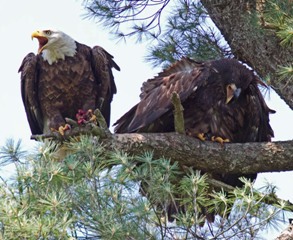
6/21 - Town of Poughkeepsie: The adult male and the fledgling from eagle nest NY62 shared a branch, with the immature looking over what appeared to be remnants of a rodent. They were both squawking! The adult flew off and for the next hour or so the fledgling did some stretches, pulled on twigs and watched two red-tailed hawks circle around several times. [Photo of father and son bald eagles by Terry Hardy.]
- Tom McDowell, Terry Hardy
6/21 - New Windsor, HRM 60: As I mowed my lawn this morning, I was on the lookout for robin fledglings that I had seen earlier in the day, and was also being careful not to mow up the various bees and butterflies on the white clover. Something unexpected popped out of the long grass ahead of me: a beautiful, shiny black snake with a yellow ring around its neck. Could this be the same northern ringneck snake that I spotted in my yard last August? This one was about a foot long and slender, somewhat larger than the one I saw last year (seven inches).
- Joanne Zipay
SUMMER 2013 NATURAL HISTORY PROGRAMS
July 20-21: Hudson River Days
More than 40 river and riverfront events will be offered, spanning the length of the Hudson from New York City to Albany, during this fifth annual celebration of the river, anchored on Saturday, July 20, by City of Water Day in New York Harbor and "Hudson Rising" on the Kingston waterfront and uptown. For a full schedule of activities, visit the Hudson River Days website. The following are a few River Days natural history programs likely to be of particular interest to Almanac readers.
July 20: 12 noon - Hudson River Fishes We Have Loved to Eat! on the Pennsy #399 barge at the Hudson River Maritime Museum, 50 Rondout Landing, Kingston [Ulster County].
For at least ten millennia, we have cherished the variety and bounty of Hudson River fishes. Join Hudson River Estuary Program Naturalist Tom Lake on a journey through time to see those species that we loved the best! Sponsored by the Hudson River Estuary Program and Hudson Rising. Questions: email Ann Loeding kingstonhistoricboatworks@yahoo.com
July 20: various times - The Second Annual Great Hudson Estuary Fish Count.
At the following sites naturalists will use seine nets, minnow traps, and rods and reels to capture live fish from the Hudson and show visitors these slippery, wriggly, and fascinating creatures usually hidden below the river's surface. During the day the sites will share news of their catches with each other to highlight the diversity of fishes throughout the estuary. The fish are released after participants view them up close.
Brooklyn - Brooklyn Bridge Park (Main St. under Manhattan Bridge): 12:00-1:30 p.m.
Seining the River Wild: Part of City of Water Day. Free but RSVP is required as space is limited; sign up at the Brooklyn Bridge Park Conservancy website.
Manhattan - East River Park at South St. & Montgomery St.: 2:00-4:00 p.m.
Catch-and-release fishing clinic as part of the Pier 42 Exhibits Opening Day and City of Water Day. Bait and tackle will be provided (or bring your own), plus basic fishing instruction and other activities to explore the estuary. Free, but materials are limited. Please register at the Lower East Side Ecology Center website.
Manhattan – Hudson River Park, Pier 25 at North Moore St. 10:00 a.m.-4:00 p.m.
Big City Fishing: catch and release fishing with rods & reels, plus river education activities for the public; look for the striped bass windsock on pier's north side. Part of City of Water Day. Free. For info email the Hudson River Park Trust or call (212)627-2020 and ask for the environment and education department.
Yonkers - Habirshaw Park [Westchester County] 1:00-3:00 p.m.
Seining program offerd by the Beczak Environmental Education Center. Part of City of Water Day. Fee $5.00. For info: (914)377-1900 x12.
Piermont - Flywheel Park [Rockland County] 11:00 a.m. -2:00 p.m.
Seining program with educators from the Lamont-Doherty Earth Observatory and Sparkill Watershed Alliance. Free. For info: email Margie Turrin or call 845-729-8535
Sleepy Hollow - Kathryn W. Davis RiverWalk Center [Westchester County] 1:30-3:30 p.m.
Seine with staff from Teatown Lake Reservation and Strawtown Art and Garden Studio, and then create art with natural pigments, clay, and crushed sandstone from the river's shores. Free. To make a reservation, call 914-762-2912 x110.
Cold Spring - Little Stony Point, Hudson Highlands State Park [Putnam County] 3:00-4:00 p.m.
Seining program with Tom Lake, Hudson River Estuary Program Naturalist. Free. Email Tom Lake for info.
New Windsor - Kowawese Unique Area [Orange County] 4:30-5:00 p.m.
Seining program with Tom Lake, Hudson River Estuary Program Naturalist. Free. Email Tom Lake for info.
Staatsburg - Norrie Point Environmental Center [Dutchess County] 4:00-5:00 p.m.
Seining program with Hudson River National Estuarine Research Reserve staff. Free. For info: 845-889-4745 x105
Kingston - Kingston Point Beach [Ulster County], 11:00 a.m.
Seining program with City of Kingston Parks and Recreation/Forsyth Nature Center staff. Free. For info: 845-481-7336 or email Steve Noble.
Athens - Cohotate Preserve [Greene County], 10:00 a.m.-12:00 noon
Seining program with Cornell Cooperative Extension of Greene County. Sponsored by Columbia-Greene Community College. Fee: $ 5.00. For more information, call 518 622 9820 x 33. To register, call Columbia Greene Community College at (518) 828-4181, ext. 3342.
HUDSON RIVER MILES
The Hudson is measured north from Hudson River Mile 0 at the Battery at the southern tip of Manhattan. The George Washington Bridge is at HRM 12, the Tappan Zee 28, Bear Mountain 47, Beacon-Newburgh 62, Mid-Hudson 75, Kingston-Rhinecliff 95, Rip Van Winkle 114, and the Federal Dam at Troy, the head of tidewater, at 153. The tidal section of the Hudson constitutes a bit less than half the total distance – 315 miles – from Lake Tear of the Clouds to the Battery. Entries from points east and west in the watershed reference the corresponding river mile on the mainstem.
TO CONTRIBUTE YOUR OBSERVATIONS OR TO SUBSCRIBE
The Hudson River Almanac is compiled and edited by Tom Lake and emailed weekly by Steve Stanne, education coordinator at DEC's Hudson River Estuary Program. Share your observations by e-mailing them to trlake7@aol.com.
To subscribe to the Almanac (or to unsubscribe), go to DEC's Email Lists page, enter your email address, and click on "Submit." A page listing available subscription topics will appear. Scroll down; under the heading "Natural Areas and Wildlife" is the section "Lakes and Rivers" with a listing for the Hudson River Almanac. Click on the check box to subscribe. While there, you may wish to subscribe to RiverNet, which covers projects, events and actions related to the Hudson and its watershed, or to other DEC newsletters and information feeds.
The Hudson River Almanac archive allows one to use the DEC website's search engine to find species, locations, and other data in weekly issues dating back to October 2003.
Discover New York State Conservationist - the award-winning, advertisement-free magazine focusing on New York State's great outdoors and natural resources. Conservationist features stunning photography, informative articles and around-the-state coverage.
USEFUL LINKS
The National Oceanic and Atmospheric Administration's high and low tide and tidal current predictions are invaluable for planning boating, fishing, and other excursions on and along the estuary.
The Hudson River Environmental Conditions Observing System [HRECOS] provides near real-time information on water and weather conditions at monitoring stations from Manhattan to the Mohawk River.
Historical information on the movements of the salt front is available on the U.S. Geological Survey's Hudson River Salt Front website.
Copies of past issues of the Hudson River Almanac, Volumes II-VIII, are available for purchase from the publisher, Purple Mountain Press, (800) 325-2665.