
Hudson River Almanac 5/17/13 - 5/23/13
The New York State Department of Environmental Conservation sent this bulletin on 05/30/2013 03:35 PM EDTYou are subscribed to receive updates from DEC. Links to receive help or to change your preferences are provided below. Having trouble viewing this email? View it as a Web page.

May 17 - 23, 2013
Compiled by Tom Lake, Hudson River Estuary Program Naturalist
OVERVIEW
Our emerging periodical cicadas provided a backdrop to the more usual flow of spring events, such as brant flying north to breed and spawned-out shad and striped bass heading back to the sea. The now fully leafed-out hardwoods were filled with breeding warblers and other songbirds.
HIGHLIGHT OF THE WEEK
5/17 - Tivoli Bays, HRM 100-99: On a kayak trip into Tivoli Bays we found a beautiful Caspian tern feeding along with a small group of ring-billed gulls. As we watched, the bird flew out of South Bay and headed north up the river. We found it again near Magdalen Island after we battled our way here against a very stiff north wind.
- Alan Mapes
[Largest of the terns, the Caspian tern breeds in six regions scattered around North America. The Great Lakes population has been expanding, and in New York State, nesting colonies have been found on islands in eastern Lake Ontario and in Lake Champlain. They species is not listed for Dutchess County, but across the river in Ulster County it is listed as "occasional" in spring migration as the species makes its way north from wintering grounds in the southeastern U.S. and the Gulf Coast. Tom Lake, Steve Stanne.]
NATURAL HISTORY NOTES
5/17 - Hyde Park, HRM 82: 0030 - In my backyard several days ago I thought I was seeing spots, but it was lightning bugs. I actually caught one to confirm I wasn't seeing things. Every night since I've seen more and more of them even though the weather got cool. I've lived here all my life and I can never remember seeing lightning bugs so early.
- Michael Paul
5/17 - New Hamburg, HRM 67.5: We decided it was time to prune the weeping Norway spruce outside the front portico and as I reached in to grasp some dead branches a feathered explosion set me back on my seat - a hen mallard had burst forth from inside the small canopy of spruce branches. As I regained my composure I looked inside and discovered a nest with ten eggs. How does a bird that small produce ten eggs? The nest was just fifteen feet from our front door and adjacent to the walkway so this represented a problem. The duck returned to the nest that afternoon but how would we co-exist for the duration of incubation? We achieved a detente: we agreed not to stare inside the canopy of branches and the duck agreed to make believe we weren't there. Now we are like any anxious parents awaiting the new arrivals any day now.
- David Cullen
[Postscript: Mama duck successfully hatched out all ten of her eggs and, in an early morning foray, hustled her ducklings down to the Hudson for indoctrination class. They have since moved on. We have not seen them circling the island but hope all is well with her and the brood. David Cullen.]
5/18 - Town of Poughkeepsie: Day 52. During a weekly and very brief perusal under the NY62 nest tree to recover bits and scraps of discarded food (fish heads and bones ... it gives us an idea of what is being consumed) I could hear two voices in the nest nearly a hundred feet overhead. One was lighter and a bit more shrill; the other more mature. It was the nestling and Mama.
- Tom Lake
[Not long ago, a third-grader asked me: "What do eagles say to each other? Do they give each other names?" The easy answer is that we do not know. However, it is useful to consider the wide range of vocalizations eagles use to communicate among and between adults and immatures. Most are squeaks, chirps, and chortles. The tone, selection, and pitch seem to vary depending on who is calling and who is listening. A nestling calling Mama in the midst of a midnight nor'easter differs from a fledgling that demands to be fed. The calls of adults communicating around their watches at the nest differ from the calls that accompany mid-winter mating. It is a beautiful mystery. Tom Lake.]
5/18 - Croton Bay, HRM 34: Stan Drisek reported that he is catching "back runners" - spawned-out "cow" [female] striped bass - up to 25 pounds.
- Christopher Letts
5/19 - Ulster Landing, HRM 97.2: Four pulls of our 30-foot-long seine at Ulster Landing Park beach yielded ten adult (8-10 inches long) river herring, twenty spottail shiners, and nine yellow perch. The water temp was 63 degrees Fahrenheit. A dead map turtle had washed ashore on the beach with no apparent injuries.
- Stephen Hart
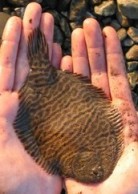 5/19 - Croton Bay, HRM 34: While Gino Garner was striper fishing, he spotted a common loon in breeding plumage repeatedly diving and coming up with small prey items and then working hard to swallow them. "It must have eaten a dozen hogchokers while we watched." Loons, apparently, are better equipped to swallow these fish than are pigs. Carp spawning was in full career, with lots of thrashing and splashing in the shallows inside the railroad bridge. We spotted a low-flying flock of brant headed up the river. Gino remarked that he had seen two such flocks the day before, all right on the deck. All three flocks numbered about 100 birds.
- Christopher Letts, Gino Garner
[Hogchokers (Trinectes maculatus) are small (penny- to palm-size) flatfish, soles actually, that seem to pave the bottom of the river in enormous numbers in Haverstraw Bay and the Tappan Zee. Tom Lake. Photo of hogchoker by Steve Stanne.]
5/20 - Ulster County, HRM 88: While striped bass fishing tonight just north of the Esopus Lighthouse, we heard and then saw five different flocks of brant heading north. These were the first that we had seen or heard this spring. Some flocks we only heard because they were moving after dark.
- Andrew van der Poel
[Dery Bennett used to mark the seasons by noting how brant, a small species of geese, left their wintering home on Sandy Hook, NJ, around Memorial Day. In his words, they would "shove off for the Canadian Arctic where they will breed, fledge young, and return around Columbus Day." Tom Lake.]
5/20 - Town of Poughkeepsie: It was Day 54 for the eagle nestling in NY62. We watched him through our spotting scope as he perched at the edge of the nest, apparently surveying the river several hundred yards away. To try to see the world through the eyes of an adult eagle is fascinating enough, but with a less-than-eight-week old eaglet, what must the colors, sounds, and smells of his universe mean? Right now, we guessed, it was mostly where the next meal would magically appear from out of the sky.
- Tom Lake, T.R. Jackson
5/20 - Town of Wappinger, HRM 67: Gray tree frogs in love treated us to a deafening chorus all night and most of the day.
- Tom Lake
5/20 - Manhattan, HRM 12.5: I went birding to Inwood Hill Park on a foggy and damp morning. In two hours I had about 50 species. Among the highlights were two great egrets in the bay, killdeer, kingbirds, a great crested flycatcher, eastern wood-pewee (calling on the ridge), both rough-winged and barn swallows (over bays at the north end), wood thrush (singing), veery, scarlet tanager (singing), and both male and female indigo buntings. Among a dozen different warblers were northern parula, magnolia, black-throated green, blackpoll, ovenbird, northern waterthrush, and Wilson's (singing).
- Joe DiCostanzo
5/21 - Kowawese, HRM 60: On a day when the air temperature reached 91 degrees F (tied the record high for the date), the cool river felt wonderful (64 degrees). We hauled our seine a few times and, perhaps because the tide was high or we lifted the bottom seamline too much, we did not catch a single fish. That is very unusual for any Hudson River beach. We had to be satisfied with a pair of spotted sandpipers that we followed down the tideline. After that it did not take long for an assault of blackflies to drive us back to our truck.
- Tom Lake, T.R. Jackson
5/21 - Fishkill, HRM 61: I saw a flock of several hundred northbound brant at dusk tonight going over Sour Mountain.
- Stephen Seymour
5/22 - Mohawk River, HRM 159: While traveling in a rural area of eastern Montgomery County this afternoon, I spotted a bobcat. It crossed the road in front of my car. Wow! What a "tank" - all power with a bob-tail, a stocky body, and legs and huge paws. It was probably at least 24 inches tall at the shoulder, but it was hard to tell as it was moving at sort of a canter. What a thrill!
- Nancy Karm
[New York State has been home to three big cats in historic times. The mountain lion, or puma, may have been here before the first of us arrived. After European settlement the species suffered from habitat loss and human intolerance, until finally being extirpated in the early twentieth century. From historical records we know that Canada lynx were present here in the past; however, we do not know for sure if there were ever self-sustaining resident populations in New York. It is likely that there were always lynx traveling through the state from other areas and that the New York population was sustained by immigration from these other areas. The third big cat is the bobcat. Similar in size and appearance to the lynx, the bobcat has proven to be much more adaptable and resilient. While very secretive, it nevertheless lives among us in less-populated woodlands. Tom Lake.]
5/22 - Rhinecliff, HRM 90: In Ferncliff Forest this morning I came upon a male mourning warbler along the Bridal Path thickets. Before I even heard it sing, it flew into a bush right alongside the path and stayed at really close range. When it did sing, it was surprisingly quiet. A Canada warbler was also singing in the vicinity.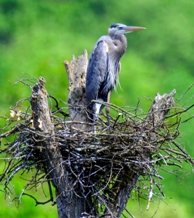 - Ryan MacLean
5/22 - Hudson Valley: As we head into the second half of spring, nesting activity appears to be in full swing. With the latest insect bloom, bluebirds and swallows are taking up residence in nest boxes. Throughout the Hudson Valley great blue herons have established their rookeries. It seems that they have human intrusion in mind when they select areas with large buffer zones of water and swamp. It's a marvel how their flimsy nest structures survive even a thunderstorm. [Photo of great blue heron on nest by Tom McDowell.]
- Tom McDowell
5/22 - Town of Poughkeepsie: Day 56. The nestling in eagle nest NY62 seems ready to start "branching." He is jumping really high during his "flap dances" and has been seriously surveying the upper limbs and perches where Mom and Dad perch.
- Terry Hardy
[The next stage of the nestling's development is to succumb to its curiosity of what the world is like outside the nest. It will begin to explore by climbing and making short "flights" from branch to branch. For bald eagles, fledging usually occurs between days 72-90. NY62 has averaged 77 days over 12 years. Tom Lake.]
5/22 - Town of Wappinger, HRM 67: Two nights ago it was tree frogs, long and loud. Last night, there was not a single tree frog singing, but there was a similarly loud chorus of spring peepers emanating from the woods.
- Tom Lake
5/23 -Rensselaer County, HRM 149: Two American bitterns flew into my small beaver pond on the Rensselaer Plateau in Taborton to make my early morning canoeing one delightful trip. They spent time on the edge of the water, even swimming across a small area. I had heard their delightful plumbing sound last year but never saw them.
- Francille Egbert
5/23 - Hyde Park, HRM 82: Early this morning I heard a strange sound coming from the woods in back of my house. It was the first cicadas starting their song, growing in pitch as the day went on.
- Ed Juras
5/23 - New Paltz, HRM 78: For at least two weeks now I have been finding the tunnels of the seventeen-year periodical cicadas, sometimes even finding the larvae as I spaded our vegetable garden beds. Two days ago I found some of the shed skins of cicadas that had emerged overnight but did not hear any cicadas calling. Yesterday I found more shed skins and two recently emerged cicadas clinging to some weeds, but still no sounds. Today I found a few more shed skins and emerged cicadas, and even saw one flying slowly up into a tree. No mistaking that for a hummingbird! I also saw a great crested flycatcher eating one up in a tree. The plants at the edge of the garden are crawling with cicadas and there are lots on shed skins clinging to the undersides of leaves. A patch of the ground nearby looks like Swiss cheese from their exit holes, but still not a peep from them.
- Lynn Bowdery
5/23 - Beacon, HRM 61: Although an inch-and-a-quarter of rain fell today, we (Beacon High School ninth graders and Scenic Hudson staff) managed to seine a small backwater pond at Long Dock Park. One long haul netted an assortment of sizes of pumpkinseed sunfish and largemouth bass. In the even light of the cloudy day, the orange-and-black Baltimore orioles were glowing in the trees. Tiger swallowtails fluttered through the phragmites and pairs of Canada geese paraded their goslings throughout the park.
- Chrissy Guarino, Tom Lake, T.R. Jackson
[The storm surge from Hurricane Sandy last October overran the floodplain along the Beacon waterfront. On October 29, 2012, we seined the parking lot at Long Dock Park, hundreds of feet from the river, and caught spottail shiners and a banded killifish. As the storm surge filled swales well back from the beach, it brought fish from the river. As the tide finally receded, the swales became small ponds and left the fish behind. Tom Lake.]
5/23 - Ossining, HRM 33: As we turned into the driveway at Mariandale this morning, we spotted two large birds on the expanse of lawn leading to the buildings on the river. One was a beautiful male wild turkey in full, colorful display. The female stood about ten feet away pecking at the ground with her back to the male, seemingly oblivious to his attempts to attract her attention.
- Dorothy Ferguson, Bob Ferguson
SPRING/SUMMER 2013 NATURAL HISTORY PROGRAMS
June 2: 2:00 PM
8,000 years of history and ecology at Clinton Point program at Zion Episcopal Church, Wappinger Falls
[Dutchess County]. Join NYSDEC Hudson River Estuary Program naturalist Tom Lake as he leads a journey through time from the first of us to live along the river to the arrival of Europeans, with a focus on the people and their lifeways. Free (a $5 donation is optional to support the Town of Wappinger Historical Society). For information: lake@sunydutchess.edu
June 22: 1:00 - 4:00 PM
Family Fishing Day at the Norrie Point Environmental Center, Staatsburg [Dutchess County]. Family-friendly, all ages, free use of rods, reels and bait; wheelchair accessible. For information: 845-889-4745 x109.
HUDSON RIVER MILES
The Hudson is measured north from Hudson River Mile 0 at the Battery at the southern tip of Manhattan. The George Washington Bridge is at HRM 12, the Tappan Zee 28, Bear Mountain 47, Beacon-Newburgh 62, Mid-Hudson 75, Kingston-Rhinecliff 95, Rip Van Winkle 114, and the Federal Dam at Troy, the head of tidewater, at 153. The tidal section of the Hudson constitutes a bit less than half the total distance – 315 miles – from Lake Tear of the Clouds to the Battery. Entries from points east and west in the watershed reference the corresponding river mile on the mainstem.
TO CONTRIBUTE YOUR OBSERVATIONS OR TO SUBSCRIBE
The Hudson River Almanac is compiled and edited by Tom Lake and emailed weekly by Steve Stanne, education coordinator at DEC's Hudson River Estuary Program. Share your observations by e-mailing them to trlake7@aol.com.
To subscribe to the Almanac (or to unsubscribe), go to DEC's Email Lists page, enter your email address, and click on "Submit." A page listing available subscription topics will appear. Scroll down; under the heading "Natural Areas and Wildlife" is the section "Lakes and Rivers" with a listing for the Hudson River Almanac. Click on the check box to subscribe. While there, you may wish to subscribe to RiverNet, which covers projects, events and actions related to the Hudson and its watershed, or to other DEC newsletters and information feeds.
The Hudson River Almanac archive allows one to use the DEC website's search engine to find species, locations, and other data in weekly issues dating back to October 2003.
Discover New York State Conservationist - the award-winning, advertisement-free magazine focusing on New York State's great outdoors and natural resources. Conservationist features stunning photography, informative articles and around-the-state coverage.
USEFUL LINKS
The National Oceanic and Atmospheric Administration's high and low tide and tidal current predictions are invaluable for planning boating, fishing, and other excursions on and along the estuary.
The Hudson River Environmental Conditions Observing System [HRECOS] provides near real-time information on water and weather conditions at monitoring stations from Manhattan to the Mohawk River.
Historical information on the movements of the salt front is available on the U.S. Geological Survey's Hudson River Salt Front website.
Copies of past issues of the Hudson River Almanac, Volumes II-VIII, are available for purchase from the publisher, Purple Mountain Press, (800) 325-2665.