
Hudson River Almanac 4/12/13 - 4/18/13
The New York State Department of Environmental Conservation sent this bulletin on 05/02/2013 04:33 PM EDT
You are subscribed to receive updates from DEC. Links to receive help or to change your preferences are provided below. Having trouble viewing this email? View it as a Web page.
Hudson River Almanac
April 19 - 25, 2013
Compiled by Tom Lake, Hudson River Estuary Program Naturalist
OVERVIEW
While the springtime pulse of American shad and striped bass in the mainstem Hudson remained largely unseen, the flow of life into the tributaries was obvious. Incredible numbers of glass eels and river herring surged upstream all week.
HIGHLIGHT OF THE WEEK
4/24 - Rondout Creek, HRM 92: The DEC Region 3 Fisheries Unit was electro shocking for walleye and largemouth bass in Rondout Creek as part of a tagging program designed to chart their seasonal movements. Among the fish we tagged and released today was a 28-inch-long, ten and three-quarter pound walleye - a true trophy gamefish.
- Ryan Coulter
NATURAL HISTORY NOTES
4/19 - Newcomb, HRM 302: There was great spring weather today, reaching up into the 60s. We could see some definite signs that spring was on the way even if the lakes and ponds were still frozen over. Although some ice still remained on the Hudson River, it was largely ice free in the slower moving sections and bays. Hiking in the woods today required a combination of snowshoes, waders, and snorkel gear with conditions ranging from bare ground to knee deep snow to flooded areas. I did get to hear some great birds, all of them warming up for the territorial song wars to come in the weeks ahead: winter wren, black-capped chickadee, ruby-crowned and golden-crowned kinglet, song sparrow, dark-eyed junco, and even a hermit thrush. I also heard a ruffed grouse drumming - first of the year. On bare ground on the south-facing slopes some trout lily leaves were just breaking their way through the leaf litter. The highlight of the day belonged to the mink swimming in the ribbons of open water that surrounded some protruding rocks on Arbutus Lake. The lake was still covered in ice, the exception being the shoreline and slim strips of open water around the sun-warmed rocks. The mink would dive into the water and be submerged for a moment or two before surfacing and climbing onto the rocks to shake the water off its fur and to warm up in the sun. It made short, little, slow lopes between the rocks on top of the ice, traveling back and forth between groups of rocks. It finally seemed to become aware of my presence (60 yards away) and decided to make a beeline for an island 40 yards in the opposite direction. It seemed that the mink was acutely aware of how exposed it was traveling over the ice for that long a distance. While it loped and walked between the rocks earlier, the trek to the island was done at full linear bore and was actually rather comical to watch.
- Charlotte Demers
4/19 - Minerva, HRM 284: I went out to the "back forty" today and enjoyed the warm air. The wetlands were still mostly frozen over with rotten ice. There were many male red-winged blackbirds, a single swamp sparrow, brown creeper, robins, and one solitary Canada goose in one of the open water areas. The auditory feast was supplemented with a nice solid slap of a beaver tail on the open water. There were only scattered patches of snow in the woods.
- Mike Corey
4/19 - Town of Wappinger, HRM 67: It was barely first light but already delightfully warm - a cool, spring warmth. And it was noisy! I was emulating one of ecologist Aldo Leopold's favorite practices, listening to the woods awaken. While it is true that a few birds seem to chirp all night, the rising crescendo of birdsong began in the last moments of darkness, mostly robins, and by now they had been joined by titmice, white-throated sparrows, cardinals, Carolina wren, crows, and several others. What had begun as melodious music had evolved into many melodies, all stepping on each other. It reminded me of an orchestra tuning up before a performance.
- Tom Lake
[See the "Great Possessions" chapter in Aldo Leopold's classic Sand County Almanac (1949) for a full rendition of this practice, beautifully written. Tom Lake.]
4/19 - Town of Wappinger, HRM 67: It was well after dark and nearly as noisy as dawn with peepers calling loudly from every quarter. A fast and strong thunderstorm swept across the river and within minutes an incredibly bright flash lit up the sky with a simultaneous loud thunderclap - it was extremely close. Power went off and the entire contingent of peepers stopped, as though they were wired into the power grid. They stayed off for 30 minutes as an inch of rain fell. Only when the storm had passed did they resume their peeper songs.
- Tom Lake
4/20 - Newcomb, HRM 302. Today I added the wood frog and spring peeper chorus to the sounds of spring. This was also the first real night of amphibian movement to vernal pools. Best of all, one of our most welcome and cherished sounds was heard today: a common loon.
- Charlotte Demers
4/20 - Black Creek, HRM 85: It took four pairs of volunteers to count all of the glass eels we had captured overnight in our fyke. All told, there were 5,176 eels in the net. We let them go upstream and watched them settle into the gaps around rocks like grout between tiles.
- Chris Bowser
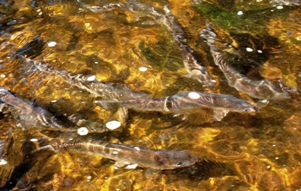 4/20 - Black Creek, HRM 85: While glass eels were demanding most of our attention, there were lots of herring splashing around as well. Kingston High School students counted 115 during their 15 minute watch. Jim Herrington pointed out that the shadbush was in bloom so I wrote a haiku. [Photo of herring by Steve Stanne.]
When the shadbush blooms
Tribs awaken with herring
Looking for their mate
- Zoraida Maloney
4/20 - Millbrook, HRM 82: A young moose, probably a yearling searching for new territory, was sighted on state Route 82 near the Village of Millbrook this afternoon.
- Deb Kral
[When the first Europeans arrived in the Hudson Valley 400 years ago, moose were common, but they had been absent from New York State since the 1860s until re-entering on a continuing basis in the 1980s. DEC biologists estimated that there were about 500 to 800 moose in New York as of 2010. Most are located in the northeastern part of the state in the Adirondack Mountains and the Taconic Highlands along the Massachusetts and Vermont borders. Along the estuary they are still very uncommon. Moose are not normally aggressive, however, they can become so when hungry, tired, or harassed by people, pets, and traffic. Tom Lake.]
4/20 - Town of Wappinger, HRM 67: If you love black and yellow, is there a more gorgeous bird in breeding plumage than the male goldfinch? Ten of them were perched fairly close together this morning, transforming my magnolia into a lemon tree. Another half dozen were emptying the feeders and were joined by four male purple finches. While we see house finches on occasion, we could not remember the last time we were visited by purple finches. Roger Tory Peterson noted in his field guides that they "look like a sparrow dipped in raspberry juice."
- Phyllis Lake, Tom Lake
4/20 - Quassaick Creek, HRM 60: From feast to famine - from a glut of more than 5,000 glass eels at Black Creek today to a mere 33 in Quassaick Creek, 25 miles downriver.
- Chris Bowser
4/21 - Minerva, HRM 284: Today I heard a wonderful and feathered annual delight of spring in the marshy area in the back forty: our American bittern! That "bad plumbing" bird was out and about again. There was also a solitary leopard frog out there as well - amphibian time.
- Mile Corey
[Roger Tory Peterson described the song of the American bittern as a "plumbing sound," or "oong-ka choonk, oong-ka choonk!" Very distinctive. Tom Lake.]
4/21 - Ulster-Dutchess Counties, HRM 87-86: Three local bald eagle nests were showing off their nestlings. Two have one eaglet each, while the third has two. All are seen being fed by parents and displaying their new feathers and grey-downed heads. There was a very impressive demonstration at one nest where the male eagle chased away a crow. It reminded me of a Piper Cub being attacked by a B2 Stealth Bomber!
- Dave Lindemann
4/21 - Black Creek, HRM 85: This Hudson River tributary continues to amaze us with its springtime biological richness. Today we counted 5,100 glass eels in our fyke net.
- Chris Bowser
4/21 - Hyde Park, HRM 82.5: Over the last few days, we have been collecting, counting, and releasing upstream hundreds of glass eels in Crum Elbow Creek. River herring had also arrived, by the dozens and maybe even hundreds, fighting, splashing, even circling around us on their way upstream to spawn.
- Dave Lindemann
4/21 - Dover Plains, HRM 75: Driving north on Route 22 this afternoon, I saw a large bobcat run across the road. I thought it was just a house cat at first, but quickly realized it was much bigger, possibly weighing thirty pounds.
- Dann Kenefick
4/21 - Lagrange, HRM 78: My children and I came upon a beautiful spotted turtle in a pond on our property. We rarely see them; this was only the second one in three years.
- Joedy Kievit
4/21 - Crugers, HRM 39: A few weeks ago the surface of Ogilvie's Pond was smooth and clear with just wisps of spatterdock poking up. Now the spatterdock has popped out and was beginning to overspread the pond. A large curved branch juts out of the water near the shoreline and, on a sunny day, it's likely that painted turtles can be seen sunning themselves on the branch. Today we saw five of them in all different sizes, covering the branch and enjoying the afternoon sunlight.
- Dorothy Ferguson, Bob Ferguson
4/21 - Orange County, HRM 35: On a cool April morning, I went on a birding field trip to Sterling Forest State Park. Just ten minutes after arriving, we were greeted with a beautiful immature bald eagle flying overhead. It appeared to be missing some of its secondary feathers as it was probably in a moult. Some of the other birds we saw included palm, pine and yellow-rumped warblers, chipping sparrow, purple finch, osprey, eastern phoebe, and sharp-shinned hawk. As we were rock hopping over a small stream, we spotted a northern water snake (42") swimming in a pond under and over some tree branches and rocks.
- Orlando Hidalgo
4/21 - Queens, New York City: While working over a flock of 29 glossy ibis at the Jamaica Bay Wildlife Refuge, I managed to pick out a white-faced ibis. The bird was in the northwest corner on the south end of the East Pond. As luck would have it, while studying the ibis, a sora [rail] walked out of the phragmites and disappeared shortly after in the same area.
- Andrew Baksh
4/22 - Hannacroix Creek, HRM 132.5: We counted 5,900 glass eels this morning from our overnight fyke net set at Hannacroix Creek - an extraordinary number.
- Chris Bowser
[These numbers point out how little we know about cause-and-effect relationships between environmental conditions and numbers of immigrating glass eels. We can guess that moon phase, tide strength, storm runoff, water temperature, and events that happened last week or last month can effect these one-night pulses. But we really do not know. If you love mysteries, this is a good one. Tom Lake.]
4/22 - Arlington, HRM 76: An immature moose, probably the same one reported two days ago near Millbrook, was spotted near the Taconic Parkway in Arlington.
- Tom Lake
4/22 - Town of Poughkeepsie: At dusk the female eagle was nestled in nest NY62 with this spring's new nestling. About 200 feet away, the male was perched on a much-used horizontal limb of another tuliptree - the bark was worn away by their talons. A crow flew past, tumbling out of his way to half-heartedly dive-bomb the male. Not a flinch. Less than a minute later a merlin cruised past and, likewise, accepted the opportunity to strafe the eagle. He passed within inches and continued on. The male did not ruffle a feather. He is eighteen years old and has weathered it all. Falcons and crows cannot show him any tricks he has not already seen, many times.
- Phyllis Lake, T.R. Jackson, Tom Lake
[An onlooker commented that, at a distance, he (the male bald eagle) looked like a big "marshmallow head" up there in the tuliptree. Tom Lake.]
4/22 -Tarrytown, HRM 27: While traveling around the Tarrytown Lakes today I was able to watch the local nesting osprey travel back and forth from reservoir number one to its nest in the Rockefeller Preserve.
- Scott Horecky
4/22 - Manhattan, New York City, HRM 7: An immature bald eagle [new four-year-old?] flew over the north end of Central Park in midday. This was a ragged-looking individual with a mostly white tail and head, though quite a few brown feathers remained on both. I first spotted it over the Reservoir as it traveled right down the center of the park. By the time it reached me it was less than twenty stories off the ground - pretty close for an eagle over the park. The eagle began its ascent over the Wildflower Meadow, flapping languidly in large circles, then dropped off low over the Meer where I lost sight of it.
- Nadir Souirgi
4/22 - Manhattan, New York City, HRM 4: Two dozen Student Conservation Association volunteers joined Hudson River Park staff for an Earth Day restoration project at the park's Habitat Garden at West 26th Street. We re-mulched the path that had been washed out last fall by Hurricane Sandy, removed phragmites, and planted bayberry bushes, coreopsis, and monarda to bring pollinators back to the garden. While we worked, half a dozen brant floated over to watch from the river, their black heads and delicate white collars standing out against the glare of the water.
- Annell Presbie
4/23 - Milan, HRM 90: The shadbush was blooming!
- Marty Otter
[Shadbush or serviceberry (Amelanchier sp.), a native species, has long been colloquially considered a harbinger of spawning American shad arriving in estuaries. However, in the last several decades either shadbush is blooming later, shad are arriving earlier, or our observations are becoming more precise. Since 1994, from early April to early May, this wildflower has been a dependable indicator of the advance of spring up the estuary. Shadbush tends to be recognizable by the white glow of its bloom, a softer, hazier white than flowering dogwood. In bloom, they also tend to have a horizontal aspect to them - dogwood seem more vertical. Since 1994, they have bloomed in the Mid-Hudson area as early as 3/26 (2012) and as late as 4/27 (2011). Tom Lake.]
4/23 - Poughkeepsie, HRM 75: Today was the last day I saw dark-eyed juncos in my yard - late in the season for them to still be around.
- Art Filler
4/23 - Croton Point, HRM 35-34: Shadbush had come into full bloom, signaling that the spring spawning run of river herring was nearing its peak. Blueback herring now make up half the catch, supplanting the alewives as the season wears on. In three days, Japanese knotweed had shot up two to three inches.
- Christopher Letts
4/24 - Newcomb, HRM302. The first wildflower of spring, coltsfoot, was in bloom along the road edges and other disturbed sites. These dandelion-looking flowers stand out dramatically against the dull browns of soil and leaf litter. Even though it is non-native, the bright flower looks so cheerful this time of year. There is still some patchy snow on the north slopes and substantial amounts linger in the High Peaks. Smaller ponds are free of ice and larger lakes can’t be more than a day or two away from being considered ice free.
- Charlotte Demers
4/24 - Hannacroix, HRM 132.5: The amazing catch totals continued. Today there were 8,067 glass eels in the Hannacroix Creek fyke net! And three elvers as well!
- Chris Boswer
4/24 - Quassaick Creek, HRM 60: It was an early evening low tide, the optimum time to pick the glass eel net for the day. The operation, which takes about an hour depending on the number of glass eels to count, was delayed for nearly ten minutes as three robins took a bath in the mouth of the fyke. Once underway the catch proved to be rather modest by recent standards: 203 glass eels and one elver. The creek was 54 degrees Fahrenheit, now only a couple of degrees warmer than the river.
- Tom Lake
4/24 - Bedford, Westchester County, HRM 35: While driving along Route 121 late this afternoon, we spotted a rookery of approximately 22 great blue heron nests high in the dead trees of a great swamp. We could see only one heron in flight as it approached a nest carrying a stick in its beak.
- Dianne Picciano, Phil Picciano
4/24 - Palisades, Rockland County, HRM 23: Tree and barn swallows were very active and very vocal this morning near the pond at the Lamont-Doherty Earth Observatory. A tree swallow nesting box put in place just before the 2000 New York State Breeding Bird Atlas has been occupied by swallows almost annually since then.
- Linda Pistolesi
4/25 - Minerva, HRM 284: I heard our first spring peepers of the season today. It was well after dark and they were peeping as I wrote this. Out in the back it was 50 degrees F, sprinkling rain, and the little frogs were happy. Wood frogs were also vocalizing this evening. Very little ice remains in the wetlands.
- Mike Corey
4/25 - Town of Lagrange, HRM 78: There is a stream, name unknown to me, running at the east end of the Multiple Use Area near the Pond Gut entrance. The slope above the creek was now entirely covered in Dutchman's breeches, with a few trillium (wet dog) interspersed. The path leading up to it, and the path entering the MUA, were quite heavy with trout lilies. Makes you wonder why this flower is here, in abundance, and the other flower there, in abundance. I'm just glad I got to see the sight of spring.
- Sue Mackson
4/25 - Ulster County, HRM 78: While walking on the Castle Point Carriage Road in Minnewaska State Park we came upon a porcupine. I began taking photos of it and followed it as the road curved around a hemlock tree. Slowly but steadily it headed toward the hemlock, climbed up about twelve feet, and then edged its way out onto a branch where it could safely observe my friend and me.
- Shirley Warren
4/25 - Town of Poughkeepsie: It was a quiet morning at the NY62 eagle nest. Both parents were actively participating in nest activities, sharing in feeding, and guarding the nestling. The two local red-tailed hawks frequently kited over the nest area under the watchful eyes of the eagles. Occasionally the guarding adult (never more than ten feet from the nest) would let out a shriek apparently to distance the hawks. The nestling was developing rapidly and was now covered with downy feathers. At times it would attempt to feed itself but could not seem to master the task of holding down the fish while tearing off a morsel. With the sun on the nest and the nestling better able to regulate its body temperature, the adults often chose a nearby branch to perch. The adult female provided a freshly caught fish for their midday meal.
- Tom McDowell
4/25 - Blooming Grove, HRM 55: I learned this week how important the flowers on trees, such as maples, are to our honeybees. I never thought about how little else was in flower when the maples bloomed. Now I’ve started to see dandelions and many other wildflowers as well to keep the bees happy.
- Betsy Hawes
SPRING 2013 NATURAL HISTORY PROGRAMS
May 4: 9:00 AM
Discover Norrie Walk: Birding for Beginners with DEC Naturalist Jim Herrington at the Norrie Point Environmental Center, Staatsburg [Dutchess County]. Free. Family-friendly, all ages. For information: 845-889-4745 x109.
May 11: 1:00 - 4:00 PM
Family Fishing Day at the Norrie Point Environmental Center, Staatsburg [Dutchess County]. Family-friendly, all ages, free use of rods, reels and bait; wheelchair accessible. For information: 845-889-4745 x109.
May 16: 7:30 PM
Tivoli Bays Talks: Two Row Wampum Renewal Campaign. Jack Manno and Frieda Jacques will speak about the history and future of the Two Row Wampum, the title of a 400 year old treaty between Native Americans and the Dutch founders of New Netherlands. Tivoli Library, Tivoli [Dutchess County]. Free. Wheelchair accessible. For information: 845-889-4745 x109.
Saturday, May 18: 9:00 AM - 1:00 PM
Conservation Planning for Woodland Pool Wildlife with Laura Heady of the Hudson River Estuary Program, Gretchen Stevens of Hudsonia, and Larry Federman of Audubon, at Roeliff Jansen Community Library and Rheinstrom Hill Audubon Sanctuary [Columbia County]. For municipal board members and interested residents, a program focused on the value of woodland pools and how to protect them in your community. Visit the Columbia Land Conservancy website for information and registration or call 518-392-5252, x207
HUDSON RIVER MILES
The Hudson is measured north from Hudson River Mile 0 at the Battery at the southern tip of Manhattan. The George Washington Bridge is at HRM 12, the Tappan Zee 28, Bear Mountain 47, Beacon-Newburgh 62, Mid-Hudson 75, Kingston-Rhinecliff 95, Rip Van Winkle 114, and the Federal Dam at Troy, the head of tidewater, at 153. The tidal section of the Hudson constitutes a bit less than half the total distance – 315 miles – from Lake Tear of the Clouds to the Battery. Entries from points east and west in the watershed reference the corresponding river mile on the mainstem.
The Hudson River Almanac is compiled by Tom Lake and emailed weekly by Steve Stanne, education director for DEC's Hudson River Estuary Program. Share your observations by e-mailing them to trlake7@aol.com .
To subscribe to the Almanac (or to unsubscribe), go to DEC's Email Lists page, enter your email address, and click on "Submit." A page listing available subscription topics will appear. Scroll down; under the heading "Natural Areas and Wildlife" is the section "Lakes and Rivers" with a listing for the Hudson River Almanac. Click on the check box to subscribe. While there, you may wish to subscribe to RiverNet, which covers projects, events and actions related to the Hudson and its watershed, or to other DEC newsletters and information feeds.
The Hudson River Almanac archive allows one to use the DEC website's search engine to find species, locations, and other data in weekly issues dating back to October 2003.
Discover New York State Conservationist - the award-winning, advertisement-free magazine focusing on New York State's great outdoors and natural resources. Conservationist features stunning photography, informative articles and around-the-state coverage.
USEFUL LINKS The National Oceanic and Atmospheric Administration's high and low tide and tidal current predictions are invaluable for planning boating, fishing, and other excursions on and along the estuary. The Hudson River Environmental Conditions Observing System [HRECOS] provides near real-time information on water and weather conditions at monitoring stations from Manhattan to the Mohawk River. Historical information on the movements of the salt front is available on the U.S. Geological Survey's Hudson River Salt Front website. Copies of past issues of the Hudson River Almanac, Volumes II-VIII, are available for purchase from the publisher, Purple Mountain Press, (800) 325-2665.