|
Land and Water Connection: Sound Coastal Gardening Course
On Long Island, the choices we make in our own backyards can have an impact beyond our property lines. The way we water a lawn, manage stormwater, choose plants, or care for our soil can ultimately affect our groundwater and surface waters. Helping Long Islanders better understand that connection, and giving them practical tools to make a difference, is at the heart of the Sound Coastal Gardening Course, offered through Cornell Cooperative Extension (CCE) of Suffolk County with funding from the U.S. Environmental Protection Agency's Long Island Sound Partnership (LIS Partnership).
Led by Roxanne Zimmer, Ph.D., Community Horticulture Specialist with CCE Suffolk, the multi-week course combines expert instruction, hands-on learning, field trips, and community stewardship to show participants how sustainable landscaping practices can benefit both their own properties and the environment.
The Course
The Sound Coastal Gardening Course began in 2025 and is modeled after a similar program run by Judy Preston through the University of Connecticut Extension and LIS Partnership which has been running since 2013.
The curriculum is organized around four modules covering the key elements of sustainable landscaping. Living by the Sea explores what it means to live near the Long Island Sound, including the role of watersheds and the benefits of natural shorelines. Water-Wise focuses on water quality issues on Long Island, with a focus on stormwater runoff and strategies to manage it, such as rain gardens. Right Plant, Right Place examines the benefits of native plants, including their ability to support pollinators, absorb stormwater, and reduce the need for traditional lawns and fertilizers. Soil Solutions focuses on building and regenerating healthy soils so they can store carbon and water rather than contribute to erosion and runoff.
Throughout the four modules, speakers from CCE, the LIS Partnership, and other organizations bring their areas of expertise to the program.
Participants in the course have included Master Gardeners, municipal representatives, community leaders, working professionals, retirees, and homeowners who simply want to learn how they can manage their landscaping more sustainably. As Roxanne explained, “participants are interested in civic community engagement and what they can do for the environment here close to the sea.” For Roxanne “coastal” gardening is relevant to everyone on Long Island. "No matter where you live on Long Island, you're not too far from a creek or a waterway that eventually connects to a body of salt water," she said. "I think of Long Island as this wonderful coastal community, even if you don't live directly by the sea per se."
Stewardship
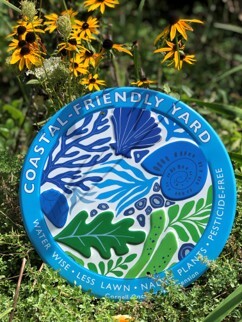
The course also gives participants an opportunity to put what they learn into practice. Each participant is asked to complete 10 hours of community stewardship. Projects have ranged from installing pollinator gardens and hosting garden tours to educating neighbors and helping make locally adapted native seeds more widely available. After completing their stewardship hours, participants come together to share their projects and receive a yard sign. As Roxanne explains, the sign itself is “a conversation piece to have a chat with a neighbor or someone walking their dog about what sustainable gardening means.”
The Sound Coastal Gardening Yard Sign also serves as an educational tool, helping to spark conversations about sustainable landscaping practices. Photo Credit: Roxanne Zimmer.
For participant Colleen Doyle-Novara, the lessons from the course have carried directly into her work as Co-President of the Long Island Native Plant Initiative (LINPI). Since taking on that role in January 2026, Colleen has helped apply what she learned in the course to the organization’s approach of growing and promoting native plants. “Roxanne’s class fundamentally expanded the way we think about LINPI’s role in supporting Long Island’s ecosystems,” Colleen said. “One tangible result has been a shift in LINPI’s growing program, which is now organized around four natural communities: dry meadow, wet meadow, shade, and coastal. The wet meadow collection includes plants suited for rain gardens, making it easier for residents to create landscapes that capture stormwater, reduce runoff, and allow rainwater to infiltrate into the ground. LINPI is also featuring 34 coastal and salt-tolerant native species that can provide pollinator habitat while helping stabilize banks, reduce erosion, and strengthen coastlines. Roxanne’s teaching didn’t simply introduce us to new plants; it helped us better understand how interconnected our landscapes are and helped shape a new direction for our organization,” Colleen added.
For Roxanne, one of the most encouraging results of the course is seeing participants take what they learn and bring it back to their communities. “The unexpected results of community stewardship have been amazing. The Long Island Native Plant Initiative is talking with Suffolk County libraries about how to get out the word about Long Island-specific native plant seeds to the public. It's fantastic,” said Roxanne.
Growing Interest
Interest in native plants and sustainable landscaping has grown significantly in recent years. Roxanne sees that shift not only through her courses, but also at local nurseries, community gardens, public spaces, and through initiatives such as the Suffolk Alliance for Pollinators, which she founded to help build a connected pollinator corridor across Long Island.
For those interested in getting started, whether or not they enroll in the course, Roxanne encourages seeing sustainable landscaping in action. She points to public sites such as East Hampton’s Town Hall gardens and New Suffolk Meadow, a native plant meadow along the waterfront in Southold, as places to find inspiration. “Go on a field trip,” she said. “Get some ideas there that will help you with whatever you want to do at your home.”
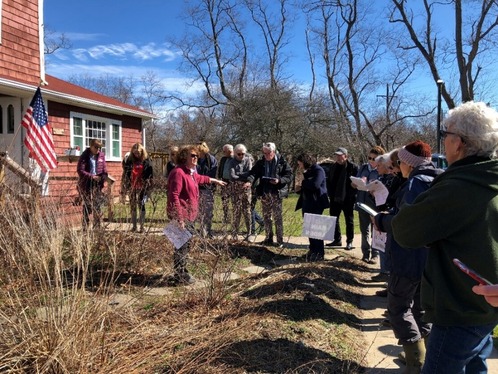
Sound Coastal Gardening participants on a winter field trip 2026 to a rain garden designed by Robin Simmen in Greenport, NY. At this time of year, the inflow, basin, berm and slope are visible for understanding the dynamics of this rain garden. Photo credit Roxanne Zimmer.
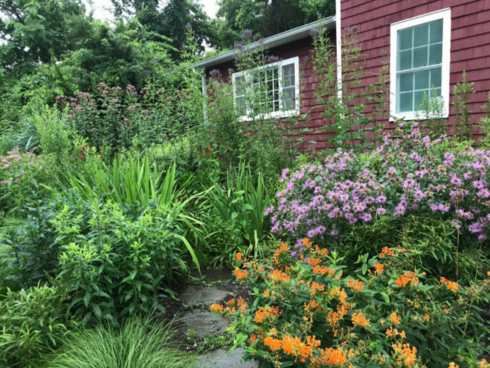
Same rain garden in Greenport, NY in full bloom. Photo credit: Roxanne Zimmer.
Roxanne hopes the Sound Coastal Gardening Course will continue reaching new audiences and encouraging more Long Islanders to bring these practices home. “I think we need to spread the word. This course needs to be offered again and again,” she said.
Healthier coastal waters can begin right at home. “By managing water wisely, choosing native plants, reducing fertilizer use, building healthier soils, and sharing these practices with others, individual actions can contribute to a healthier Long Island,” said Roxanne.
Looking Ahead
The connection between education and community action will continue in Northport Village, which will host the next Sound Coastal Gardening Course in October. There, Monica Zenyuh, a Northport Village Trustee and Commissioner of Parks, has already been working to expand the use and understanding of native plants and rain gardens as tools for managing stormwater and protecting Northport Harbor.
“As a Master Gardener and Northport Native Garden Initiative (NNGI) member, I’ve learned about the importance in planting native plants and the need for rain gardens, especially in Northport Village, to catch the floodwaters and filter the runoff before it enters our harbor,” said Monica. There are currently 4 rain gardens/bioswales in the Village that catch over 130,000 gallons of runoff a year. The Northport Rain Garden Stewards volunteer group, started by Monica and Nicole Tamaro the founder of NNGI and a Village resident, is made up of 30 men and women who help maintain the gardens. “When Roxanne mentioned running this course (in Northport), I jumped at the opportunity. My belief is that education is key. The more people that understand our coastal environment and the profound impact our actions have, the better chance we have to clean our harbor, support pollinators, and increase plant diversity in our community,” said Monica.
Monica’s involvement demonstrates how the course can complement environmental work already underway in a community. Roxanne pointed to Northport’s rain garden efforts as an opportunity for future participants to put what they learn into practice and potentially support the Village’s ongoing work.
Due to high demand, the upcoming Sound Coastal Gardening Course offering is now closed. If you’re interested in future course offerings, visit the program webpage: Cornell Cooperative Extension of Suffolk County.
Connect with Us!
|