|
Rethinking Long Island's Shorelines Through Nature-Based Resilience
Strong, healthy shorelines are essential to New York’s coast. They are the first line of defense for storms, can improve water quality through filtering stormwater runoff, provide critical habitat for wildlife, and help sustain local industries. Yet, they are increasingly at risk from extreme storms, erosion, and rising sea levels.
Protecting shorelines doesn’t always require building hard barriers. Natural shorelines are coastal areas where native ecosystems, such as marshes, dunes, and submerged vegetation, remain intact or are restored to function as a living buffer between land and water. Unlike hardened structures, like bulkheads and sea walls, they are built from natural materials that work in concert with coastal processes rather than against them. As a result, they are increasingly recognized as an important climate resilience strategy.
In this edition of the LIWP newsletter, we spoke with Jade Blennau, Coastal Resilience and Communities Coordinator at the Peconic Estuary Partnership (PEP) to learn how PEP is advancing natural shoreline management efforts through science, policy, and on-the-ground demonstration as part of a broader effort to support a healthier, more resilient Long Island coastline.
Defining Natural Shorelines
Natural shorelines use materials like native vegetation, to stabilize and protect coastlines. In many cases, these approaches can be combined with structural elements such as rock, wood, fiber rolls, bagged shell, or shellfish substrate to create shorelines that provide additional stability while still maintaining ecological function.
“The key to these types of shorelines is that they are dynamic and adaptive. They work with natural processes rather than blocking them the way traditional bulkheads and other hardened structures do. And because of the way they’re constructed, they also create habitat value in addition to providing resilience benefits,” said Jade.
In addition to reducing erosion and stabilizing shorelines, natural systems also support water quality and coastal ecosystem health. “Plants are holding on to sediment through their root structures. They're storing carbon and they're helping filter out nutrients as they take on stormwater right before it hits our embayments and they're supporting fisheries by making habitats for wildlife”, Jade said. These ecological benefits make natural shorelines an important tool not only for coastal resilience, but for improving the long-term health of the estuary.
The specific materials used in natural shoreline projects often vary depending on site conditions. Lower-energy environments may incorporate bio-logs, like coir-logs, shell bags, marsh grasses, oysters, or mussels, while higher-energy shorelines may require more structurally robust approaches. “There are places that use oysters or coir log. There are places that are just using plant materials,” Jade explained. “There’s a lot of different options.”
In New York State, they are now considered the preferred method for protecting and stabilizing tidal shorelines, with recent amendments to New York State Environmental Conservation Law encouraging the use of nature-based solutions whenever feasible.
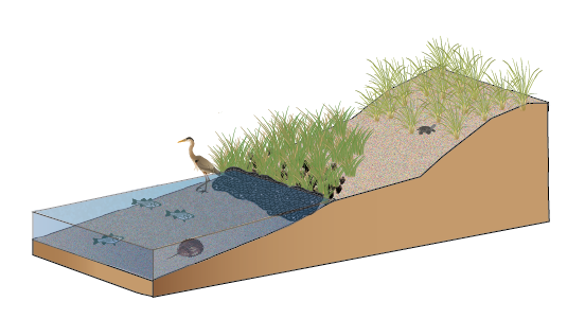
Natural shorelines use native plants, shellfish, and other natural features such as rocks, sand, wood, coconut fiber, and shells to stabilize and protect coasts and decrease direct wave energy. They are designed to mimic the natural environment and provide ecological benefits.Photo credit: PEP.
Understanding Wave Energy and Erosion
A major factor influencing shoreline stability is wave energy, and one of the most significant differences between hardened and natural shorelines is how they interact with waves.
"When you have a hardened shoreline and you have wave energy either from boat traffic or wind-driven (waves), that energy hits the bulkhead and refracts in different directions," Jade explained. “This can lead to unintended consequences, including erosion in neighboring areas and impacts to sensitive habitats. "
Natural shorelines function differently. They absorb and dissipate wave energy and allow for natural water and sand movement patterns. “If there is a natural marsh in an area, the sediment, root structures, and plant material could help absorb the wave energy and prevent the kind of erosion and shoreline loss we sometimes see with hardened structures,” said Jade.
The Shoreline Adaptation Initiative
Although natural shoreline approaches offer significant resilience and ecological benefits, implementing them remains complicated. One of the primary barriers is the complexity of the permitting and regulatory process, where barriers exist in local codes, zoning, and permitting.
To help address those challenges, PEP has partnered with the New York Sea Grant to launch the Shoreline Adaptation Initiative, a multi-year effort focused on evaluating shoreline adaptation barriers and opportunities throughout the estuary. The Initiative's mission is to synthesize information gathered from diverse partners, leverage funding, and create resources and policy recommendations that align the goals, decisions, and interpretation of shoreline management across the Peconic Estuary.
"The system that we're currently functioning in is not set up to incentivize homeowners, landowners, contractors, or even townships to be able to do this work," Jade said. “There are many layers to this. It’s multi-jurisdictional. If you want to do something on your shoreline, you become part of a process that exists at the town, state, and federal levels. And in some areas on the East End, you’re also within a trustee jurisdiction or village jurisdiction,” explained Jade. As a result, even relatively small shoreline projects can involve overlapping agencies, regulations, and review processes that are often difficult for homeowners and municipalities to navigate. “A single person trying to create a natural shoreline is already part of multiple different processes that they may know nothing about,” she added.
To better understand those challenges, the Initiative documented experiences across agencies and municipalities while assessing shoreline codes, identifying differences across jurisdictions, and working directly with municipalities to help draft meaningful policy changes. "My goal was to document the experiences of people, document their processes, and connect all of the pieces," Jade said. "How does what's happening in the Town of Shelter Island relate to what's happening in New York State agencies? How are all of these experiences connected?"
The Initiative first brought together primary stakeholder groups, including regulatory agencies, policymakers, land managers, homeowners, engineers, and shoreline practitioners. These groups worked to identify permitting hurdles, document interagency challenges, and develop recommendations for improving shoreline policies, zoning regulations, and permitting processes.
The recommendations aim to provide a roadmap to improve communication, streamline permitting, and create a more supportive framework for shoreline adaptation projects, ultimately building a system in which natural shorelines become a viable option across the Peconic Estuary.
Building Better Tools for Shoreline Planning
Another key initiative currently underway is the development of a Shoreline Adaptation Site Suitability Model in partnership with the Virginia Institute of Marine Science.
The model is intended to help municipalities, regulators, engineers, and waterfront property owners evaluate which shoreline adaptation strategies may be most appropriate for a given site based on environmental conditions and ecological priorities.
“We're really excited about the model that we're investing in right now,” Jade said. “What if we all started from the same position and then dug deeper in a way that we were collaborating and thinking about critical environmental factors when we choose the best, most responsible actions at a particular site?”
The project builds upon years of shoreline inventories, habitat mapping, and environmental data collection conducted throughout the estuary. For PEP, the goal is not to eliminate hardened infrastructure entirely, but to ensure shoreline decisions are grounded in science and tailored to site-specific conditions.
“Protecting natural shorelines that currently exist should be our number one priority always,” Jade emphasized. “If there are places that are natural now, they should stay natural.”
At the same time, she acknowledged that hardened structures remain necessary in some highly developed or vulnerable areas. “There are areas where bulkheads are 100% needed,” Jade said. “If prioritized infrastructure was built without proper setbacks and facing inundation, then your bulkhead is currently necessary.”
Shoreline stabilization techniques are not “one size fits all.” Every project is developed on a case-by-case basis and differ depending on specific conditions at each site. “Selecting the most nature-based approach that fits the site conditions provides the greatest ecological benefits while still protecting the shoreline,” Jade noted.
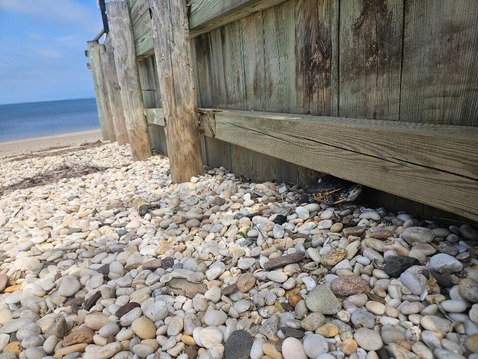
Diamondback Terrapin Against Hardened Shoreline Structure. Photo Credit: Jade Blennau.
Demonstrating Nature-Based Resilience
Faced with an increasing demand for shoreline protection among property owners, the Town of Southold wanted to provide its residents with an example of an environmentally conscious alternative to shoreline hardening. For this reason, PEP worked in collaboration with the Town of Southold, Suffolk County, and Cornell Cooperative Extension (CCE), to create a living shoreline demonstration that allows municipalities, environmental professionals, and the public to observe shoreline adaptation strategies under real-world conditions. Funding for this demonstration project was provided by the USEPA, the Suffolk County Water Quality Protection and Restoration Program, and the Town of Southold.
This shoreline project, installed along the banks of a creek at the Suffolk County Marine Environmental Learning Center (SCMELC) in Southold, incorporates several layers of shoreline stabilization including a combination of cultured ribbed mussel and adult, transplanted ribbed mussels, bagged shell, rocks, bio-logs, and wooden terracing. Smooth cordgrass seeds from nearby marshes were collected, propagated and raised in the CCE habitat restoration greenhouse prior to being planted. These features were selected to test and demonstrate benefits, effectiveness, and appearances of each material in combination with the living features of the shoreline.
Projects like the Southold demonstration site serve as educational tools intended to build broader public understanding and confidence in shoreline adaptation strategies.
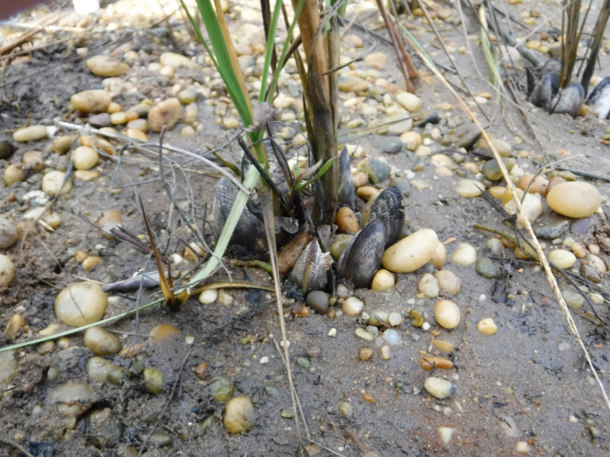
Ribbed mussels clustered around Spartina shoots at the demonstration project site. Photo Credit: PEP
Through research, coordination, restoration planning, and stakeholder engagement, the Peconic Estuary Partnership is working to create systems that support both environmental protection and coastal resilience. At the heart of that effort is a recognition that protecting Long Island’s coastlines requires not only strong science and thoughtful policy, but also collaboration among the many people responsible for managing and protecting these environments. “The people that protect the coastal zone are protecting the future habitability of this island,” Jade said. “All of this work is about helping these natural resource protectors feel confident that they can do their jobs in the most science-based and thoughtful way possible.”
To learn more about the PEP Shoreline Adaptation Initiative, visit the webpage here.
Connect with Us!
|