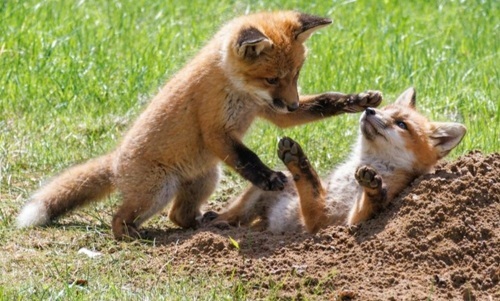
Photo of red fox kits courtesy of Andy Walters
In this issue:
We shared this week with the 56th annual Earth Day. Although it was just a single day, it gave us the opportunity to see the entire week, and all wildlife we came upon, through the lens of a healthy and cared for environment.
4/22 – Hudson River Watershed: Our first Earth Day was celebrated on April 22, 1970, 56 years ago today. It was an occasion to be optimistic.
Many believe that the seed for Earth Day was planted in 1962 with Rachel's Carson's seminal work Silent Spring, a warning of ecological human abuses and excesses that needed to be confronted. That initial Earth Day did indeed increase environmental awareness in America: By July of 1970 the Environmental Protection Agency was established by special executive order to regulate and enforce national pollution legislation. Earth Day also led to the passage of the Clean Water (1972) and Endangered Species (1973) acts. On Earth Day, Rachel Carson’s seed sprouted ushering in the birth of the modern environmental movement.
On Earth Day, for a very poignant and succinct recipe, we can look to the first stanza in English poet William Blake’s Auguries of Innocence (1803):
To see a World in a Grain of Sand
And a Heaven in a Wild Flower
Hold Infinity in the palm of your hand
And Eternity in an hour.
- Tom Lake
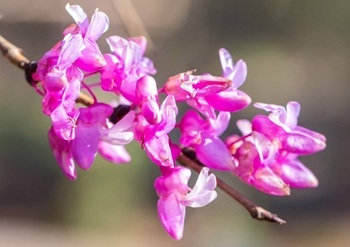
Photo of Eastern redbud courtesy of Tom Hennessey
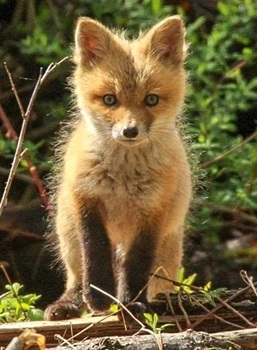
4/18 – Dutchess County: This is the season for red fox kits. However, until they grow a bit and begin to romp with siblings, they tend to be unnoticed, sequestered in their den, or outside for short forays.
- Tom Lake
Photo of red fox courtesy of Joe Licari
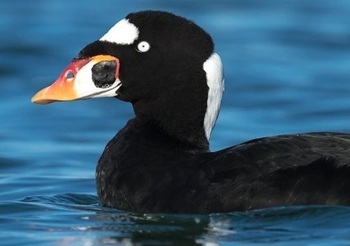
4/18 – Orange County, HRM 41: When I arrived at Wickham Lake, Town of Warwick, this morning, it was a steady rain. I was initially viewing from under the pavilion, but then I saw some interesting ducks, so I had to venture out into the rain for a closer look from the shore. I was super excited when I got a better look at five sea ducks, four surf scoters (Melanitta perspicillata), and a single black scoter (M. americana).
- Matt Zeitler
Photo of surf scoter courtesy of Dorian Anderson
4/18 – Hook Mountain, HRM 31: Among the 30 north-migrating raptors today at the Hook Mountain Hawkwatch, broad-winged hawk was high count with 19. Osprey was next with six. There was much entertaining local action with eagles: Two immature bald eagles flew back and forth along the south side of the Hook; four adults interacted and shrieked at each other overhead; two red-tailed hawks were kiting, diving, and flipping over one another.
In an oddity that would be very unusual for any spring or autumn hawk watch, there were no migrating vultures, neither turkey or black.
- Peter Nixon, Glyn Nixon
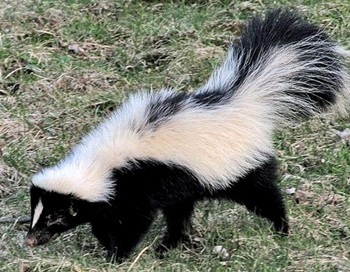
4/19 – Brooklyn, New York City: Rounding the labyrinthine roads leading to the Ryan Visitor Center at Floyd Bennett Field, my eyes caught sight of something I've been hoping to see for some years now: A live striped skunk was foraging in a grassy field just north and a little west of the Floyd Bennett Community Gardens.
Not wishing to miss the opportunity for a photograph, I parked and walked quickly out to the field to document this rare visitor.
Skunks have become more common in New York City — certainly a skunk in the Bronx or in northern Manhattan is no longer the rarity it once was, I've even seen dead road-killed skunks on Staten Island — but after decades of absence, these mustelids seem to be spreading into southern Brooklyn.
Over the last several years I've documented three skunks in southern Brooklyn; all dead along roadsides leading to the park. While the current skunk foraged, I snuck closer for a good photograph. The animal was injured, and was dragging its left rear foot, but it was mobile and otherwise seemed healthy. I was pleased to let it escape as I shot a last video.
Outside my office, Jimmy and Tyler, two park bio-technicians, told me they'd found the first piping plover (Charadrius melodus) of 2026 on eggs. It was an overall auspicious day for New York City wildlife!
- Dave Taft
Photo of striped skunk courtesy of Jon Hawkinson
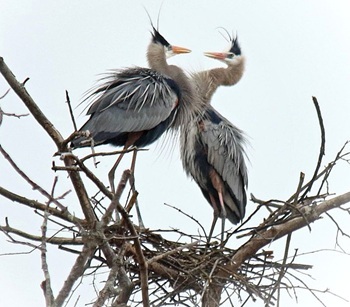
4/20 – Westchester County, HRM 33: I was able to pull off the Saw Mill River Parkway briefly today for a quick look at the great blue heron rookery in the Chappaqua-Mount Kisco area. (Note of caution: The Saw Mill River Parkway does not have adequate pull-offs, so extreme care must be taken to stop and look).
The rookery is quite large and extends for a quarter-mile parallel to the Parkway. It is in very close proximity to the Metro North train tracks (Harlem Line). I counted at least nine active nests and there are likely more I missed. Lots of birds were coming and going, clacking all the while. With many intervening trees and the busy parkway, it may be impossible to closely watch the rookery later this spring. The best place to see them might be on board a Metro North train between the Mount Kisco and Chappaqua stations.
- Rick Stafford
Photo of great blue heron courtesy of Dana Layton
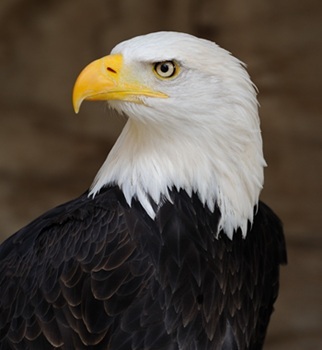
4/21 – Manhattan, HRM 1-2: Hudson River Park security staff noticed a large bird of prey perched on the western end of Pier 40 overlooking the Hudson River. With a closer look, it was confirmed to be a bald eagle, a rare but not unheard of visitor in the boundaries of Hudson River Park. Earlier in the winter there were several reports of an immature flying over the ice floes that dominated the river at the time, and prior to that an adult individual was spotted consuming an American eel on Gansevoort Peninsula in 2023. The individual sited this week remained perched at the Western end of Pier 40 for about half an hour before taking flight.
- Toland Kister
Photo of bald eagle courtesy of Bob Rightmyer
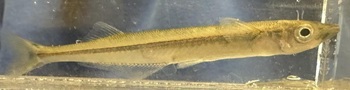
4/22 – Staatsburg, HRM 85: Beacon High School students came seining with us to help celebrate Earth Day at the Norrie Point Environmental Education Center. With the river at peak spring conditions, we netted up some familiar fish: Spottail shiners, bluegill and pumpkinseed sunfish, tessellated darters, banded killifish, American eel), and one rarity, a three-inch (76 mm) brook silverside (Labidesthes sicculus). These freshwater silverside are a little thinner with a more beak-like snout than their saltier relations the Atlantic silverside. They are a nonnative species, likely canal immigrants from the Great Lakes where it is a native species (Hubbs and Lagler 1947). We've caught them before occasionally in our seines, but not often.
- Chris Bowser, Maija Niemisto, Martice Smith, Emily Zheng, Natalie Rider
[Note: One-inch equals 25.4 millimeters (mm). Tom Lake]
Photo of brook silverside courtesy of Chris Bowser
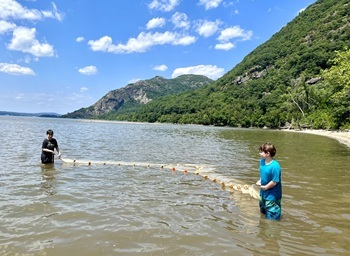
4/22 – Little Stony Point, HRM 55: A dozen of us gathered on the beach at Little Stony Point (Hudson Highlands State Park) for the 56th Earth Day. Few places can match the Hudson Highlands as a background for Earth Day. The beach is cradled in the grandeur of ancient peaks called Crow’s Nest, Storm King, Breakneck Ridge, and Mount Taurus, embodying the essence of Earth Day. Storm King has its own special environmental protection tale to tell. As the Laurentide Ice Sheet inched its way south from the Arctic no less than 20,000 years ago, it discovered that the billion year-old bedrock of the Hudson Highlands, igneous and metamorphic rock, was far too resistant to the erosive nature of the mile-high glacier. Thus, the Highlands was spared.
The river was a chilly 52 degrees Fahrenheit with no measurable salinity. Our catch after more than a dozen seine hauls was light — the vagaries of nature. However, our heartfelt tribute to Earth Day was not measured by how may fish we caught. The five species included yearling American eels (“glass eels”), young-of-year bay anchovy (58 mm) headed upriver from more saline waters, and three residents, white perch, spottail shiner, and young of year bluegill sunfish (28 mm).
- Tom Lake, Matt Polands, Suzanne Pierce, Seth Dinitz
Photo of seining courtesy of Tom Lake
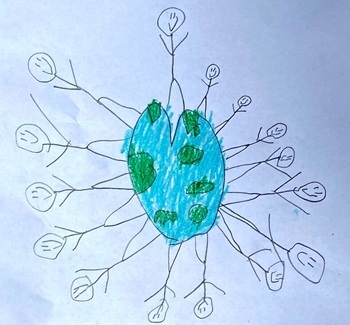
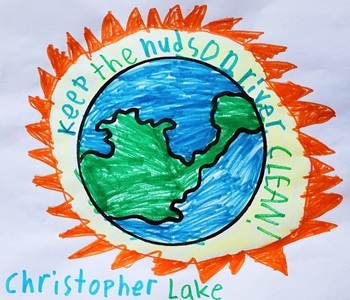
4/22 – Earth Day 4th Grade Student Art
Earth Day 4th Grade Student Art courtesy of Benjamin J
Earth Day 4th Grade Student Art courtesy of Christopher T.
Earth Day 4th Grade Student Art courtesy of Jason Knapp
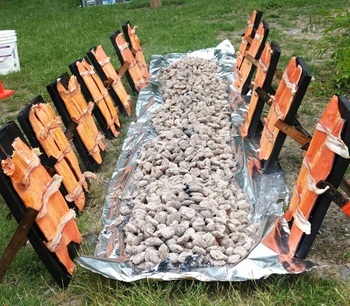
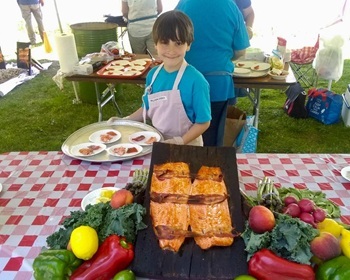
4/22 – Earth Days Past, Bear Mountain, HRM 46: The start of the new millennium, 2000, was also the 30th anniversary of Earth Day, as well as a free public shad bake. Despite the raw and rainy conditions, more than 200 people came to Bear Mountain State Park and shared our celebration with pickled, baked, and smoked American shad. White-throated sparrows provided the music, and a black V of double-crested cormorants, perhaps 50 birds, passed overhead, headed upriver.
- Christopher Letts, Andra Sramek, Tom Lake
Photo of public shad bakes (cooking shad) courtesy of Tom Lake
[People have been celebrating the river’s annual shad run for millennia. There is archaeological evidence that ancestral Hudson Valley Native people baked and smoked (to extend shelf life) shad on huge riverside roasting platforms, some an acre in size. Fires, hot coals and cobbles were set around flat stones upon which shad were placed for slow cooking and smoking. Millions of shad scales have been recovered at such sites and the associated charcoal dates back at least 3,000 years ago.
In historic times, shad bakes were community activities, a part of spring in the Hudson Valley in concert with of a booming commercial shad fishery. As recently as the decade of the 1990s, we would run a dozen or more free shad bakes each spring at towns along 160 miles of tidewater from Liberty State Park (NJ), New York Harbor, to the federal dam at Troy, sponsored by the Hudson River Foundation, Clearwater, and the New York State DEC. Tom Lake]
Photo of public shad bakes (serving shad) courtesy of Tom Lake
4/22 – Hudson River Watershed: One of the values of Earth Day, and throughout the entire Spring, is the reminder that we share a community of wildlife. We often see young-of-the-season bald eagle, red fox, white-tail fawns, waterfowl, and other wildlife. It is a time to remember the “wild” in wildlife and temper our enthusiasm to get closer. Mothers will often abandon their young if they feel threatened. Close is the function of our optics.
- Tom Lake
4/22 – Manhattan, HRM 1-2: Hudson River Park’s River Project staff with our CUNY interns checked our research gear (pots and traps) that we deploy from floating docks on the south-side of Piers 26 and 40 as part of our ongoing Fish Ecology Survey.
Overnight our gear had collected two white perch (195 mm), one blackfish or tautog (260 mm), and one blue crab (30 mm). Invertebrates included grass shrimp, mud crabs, amphipods, marine leeches, mud dog whelks, sand shrimp, and marine isopods.
- Renee Mariner
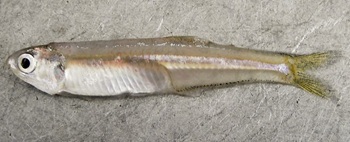
4/23 – Hudson River Watershed: Fish-of-the-Week for Week 363 is the bay anchovy (Anchoa mitchilli), number 34 (of 237), on our Hudson River Watershed List of Fishes. If you would like a copy of our list, e-mail: trlake7@aol.com
The bay anchovy is one of two Anchovies (Engraulidae) documented for the watershed. The other is the striped anchovy (A. hepsetus). The former is designated as a native estuarine species, the latter a temperate marine stray.
(Smith 1985) describes the bay anchovy as a delicate species that occurs in huge schools in coastal waters as well as brackish-water estuaries. In the Hudson River estuary, they are often the dominant [fish] species (Dovel 1977).
They are transparent as larvae, translucent as adults, with a bright silver lateral band, like the Atlantic silverside. The bay anchovy has a prominently-projecting conical snout that lays over their mouth with a maxillary (lower jaw) that is stepped back nearly to their opercle (gill cover).The net of this arrangement is their most notable field mark is a hinge formed by their jaw giving them a huge mouth when fully opened with which they filter feed, consuming a diet of zooplankton. At the other end of the food chain, along with other small, bright, and shiny fishes such as the herrings, they are essentially snacks for predators like bluefish and striped bass.
They are spring spawners in salt or brackish water in bays and estuaries from Maine to the Gulf of Mexico. Their ability to adapt to changing conditions makes them a prime examples of an estuarine species. In the Hudson River estuary, they venture into freshwater as far upriver as Kingston (river mile 92). J.R. Greeley, in his A Biological Survey of the Lower Hudson Watershed (1937), found them “common” in the lower Hudson River and remarked that their schools “make their way up the river in summer for a considerable distance.”
The bay anchovy’s Type Site is New York, with no specificity as to a more precise location. However, it was there where French zoologist Achille Valenciennes first described Anchoa mitchilli to science (with another French zoologist, Georges Cuvier) in 1848.
When we first encountered a spring-run of young-of-year bay anchovies a few years ago, we only noticed their presence when we saw a cascade of tiny wrigglers, scores of them, all 15 mm, rippling down the beach having escaped from the bag of our seine. Being small and very thin, they had easily slithered through the net’s 10.0 millimeter mesh to escape and reach the river. We stepped the mesh size back to 5.0 mm and that made all the difference to our catch.
-Tom Lake
Photo of bay anchovy courtesy of Tom Lake
4/23 – Waterford, HRM 158: Now in its ninth season at Peebles Island State Park at the junction of the Mohawk and Hudson rivers, bald eagle nest NY485 had at least one nestling spring. The first eight seasons have been successful by any measure averaging two nestlings each.
I arrived this morning in time for first feeding, but I never saw a nestling, it was all pantomime: the female’s head jerking as she tore a piece of fish to feed something down out of sight.
- Howard Stoner
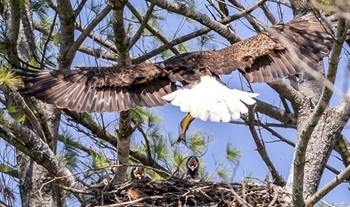
4/24 – Town of Poughkeepsie: The three bald eagle nestlings at NY62 sat up at attention, eyes expectant, mouths open, as the adult male swooped into the nest carrying a large channel catfish. The 37-day-old nestlings — hatched March 19 — have been eating well.
- Bob Rightmyer
Photo of bald eagles courtesy of Bob Rightmyer
4/24 – Yonkers, HRM 18: Across five days this week (April 18-24) we made 50 seine hauls off the Beczak Beach with student groups including our EELS Team Research Showcase event, Ossining High School (juniors-seniors), and the 5th grade at the Collegiate School in Manhattan. Among the highlights of our catch were yearling striped bass (75–180 mm), Atlantic silverside (75 mm), mummichog, white perch, and one blue crab. Across the same five days, we checked our glass eel fyke net and found indications that the spring run of these juvenile American eels was either at peak, or somewhat past.
Water temperature averaged 53 degrees Fahrenheit, salinity averaged 6.9 parts-per-thousand, and dissolved oxygen (DO) averaged a healthy 10.6 parts-per-million.
- Jason Muller, Suzy Schwimmer, Stella Sturgill, Christina Tobitsch, Katie Lamboy Roman, Daniel Basso
Science Saturday at Norrie Point Environmental Center
Join us for our monthly Science Saturday programs and explore Norrie Point. Check out our series by visiting the Hudson River website. Events are free and open to the public. Registration is not required. All programs meet at the Norrie Point Environmental Center, 256 Norrie Point Way, Staatsburg NY 12580. Dress for the weather and being outside! Otherwise, no special equipment is needed.
The upcoming Science Saturday programs are:
- Rebecca Houser, Education and Outreach Specialist, HREP and NEIWPCC
Snapshot NY
The NYSDEC, in collaboration with the New York Cooperative Fish and Wildlife Research Unit at Cornell University, has launched Snapshot NY, a citizen science program that allows the public to participate in wildlife monitoring through the deployment of trail cameras. The project will help improve the way DEC monitors and manages more than a dozen wildlife species. For more information on Snapshot NY and how to participate, visit the Snapshot NY website.
Hudson River Lesson Plans
Explore our collection of Hudson River lesson plans, videos and online activities to support hand on investigations of the Hudson River in your classroom.
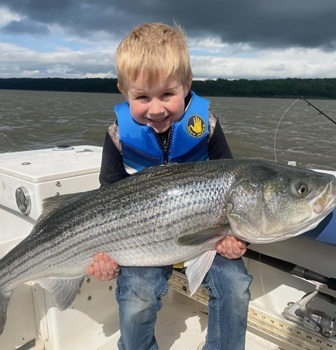
Hudson River: Striped Bass Cooperative Angler Program
You can share your fishing trip information and help biologists understand and manage our Hudson River striped bass fishery.
Here’s how it works: Fill out a logbook provided by us whenever you fish on the Hudson River (by boat or from shore). You can also use our survey123 app and record your trips using a smart phone or computer.
Record general location, time, gear used, what you caught (or if you didn’t catch anything) and return the logbook when you are done fishing for the season. You’ll receive an annual newsletter summarizing the information in addition to the latest news regarding regulations and the river. Whether you catch-and-release or take home a keeper, you can be part of the Cooperative Angler Program. Online logbook instructions (PDF)
Join today by contacting: hudsonangler@dec.ny.gov
- Jessica Best
Photo of DEC Angler Program courtesy of Jess Best
Hudson River Miles
The Hudson is measured north from Hudson River Mile 0 at the Battery at the southern tip of Manhattan. The George Washington Bridge is at HRM 12, the Tappan Zee 28, Bear Mountain 47, Beacon-Newburgh 62, Mid-Hudson 75, Kingston-Rhinecliff 95, Rip Van Winkle 114, and the Federal Dam at Troy, the head of tidewater, at 153. The tidal section of the Hudson constitutes a bit less than half the total distance—315 miles—from Lake Tear of the Clouds to the Battery. Entries from points east and west in the watershed reference the corresponding river mile on the mainstem.
To Contribute Your Observations
The Hudson River Almanac is compiled and edited by Tom Lake and emailed weekly by DEC's Hudson River Estuary Program. Share your observations by e-mailing them to trlake7@aol.com.
Was this Newsletter Forwarded to You?
Subscribe today to DEC Delivers Hudson River Almanac topic for weekly natural history journal that covers the Hudson from the High Peaks of the Adirondacks to New York Harbor.
Helpful Resources
National Oceanic and Atmospheric Administration online tide and tidal current predictions are invaluable when planning Hudson River field trips. For real-time information on Hudson River tides, weather, and water conditions from sixteen monitoring stations, visit the Hudson River Environmental Conditions Observing System website.
DEC's Smartphone app for iPhone and Android is now available at New York Fishing, Hunting, and Wildlife App.
|