|
Nutrient Bioextraction Initiative Update
Since its launch in 2018, the Nutrient Bioextraction Initiative has been investigating using shellfish and seaweed cultivation as a potential nitrogen management strategy to address hypoxia and other water quality issues. By integrating scientific research, economic analysis, and coordination across agencies, researchers, and industry experts, the Initiative is helping to understand the potential of bioextraction as a viable and scalable approach to improve water quality.
In this edition of the LIWP newsletter, we are excited to introduce Kyra DeGroat, the new Bioextraction Assistant, and delve into her background. We sat down with Kyra and Kimarie Yap, the Bioextraction Coordinator, to discuss the Initiative’s progress, current research, key findings, and future priorities.
Nutrient bioextraction combines growing and harvesting shellfish and seaweed (known as aquaculture) for the purpose of removing excess nitrogen and other nutrients that impair coastal waters. Shellfish and seaweed use nitrogen and phosphorus in the water to grow and develop, similar to land plants. Nutrient bioextraction may also provide additional ecological benefits, such as creating habitats for marine life and increasing water clarity, making it a potentially valuable strategy in helping to improve water quality.
The Nutrient Bioextraction Initiative was created in 2018 by DEC’s Long Island Nitrogen Action Plan (now the Long Island Watershed Program) in partnership with NEIWPCC and the Long Island Regional Planning Council, and with funding from the United States Environmental Protection Agency (EPA) through the Long Island Sound Partnership (formerly Long Island Sound Study).
Since its founding, the Initiative has completed projects that have helped identify key knowledge gaps, refined a list of promising shellfish and seaweed bioextraction species, and built connections among scientists, regulators, students, and aquaculture experts across the region.
In addition to environmental benefits, the Initiative is exploring the broader economic and community value of bioextraction.
“If research demonstrates that a bioextraction industry is viable and can provide substantial water quality benefits, an established bioextraction industry could potentially offer environmental stewardship opportunities for students and community members, as well as strengthen coastal economies and local businesses,” said Kimarie.
Welcoming New Program Support
To support the continued growth of the Nutrient Bioextraction Initiative, the program recently welcomed Kyra DeGroat as Bioextraction Assistant.
Kyra brings a strong background in marine research and science communication. While obtaining her bachelor’s in Biology at the College of the Holy Cross, she spent a summer drafting marine science content for the National Oceanic and Atmospheric Administration (NOAA)’s Office of Protected Resources. She then completed a National Science Foundation-funded research internship with the Virginia Institute of Marine Science and a senior thesis project on the temperate Northern Star Coral with her school’s Marine Organismal Biology lab. After graduating, she continued working in research and performed fieldwork and lab analyses as a physical science technician for NOAA Fisheries Northeast Fisheries Science Center.
In her current role, Kyra is excited to be returning to the topic that started her research journey: water quality. “In high school, I volunteered at my town’s center for student coastal research, collecting water samples and analyzing them for bacteria, chlorophyll-a, nitrates, and nitrites. Seeing firsthand how relevant our research was to the community was very rewarding and really sparked my interest in science,” Kyra explained.
As Bioextraction Program Assistant, Kyra is applying her research and communications background to assist in the coordination of bioextraction projects that aim to reduce nitrogen pollution in Long Island Sound. She will also assist in communication efforts for the Initiative.
Current Research Highlights
Kimarie and Kyra shared highlights on project updates. These projects were all funded by the Long Island Sound Partnership in support of the Nutrient Bioextraction Initiative.
Long-Term Nitrogen and Carbon Removal Study
A major research effort, conducted by Stony Brook University School of Marine and Atmospheric Sciences (SoMAS), investigated seaweeds and oysters’ long-term bioextraction nutrient removal performance across a water quality gradient in the Long Island Sound. The results from this study are crucial to evaluating bioextraction’s effectiveness in removing nitrogen to meet reduction goals and resulting water quality changes. The first two years of the study are complete, and the study will continue for another two years.
“Based off the first two years of project data and models informed from existing Long Island aquaculture farms, the study found that if 1% of surface waters were used for seaweed-shellfish aquaculture farming, it could offset 3% of the 60% nitrogen reduction goal for Oyster Bay and 7% of the 37% nitrogen reduction goal for Northport Bay. The first two years of the study also saw improvements in localized water quality for dissolved oxygen and pH in seaweed deployment areas compared to control sites,” Kimarie added. “One takeaway from this project is that bioextraction demonstrated greater potential for nitrogen removal in mild to moderately eutrophic embayments compared to severely eutrophic embayments.”
Check out the virtual webinar presentation on this research here.
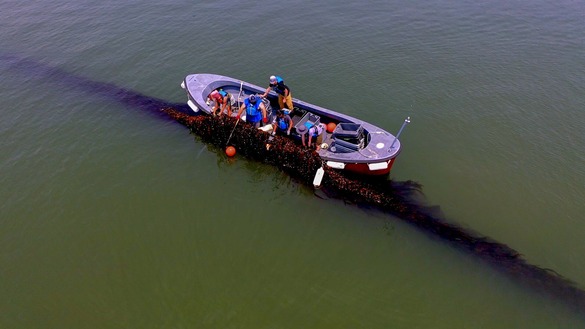
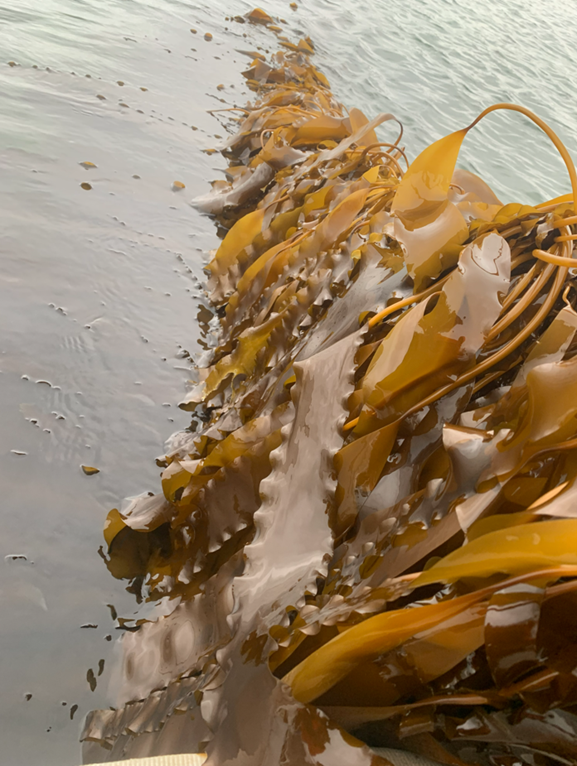
Sugar kelp monitoring and harvest in the East River in June 2025 by SUNY Maritime College and Stony Brook SoMAS. Photo credit: Dan Bower, courtesy of Lazy Point Farms.
Economic Feasibility Study
A cornerstone of the Initiative has been understanding whether bioextraction-based aquaculture can viably support a sustainable commercial industry in the Long Island Sound watershed.
“The Economic Feasibility of Commercial Nutrient Bioextraction in Long Island Sound was an important study that sought to answer a lot of early questions for the Initiative and lay the foundation for future bioextraction projects.” said Kimarie.
The study conducted by Farmingdale State College identified the species that hold the greatest potential for further bioextraction research based on nitrogen extraction rates, growth rates, and year-round habitat suitability in Long Island Sound. Based on their analysis, the study identified Ulva and Cladophora as promising seaweeds, and soft-shell clams, Atlantic bay scallops, and ribbed mussels as strong shellfish candidates.
The study also determined the most feasible and profitable seaweed markets to support a bioextraction industry. Near-term opportunities include fertilizer amendments and cosmetics, while longer-term markets, such as bioplastics, construction materials, and pharmaceuticals, may become viable with sufficient production scale and infrastructure investment.
The study ultimately concluded that a commercial bioextraction industry is feasible if barriers are addressed, such as lack of startup resources and capital for new growers and lack of local processing facilities for products made with seaweed. Read the full study here.
Ribbed mussels continue to emerge as one of the most promising shellfish species for nutrient bioextraction, particularly because they can be cultivated in waters closed to shellfish harvest for human consumption, where nitrogen removal may be most needed. A pilot study, conducted by Cornell Cooperative Extension of Suffolk County, NEIWPCC, and DEC, evaluated their nutrient extraction potential and suitability as animal feed.
“A key finding from this pilot study was that a one-acre ribbed mussel farm could remove up to 120 pounds of nitrogen and 700 pounds of carbon from a Long Island Sound embayment at harvest after cultivation for 3–4 years, a time period equivalent to oyster farming,” said Kimarie.
The study also found that harvested ribbed mussels contained amino acids vital for livestock growth and contained no pesticides or PCBs, suggesting they may have potential suitability as animal feed. Heavy metals were detected but below maximum tolerance levels established for animal feed. “Further investigation is needed to more accurately determine animal feed suitability as the mussels were not dried prior to analysis, unlike commercial products,” Kimarie noted.
Check out the final report for this ribbed mussel bioextraction pilot here.
Cornell Cooperative Extension is also studying how to refine ribbed mussel hatchery methods to create a reliable, efficient way to produce large numbers of mussels for future research, restoration projects, and a potential bioextraction industry. “Currently, there is no established method to culture ribbed mussels in a hatchery setting, so projects that utilized ribbed mussels had to collect them from wild populations in salt marshes. This is a big bottleneck for projects like those for bioextraction, pathogen removal, and shoreline restoration that may require millions of mussels to achieve their goals. That's why this is a really exciting project that can lead to the development of a ribbed mussel aquaculture hatchery guide so they can be sustainably sourced in the future,” explained Kimarie.
“The study found that a shellfish spawning method developed by Rutgers University called the ’bin-silo’ method provided consistent success for ribbed mussel spawning and demonstrated promise for future large-scale ribbed mussel production,” said Kyra.
Check out the final report for this ribbed mussel hatchery study here.
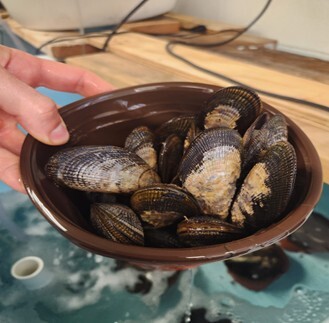 |
Adult ribbed mussels used for spawning trials conducted by Cornell Cooperative Extension of Suffolk County. Photo Credit: Kimarie Yap, NEIWPCC/NYSDEC Bioextraction Coordinator.
Another project conducted by SoMAS is focused on refining methods to improve sugar kelp cultivation that may address challenges related to climate variability.
Sugar kelp is a cold-season species that develops its reproductive tissue as water temperatures cool in the fall. Currently, the kelp industry is highly dependent upon the collection of this wild reproductive tissue to produce kelp seed spools that are deployed in the water to grow. Warming waters in the region are delaying the development of this reproductive tissue, resulting in postponement of seed spool production and deployment to farms for cultivation. This effectively shortens the growing season, reducing harvest yields needed for effective nutrient removal.
To address this issue, researchers are testing a new seed production method using gametophyte cultures. Under controlled light and environmental conditions, kelp gametophytes can be stored year-round and sourced at the start of the growing season as needed, offering more control for growers over when they can plant their kelp.
“This advancement could reduce reliance on collection of wild kelp reproductive tissue and extend the growing season by allowing growers to plant their kelp seed earlier in the growing season. This extended growing season could potentially result in greater kelp production and maximize bioextraction productivity,” said Kyra.
Wild Seaweed Harvesting
The Initiative is also exploring wild harvesting as a complementary approach to aquaculture-based bioextraction, in another project conducted by SoMAS.
“Annually recurring nuisance seaweed blooms take up nutrients during the summer and decay in the fall, re-releasing nutrients back into the water,” said Kimarie. “This project will sample naturally occurring seaweed blooms, quantify the nitrogen and carbon content, and evaluate the wild harvest method’s effectiveness as an alternative bioextraction method,” she added.
“The Bioextraction Initiative is excited to share the launch of two new projects, including a continuation of the long-term bioextraction monitoring study and Phase 2 of the ribbed mussel hatchery study. These projects will continue measuring the long-term water quality changes and nitrogen extraction rates from bioextraction, and refining methods needed to scale ribbed mussel seed production,” said Kyra.
Research findings to date reinforce the potential for bioextraction to play a meaningful role in improving water quality. “Based on preliminary research so far, bioextraction has demonstrated potential to impact water quality in the Long Island Sound through the removal of nitrogen and may be a promising complementary approach to land-based nitrogen mitigation strategies,” said Kimarie.
She emphasized that there is still much to be done through the Initiative to move bioextraction from research projects to viable commercial-scale implementation, such as refining cultivation methods and understanding the impact to water quality, how climate variability will impact bioextraction species, evaluating best post-harvest uses, and industry feasibility.
However, small-scale environmental stewardship efforts to grow seaweed and shellfish for water quality remediation can have compounding positive environmental and community benefits while connecting folks to their local waters, leaving a meaningful, lasting social impact. The Initiative encourages readers to get involved with bioextraction activities like non-profit restoration groups that grow kelp in their local communities and learn more about the coastal and marine ecosystems where they live.
For more information on the Nutrient Bioextraction Initiative and to stay updated on ongoing projects, visit the Nutrient Bioextraction Initiative website.
Sugar kelp monitoring in the East River in May 2025 by SUNY Maritime College and Stony Brook SoMAS. Photo credit: SUNY Stony Brook SoMAS.
Connect with Us!
|