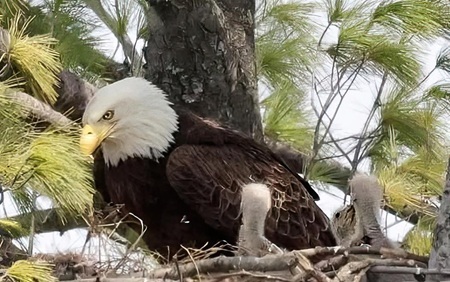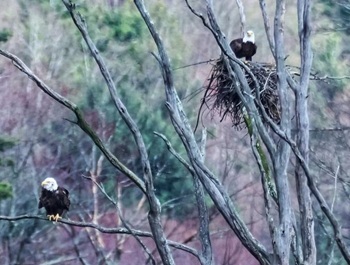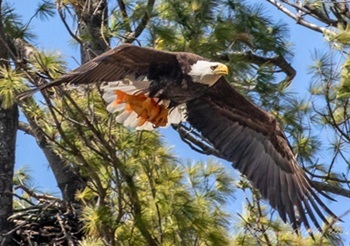
Photo of bald eagle with nestlings courtesy of Don Wingfield
In this issue:
Bald eagles dominated the week from nests to nestlings. While tidewater was filling with fishes from the sea to spawn, the now fully-thawed river of the highlands above the tide was welcoming an abundance of waterfowl.
4/3 – Town of Poughkeepsie: The adult female in bald eagle nest NY62 laid her eggs on February 20. After 27 days of combined incubation by the adults, there was a hatch of three nestlings on March 19. For several days, the nestlings stayed hidden in the bottom of the nest, regularly fed by offerings of fish from the river by the adults, and protected primarily by the female. In recent days the three nestlings had grown to a small, gray, fuzzy size to be seen and photographed by Don Wingfield (pictured above).
- Bob Rightmyer
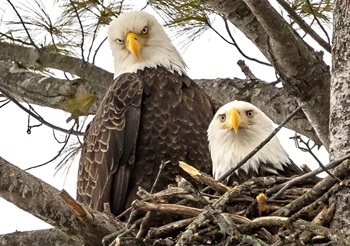
Photo of bald eagle adults courtesy of Bob Rightmyer
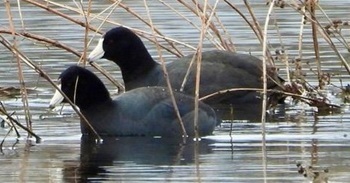
4/4 – Saratoga County, HRM 167: I found and photographed a pair of American coot (Fulica americana) this morning on Round Lake Preserve. Round Lake Preserve is comprised of 57 acres on the eastern shore of Round Lake. Since we know of no local breeding of coot, these were likely in migration to nesting grounds to the north and Canada.
- Katrina Van Tassel
Photo of American coot courtesy of Katrina Van Tassel
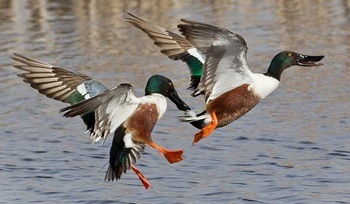
4/5 – Saratoga County, HRM 157: Eight Hudson-Mohawk Bird Club members showed up this morning at the Vischer Ferry Preserve under a solid blanket of gray. Along the way we encountered wall-to-wall ring-necked ducks. Then we saw a new duck, a lesser scaup tucked in with the ring-necks. After that, I found more ducks including wood ducks, green-winged teal, American wigeon, and blue-winged teal. Among songbirds there were eastern bluebirds, northern cardinals, and red-bellied woodpeckers. Overall, common grackles and red winged blackbirds dominated the towpath. On the walk back we got the highlight of the morning, a beautiful pair of northern shovelers dropping in with a dramatic splashdown.
- Dave Massa
[The Mohawk Towpath Byway runs from Waterford to the historic Stockade District of Schenectady along the historic route of the Erie Canal. The word "towpath" comes from a period of the Erie Canal's history when canal vessels moved principally by draft animals — mostly mules — that pulled craft from the path atop the side berm of the canal. Tom Lake]
Photo of Northern shovelers courtesy of USF&W
4/5 – Hammond Point, HRM 60: Not far from Denning’s Point, near the Hudson River, is bald eagle nest NY313. Our best guess as to when the nest first became viable was 2014. In the thirteen years since, the adults (assuming it has been the same pair) have had good success hatching and fledging young. They had one failed year but then had three nestlings the next.
Today John Huntington confirmed activity with a series of long-distance photos of the adults in and around the nest. John’s videos showed two nestlings. They suggested the beginning of a good season for NY313.
- Tom Lake
4/5 – Westchester County, HRM 39: A pair of adult bald eagles apparently took over a great blue heron nest in a rookery at the Mountain Way marsh in Montrose.
- Andy Walters
[My first thought was, given the apparent fragile nature of heron nests, this had to be a short-stay solution. Heron nests seem more vertically built rather than the horizontal nature of an eagle nest. A 12 lb. female eagle would be forced to sit very still. Pete Nye points out that the choice of such a location is close to an abundant and readily accessible food source. In the short term. Tom Lake]
Photo of bald eagles courtesy of Andy Walters
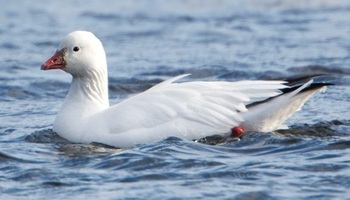
4/6 – Tappan Zee, HRM 36: I was at the Haverstraw Ferry Pier this afternoon when a string of 4-5 male mallards passed by. Looking quite out of place, a Ross’s goose followed closely in their wake. I took a photo that was good for a positive identification, but too blurry for the Almanac.
- Larry Weiss
[Ross’s goose (Anser rossii) is a tundra breeder seen in our area only in migration. They breed in the Canadian arctic; the exact location was not discovered until 1938. A few turn up in the East, normally with snow geese, with which they hybridize. The first sighting of a Ross’s goose in New York State, where they are considered rare, was in 1983 at Round Pond, Amenia, in Dutchess County (New York State Avian Records Committee). Stan DeOrsey, Barbara Butler]
Photo of Ross's goose courtesy of Matt Zeitler
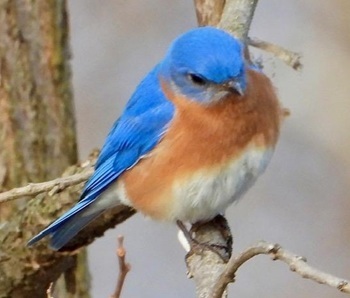
4/7 – Saratoga County, HRM 157: Gadwall, wild turkey, blue bird, and a muskrat were all at the Vischer Ferry Preserve this morning.
- Katrina Van Tassel
Photo of Eastern bluebird courtesy of Katrina Van Tassel
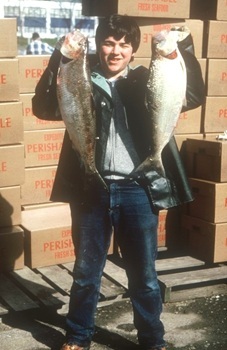
4/7 – Hudson River Watershed: Fish-of-the-Week for Week 361 is the American shad (Alosa sapidissima) number 27 (of 240) on our watershed list of fishes. If you would like a copy of our list, e-mail: trlake7@aol.com.
The American shad was formerly one of nine herrings (Clupeidae) in our watershed. In a taxonomic reassessment of the herrings, the nine species were scattered into four families: Alosidae (shads), Clupeidae (herrings, sardines, menhadens), Dussumieriidae (round herrings), and Dorosomatidae (gizzard shads and sardinellas). American shad remained with Alosidae (shads).
American shad is the largest of the river herrings (Alosa sp.). Their body is strongly compressed, bright silvery on the sides, blueish to greenish above, with silvery deciduous scales. Their native range on the East Coast stretches from Labrador south to the Saint John's River in Florida. Their Type Site is the Delaware River at Philadelphia, where naturalist Alexander Wilson first described Alosa sapidissima to science in 1811.
Shad are anadromous, in that they spend most of their life in salt water, wintering offshore along the coast south to the Carolinas, but returning to inland freshwater, often their natal river, to spawn. Their popularity as both a food fish and a recreational species prompted a successful transport of 35,000 Hudson River shad into the Sacramento River in July 1873, where the species became well established on the West Coast. Their scientific name comes from Latin as Alosa (shad) sapidissima (sapidus = savory).
As the water warms in late March, shad, primarily males, enter the estuary in pulses, each intent on reaching their spawning grounds. The shadbush (Amelanchier sp.) has been, at least colloquially on the East Coast, considered a harbinger of their arrival from the sea. The males, or buck shad, begin nosing up the river, a sinuous journey, that allows them to slowly acclimate to the lessening salinity. In the weeks that follow, more females, or roe shad, ascend the river, all heading above the salt to a 70-mile freshwater spawning reach from Hyde Park to the head of tide at Green Island (Troy). Eventually, the run evens out — similar numbers of bucks and roe — before concluding in late May, dominated by roe shad.
In April and May, from the1980s-2000s, commercial fishermen and estuary educators ran up to a dozen free public shad bakes at ports along 150 miles of riverfront from Troy to the Battery. This was a concerted effort to reestablish the public's confidence in the river's viability following the cultural impacts of PCBs in the river. With an OK from the NYS Health Department, we featured smoked, planked (baked), and pickled shad. Our draw ranged from several hundred people per event to a thousand or more.
American shad, primarily as a commercial fish, has been an important part of Hudson River lore, legend, history and culture, beginning in prehistoric times. Archaeological remnants of smoking huts and processing refuse middens for shad and sturgeon, dating to at least 5,000 years ago, have been excavated along the river. These documented finds provide ample evidence that smoking, as well as baking, was a means of extending the shelf life of shad and sturgeon. Both have long been favorite springtime protein resource favorites in the Hudson Valley.
Shad have a well-earned reputation as being a bony and difficult fish to process — they have 769 bones. However, pickling shad has been appreciated as a bone-free product. Perhaps the major attraction with shad has been its eggs or roe. In historic times, shad roe has been a sought-after springtime culinary delight.
- Tom Lake
Photo of American shad courtesy of Tom Lake
Many excellent books have been written on the American shad.
- One of the best is The Founding Fish (John McPhee 2003), a blend of personal history, natural history, and American history including the shad's cameo role in the lives of George Washington and Henry David Thoreau. The Founding Fish is a fitting companion to McPhee's The Survival of the Bark Canoe (1982), an ode to the common loon (Gavia immer).
There are also two excellent fictional accounts of American shad's indelible cultural influence.
-
Shad Run by Howard Breslin (1955)
Set just six years after the American Revolution (1788), this is a story of remembrances. It tells of a time on the Hudson River in the Town of Poughkeepsie when spotters climbed up on Blue Point (400-foot elevation) in spring as lookouts for the possibility that British warships that might come up the river. Drifting down the river at the same time were hand-crafted wooden shad boats working the ebb tide every day with a weather eye for lantern-lit warning signals from Blue Point. Back in Poughkeepsie, fishmongers loaded their wagons and walked the streets selling fresh American shad.
-
Shad Haul by Paul Corey (1947)
The story takes place on the Hudson River in Philipsville (a thinly veiled Cold Spring) and the Philipsville High School (Haldane High School) in post-World War II Putnam County. Two high school students join as apprentices with a couple of rugged river men to drift their shad nets in the shadow of the Hudson Highlands.]
[American shad stocks are managed through the Atlantic States Marine Fisheries Commission (ASMFC). Due to significant declines in coastal landings of American shad, ASMFC recommended a closure of all ocean fishing in 2005. Shortly after, the 2007 ASMFC stock assessment indicated the Hudson River American shad population was severely depleted from over harvesting prompting a complete closure of recreational and commercial fishing in the Hudson River in 2010. Since the closure, the Hudson River population remains depleted based on findings from the most recent 2020 ASMFC benchmark stock assessment.
On March 23, 2024, DEC released the final Recovery Plan for Hudson River American Shad. This plan outlines the efforts undertaken to recover the stock since its collapse and develops a transparent and science-based roadmap for re-opening the shad fisheries. The success of this plan could renew our culinary relationship with shad. NYSDEC]
4/8 – Manhattan, HRM 102: Hudson River Park’s River Project staff checked our research gear (pots and traps) today that we deploy from floating docks on the south-side of Piers 26 and 40 in Hudson River Park.
Recently, our catch had been comprised mostly of invertebrates: Grass shrimp, mud crabs, marine leeches, amphipods, sand shrimp, isopods, Pacific shore crabs (10-20 mm), and a solitary blue crab (30 mm) were collected.
Today, however, we were also thrilled to see two northern pipefish (140 mm) at the Pier 40 trap site. With water temperature steadily rising, we will no doubt see more fish activity in the coming weeks.
- Renee Mariner, Eli Burrel, Toland Kister
[Note: One-inch equals 25.4 millimeters (mm). Tom Lake]
4/9 – Town of Poughkeepsie: In what has become an annual rite of spring, the adult male at bald eagle nest NY62 brought a bright orange goldfish (Carassius auratus) to the nest this morning. The three, 37-day-old, nestlings would eat well today.
- Bob Rightmyer
Photo of bald eagle with goldfish courtesy of Bob Rightmyer
4/9 – Town of Poughkeepsie: This year (2026) is year 26 for bald eagle nest NY62. The nest was first noticed in 2001 in the Town of Wappinger. It was apparent that the large but thinly built nest, 90 feet up a white pine, was a new one. The adults had more work to do.
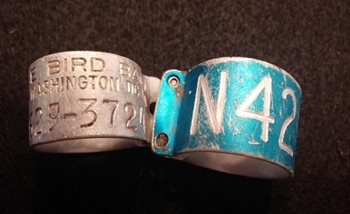
The original male was banded N42 in May 1995 as a nestling from a Delaware River nest in Sullivan County. On February 24, 2017, N42 was struck and killed by a train. Almost immediately, a new unattached male was accepted and has been the female’s mate for ten years.
The female, a new four-year-old adult (class of 1997), and now 29 years-old, has produced 36 nestlings in 20 years (there were no eggs in six years, including year one, 2001).
- Tom Lake
Photo of bald eagle NY62 bands courtesy of Tom Lake
4/10 – Yonkers, HRM 18: Our research and education team at the Sarah Lawrence Center for the Urban River at Beczak found a modest flow of glass eels this week. Our beach seine continued to find empty water. In six hauls of our net the highlight was a single yearling striped bass (130 mm). The salinity was still very low for us ranging 1.5 to 1.9 parts-per-thousand for the week. The dissolved oxygen (DO) seemed rather normal,11.5 to 12.9 parts-per-million.
- Jason Muller, Hamima Hossain, Andrea Guttman, Caitie McCabe, Hilary Vidalakis, Audrey Mattison, Stella Sturgill, and the Rockefeller State Park Preserve Staff
Science Saturday at Norrie Point Environmental Center
Join us for our monthly Science Saturday programs and explore Norrie Point. Check out our series by visiting the Hudson River website. Events are free and open to the public. Registration is not required. All programs meet at the Norrie Point Environmental Center, 256 Norrie Point Way, Staatsburg NY 12580. Dress for the weather and being outside! Otherwise, no special equipment is needed.
The upcoming Science Saturday programs are:
- Rebecca Houser, Education and Outreach Specialist, HREP and NEIWPCC
There are two opportunities to view the short film, The Nature of Nature: Biodiversity in the Hudson Valley, on the big screen this month. From high elevation forests to the globally rare freshwater tidal marshes along the Hudson estuary, The Nature of Nature captures the beautiful, the complex, the familiar, and the unknown…guided by the plants, animals, and people that call the Hudson Valley home. You can read an interview (PDF) about the filmmaking process in the article, “The Nature of Nature: Film delivers a moving ecological portrait of the Hudson Valley” in the current New York State Conservationist magazine.
EarthFest at the American Museum of Natural History
On Saturday, April 18, the film will have its New York City premiere at the American Museum of Natural History’s annual EarthFest event. The Nature of Nature will be on loop in the Hall of Biodiversity throughout the festival. For more details and a full schedule of the event’s offerings, visit Earth Day at the Museum: April 18, 2026 | AMNH. EarthFest is free for members or with museum admission.
Earth Day Celebration in Columbia County
On Sunday, April 19, Columbia Land Conservancy (CLC) and the Columbia County Climate Smart Task Force will cohost Earth Day events in Chatham. The recently completed Plan to Conserve Columbia County, an Estuary Grant-supported conservation plan, will be on display starting at noon at the CLC office. Across the street at the Crandell Theatre, a film festival will run from 1:00 to 3:00pm, featuring Farmscape Ecology, a local film by Jon Bowermaster, and The Nature of Nature: Biodiversity in the Hudson Valley, a local film by Flicker Filmworks and the DEC Hudson River Estuary Program. A panel discussion will follow. Full details are available on the Columbia County website.
Snapshot NY
The NYSDEC, in collaboration with the New York Cooperative Fish and Wildlife Research Unit at Cornell University, has launched Snapshot NY, a citizen science program that allows the public to participate in wildlife monitoring through the deployment of trail cameras. The project will help improve the way DEC monitors and manages more than a dozen wildlife species. For more information on Snapshot NY and how to participate, visit the Snapshot NY website.
Hudson River Lesson Plans
Explore our collection of Hudson River lesson plans, videos and online activities to support hand on investigations of the Hudson River in your classroom.
Hudson River: Striped Bass Cooperative Angler Program
You can share your fishing trip information and help biologists understand and manage our Hudson River striped bass fishery.
Here’s how it works: Fill out a logbook provided by us whenever you fish on the Hudson River (by boat or from shore). You can also use our survey123 app and record your trips using a smart phone or computer.
Record general location, time, gear used, what you caught (or if you didn’t catch anything) and return the logbook when you are done fishing for the season. You’ll receive an annual newsletter summarizing the information in addition to the latest news regarding regulations and the river. Whether you catch-and-release or take home a keeper, you can be part of the Cooperative Angler Program. Online logbook instructions (PDF)
Join today by contacting: hudsonangler@dec.ny.gov
- Jessica Best
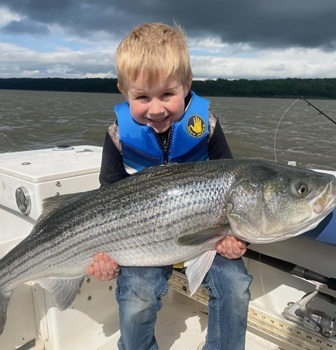
Photo of DEC Angler Program courtesy of Jess Best
Hudson River Miles
The Hudson is measured north from Hudson River Mile 0 at the Battery at the southern tip of Manhattan. The George Washington Bridge is at HRM 12, the Tappan Zee 28, Bear Mountain 47, Beacon-Newburgh 62, Mid-Hudson 75, Kingston-Rhinecliff 95, Rip Van Winkle 114, and the Federal Dam at Troy, the head of tidewater, at 153. The tidal section of the Hudson constitutes a bit less than half the total distance—315 miles—from Lake Tear of the Clouds to the Battery. Entries from points east and west in the watershed reference the corresponding river mile on the mainstem.
To Contribute Your Observations
The Hudson River Almanac is compiled and edited by Tom Lake and emailed weekly by DEC's Hudson River Estuary Program. Share your observations by e-mailing them to trlake7@aol.com.
Was this Newsletter Forwarded to You?
Subscribe today to DEC Delivers Hudson River Almanac topic for weekly natural history journal that covers the Hudson from the High Peaks of the Adirondacks to New York Harbor.
Helpful Resources
National Oceanic and Atmospheric Administration online tide and tidal current predictions are invaluable when planning Hudson River field trips. For real-time information on Hudson River tides, weather, and water conditions from sixteen monitoring stations, visit the Hudson River Environmental Conditions Observing System website.
DEC's Smartphone app for iPhone and Android is now available at New York Fishing, Hunting, and Wildlife App.
|