In this issue:
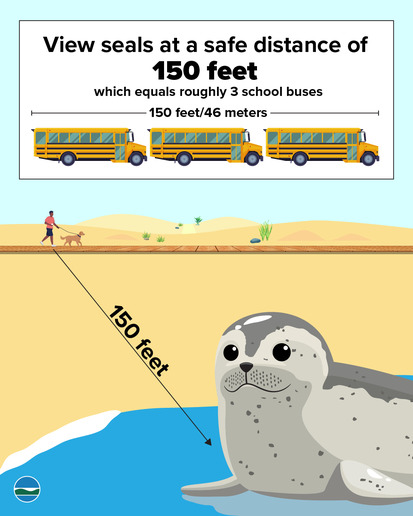
In New York, we share our beaches with a variety of marine life, including several species of seals. It is normal for seals, even pups, to "haul-out" or rest on a beach. Although it can be tempting to get close when you see one, please remember to keep a distance of at least 150 feet. This distance serves two purposes: to protect both you and the seal! Seals are wild animals that can bite you or your pets, causing injury or spreading zoonotic diseases. Being closer than 150 feet can increase a seal’s stress and alter its natural behavior.
If a seal appears sick or injured, please call the New York Stranding Hotline at 631-369-9829 to report the animal. Please provide the location, details, and your contact information so that the New York's Marine Rescue Center's trained biologists and staff may assess the situation as well as the condition of the animal.
Seals are federally protected under the Marine Mammal Protection Act. Learn more about seals in New York by visiting DEC’s website. You can also learn more about responsible viewing on NOAA's website.
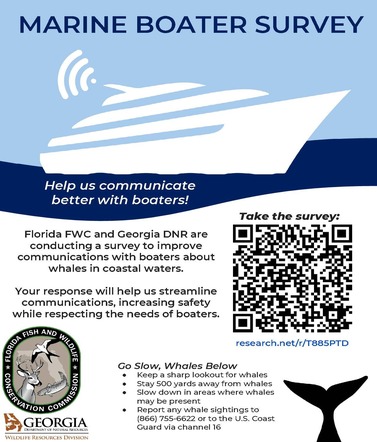
DEC’s Division of Marine Resources is a supporting party to a survey effort led by Florida Fish and Wildlife Conservation Commission and the Georgia Department of Natural Resources’ Wildlife Resources Division.
This survey which closes on March 31, aims to learn more about the communications preferences of boaters as we collectively work to improve outreach about the presence of whales in coastal waters and boater safety.
The survey will take about 10 minutes. Your participation is voluntary and anonymous, and you can stop responding at any time. Please click the link below to take the survey.
Thank you for joining your fellow boaters in taking this survey. For more information on how to boat safely around whales, take the new course Eyes on the Water: Boating with Whales created for New York boaters.
NOAA Fisheries announces a comment period extension on a proposed rule to revise the commercial Atlantic blacknose shark and recreational Atlantic shark fisheries management measures.
What will it do?
The comment period for this proposed rule is being extended through May 29, 2026. A full description of the proposed management measures can be found in the proposed rule which was published on January 5, 2026. The full range of alternatives considered can be found in the draft environmental assessment. The proposed measures are summarized below.
In commercial shark fisheries:
- Remove the blacknose shark management boundary in the Atlantic region.
- Modify the commercial retention limit for blacknose sharks in the Atlantic region.
- Remove commercial management group quota linkages.
In recreational shark fisheries:
- Revise the recreational minimum size limits for Atlantic sharks.
- Revise the recreational retention limits for Atlantic sharks.
Who is affected?
- Any commercial or recreational shark fisher in the northwestern Atlantic Ocean, including the Gulf of America and Caribbean Sea.
- Any dealer who buys or sells sharks or shark products in these areas.
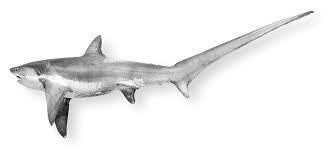
Thresher shark image courtesy of NOAA
DEC's Division of Marine Resources (DMR) has filed a Notice of Proposed Rule Making to amend 6 NYCRR Part 38, Marine Fisheries Data Management and Part 40, Marine Fish (Striped Bass) that will establish a program that allows for transfer of commercial Striped Bass tags amongst Striped Bass Commercial Harvester permit holders, and amends Part 38 to update reporting regulations associated with commercial fishing for Striped Bass.
The Notice of Proposed Rulemaking is available in the January 21, 2026, issue of the State Register.
A public comment hearing for the proposed rulemaking will be held before an Administrative Law Judge (ALJ) via webinar on March 24, 2026 at 2 p.m.
Written public comments will be accepted by the DEC through 5 p.m. March 30, 2026
Details on the rulemaking, and instructions on how to register for the public comment hearing can be found on DEC's website.
Research Area
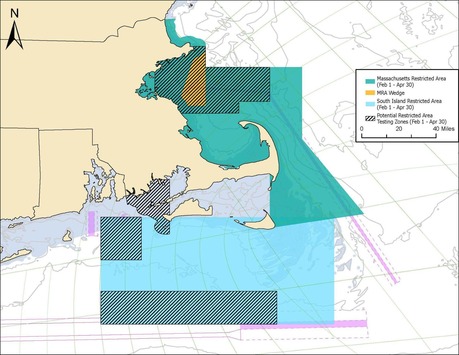
Commercial lobstermen working with NOAA Fisheries will deploy on-demand fishing gear between February 1 and April 30, 2026, with possible extension into May in state waters north of Cape Cod. Gear will be located in portions of the South Island and Massachusetts Restricted Areas when lobster fishing using traditional vertical lines is restricted. The Restricted Areas are shaded in the chart below, with research sites hatched. Research is prohibited in Cape Cod Bay and Nantucket Sound. On-demand fishing gear will not be visible at the surface since it has no surface buoys.
2026 Northeast Experimental On-Demand Fishery Map
Avoiding Gear Conflict
On-demand research gear will be moved ahead of the Northern Gulf of Maine Scallop Management Area opening on April 1 to avoid areas of typical scalloping activity. Research gear will not be surface marked, but will be marked digitally and can be viewed using the free EarthRanger Buoy app or select chartplotters. TimeZero users can view gear positions by turning on the experimental feature in version 5. Olex users can purchase an update to add this functionality. Stable internet is needed to view nearby gear positions in real-time. Those without internet at sea can download gear positions using the EarthRanger Buoy app before leaving the dock. Stored positions will display when within a 5-mile radius, but will not reflect changes made after the download.
If you accidentally tow up on-demand gear, please mark the location and reach out to the Gear Research Team at nec.gearlibrary@noaa.gov or call (508-495-2000).
As part of the 50th Anniversary celebration, the Mid-Atlantic Fishery Management Council is excited to announce the launch of their first photo contest. Whether you are a professional photographer, a commercial fisherman, or a weekend angler, your photos can help tell the story of our region's vibrant and productive marine fisheries.
We are looking for compelling images that capture the many dimensions of marine fisheries in the Mid-Atlantic, including:
-
Commercial and Recreational Fishing: Action shots on the water, especially those featuring Council-managed species.
-
Vessels and Gear: The tools of the trade, from fishing vessels to rods and nets.
-
Marine Life and Habitat: Fish, invertebrates, and the underwater or coastal environments they call home.
-
Science and Research: Data collection and fisheries science in action.
-
Coastal Communities: Working waterfronts, seafood processing, and dockside life.
Selected photos will be featured in a gallery on our 50th anniversary webpage, displayed in the Council’s office in Dover, Delaware, and used in future Council communications and outreach materials (with appropriate photographer credit).
How to Enter
- Submit your photos by Friday, March 20, 2026 using the Photo Entry Form
- Each photographer may submit up to 10 photos. A separate entry form is required for each photo submission.
- All submissions must include a short description of when and where the photo was taken and what is shown in the photo (please identify any species shown, if known).
- Photos should be taken within the Mid-Atlantic region (New York through North Carolina) or, if taken elsewhere, depict fishing activities related to Council-managed species.
Visit the website for complete contest details and rules.
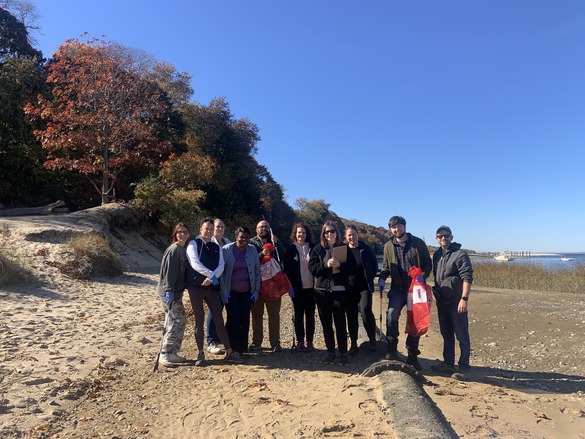
Ocean literacy and education promotes the understanding of the relationship between people and their coastal environment: the ocean’s influence on us and our influence on the ocean. To assist and simplify getting ocean-themed lessons into the classroom, DEC’s Division of Marine Resources hosts ocean themed professional development courses for educators. These courses have two major themes: Coastal acidification and Plastic Pollution in our waters. These CTLE credited courses are available free of charge throughout the Marine District.
These courses are available upon request. DEC staff will work with school systems and teacher groups to schedule a time and place to train staff on one or both curriculums. Tell us when and where and we’ll be there!
For more information and to organize a training in your district, please contact francis.mcparland@dec.ny.gov.
Educators Attending Marine Debri Professional Development Workshop
Continuing the Largest-ever Environmental Protection Fund Investment
The Executive Budget proposal would continue the largest-ever Environmental Protection Fund investment of $2.1 billion over five years, equivalent to $425 million per year. This funding goes toward forest and farmland protection, local parks, environmental justice initiatives, implementing the State’s watershed programs, and successful grant programs like the Water Quality Improvement Project program that is helping safeguard drinking water, combat contributors to harmful algal blooms, update aging water infrastructure, and improve habitat in communities statewide.
This funding also helps to support the protection of our fisheries and habitat by investing in effective programs that prevent invasive species, and promote the health of rivers and estuaries statewide.
2026 State of the State Highlight: Governor Kathy Hochul’s State of the State agenda launches DEC’s expansion of accessible features specifically for children with disabilities. The “These Lands are for Everyone” initiative will provide more opportunities for people of all abilities to connect with nature. The program will support new tactile exhibits, sensory trails, and inclusive nature centers, ensuring all children can enjoy New York’s natural treasures.
Learn more in the FY2027 NYS Executive Budget document (PDF).
Marine Resources Advisory Council (3/10, 2pm)
Joint Ecosystem and Ocean Planning (EOP) Committee and Advisory Panel Meeting (3/10, 1pm-4pm)
March 2026 MAFMC Scientific and Statistical Committee (SSC) Meeting, (3/10, 12:30pm)
NEFMC Scientific and Statistical Committee (SSC) Sub-panel Webinar, (3/13, 9am)
Winter Flounder Technical Committee, (3/17, 1pm-2:30pm)
Tautog Technical Committee, (3/17, 1pm-3pm)
Joint Monkfish Advisory Panel and Committee and Skate Advisory Panel and Committee Webinar (3/19, 9am)
NEFMC SSC Meeting, (3/30, 9am)
NEFMC Groundfish Joint Committee and Advisory Panel Webinar, (3/31, 9am)
|