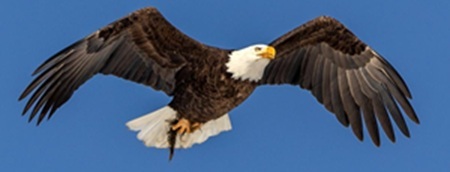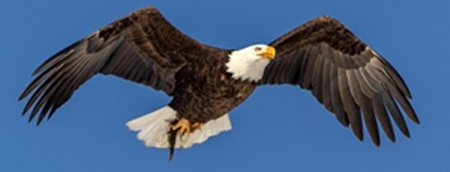
Photo of bald eagle courtesy of Bob Rightmyer
In this issue:
For those of us who grew up in a Hudson Valley where few eagles flew, and even those were wintering birds, weeks like this one rekindles why we cherish their resurgence. In company with eagles was the Arctic cold and a frozen Hudson River.
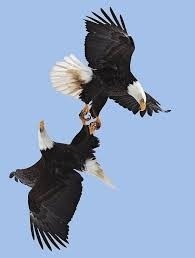
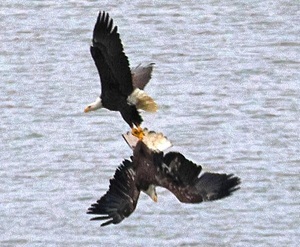
2/6 – Hudson River Estuary: On a Valentine's Day dawn at New Hamburg several years ago, we watched two adult bald eagles pirouetting several hundred feet over the river above Diamond Reef. It was eagle courtship, an aerial performance of grace and symmetry usually performed by breeding pairs in the days before the late-winter nesting season. We have euphemistically called this “sky dancing.”
They would shadow each other over the ice with loop-de-loops and wing-touches. At the climax of a long acrobatic arc in the sky, they would lock talons — one turned on its back in the air, the other mirroring it from above — and go into a free-fall. Seconds before a crash on the ice-hardened river, they’d release in a ritual of trust. Then, falling away in synchronized flight — flap-flap-glide — they flared out over the ice, both wheeling and banking away in perfect form, like an exquisite ballet performance. At times they flew so close to each other that they cast only one shadow as they drifted across the limestone face of Cedarcliff. Their effortless yet powerful wing beats moved them through the air as a single bird, communicating more through instinct than any sound.
- Tom Lake
Photo of bald eagles sky dancing courtesy of Tom Lake
1/31 – Warren County, HRM 245-240: I've been taking the Golf Course-River Road these days whenever I head down to Warrensburg from Minerva. Five days ago, the iced-over and snow-covered Hudson River south of The Glen was smooth and white.
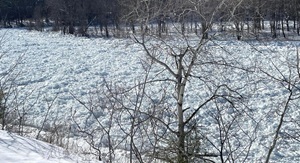
Today, the river south of The Glen down to the Ice Meadows had a totally different look. Following the blizzard of six days ago, the river was now comprised of broken-up chunks of ice of all sizes looking like a whipped cream topping on the river. There was no sign of a channel as the water rushed seaward, unseen beneath the whipped topping. It was stunning.
- Mike Corey
Photo of The Ice Meadows courtesy of Mike Corey
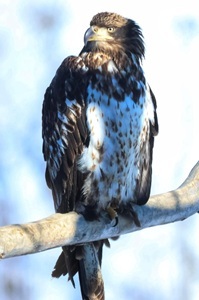
1/31 – Saratoga County, HRM 157: Despite being so near to considerable iced-over water, bald eagles continue to find a prime wintering spot that provides them with open water and plenty of prey in the Mohawk River under the Falls at Cohoes. As expected, the immatures almost always outnumber the adults. Perhaps the best feature of this location, even at minus-three degrees Fahrenheit (F), is the endless number of prime perching and loafing trees.
- Andrew Walters
Photo of bald eagle courtesy of Andrew Walters
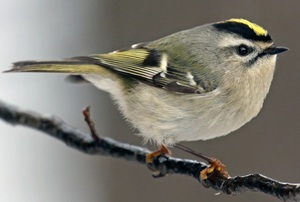
2/1 – Town of Poughkeepsie, HRM 67.5: I watched Chris Slagle studiously peering into the distance with his binoculars. I assumed there was an eagle about since he rarely moved the glasses off one spot. It seemed strange and I had to ask. Chris, a superb birder, had a golden-crowned kinglet (Regulus satrapa), a small songbird, in his sight. While I was looking to the sky or some distant spot, Chris had found the kinglet in a pine not more than 30 feet in front of us.
-Tom Lake
Photo of goden-crowned kinglet courtesy of Ryan Schain
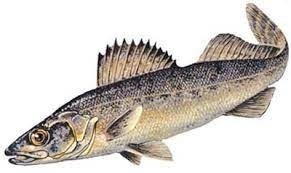
2/1 – Hudson River Watershed: Fish-of-the-Week for Week 352 is the blue pike Stizostedion vitreum glaucum (Hubbs 1926). The blue pike appears on our list of fishes of the Hudson River Watershed as a questionable addendum where it sits just below the walleye. If you would like a copy of our watershed list of 239 fishes, e-mail trlake7@aol.com.
This is not a typical Fish-of-the-Week. Today we go in search of the blue pike. Legends that linger in the memory of the masses often take on a life approaching reality. This Almanac entry is a broad-reaching story of a near mythical fish that transcends time, space, perhaps even its existence, that touches our watershed.
For Ed McGowan, Assistant District Manager, NY State Parks, the stories lasted and resurfaced years later when he visited a dune system along the Lake Erie shore in Canada, near his grandfather’s’ farm. He was looking for artifacts and bones exposed by erosion. A 2,000-foot stretch of dune remained wild and was being carved out by wind and storms, without replenishing sands due to beach stabilization elsewhere.
Ed’s reconnaissance produced some amazing finds including black bear and gray wolf teeth and articulated eastern elk vertebrae. Among the old-looking fish remains, both recent and ancient, were several tiny toothy mandibles. Ed had always wondered if those could have been from the distinctive, but terribly elusive, blue pike, given their small size yet relatively large teeth. Among stone tools was a finely crafted Madison projectile point, an arrowhead found among a cluster of crumbling white-tailed deer bones that likely was fashioned by the Haudenosaunee (Iroquoian) a millennium ago. It was as if Ed had taken a trip in a Time Machine.
The blue pike, in all its iterations, is a member of the perch family (Percidae), along with its close relative the walleye (Sander vitreus). Blue pike, also known as blue walleye, are steel blue dorsally, with silvery-bluish sides, and ventrally milk-white (Stepien 2014). Adults get to be 16-inches and two pounds with the occasional larger fish that may have been hybrid walleyes. The blue pike is native to Lakes Erie and Ontario, co-occurred with walleye, and was reputed to favor the deeper and cooler waters of these lakes.
The blue pike’s Type Site is Lake Erie, where Carl Hubbs described Stizostedion vitreum glaucum to science in 1826. Morphometric studies at the time led biologists to classify the blue pike as a separate species, although it was later downgraded to a subspecies in 1947 by Hubbs and Lagler's Fishes of the Great Lake Region.
The blue pike, in its unsteady taxonomy, was an important commercial species in the 1940s and 1950s but the harvest level proved unsustainable and populations collapsed by the early 1960s. In 1975, the blue pike was declared functionally extinct.
Our memory of the blue pike has its roots in New York. A decade ago, I received a phone call from the Norrie Point Environmental Education Center. Students had caught a fish in their seine that they thought might be the rare blue pike. In the lore and legend of Hudson River fishes, the blue pike had long been a cryptically mysterious fish—more memories than substance.
I was dispatched to Norrie Point to take a look. At first glance, the fish was certainly a 15-inch walleye and had a blueish tint or tinge. As a test, I transferred the walleye from the cool river water to an aquarium of warmer tap water. After stabilizing, the color morphed back to the dark olive and gold color of a walleye. Could this transformation have been the basis of some of the earlier blue pike claims?
One summer, when I was in graduate school on Lake Erie, my Ichthyology professor and mentor, Dr. C. Lavett Smith, and I, did a semester long search of Lake Erie (the blue pike was Smitty’s Moby Dick). With seine and hook-and-line, we caught and examined dozens if not scores of walleyes noting any possible adaptations and other morphologies (teeth included) that might suggest blue pike. Despite our efforts, we came across nothing conclusive.
Smitty was a disciple of Milton Trautman, an academic giant in Midwest fisheries. (For the story of Trautman’s blue pike, see The Fishes of Ohio, 1981). In his account, unlike Hubbs and Lagler, Trautman sees the blue pike as a valid separate species Stizostedion vitreum glaucum.
The fish made one more taxonomic stop in 1967 when it was listed as a valid endangered species by the U.S. Fish and Wildlife.
In the late 1980s, DNA became the gold standard for species identification supplanting morphology (Sweeney 2025). In the instance of the blue pike, DNA was seen as the tie-breaker. In some quarters today, the blue pike is considered either extinct, extirpated, or have had their DNA compromised by the swamping of its DNA with walleye.
A 2014 DNA study of preserved blue pike and modern walleye found no evidence for concluding that blue pike was genetically distinct from walleye (Haponski 2014). The consensus was that the blue pike, now Sander vitreus var. glaucus (Mitchill 1818) was a unique color morph of walleye that was endemic to the Great Lakes. The net of all this becomes both a taxonomic and an ecological mystery. To say the blue pike’s taxonomy is still in flux understates the confusion.
Edward Drinker Cope’s assessment (1892) that “Taxonomy is Science only so far as it is exact,” creates a difficult standard. In their work, Hubbs, Lagler, and Trautman, detail verifiable, repeatable, consistent, albeit rare, morphological traits, that seem to be, collectively, on the road to exactness. However, it seems as though DNA made all that just a distraction.
I’d like to believe that blue pike is still out there in the deep waters of the Great Lakes. Otherwise, it is as though we have just denied the existence of the Loch Ness Monster and Santa Claus.
- Tom Lake
Photo of blue pike courtesy of James Proffitt
2/1 – Hudson River Watershed: Among indigenous peoples, full moons have long been labeled with fanciful names that are rooted in oral traditions, indigenous memories, and ethnographic accounts. Among Mohican people, whose ancestral homeland lies wholly within the Hudson River watershed, the February full moon is known as the Deep Snow Moon (Mo'che osãane keesook).
Among the Haudenosaunee (Iroquoian speakers), much of whose ancestral homeland lies within the Mohawk River Valley on the western periphery of the Hudson River watershed, the February full moon is known Wata’kerokwaskó:wa Wenhnì:tare, the Great Snow Moon.
Tribal translations of full moons pre-date colonization and generally reflect the seasonality of the lunar phase. Moon phases, in fact, were used by indigenous people as measurements of time.
- Larry Madden
2/2 – Ulster County: It was Ground Hog Day, with bright blue skies, and I was in Ulster County visiting an eagle nest that was on the verge of a new breeding season. We heard that Punxsutawney Phil had seen his shadow, suggesting six more weeks of winter. Eagles, with their notable resiliency, would not have cared.
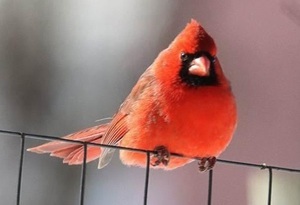
The adjacent Hudson River was frozen nearly solid, save for the icebreaker’s path for boat passage, and loud booms of cracking ice cut the morning stillness. While I waited for eagle activity, a familiar splash of crimson darted across the deep shimmering snow to a local bird feeder. It was a common yet spectacular bird, the northern cardinal (Cardinalis cardinalis). The cardinal’s early spring call, “cheer, cheer, cheer,” was ringing out against the intense winter chill.
I was watching a male cardinal with an orange-crimson breast in the full morning sunlight. The lighting made its eyes stand out from the black mask that wraps around the broad orange-red seed crushing bill. A female was present as well and she was only a little less showy than the male. As they posed on a dogwood branch and fence top, the pair just made my red, white, and blue Groundhog Day.
- Mario Meier
[Of Interest, the cardinal’s vibrant trademark color is not due primarily to genetics but to the carotenoids in the fruits and berries they eat. The cardinal common name came from the rich red robes worn by Catholic hierarchy. Mario Meier].
Photo of Northern cardinal courtesy of Mario Meier
2/2 – Town of Poughkeepsie: The adults in bald eagle nest NY62 seemed ready for the incubation season soon to come. The female was sitting on a small cup constructed from soft grass in the center of the nest where the eggs will be laid. The male, perched behind the female, seemed to loom in a protective posture.
- Bob Rightmyer
Photo of bald eagle courtesy of Bob Rightmyer
2/2 – Yonkers, HRM 18: The river was quite frozen in Yonkers today, the most extensive amount of icing since 2015 with the inauguration of the Sarah Lawrence Center for the Urban River at Beczak. During the last couple of years, our American eel fyke net sampling for elvers began in late January or early February, but it looks like we’re still weeks away before the ice clears and we can set our gear.
- Jason Muller
2/3 – Columbia County, HRM 109: Today’s solidly frozen Hudson River reminded me of a cold winter’s day past. On that morning, at slack water, I cautiously ventured 500 feet out on the river from the DEC boat launch at North Germantown. With “picks of life” around my neck, I drilled a hole (six-inches of ice as I recall, plenty thick enough) and then spent an hour jigging with a bucktail hoping for anything and catching nothing. It was an adventure not to be tried by anyone who is not fully experienced with the vagaries of ice on tidewater.
- Tom Lake
2/4 – New Hamburg, HRM 67: The river appeared to be frozen, bank-to-bank, a perfect day for ice boating, but I saw none. On days like this, legendary riverman John Scardefield of New Hamburg (a sometimes partner drifting for shad) was always busy. In the 1950s, John used to go out to mid-river, cut a narrow trench in the ice, lower a short gill net, and catch white perch (to market), as well as the occasional striped bass and tomcod. John would have been out there today.
- Tom Lake
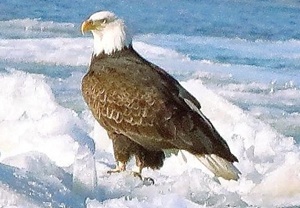
2/5 – Bronx, New York, HRM 12: The Hudson river at Dykeman Street at Inwood was covered in ice. I had not seen anything like this in many years. Bald eagles, pushed here by the heavy ice upriver, have been appearing on the floes every day.
- Wandermann
Photo of bald eagle courtesy of Wandermann
2/6 – Bowline Point, HRM 37: The ice in Haverstraw Bay at Bowline Point has been a very busy venue. Groups of bald eagles were interacting with fish being the center of attention. Immatures were engaged in catching and carrying tomcod and then fending off others from taking their fish. Adults were still focused on courtship.
- Larry Weiss
Photo of bald eagles couretsy of Larry Weiss
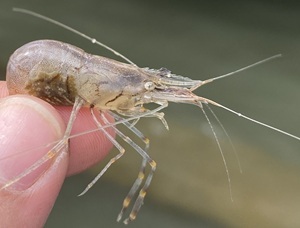
2/6 – Manhattan, HRM 1-2: Trap checking resumed in Hudson River Park this week after a particularly heavy inundation of snow and ice floe in that park. The water was a frigid zero degrees Celsius (32 degrees F), so our traps were understandably empty except for grass shrimp (Palaemon sp.).
- Renee Mariner, Jenevieve Joseph
Photo of grass shrimp courtesy of Tom Lake
2/6 – Manhattan, HRM 1-2: The alleviation of ice floes around our Hudson River Park Pier 40 dock allowed our staff to collect a particularly vibrant plankton sample. This density of plankton, referred to as a plankton bloom, is the result of increased availability of nutrients, sunlight, and rising water temperatures that create the perfect conditions for phytoplankton to proliferate after a long winter.
This phenomena has the effect of jump-starting marine ecosystems as winter becomes spring, providing the first burst of energy and oxygen that supports zooplankton and other organisms at higher trophic levels.
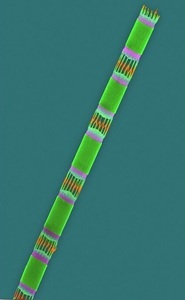
Among the ten phytoplankton species identified this week was Skeletonema costatum, as well a smattering of less populous diatoms and dinoflagellates. Zooplankton observed were limited to copepods and polychaete worm larvae, though we should expect an increase in zooplankton population and diversity in the coming weeks.
- Toland Kister
Photo of Phytoplankton-Skeletonema costatum courtesy of Dennis Kunkle
Science Saturday at Norrie Pint Environmental Center
Join us for our monthly Science Saturday programs and explore Norrie Point. Check out our series by visiting our website. Events are free and open to the public. Registration is not required.
The upcoming Science Saturday programs are:
- February 21, 10 am -12 pm - Winter Mysteries
- March 28, 10 am - 12 pm - Signs of Spring
- April 18, 10 am - 12 pm - Vernal Pool Exploration
- May 2, 10 am - 12 pm - I Love my Park Day
The Norrie Point Environmental Center is located at 256 Norrie Point Way, Staatsburg NY 12580
- Rebecca Houser, Education and Outreach Specialist, HREP and NEIWPCC
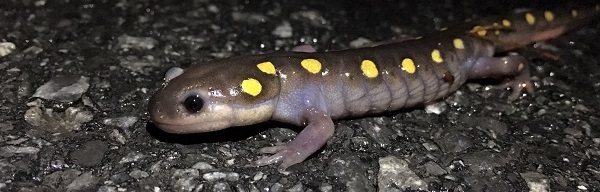
Amphibian Migrations & Road Crossings Program – 2026 Volunteer Trainings
Join the DEC’s Hudson River Estuary Program and Cornell University to learn how to volunteer with the Amphibian Migrations & Road Crossings Project. Volunteers find locations where migrating salamanders and frogs cross roads on their way to vernal pools for breeding in late winter and early spring. They document weather, traffic, and species, and assist amphibians across the road safely. Trainings will be offered on the following dates:
In-person trainings are filling up, but interested volunteers can join our Virtual Training on Tuesday, February 24 at 5:30-7:30pm or attend a program offered by an AM&RC Project Partner. Full details are available: 2026 Volunteer Trainings for the Amphibian Migrations & Road Crossings Project | Conservation Planning in the Hudson River Estuary Watershed.
Snapshot NY
The NYSDEC, in collaboration with the New York Cooperative Fish and Wildlife Research Unit at Cornell University, has launched Snapshot NY, a citizen science program that allows the public to participate in wildlife monitoring through the deployment of trail cameras. The project will help improve the way DEC monitors and manages more than a dozen wildlife species. For more information on Snapshot NY and how to participate, visit the Snapshot NY website.
Join DEC's Hudson River Estuary Management Program and the Hudson River National Estuarine Research Reserve’s - Free Virtual Winter Speaker Series!
Meet and learn from scientists, community leaders, and environmental educators who work at the intersection of research, education, and environmental and social justice. Engage in discussions about monitoring and research, field-based learning, and creating pathways to overcome barriers and challenges in the field of science and education. Visit our website for more information and to register.
The upcoming webinars are:
- February 25, 3:30-4:30 pm, Portrait of a Graduate: Environmental Education for Changing Guidelines by Emily Marcet
Hudson River Lesson Plans
Explore our collection of Hudson River lesson plans, videos and online activities to support hand on investigations of the Hudson River in your classroom.
Hudson River Miles
The Hudson is measured north from Hudson River Mile 0 at the Battery at the southern tip of Manhattan. The George Washington Bridge is at HRM 12, the Tappan Zee 28, Bear Mountain 47, Beacon-Newburgh 62, Mid-Hudson 75, Kingston-Rhinecliff 95, Rip Van Winkle 114, and the Federal Dam at Troy, the head of tidewater, at 153. The tidal section of the Hudson constitutes a bit less than half the total distance—315 miles—from Lake Tear of the Clouds to the Battery. Entries from points east and west in the watershed reference the corresponding river mile on the mainstem.
To Contribute Your Observations
The Hudson River Almanac is compiled and edited by Tom Lake and emailed weekly by DEC's Hudson River Estuary Program. Share your observations by e-mailing them to trlake7@aol.com.
Was this Newsletter Forwarded to You?
Subscribe today to DEC Delivers Hudson River Almanac topic for weekly natural history journal that covers the Hudson from the High Peaks of the Adirondacks to New York Harbor.
Helpful Resources
National Oceanic and Atmospheric Administration online tide and tidal current predictions are invaluable when planning Hudson River field trips. For real-time information on Hudson River tides, weather, and water conditions from sixteen monitoring stations, visit the Hudson River Environmental Conditions Observing System website.
DEC's Smartphone app for iPhone and Android is now available at New York Fishing, Hunting, and Wildlife App.
|