Photo of short-eared owl courtesy of Matt Zeitler
In this issue:
Much of this week’s activities were affected by a major winter storm that included heavy snow, arctic cold, and severe wind-chill. Amid all the turmoil, our Hudson Valley bald eagle put on a show.
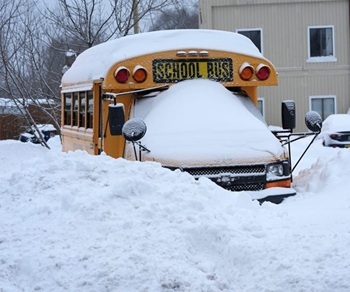
1/25 – Hudson River Watershed: A major winter storm hit the Hudson River Valley. From the Hudson Highlands upriver through the Catskills, snowfall in most areas measured no less than 22-inches. The last snowstorm of that magnitude occurred in January 2014, and it was also 22-inches.
- National Weather Service
Photo of Hudson Valley snowstorm courtesy of Frank Becerra
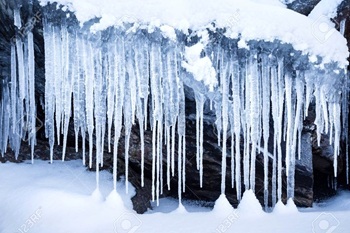
1/24 – Essex County, HRM 302: We were on the eve of a blizzard, and the watershed was braced for a major winter storm. While other locations in the Hudson River Watershed would receive higher totals of snowfall than Newcomb’s 15-inches, none had a lower nighttime, blizzard-eve, air temperature than Newcomb’s minus-26 degrees Fahrenheit (the record low for the date is minus-38 degrees).
- National Weather Service
Photo of icicles courtesy of Sarah Moore
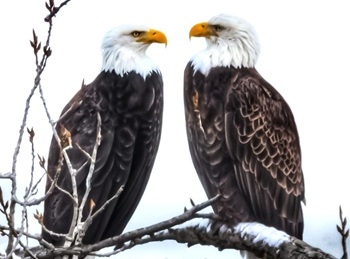
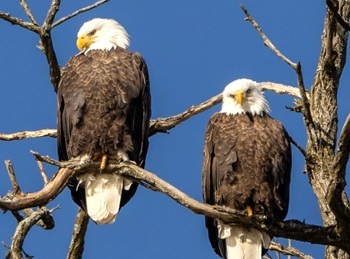
1/24 – Saratoga County, HRM 157: Bald eagles continue to find the combination of open water and plenty of prey in the Mohawk River under the Falls at Cohoes. These two adults (possible mated pair from a close-by nest) took a breather from their job.
- Andy Walters
Photo of bald eagles courtesy of Andy Walters
1/24 – Town of Wappinger, HRM 67: In advance of a blizzard [we caught 22-inches the next day], the adults from bald eagle nest NY459, seemed at ease posing in a nearby hardwood.
- Bob Rightmyer
Photo of bald eagles courtesy of Bob Rightmyer
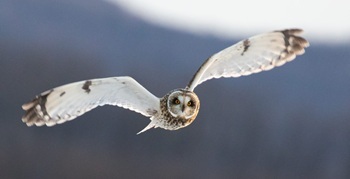
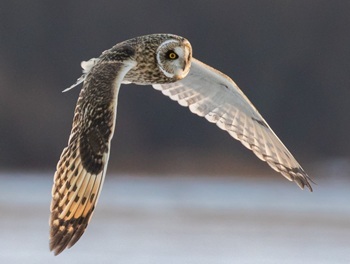
1/24 – Orange County, HRM 41-44: I went out to the Black Dirt Region of Orange County this afternoon to try for short-eared owls for the first time in a long while. I got lucky—barred owls get up early while short-eared owls are late-day risers and that made for an excellent evening with plenty of action.
- Matt Zeitler
[“Black Dirt” is an area of southwest Orange County between Florida and Pine Island. The region is an important agricultural area growing farm produce such as onions, potatoes, lettuce, radishes, cabbage, carrots, corn, pumpkin, and squash in the rich black soil. The Black Dirt topsoil is immensely organic, essentially a compost heap, originating from the decaying flora and fauna of a late-Pleistocene post-glacial lake and swampland. The fields and wetlands contain bones of long extinct species such as mammoth, mastodon, elk-moose, peccary, ground sloth, horse, giant beaver, and other magnificent animals that lived and died there. Tom Lake]
Photo of short-eared owl courtesy of Matt Zeitler
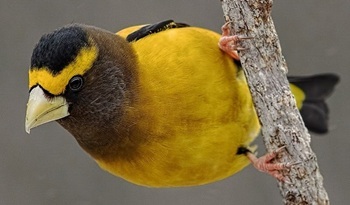
1/25 – Saratoga County, HRM 177: It had been 17 years since I last saw evening grosbeaks wintering in Saratoga County. So, it was exciting when, in company with Ray Perry and John Hershey, we recently spotted at least 32 between two different feeders on Fox Hill Road.
- Ron Harrower, Hudson-Mohawk Bird Club
Photo of evening grosbeak courtesy of Deborah Allen
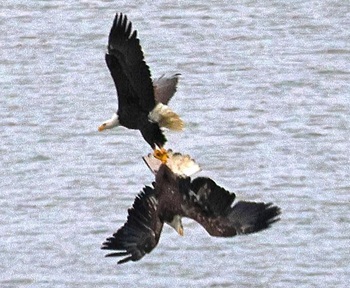
1/25 – Haverstraw Bay, HRM 38.5: I counted no fewer than 16 bald eagles of mixed age out on the ice today off Admiral’s Cove. The river was filed with scattered ice floes, slowly heading to the sea. While some of the birds were engaged in raucous behavior, others were performing intricate aerial courtship maneuvers.
- Larry Weiss
Photo of bald eagles courtesy of Deborah Allen
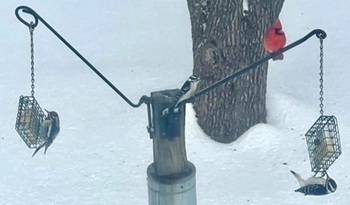
1/26 – Putnam County, HRM 51: While not rare, I thought it was unusual to find three different woodpeckers species on my suet feeders in Garrison. It was a woodpecker trifecta: downy, hairy, and a yellow-bellied sapsucker. All that was missing for a four-bagger was a red-bellied woodpecker.
- Justin Allen
Photo of woodpeckers courtesy of Justin Allen
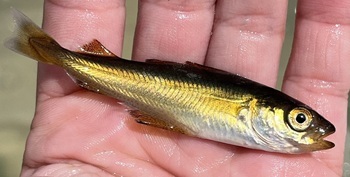
1/26 – Hudson River Watershed: Fish-of-the-Week for Week 351 is the pollock (Pollachius virens Linnaeus, 1758), fish number 107 (of 239), on our Hudson River Watershed List of Fishes. If you would like a copy of our list, e-mail: trlake7@aol.com.
Pollock is one of three cods (Gadidae) documented for our watershed. The others are the Atlantic cod and the Atlantic tomcod. Atlantic cod and pollock are strictly marine species; Atlantic tomcod is anadromous, migrating in from the sea to inland tidewaters to spawn.
Making our Hudson River Watershed Fish List can be a serendipitous proposition. Pollock has been on our list by virtue of a single occurrence, a 53-millimeter young-of-year (Smith 1985) in April 1980 (AMNH 48284) at Indian Point (river mil 42). Beebe and Savidge (1988) indicate that at least one other specimen was seen in New York Harbor (Bob Schmidt). Pollock are presently designated as a temperate marine stray.
Pollock, known colloquially as Boston blue, as coalfish and green cod (UK), and saithe (Norwegian spelling) is found in the western Atlantic primarily from Nova Scotia to the New York Bight although uncommon south of Cape Cod. Juvenile pollock from New England are relatively common in the New York Bight (Waldman & Briggs 2002) and typically winter inshore south to Virginia. Large adult pollock can reach 42-inches and weigh 70 pounds (Robbins, Ray, Douglas 1986). Pollock feed on small fish and larger crustaceans along coastal slopes that favor a hard bottom. They spawn in late autumn and early winter.
Pollack come in several shades and colors including brownish-green, grayish, smoke gray, but always with an underlying greenish hue. Bigelow and Schroeder in their Fishes of the Gulf of Maine (1953) cite its beautiful olive green color as a ready field mark when caught in the company of Atlantic cod and haddock. Another easy field mark is the lateral line: In pollack it is nearly straight; in cod the lateral line arches forward.
Bigelow & Schroder (1953) report schools of young pollock running up New England estuaries in autumn in pursuit of rainbow smelt. There was a time when the Hudson River estuary had a significant population of anadromous rainbow smelt. In the time before we compiled serious fish lists for the Hudson River, did we miss noticing pollock chase smelt up our estuary in late summer and autumn? Being essentially a cold water fish favoring seawater temperatures of 52 degrees Fahrenheit or less, warm autumn water temperatures may have limited their range in the Hudson.
- Tom Lake
Photo of pollock courtesy of Christina Tobitsch
1/27 – Ulster County, HRM 82: The John Burroughs Natural History Society Ulster County segment of the annual New York State January Waterfowl Count was conducted over a two-day period this year, January 17-18. Fifteen participants in seven field parties encountered a rather meager 2,761 waterfowl representing 12 species.
A significant snow storm moved into the region on January 17 and continued throughout the day with occasional heavy snow squalls and dense fog limiting visibility at various sites and inhibiting access to a few others. Sunday, January 18 was not a big improvement with additional snow showers, dark overcast skies, and generally poor visibility.
Considering the abysmal weather and viewing conditions it was no surprise that this year’s effort ranks as one of the lowest for total abundance (ten-year average 7,050) and four species below our recent ten-year diversity average.
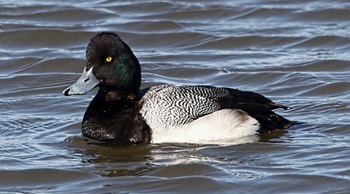
Two lesser scaup were noted on Rondout Creek, an unusual find for a species that has only been recorded on this count on three previous occasions over the last twenty years. Five long-tailed ducks represented a new high count, and our sixth record in twenty years. Four mute swans counted on Esopus Creek are noteworthy additions for a species that appears to be on a trajectory towards extirpation in Ulster County.
Additional water-dependent birds observed during the waterfowl count include a total of 18 Bald Eagles (13 adults, 5 immatures), an atypically low count in comparison to recent past years. Thanks to the field observers for providing good coverage under very difficult conditions.
- Steve M. Chorvas
Photo of lesser scaup courtesy of Terry Hardy
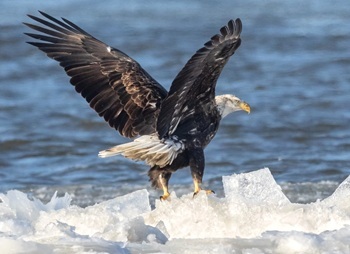
1/28 – Dutchess County, HRM 66: My lens caught a near-adult bald eagle today descending onto the river ice in a perfect example of an immature eagle in eclipse to adulthood. Its head and tail were trying to reach all-white but still showing some of the chocolate feathers of an immature.
- John Badura
Photo of Bald eagle courtesy of John Badura
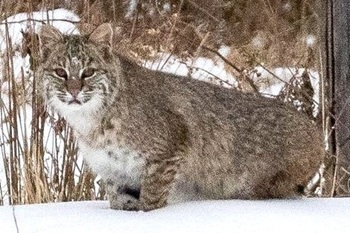
1/29 – Hudson River Watershed: Bobcats (Lynx rufus) urinate primarily to mark territory within their home range, often by spraying urine backward onto vertical surfaces like trees, stumps, and rocks (“retromingent spraying”). The bobcat elevates its tail, which often vibrates or quivers, as it sprays urine. Both males and females mark in this fashion, though males do it more frequently, especially during the winter breeding season which is almost upon us. (Females often urinate downward from a squatting position as well.) This behavior is used to indicate ownership, attract mates, and communicate with other bobcats.
Bobcat urine has a very strong, pungent ammonia smell, like an uncleaned domestic cat litter box, and is easily detected. Often a rotting stump is the chosen target, as it is very absorbent. A single bobcat may spray one to five times per mile while patrolling its territory. Bobcats also create scrapes in the ground using their hind feet, sometimes depositing urine or feces directly onto them.
- Mary Holland
Photo of bobcat courtesy of Robert Reed
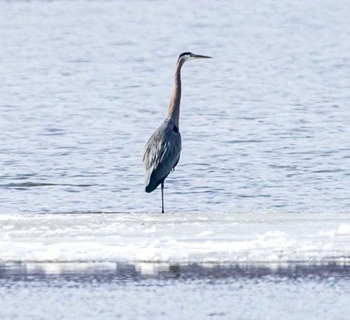
1/30 – Westchester County, HRM 43: Here was something you do not see very often: a great blue heron standing on Hudson River floe ice off Peekskill.
- John Badura
[Great blue herons are waders, water birds (Ardeidae), that generally migrate south in search of open water and winter from the DelMarVa south to the Gulf Coast. Tom Lake]
Photo of great blue heron courtesy of John Badura
1/30 – Manhattan, HRM 1-2: Due to the winter storm and storm surge this week that completely inundated our docks with snow and massive amount of ice, for reason of safety, our Hudson River Park's River Project staff was unable to check our research gear (pots and traps) that we deploy from floating docks on the south-side of Piers 26 and 40 for our ongoing Fish Ecology Survey. Thus, we have no data this week. We should have something for the Hudson River Almanac next week!
- Toland Kister
An often quoted axiom of science, “no data is still data,” seems to apply here. Tom Lake]
The Nature of Nature: Biodiversity in the Hudson Valley – Film and Panel Event Sunday, February 8, 3:30pm
Bard College will host a free screening of our new short film The Nature of Nature: Biodiversity in the Hudson Valley on Sunday, February 8, 3:30-5:00pm. From high elevation forests to the globally rare tidal marshes along the Hudson estuary, the 30-minute documentary film captures the beautiful, the complex, the familiar, and the unknown… guided by the plants, animals, and people that call the Hudson Valley home. The screening will be followed by a panel discussion and reception. Register to attend.
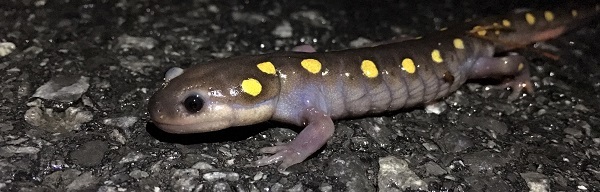
I Love a Rainy Night: The Rhythm of Forest Amphibians Thursday, February 12, 7:00pm
Cary Institute will host Hudson River Estuary Program and Cornell biologist Laura Heady for lecture on the fascinating world of forest amphibians, their life histories and role in forest ecosystems, and opportunities to get involved in conservation of vernal pool-breeding amphibians. The event is free and open to all, but registration is required. Sign up to attend in person at Cary Institute in Millbrook or watch a live stream online at the Cary Institute website.
Amphibian Migrations & Road Crossings Program – 2026 Volunteer Trainings
Join the DEC’s Hudson River Estuary Program and Cornell University to learn how to volunteer with the Amphibian Migrations & Road Crossings Project. Volunteers find locations where migrating salamanders and frogs cross roads on their way to vernal pools for breeding in late winter and early spring. They document weather, traffic, and species, and assist amphibians across the road safely. Trainings will be offered on the following dates:
- In-person: Wed., February 11 (snow date Feb. 12), 6:00-9:00pm, Albany
- In-person: Sat., February 14 (snow date Feb. 21), 9:30am-12:30pm, New Paltz
- In-person: Thurs., February 18 (snow date Feb. 19), 6:00-9:00pm, Garrison
- Virtual: Tues., February 28, 5:30-7:30pm, online
Full details and registration links are available on our Events webpage at Events | Conservation Planning in the Hudson River Estuary Watershed.
 Snapshot NY
The NYSDEC, in collaboration with the New York Cooperative Fish and Wildlife Research Unit at Cornell University, has launched Snapshot NY, a citizen science program that allows the public to participate in wildlife monitoring through the deployment of trail cameras. The project will help improve the way DEC monitors and manages more than a dozen wildlife species. For more information on Snapshot NY and how to participate, visit the Snapshot NY website.
Join DEC's Hudson River Estuary Management Program and the Hudson River National Estuarine Research Reserve’s - Free Virtual Winter Speaker Series!
Meet and learn from scientists, community leaders, and environmental educators who work at the intersection of research, education, and environmental and social justice. Engage in discussions about monitoring and research, field-based learning, and creating pathways to overcome barriers and challenges in the field of science and education. Visit our website for more information and to register.
The upcoming webinars are:
- February 4, 3:30-4:30 pm, How Hands-on Learning and Water Quality Testing Combine to Tackle Impairment in the Mohawk Watershed by Barbara Brabetz
- February 11, 3:30-4:30 pm, Making Flood Risk Visible: Communicating the Science of Resilience in New York State by Rewa Phansalkar
- February 25, 3:30-4:30 pm, Portrait of a Graduate: Environmental Education for Changing Guidelines by Emily Marcet
Hudson River Lesson Plans
Explore our collection of Hudson River lesson plans, videos and online activities to support hand on investigations of the Hudson River in your classroom.
Hudson River Miles
The Hudson is measured north from Hudson River Mile 0 at the Battery at the southern tip of Manhattan. The George Washington Bridge is at HRM 12, the Tappan Zee 28, Bear Mountain 47, Beacon-Newburgh 62, Mid-Hudson 75, Kingston-Rhinecliff 95, Rip Van Winkle 114, and the Federal Dam at Troy, the head of tidewater, at 153. The tidal section of the Hudson constitutes a bit less than half the total distance—315 miles—from Lake Tear of the Clouds to the Battery. Entries from points east and west in the watershed reference the corresponding river mile on the mainstem.
To Contribute Your Observations
The Hudson River Almanac is compiled and edited by Tom Lake and emailed weekly by DEC's Hudson River Estuary Program. Share your observations by e-mailing them to trlake7@aol.com.
Was this Newsletter Forwarded to You?
Subscribe today to DEC Delivers Hudson River Almanac topic for weekly natural history journal that covers the Hudson from the High Peaks of the Adirondacks to New York Harbor.
Helpful Resources
National Oceanic and Atmospheric Administration online tide and tidal current predictions are invaluable when planning Hudson River field trips. For real-time information on Hudson River tides, weather, and water conditions from sixteen monitoring stations, visit the Hudson River Environmental Conditions Observing System website.
DEC's Smartphone app for iPhone and Android is now available at New York Fishing, Hunting, and Wildlife App.
|