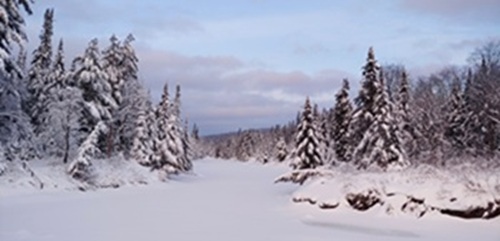
Photo of winter in the Adirondacks courtesy of Charlotte Demers
In this issue:
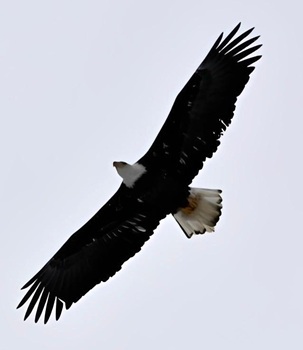
It would have been difficult to avoid mentioning bald eagles this week. This is the beginning of their 2026 breeding season, and their days are filled with nest refurbishing, mating, and making themselves conspicuous in the sky.
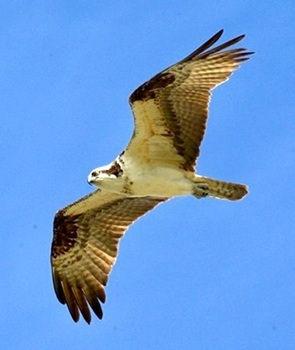
1/19 – Westchester County, HRM 34: It caught my breath! As we drove across the Route 9 Croton River Bridge, only 100 feet above us soared an osprey—right place, wrong season.
- Christopher Letts, Nancy Lets
[Osprey, with some exceptions, winter along the Southeast and Gulf coasts (Sibley 2000). Tom Lake].
Photo of osprey courtesy of Bob Rightmyer
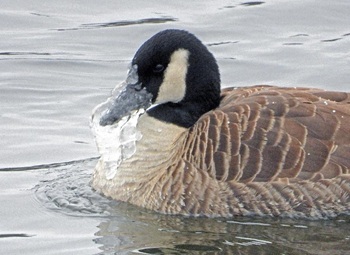
1/17 – Saratoga County, HRM 174: I was recently observing a large flock of Canada geese on the Hudson River at Stillwater’s Block House Park. I noticed a goose that had a nearly total accumulation of ice on its bill. This is not that rare, inconvenient, but geese find workarounds. There was enough of a gap in the ice to breathe, so hopefully with warmer weather the goose would shed its block of ice.
I also scanned the flock, unsuccessfully, looking for the reported cackling goose (Branta hutchinsii), a goose that shares the genus Branta with the Canadas.
- Jacquie Tinker
Photo of Canada goose courtesy of Jacquie Tinker
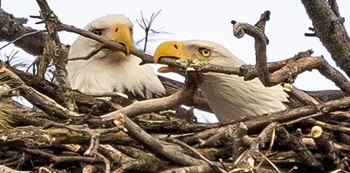
1/17 – Town of Poughkeepsie: Refurbishing was the task of the day at bald eagle nest NY62. With a promise of nestlings to come, both adults were busy making accommodations. They showed great teamwork by sharing the lift of clumsy branches prior to an exact placement. It suggested a couple expecting a baby, finding themselves busy furnishing a new child’s bedroom.
- Bob Rightmyer
Photo of bald eagles courtesy of Bob Rightmyer
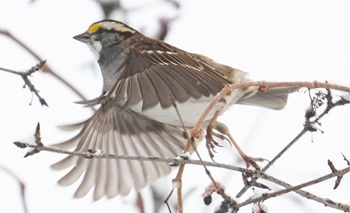
1/18 – Orange County, HRM 60 : It was certainly a snowy weekend, and I birded as the snow fell on both mornings. First thing Saturday morning I took a walk at Black Rock Forest. There is a feeder station there that was active, particularly with a modest sized flock of purple finches. Afterwards, I went to the Newburgh waterfront. The visibility was terrible with the heavy snowfall, but it was still nice to be out and at the river. I was enjoying the different aesthetic of the day, where everything was just in shades of gray and white.
- Matt Zeitler
Photo of white-throated sparrow courtesy of Matt Zeitler
1/18 – Hudson River Watershed: The Northeast recently experienced what some refer to as a “January thaw,” a few days of unseasonably warm temperatures which usually occur in January. During this thaw, temperatures are generally about ten degrees Fahrenheit above normal. The physical reason for this phenomenon is somewhat elusive, but the most widely accepted view is shifting jet stream patterns.
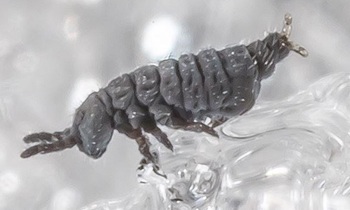
A January thaw is prime time to look for certain small creatures, such as snowfleas and winter crane Flies, which tend to appear during warmer winter days. Tiny snowfleas (1/16th of an inch long), a type of springtail, climb up from the leaf litter to the surface of the snow, where they use an abdominal appendage called a furcula to propel themselves upward and outward, resembling specks of pepper in constant motion.
Winter crane flies, also known as winter midges or winter gnats, can also be seen on warm, winter days. Superficially resembling large mosquitoes, these insects have reduced or no mouthparts, and they only live a few days.
- Mary Holland
Photo of snowflea courtesy of Michael Runtz
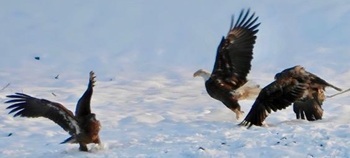
1/19 – Saratoga County, HRM 157: I witnessed a three-eagle engagement on the river today at the Halfmoon Light House Park in eastern Saratoga County. Two immatures and one adult bald eagle struggled to gain possession of a channel catfish. After many feints and talon thrusts, one of the immatures cornered the catfish in a slushy puddle on the ice, and the show was over.
- Katrina Van Tassell
[Food fights among eagles are not that common. It expends far too much energy. In winter, eagles are all about food management and saving calories for the frigid nights. Tom Lake]
Photo of bald eagles courtesy of Katrina Van Tassel
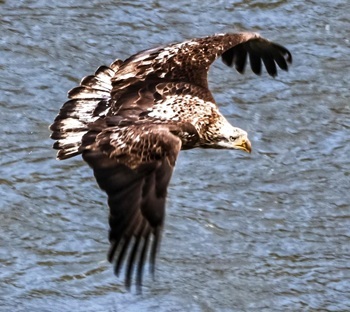
1/19 – Saratoga County, HRM 157: In response to the Arctic cold, bald eagles continued to find the combination of open water and plenty of prey in the Mohawk River under the Falls at Cohoes in western Saratoga County. From Overlook Park in Cohoes, with a panoramic view of The Falls, the eagles were again on display.
Today’s mix included many near-adults, three-year-olds within months of molting into adult plumage. To quote Peter Dunne (Hawks in Flight 1988), several of them sported “lavish amounts of white on their back, belly, and underwing linings, and we call them white extremes.”
- Andy Walters
Photo of bald eagle courtesy of Andrew Walters
1/19 – Westchester County, HRM 34-35: Martin Luther King Day marked my latest bald eagle program of many trips along the Tappan Zee and Haverstraw Bay to look for wintering Bald Eagles. We began slowly at the mouth of the Croton River with five eagles, then four more on Croton Point, and finally five at George’s Island Park in Montrose, a spot that used to provide a dozen or more. Sightings picked up in the afternoon at Verplanck with several more, and then a few others were spotted across the river at Stony Point. We finally hit the jackpot at Charles Point in Peekskill as we counted at least 18 eagles. The final tally was near 40 birds. The star of the day was an adult that landed near Fleischmann’s Pier and perched in a tree for our viewing.
- Bob Rancan
Photo of bald eagle couresy of Bob Bozzo
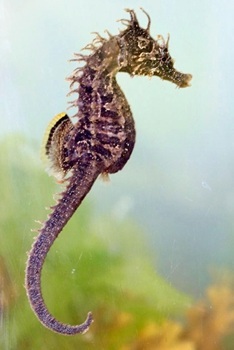
1/20 – Hudson River Watershed: Fish-of-the-Week for Week 350 is the lined seahorse (Hippocampus erectus George Perry 2010), number 132 (of 239) on our watershed list of fishes. If you would like a copy of our list, e-mail trlake7@aol.com.
The lined seahorse is one of two pipefishes (Syngnathidae) documented for our watershed. The other is the northern pipefish (Syngnathus fuscus). The lined seahorse is a small, pinky-finger to palm-sized, fish (to 190 millimeters) that swims in an upright position looking much like the Knight piece in a game of chess.
They are found in the western Atlantic from Canada to Brazil generally in coastal waters, often around man-made structures. Lined seahorse moves into deeper waters during winter. They feed by sucking in small organisms, using its long face as a pipette, such as small crustaceans.
They are poor swimmers as fish go and use their prehensile tail to wrap around stationary objects such as vegetation, crab pots, pilings, ropes, or other hold-fasts to maintain their place in the face of strong currents. Seahorse colors are highly variable, ranging from olive-brown to orange and yellow. They are a master of camouflage and a voracious ambush predator. It can change its color in seconds to match its background and await potential prey items.
Male sea horses are notable for their ventral brood pouch in which they carry fertilized eggs (250-300) deposited by the females. In one of the rare instances in the animal kingdom, it is the males that give live birth (Lourie, Pollom, and Foster 2016).
- Tom Lake]
[Note: One-inch equals 25.4 millimeters (mm). Tom Lake]
Photo of lined seahorse courtesy of Chris Bowser
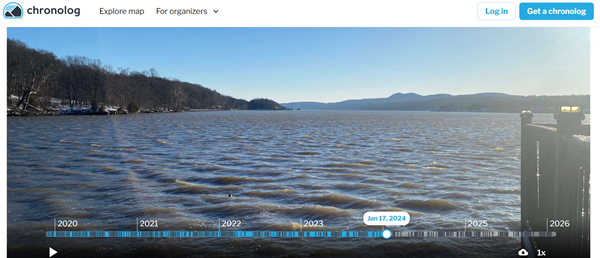
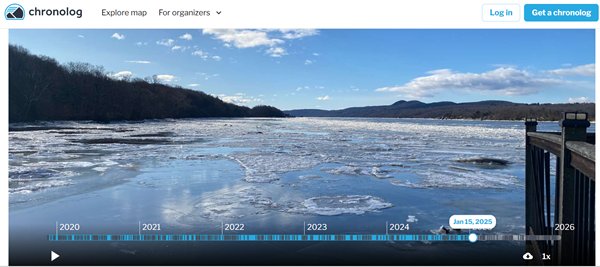
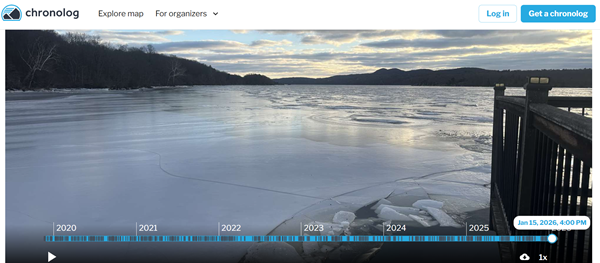
1/21 – Norrie Point, HRM 85: Phenology is the study of nature as it changes through the seasons. The budding leaves, nesting birds, mating frogs, and migrating fish all reflect the changing seasons. At the Norrie Point Environmental center, we have a visual community-science tool called “Chronolog” that allows anyone with a phone camera to record the changes on the river. For example, these three photos show the river in mid-January of the last three years (2024-2026), Sometimes ice-bound, sometimes not. You can watch the river through the years yourself at https://www.chronolog.io/map . You don’t have to “log in”, just start exploring our Hudson River sites at HRE-101, HRE-102, and HRE-103. Enjoy!
- Chris Bowser
Chronolog - Norrie Point January 2024
Chronolog - Norrie Point January 2025
Chronolog - Norrie Point January 2026
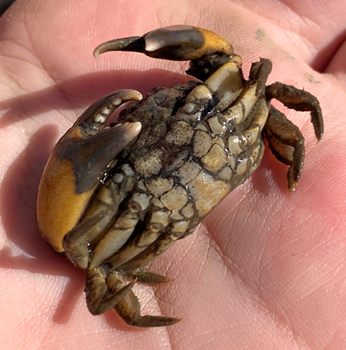
1/21 – Manhattan, HRM 1-2: Despite icy ropes and leads, and under brisk winter conditions, Hudson River Park's River Project staff checked our research gear (pots and traps) that we deploy from floating docks on the south-side of Piers 26 and 40 for our ongoing Fish Ecology Survey. Our gear collected one skilletfish (70 mm) as well as some black-fingered mud crab (Panopeus herbstii), and several dozen grass shrimp.
- Siddhartha Hayes, Renee Mariner, Beryl Kahn
Photo of black-fingered mud crab courtesy of Zoe Kim
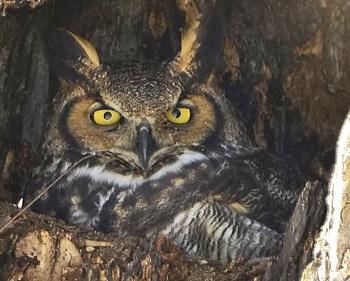
1/22 – Rensselaer County, HRM 139: I have been delighted in the last few weeks in Schodack to hear the "duets" of a mating pair of great horned owls, especially on still and snowy nights. Two days ago, I even heard them in the afternoon. I thought barred owls were the only daytime calling owls. It seems more typical to hear the daytime duets of the great horned owls during their courtship and nesting season.
- MaryEllen Grimaldi
Photo of great-horned owl courtesy of John Devitt
1/23 – Hudson River Watershed: Birds that do not migrate have many strategies for surviving the brutal cold weather much of the Northeast is going to experience this winter. Most birds will try to find food late in the day to sustain themselves through the night. Fluffing up feathers is a common practice to increase insulation, as is shivering to generate heat. A few birds, including black-capped chickadees, go into a state of torpor, where their body temperature of 107 degrees Fahrenheit drops down to about 86-90 degrees. The lowering of their metabolism conserves precious body fat. Some birds, such as eastern bluebirds, huddle together in insulated roosts. Others, including American goldfinches and northern cardinals, grow extra down feathers for the winter. Many birds seek shelter in tree cavities and conifers where they are protected from the wind.
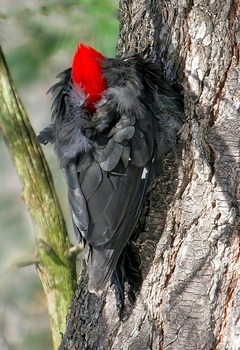
The pictured pileated woodpecker was seen on a sub-zero day, clinging to a sunny spot on the trunk of a white pine after filling itself with dried grapes from a nearby vine. It spent several minutes shivering before tucking its head under its wing where it was sheltered from the wind and cold.
- Mary Holland
Photo of pileated woodpecker courtesy of Mary Holland
The Nature of Nature: Biodiversity in the Hudson Valley – Film and Panel Event Sunday, February 8, 3:30pm
Bard College will host a free screening of our new short film The Nature of Nature: Biodiversity in the Hudson Valley on Sunday, February 8, 3:30-5:00pm. From high elevation forests to the globally rare tidal marshes along the Hudson estuary, the 30-minute documentary film captures the beautiful, the complex, the familiar, and the unknown… guided by the plants, animals, and people that call the Hudson Valley home. The screening will be followed by a panel discussion and reception. Register to attend.
I Love a Rainy Night: The Rhythm of Forest Amphibians Thursday, February 12, 7:00pm
Cary Institute will host Hudson River Estuary Program and Cornell biologist Laura Heady for lecture on the fascinating world of forest amphibians, their life histories and role in forest ecosystems, and opportunities to get involved in conservation of vernal pool-breeding amphibians. The event is free and open to all, but registration is required. Sign up to attend in person at Cary Institute in Millbrook or watch a live stream online at the Cary Institute website.
Amphibian Migrations & Road Crossings Program – 2026 Volunteer Trainings
Join the DEC’s Hudson River Estuary Program and Cornell University to learn how to volunteer with the Amphibian Migrations & Road Crossings Project. Volunteers find locations where migrating salamanders and frogs cross roads on their way to vernal pools for breeding in late winter and early spring. They document weather, traffic, and species, and assist amphibians across the road safely. Trainings will be offered on the following dates:
- In-person: Wed., February 11 (snow date Feb. 12), 6:00-9:00pm, Albany
- In-person: Sat., February 14 (snow date Feb. 21), 9:30am-12:30pm, New Paltz
- In-person: Thurs., February 18 (snow date Feb. 19), 6:00-9:00pm, Garrison
- Virtual: Tues., February 28, 5:30-7:30pm, online
Full details and registration links are available on our Events webpage at Events | Conservation Planning in the Hudson River Estuary Watershed.
Snapshot NY
The NYSDEC, in collaboration with the New York Cooperative Fish and Wildlife Research Unit at Cornell University, has launched Snapshot NY, a citizen science program that allows the public to participate in wildlife monitoring through the deployment of trail cameras. The project will help improve the way DEC monitors and manages more than a dozen wildlife species. For more information on Snapshot NY and how to participate, visit the Snapshot NY website.
Join DEC's Hudson River Estuary Management Program and the Hudson River National Estuarine Research Reserve’s - Free Virtual Winter Speaker Series!
Meet and learn from scientists, community leaders, and environmental educators who work at the intersection of research, education, and environmental and social justice. Engage in discussions about monitoring and research, field-based learning, and creating pathways to overcome barriers and challenges in the field of science and education. Visit our website for more information and to register.
The upcoming webinars are:
- February 4, 3:30-4:30 pm, How Hands-on Learning and Water Quality Testing Combine to Tackle Impairment in the Mohawk Watershed by Barbara Brabetz
- February 11, 3:30-4:30 pm, Making Flood Risk Visible: Communicating the Science of Resilience in New York State by Rewa Phansalkar
- February 25, 3:30-4:30 pm, Portrait of a Graduate: Environmental Education for Changing Guidelines by Emily Marcet
Hudson River Lesson Plans
Explore our collection of Hudson River lesson plans, videos and online activities to support hand on investigations of the Hudson River in your classroom.
Hudson River Miles
The Hudson is measured north from Hudson River Mile 0 at the Battery at the southern tip of Manhattan. The George Washington Bridge is at HRM 12, the Tappan Zee 28, Bear Mountain 47, Beacon-Newburgh 62, Mid-Hudson 75, Kingston-Rhinecliff 95, Rip Van Winkle 114, and the Federal Dam at Troy, the head of tidewater, at 153. The tidal section of the Hudson constitutes a bit less than half the total distance—315 miles—from Lake Tear of the Clouds to the Battery. Entries from points east and west in the watershed reference the corresponding river mile on the mainstem.
To Contribute Your Observations
The Hudson River Almanac is compiled and edited by Tom Lake and emailed weekly by DEC's Hudson River Estuary Program. Share your observations by e-mailing them to trlake7@aol.com.
Was this Newsletter Forwarded to You?
Subscribe today to DEC Delivers Hudson River Almanac topic for weekly natural history journal that covers the Hudson from the High Peaks of the Adirondacks to New York Harbor.
Helpful Resources
National Oceanic and Atmospheric Administration online tide and tidal current predictions are invaluable when planning Hudson River field trips. For real-time information on Hudson River tides, weather, and water conditions from sixteen monitoring stations, visit the Hudson River Environmental Conditions Observing System website.
DEC's Smartphone app for iPhone and Android is now available at New York Fishing, Hunting, and Wildlife App.
|