In this issue:

-
6 NYCRR Part 242: Regional Greenhouse Gas Initiative Update: The proposed amendments to 6 NYCRR Part 242 CO2 Budget Trading Program would reduce the annual budget of CO2 allowances through 2037, add a second tier of Cost Containment allowances, remove the emissions containment reserve, remove offset projects, remove eligible biomass provisions, increase the minimum reserve price, and make other improvements and clarifications to the program. The Department is also proposing attendant amendments to listings of related reference material in 6 NYCRR Part 200 General Provisions. Additionally, New York State Energy Research and Development Authority is proposing to amend 21 NYCRR Part 507 CO2 Allowance Auction Program to align with the proposed amendments to 6 NYCRR Part 242. The public comment deadline is February 16, 2026, at 5:00 pm.
-
Effective December 25, 2025: 6 NYCRR Part 253: Mandatory Greenhouse Gas Reporting Program: As part of the State’s ongoing efforts to gather information regarding sources of air pollutant emissions and to support the reduction of emissions under the Climate Leadership and Community Protection Act, Chapter 106 of the Laws of 2019, the Department established a mandatory greenhouse gas (GHG) reporting program that requires certain GHG emission sources to report emissions to the Department. The Department also includes attendant revisions to 6 NYCRR Part 200 to capture all incorporation by reference documents from Part 253.
-
Green Jobs for Youth Grant: There is $4 million in Environmental Justice Green Jobs for Youth Grants now available to help youth in environmental justice communities to develop skills training and promote job placement in various green industries. The DEC’s Office of Environmental Justice is launching this second round of Green Jobs for Youth funding with a focus on skills training. Applications are due on January 28, 2026, at 3:00 pm.
-
Ongoing Public Engagement: Statewide Community Air Monitoring Initiative Meetings – DEC undertook a statewide community-based air quality monitoring effort, focused on ten disadvantaged communities with high air pollution burdens around the State. Check the 2022-23 Statewide Community Air Monitoring Initiative webpage for the latest developments on the project.
-
Environmental Notice Bulletin (ENB): Check out the various projects in NYS on the Environmental Notice Bulletin (ENB).
Air Mail! is the publication to announce public and stakeholder information about air quality topics. All NYS residents are environmental stakeholders – we welcome anyone to join the information sessions and other opportunities posted here.
The Air Mail! Team wishes you and your family a happy holiday season.

This is a special issue of Air Mail!. What makes it so special? It’s the 100th issue! For over eight years, Air Mail! has been used to communicate with the public on all things air quality. With an average of three articles a month, readers can learn about a number of topics, including the Clean Air Act, particulate matter, or a historic event.
Air Mail! was first published in 2017 to engage and inform New Yorkers. The original Air Mail! team was led by Division of Air staff members, John and Heidi, supported by a web content coordinator and an intern. They worked together to build Air Mail! into what we know today. The first Air Mail! article was about the Science and Technology Entry Program (STEP), showcasing middle and high schoolers learning about air quality and collecting air quality measurements.
Having worked at DEC for 33 years, John was well-equipped with air knowledge to lead Air Mail! in 2017. Considering himself the “Editor in Chief,” John oversaw the creation of Air Mail! throughout its earliest years. Modeled after the Conservationist, DEC’s premiere outdoor magazine, Air Mail! distinguished itself from other newsletters by including eye-catching imagery and multiple article topics each month. John’s favorite articles focused on meteorology and DEC research, believing this information would be useful and interesting to New Yorkers. Setting the reins down in 2021, John retired and left Air Mail! in the hands of its next Editor.
Air Mail! has gone through many changes over the years, but one Air Mail! Team member has been a constant since the beginning. In the early issues, Heidi was an Air Mail! author and content creator. Her favorite articles to write were “look-back” articles - those that compared air quality before and after air regulations and included pictures with clear, visual differences. After John’s retirement, she has taken on the role of managing the newsletter, using her experience to oversee the current authors and guide the publication process.
Having seen the publication start with very few subscribers and grow to about 50,000 today, Heidi wants to keep seeing Air Mail! grow. In her own words, “This newsletter is one of the best tools DEC has to communicate air quality topics to the public.” In one issue of Air Mail!, subscribers can read about proposed regulations and upcoming public comment periods, monthly article topics, relevant upcoming dates, and information updates on the Air Quality Index (AQI). If you know anyone who would be interested in learning about air quality, encourage them to subscribe today.
Whether you’re a long-time or first-time reader, we want to send a huge thank you to all our subscribers. Our readers are what make Air Mail! so successful. If you have article topic ideas or photos you’d like to see in future issues of Air Mail!, contact us at DAR.Web@dec.ny.gov.
Thank you for supporting Air Mail!,
The past, present, and future Air Mail! Team
Regulations play a key role in protecting our environment and our air. The regulations passed under the mandates of the Clean Air Act (CAA) of 1970 and its subsequent amendments have led to the implementation of state programs that have resulted in the cleaner air that we breathe today. NYS has been a leader in improving air quality through the many programs already in place, as well as new initiatives such as the Climate Leadership & Community Protection Act (CLCPA). CLCPA sets forth a process to develop a comprehensive plan, through consensus and policy. Regulations have been designed to meet goals to help reduce greenhouse gases (GHG) over time.
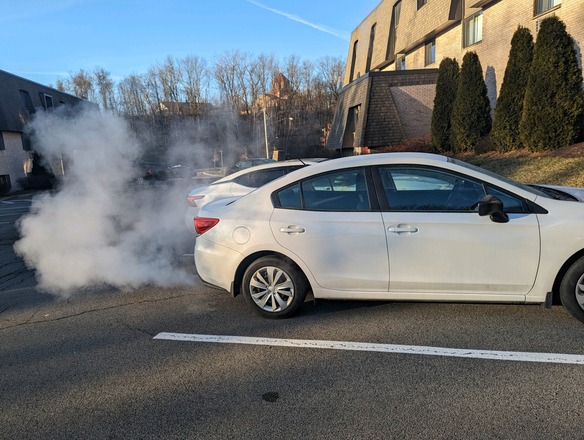
The transportation sector accounts for 28% of total US GHG emissions. Light-duty vehicles, medium- and heavy-duty trucks can generate large amounts of pollution. In the US transportation sector, these motor vehicles account for 80% of transportation sector’s GHG emissions.
With the passage of the CAA of 1970 and its later amendments, there have been vast improvements in the air we breathe. Current vehicles are 99% cleaner than 1970 models. Regulations have driven the adoption of emission control technologies, cleaning up tailpipe emissions. The catalytic converter in gasoline-powered vehicles is one such example. Another regulatory requirement removed lead from gasoline.
Even so, the number of vehicles and miles driven has risen significantly since the initial CAA of 1970. Subsequent amendments to the CAA further reduced emissions. The CAA of 1977 set more achievable schedules for reducing vehicle air pollution. This was followed by the CAA of 1990, which resulted in more stringent standards for both cars and trucks at both the federal and state levels.
Adopting clean energy alternatives and lifestyles will create a more sustainable environment. You can do your part to keep our air clean by carpooling, walking, biking, or taking public transportation. If you plan to shop for a new car, electric, hybrid, fuel-cell, or plug-in vehicles are some air friendly choices. Reducing air pollution protects both the environment and the health of all NYS residents.
 |
DEC has pursued its environmental protection mission since its creation in 1970. One way to do that is through the variety of air quality initiatives we have seen just this year alone. The Mandatory Greenhouse Gas Reporting Rule program, which will collect greenhouse gas emissions data statewide, was recently adopted. Thousands of trees have been planted across NYS to advance the 25 Million Trees by 2033 initiative, and the Air Quality Index (AQI) continues to be forecast daily. These governmental actions have made strides in protecting the health of all NYS residents and our environment. You can join and make a difference too. As 2026 approaches, consider taking on any of these sustainable New Year’s resolutions to help protect our health and environment:
-
Buy second-hand: Save money and the environment by thrifting your next cozy sweater or décor piece.
-
Compost: Composting keeps organic material out of landfills and reduces methane gas production.
-
Use less energy: Vampire devices, such as coffee machines or gaming systems, can still draw energy even when you think they are turned off. To prevent this, be sure to unplug devices when not in use. Consider investing in a community solar project near you to buy and use renewable energy in your home.
-
Repair over replace: Learning to mend clothing or fix appliances can help save money and extend the lifecycle of items that would otherwise be thrown away. Check your area for repair cafe locations or events to attend.
-
Volunteer: Donate your time to the environment by volunteering for trail maintenance, wildlife rehabilitation, or other environmentally focused causes you enjoy.
Resolutions don’t have to be overwhelming. Small and consistent changes can make a big impact. Make 2026 an even greener year than the one before by taking on a sustainable resolution.
The projects are designed to reduce emissions in areas with higher air pollution burdens, which also suffer negative quality-of-life impacts. These negative impacts can result from excessive noise and odors caused by the unequal distribution of sources and infrastructure that produce large amounts of pollution, such as major roadways, diesel truck routes, asphalt plants, and industrial sources.
Both projects received $500,000 in grant funding. DEC awarded the Buffalo Prenatal-Perinatal Network to support its efforts to enhance indoor air quality and maternal health by utilizing cost-effective air filtration devices and community education initiatives. Clean Air New Rochelle, led by the Energy Justice Law and Policy Center in partnership with the city of New Rochelle, was also awarded funding to support efforts to monitor air pollution in DACs.
You can learn more about the grant awards and how the organizations plan to use the funding in the press release. Clean air is a team effort, from governmental regulation to personal action, and every step in-between. So do your part to keep our air clean by taking on sustainable habits. Limiting the amount of time you drive alone, such as by carpooling or taking public transportation, or reducing your energy usage by wearing layers before turning the thermostat up this winter, are some actions you can take to help protect our air.
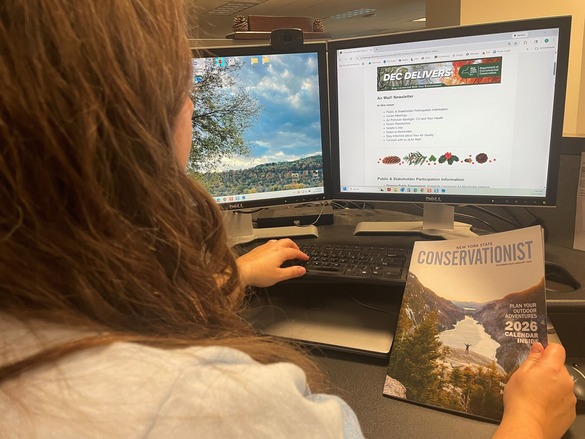
Looking for the perfect present for all the nature lovers and outdoor enthusiasts in your life? Give the gift of Conservationist magazine! A subscription includes 6 issues published throughout the year, making it the gift that keeps on giving!
Through Christmas Eve, you can get 6 issues of Conservationist for only $6.00! For an even better deal, why not sign up for 3 years (18 issues) for only $15.00 – less than $1 per issue!
Subscriptions ordered through Christmas Eve will start with the December 2025/January 2026 issue, which includes our popular annual calendar, featuring winners of our photo contest.
If you are a current subscriber or gift giver, the existing subscription(s) will be extended. If you are logged into your account, you can get the deal by using promo codes hol256 or hol2515 at checkout. Click "Add Promo Code" and enter the promo code of your choice in the box that opens. Please send us an email with any questions.
Subscription rates will be going up in April, so now is the perfect time to extend your subscription or gift(s) or start a new subscription!
 |
-
DECinfo Locator – An interactive map that lets you access DEC documents and public data about the environmental quality of specific sites in NYS as well as outdoor recreation information.
-
DEC Delivers – Stay in-the-know by subscribing to the environmental topics that interest you. We will send you information, updates, and e-newsletters on the topics of your choosing. As an Air Mail! subscriber, you may be interested in subscribing to the Air Quality Alert topic so you know when air quality levels are a concern in your area.
-
DEC Does What?! – Check out our new podcast, which highlights what DEC does to protect our environment.
-
AQI Forecasts – Check the daily ozone and particulate matter pollution forecast for your area of NYS.
-
NYSDEC YouTube – Keep up with what's going on with DEC staff by subscribing to our YouTube channel. Watch video clips of DEC public protection in action, learn about the Hudson River, or watch the latest episode of "On the Front Lines," DEC's video series.
-
Conservationist – NYS’ premiere outdoor magazine--bringing nature to your door! Published six times a year, Conservationist is a NYS-focused magazine that is packed with informative and entertaining articles, first-rate photography, and stunning artwork. Articles cover a broad range of environmental and natural history related topics. Subscribe today to get a piece of the outdoors in your mailbox.
-
Now through January 5: Holiday Bird Counts – Grab your binoculars and head out to conduct some citizen science by identifying and counting birds over the holidays.
-
December 31: Clean Air Act of 1970 was enacted – One of several upgrades to the Clean Air Act that put federal and state regulations in place to limit the interstate transport of air pollution. It also gave birth to some of the important pollution control programs that we still utilize today, such as NAAQS, SIPs, and NESHAPs.
-
January 1: New Year – Start the year off with a breath of fresh air by taking a First Day Hike. Find a great winter hiking spot near you.
NYS' ozone season runs from April through September. DEC publishes ground level ozone forecasts during ozone season and particulate matter pollution forecasts year-round, using a scale called the Air Quality Index (AQI). DEC sends out an air quality alert when there is a high AQI value, which indicates polluted air. Individuals with pre-existing respiratory or cardiovascular conditions and people who exercise outdoors should take caution during an air quality alert.
The AQI can be accessed in four ways:
Did you enjoy reading this issue? Perhaps your friends and family would too. Share Air Mail! by using the “Share” button below. If you would like to receive Air Mail! in your own email box, sign up now!
We would also like to know what you think. Send your Air Mail! questions and comments to the team at DAR.web@dec.ny.gov.
|